
City Guides
Tax Relief Los Angeles: Every Real Option for IRS and FTB Debt in 2026
The short answer: in Los Angeles, tax debt usually means two collectors — the IRS and the California Franchise Tax Board. Real relief options include payment plans, hardship status, penalty abatement, and (when the math supports it) an Offer in Compromise. The FTB can collect for 20 years, twice the IRS's 10, so ignoring the state side is the costlier mistake.
Maybe the balance showed up your first year filing alone after a divorce — withholding set for a joint return, income now taxed as single, and suddenly a bill from Fresno or Ogden with your name only. That's fixable. This guide maps the tax relief Los Angeles filers can actually use in 2026: every real program, what each costs, and which agency to deal with first.
⏱ The clock that's actually running: there's no single deadline on a search like this, but IRS late-payment penalties accrue at 0.5% per month with daily-compounding interest on top, the FTB adds its own collection fees, and the FTB's collection window is 20 years. Every month of waiting makes the same debt more expensive.
Why Los Angeles tax debt usually means two agencies, not one
Almost every income tax debt in Los Angeles exists twice: once with the IRS and once with the California Franchise Tax Board. If you underpaid federal tax, you almost certainly underpaid state tax for the same year, and each agency bills, penalizes, and collects independently. Resolving one does nothing for the other.
Business owners can face two more: the Employment Development Department (EDD) for payroll tax and the CDTFA for sales tax, plus the City of Los Angeles gross-receipts business tax. If that's you, start with our tax relief for small business buyer's guide after this one.
There's one quiet advantage to owing from LA: the IRS measures your ability to pay against local cost-of-living standards, and Los Angeles County's housing allowance is among the higher ones in the country. High rent that feels like a burden can actually work in your favor in hardship and Offer in Compromise calculations.
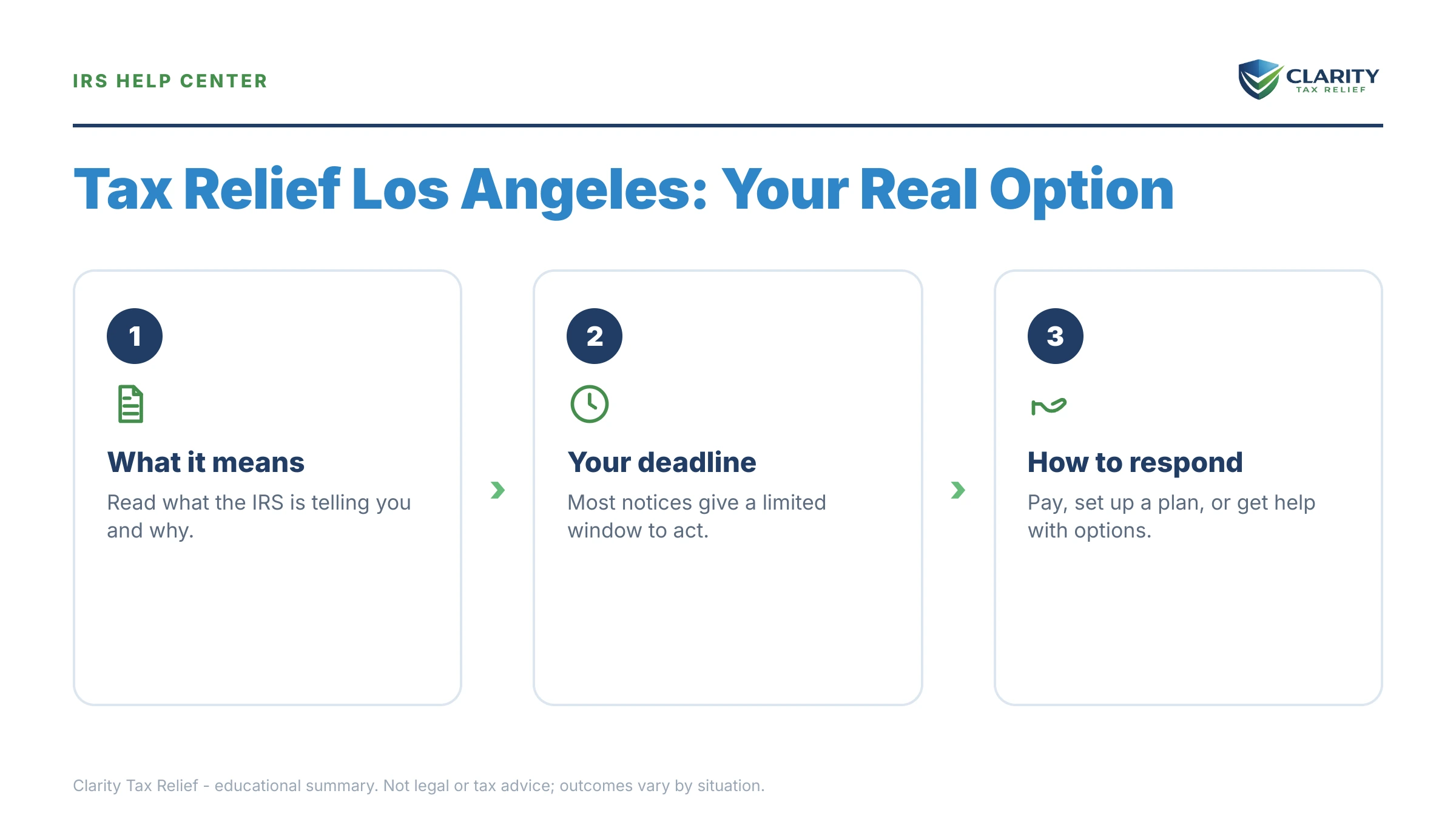
“We generally approve an offer in compromise when the amount you offer represents the most we can expect to collect within a reasonable period of time. Explore all other payment options before you submit an offer in compromise.”
— Offer in compromise (IRS.gov)
What happens if you ignore tax debt in Los Angeles
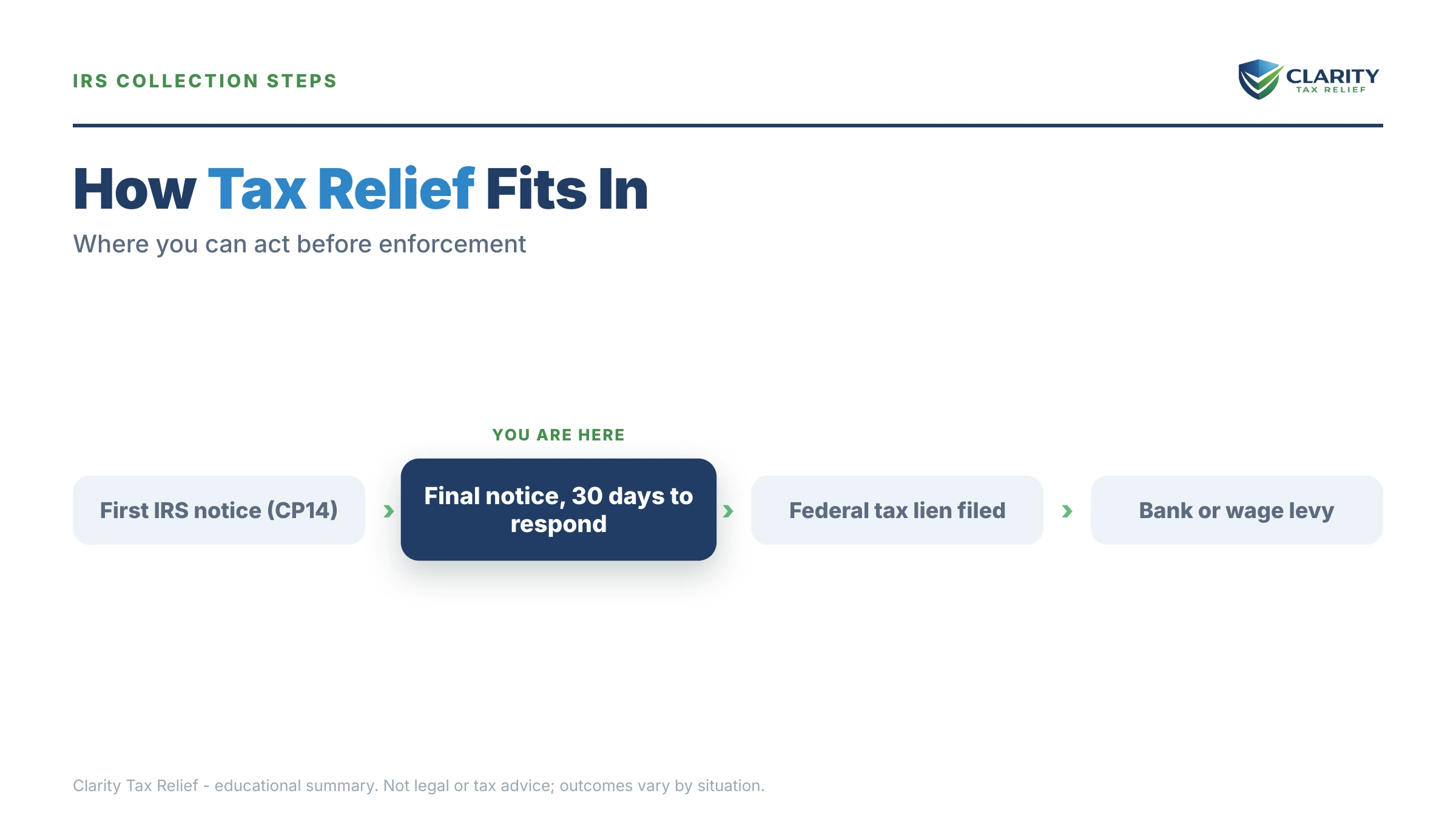
Ignored tax debt in Los Angeles escalates on two automated tracks at once, federal and state, and neither waits for the other. On the IRS side, the sequence runs in a fixed order:
- CP14 — the first bill, with roughly 21 days to pay before the next notice queues up.
- CP501 / CP503 — reminders. Still just bills, but penalties and interest compound monthly.
- CP504 — Notice of Intent to Levy. The IRS can now take your California state refund, and a federal tax lien becomes realistic.
- LT11 / Letter 1058 — the Final Notice. This starts a 30-day clock and your Collection Due Process rights; after it passes, wage garnishment and bank levies are on the table.
- Enforcement — a bank levy freezes funds with a 21-day hold before they're sent; a wage levy is continuous until released. Debts above $66,000 (the 2026 threshold) can also trigger passport certification.
Meanwhile, the FTB runs its own track: demand notices, collection fees added to the balance, an intent-to-levy notice, then wage garnishment through an Earnings Withholding Order, bank levies, and state tax liens. California's largest debtors can even land on the FTB's public Top 500 list, which carries professional and driver's license suspension. And because the FTB's statute runs 20 years under R&TC §19255, "waiting it out" fails on the state side long after the federal clock would have expired — see California's 20-year collection statute.
One more 2026 reality: the IRS workforce shrank roughly 27% in 2025, so reaching a human is harder than ever. But the notices, liens, and levies are generated by automated systems that never stopped. Silence from the IRS is not the same as being forgotten.
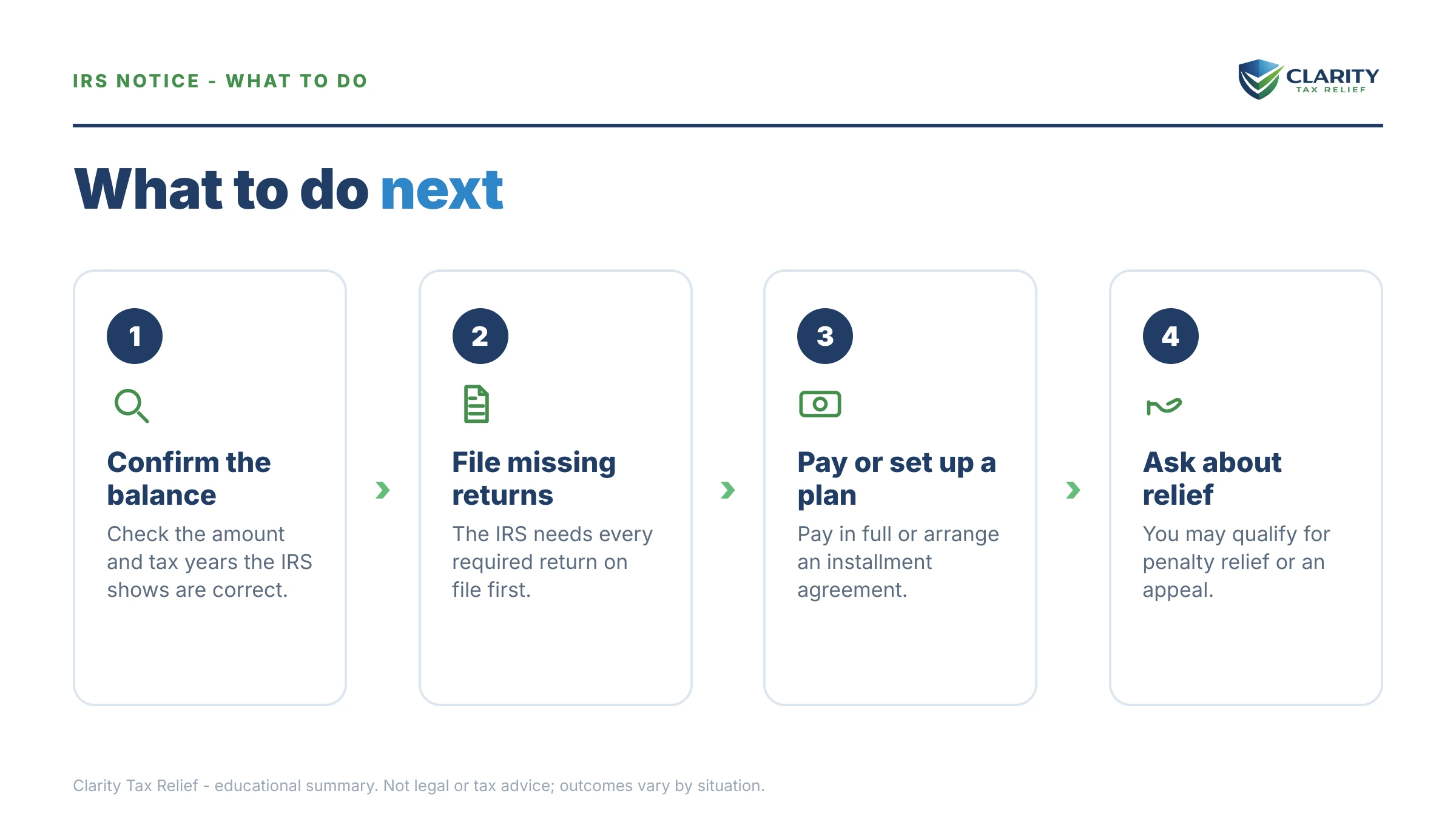
Owe the IRS, the FTB, or both?
Send us your notices — federal and state. An experienced tax professional will pull your transcripts, confirm exactly what each agency claims, and map your options before penalties and interest add another month to the bill. Free and confidential.
Tax relief Los Angeles residents can actually get: your options compared
Every legitimate relief program is means-tested — which one fits depends on how much you owe, to whom, and what your finances show. Here's the full menu on the federal side:
| Option | Who qualifies | Cost & the catch |
|---|---|---|
| Short-term payment plan | Can pay in full within 180 days | $0 setup; interest and penalties keep accruing until paid |
| Guaranteed installment agreement | Owe $10,000 or less in tax, clean filing history, can pay within 3 years | The IRS must accept; modest setup fee; interest continues |
| Streamlined installment agreement | Owe $50,000 or less | Up to 72 months, set up online without financial disclosure |
| Currently Not Collectible (CNC) | Paying anything would leave you unable to cover basic living costs | Collection pauses; the debt remains and interest still grows |
| Offer in Compromise (Form 656) | Assets plus future income genuinely can't cover the debt | $205 fee + 20% down on lump-sum offers (both waived if AGI ≤ 250% of poverty); the IRS accepted roughly 1 in 5 offers in FY2024 |
| Penalty abatement / AEP | Clean prior 3 years (first-time abate) or reasonable cause; AEP relief becomes automatic starting summer 2026 | Free to request; removes penalties, not tax or interest |
The FTB runs parallel, but separate — versions of most of these: its own payment plans, its own hardship status. Its own Offer in Compromise with stricter standards. Nothing you set up with the IRS transfers over. The state playbook is covered in our California FTB back taxes hub.
If your balances are modest and your situation is simple, you can set up most of this without hiring anyone — our step-by-step guide to how to settle tax debt yourself walks through each program.
A worked example: divorced in LA, owing $7,400
Say you owe the IRS $7,400 after your first post-divorce return — your W-4 was still set for married filing jointly, so withholding came up short all year. Because the tax owed is under $10,000, you're in guaranteed installment agreement territory: if you've filed and paid on time for the prior five years and can pay within three, the IRS must accept the plan.
The math, roughly: $7,400 over 36 months is about $206/month before interest. Do nothing, and the failure-to-pay penalty alone adds about $37 a month (0.5%), plus daily-compounding interest. On an approved installment agreement, that penalty rate is cut in half to 0.25%, about $18.50 a month at the start, so the plan doesn't just stop enforcement, it slows the bleeding. Prefer to avoid a multi-year plan? A 180-day short-term plan clears it at roughly $1,235/month with no setup fee. You can estimate your own penalty and interest buildup with our Penalty & Interest Calculator.
One caution: if a matching California balance exists for the same year, budget for both plans from the start. Committing your whole monthly surplus to the IRS and then getting an FTB garnishment notice is the most common way LA payment plans collapse.
IRS vs. California FTB: which debt to tackle first
When you owe both, the FTB usually deserves your first phone call. It collects for twice as long and typically escalates to garnishment with less warning. The key differences at a glance:
| Question | IRS (federal) | California FTB (state) |
|---|---|---|
| How long can they collect? | 10 years from assessment (pausable by appeals, OIC, bankruptcy) | 20 years under R&TC §19255 |
| Payment plans | Online up to $50,000, up to 72 months | Separate FTB plan with its own terms and application |
| Settlement program | Offer in Compromise (Form 656) | Separate FTB Offer in Compromise, generally stricter |
| Wage garnishment | Continuous levy after LT11 final notice + 30 days | Earnings Withholding Order, often with less warning |
| Extra costs | Penalties + daily-compounding interest | Penalties, interest, plus its own collection fees |
Sequencing the two — which agency gets the bigger monthly payment, which resolution to file first — genuinely changes the total you pay. The full decision framework is in FTB vs IRS which first.
Divorced in Los Angeles: whose tax debt is it?
A joint tax return makes both spouses liable for 100% of the debt, and your divorce decree cannot change that. The IRS and the FTB are not parties to your divorce. If the decree says your ex pays the taxes and they don't, both agencies can still collect the entire balance from you.
California adds a wrinkle: it's a community property state, which means income earned during the marriage, even income only your ex earned, can affect what you owe, sometimes even on separate returns. That cuts both ways, so it's worth a professional look before you assume the worst.
If the debt traces to income your ex hid or understated without your knowledge, innocent spouse relief can remove your liability, and separation-of-liability relief can split a joint debt between divorced spouses. Both have real eligibility tests and time limits — start with innocent spouse relief: how to qualify and the broader question of divorce and IRS debt: who pays. The FTB has its own parallel innocent spouse program, requested separately.
How to get tax relief in Los Angeles, step by step
- Pull your balances from both agencies. Log into your IRS online account for federal balances by year, and check MyFTB or your latest FTB notice for the state side. You can't pick a resolution until you know exactly who claims what.
- File any missing returns first. Neither the IRS nor the FTB will approve a payment plan or offer while returns are unfiled, and filing stops the 5%-per-month failure-to-file penalty, which is ten times the failure-to-pay rate.
- Match each balance to a program. Use the options table above: full pay or a 180-day plan for balances you can clear, an installment agreement for the rest, CNC if paying anything creates hardship. An Offer in Compromise only if the math genuinely supports it.
- Set up the IRS and FTB resolutions separately. Resolving one agency does nothing for the other. Set up the IRS agreement at IRS.gov, then contact the FTB about its own payment plan, and decide deliberately which agency gets paid down first.
- Request penalty relief before you finish. Ask the IRS about first-time abatement (or the new automatic AEP relief rolling out in 2026), and ask the FTB about its own abatement — penalty relief is the most commonly missed money in two-agency cases.
When you can handle this yourself, and when help changes the outcome
Plenty of Los Angeles tax debts don't need a professional. If you owe one agency, for one year, an amount you can pay within 180 days, or you qualify for a streamlined plan and your returns are all filed — set it up yourself online in an afternoon. Anyone who charges you thousands for that is selling you something you didn't need.
Experienced help earns its fee when the case has moving parts: a garnishment or bank levy already in motion, multiple unfiled years, IRS and FTB balances that need sequencing, business or payroll tax, an innocent spouse claim after divorce, or Offer in Compromise math where equity in an LA-priced home makes or breaks the offer. In those cases, the order and framing of each move changes the total you pay.
If you do hire someone, vet them the same way whether they're in Century City or another state — credentials, flat-fee transparency. A transcript review before any quote. Our how to choose a tax relief company checklist covers exactly what to ask, our guide to how much does tax relief cost covers fair pricing, and if you've been quoted by one of the big national advertisers, compare first — start with our Optima Tax Relief alternatives breakdown.
Terms you'll see on IRS and FTB letters, decoded
- FTB — the Franchise Tax Board, California's income tax collector; a completely separate agency from the IRS.
- CSED — Collection Statute Expiration Date; the day the IRS's 10-year collection window closes (the FTB's runs 20 years).
- Earnings Withholding Order (EWO) — the FTB's version of a wage garnishment, sent straight to your employer.
- Joint and several liability — each spouse on a joint return owes the full debt, not half, regardless of the divorce decree.
- Levy vs. lien — a lien is a legal claim against your property; a levy is the actual taking of wages, bank funds, or assets.
- Offer in Compromise (OIC) — a program to settle for less than the full balance when your assets and income genuinely can't cover it. Both agencies run their own version.
Tax relief in Los Angeles: your questions, answered
Is there a Los Angeles city tax relief program?
No — the City of Los Angeles doesn't tax personal income, so there's no city program for income tax debt. Your debt is federal (IRS) or state (Franchise Tax Board), and each agency runs its own relief programs. The one exception is business owners: the City of Los Angeles Office of Finance administers a gross-receipts business tax with its own billing and penalty rules, separate from both the IRS and the FTB.
Do I need a tax relief company located in Los Angeles?
No. IRS representation works through Form 2848 (power of attorney), which lets an experienced tax professional anywhere in the country represent you, and FTB matters are handled the same way with the state's authorization form. Almost everything happens by phone, mail, and secure upload — in-person meetings are rarely needed. What matters is that whoever you hire has real California FTB experience, because LA cases are usually two-agency cases.
How is the California FTB different from the IRS?
The FTB is a separate agency with its own notices, its own payment plans, its own Offer in Compromise program, and a 20-year collection window under R&TC §19255, twice the IRS's 10 years. The FTB also adds its own collection fees to unpaid balances and sends fewer warning notices before garnishing wages or levying bank accounts. An IRS resolution does nothing to your FTB balance; each debt has to be resolved separately.
Am I responsible for my ex-spouse's tax debt in California?
If the debt comes from a jointly filed return, yes — both spouses are jointly and severally liable for the full amount. A divorce decree assigning the debt to your ex does not bind the IRS or the FTB. Because California is a community property state, even some income earned only by your ex can affect your liability. Innocent spouse relief and separation-of-liability relief exist at both agencies for spouses who didn't know about or benefit from the understatement.
How long can tax debt be collected in Los Angeles?
The IRS generally has 10 years from the date it assesses the tax, though appeals, an Offer in Compromise, or bankruptcy can pause that clock. The California FTB has 20 years under R&TC §19255 — which is why a strategy of quietly waiting out the state almost never works. Many Los Angeles taxpayers resolve the IRS side and are surprised the FTB is still collecting a decade later.
How much does tax relief cost in Los Angeles?
Government fees are small: $0 for a short-term IRS plan, modest setup fees for installment agreements, and a $205 application fee for an IRS Offer in Compromise (waived with low-income certification). Professional fees vary widely by case complexity — a simple single-year payment plan costs far less than a two-agency case with unfiled returns. Be wary of any firm quoting a large flat fee before anyone has reviewed your transcripts.
Can the IRS or FTB take my house in Los Angeles?
Both agencies can file a lien against your home, which attaches to the title and gets paid when you sell or refinance. That happens routinely. Actually seizing and selling a primary residence is rare and, for the IRS, requires court approval; it's reserved for large debts with no cooperation. The bigger LA-specific issue is equity: high home values count against you in Offer in Compromise math, because the IRS treats accessible equity as money it could collect.
Your next 24 hours
- Find every balance. Log into your IRS online account and dig out your most recent FTB notice. Write down what each agency claims, by tax year.
- Gather three things: your last filed return, every IRS and FTB letter you've received, and, if you're recently divorced, your decree and any joint returns from the marriage years.
- Get a free case review. Call (888) 825-7779 or use the 2-minute form. An experienced tax professional will confirm both balances and map your federal and state options, before another month of penalties and interest is added to each.
If you'd rather pay directly today, the IRS accepts payments and plan setups at IRS.gov/payments. State balances are handled through the California Franchise Tax Board. If an IRS action is causing immediate hardship, the independent Taxpayer Advocate Service can intervene at no cost, and Los Angeles has Low Income Taxpayer Clinics that represent qualifying taxpayers free — see our guide to Low Income Taxpayer Clinics.
This guide is general information, not tax or legal advice for your specific situation. Eligibility for IRS programs depends on individual facts and circumstances; no outcome is guaranteed.