
City Tax Relief Guides
Tax Relief San Diego: Your 2026 Guide to IRS and California FTB Options
The short answer: real tax relief San Diego taxpayers can use comes from two governments — the IRS and California's Franchise Tax Board. Federal options include payment plans up to 72 months, hardship status, penalty abatement, and, for some, an Offer in Compromise. The FTB runs separate programs, and can collect for 20 years.
You're a contractor in San Diego — maybe you consult for a biotech in Sorrento Valley, sub on job sites in Chula Vista, or drive between Mission Valley and downtown for an app — and this year's return landed with a balance you can't just write a check for. That knot in your stomach is normal. It's also fixable: San Diego tax debt follows a predictable playbook, and this page walks you through every real option, with the actual numbers.
One thing that makes tax relief in San Diego different from most of the country: you're usually dealing with two collectors at once, the IRS and the FTB, and they don't coordinate, don't share your payment plan, and don't run on the same clock.
⏱ The real clock: a general tax balance has no single deadline, but the IRS failure-to-pay penalty adds 0.5% of your balance every month, interest compounds daily on top of it, and the FTB can legally collect a California balance for 20 years. Every month you wait is accrual you can't undo.
Why San Diego tax debt usually comes in pairs
Most San Diego tax debt involves two agencies at once, the IRS and California's Franchise Tax Board, because a federal balance almost always produces a matching state balance. California piggybacks on federal income data, so if your 1099 income created an IRS debt, an FTB bill for the same year is usually already in the pipeline.
San Diego's economy makes this common. Defense and biotech contractors, real estate agents, rideshare and delivery drivers, hospitality workers with tip income, military spouses freelancing between moves — a huge share of this county earns 1099 income with no withholding at all. Self-employment tax alone runs 15.3% before income tax even starts, which is why the first full year of contracting so often ends in a shock balance. If that's you, our guide to the first year self employed owe taxes problem explains where the number came from.
The debt also tends to repeat. If you didn't send quarterly payments last year, nothing about this year is different yet — fixing the current balance without fixing the quarterly habit just books next April's crisis. Our walkthrough of how do quarterly estimated taxes work shows how to break the cycle while you resolve the old balance.
If you run a business here, two more California agencies can be in the mix: the CDTFA for sales tax and the EDD for payroll tax. Both collect trust-fund-style debts aggressively and can pursue owners personally — more on the California side below.
“An offer in compromise allows you to settle your tax debt for less than the full amount you owe. It may be a legitimate option if you can't pay your full tax liability or doing so creates a financial hardship.”
— Offer in compromise (IRS.gov)
What happens if you ignore tax debt in San Diego
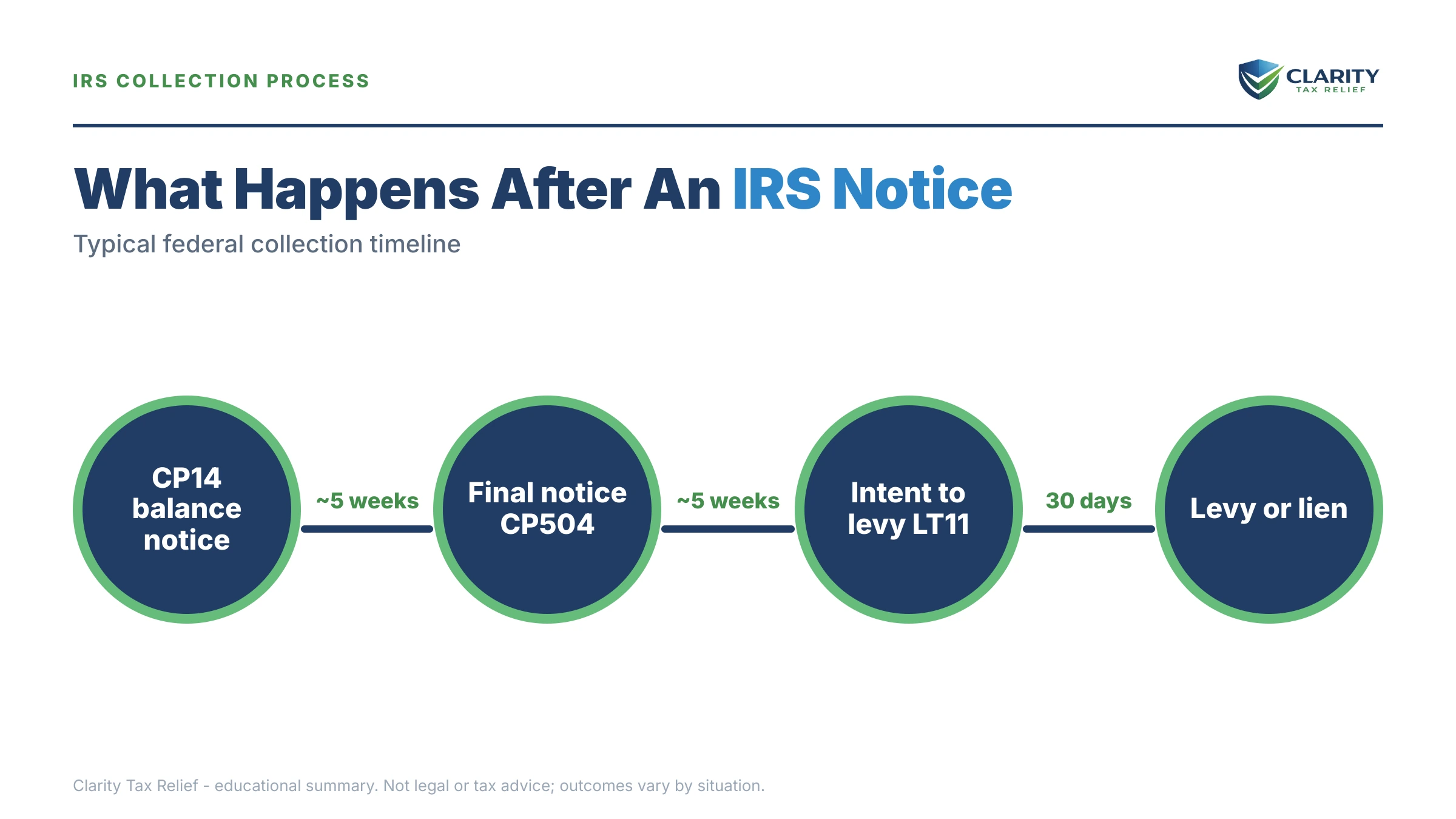
Ignoring a federal balance triggers an automated notice sequence that ends in levy power. The FTB runs its own separate track at the same time. On the IRS side, the order is fixed:
- CP14 — the first bill, typically with about 21 days to pay before the sequence continues. No enforcement yet; this is the cheapest moment to act.
- CP501 / CP503 — reminder bills. Still no enforcement, but the 0.5% monthly penalty and daily interest are compounding.
- CP504 — Notice of Intent to Levy under IRC §6331(d). The IRS can now take your California state refund. Despite the alarming name, this is not the final notice.
- LT11 / Letter 1058 — the true final notice. A 30-day clock starts, along with your right to a Collection Due Process hearing via Form 12153. After 30 days, the IRS can levy bank accounts and income.
- Levy — a bank levy freezes funds for a 21-day hold before the money leaves. For a 1099 contractor, a levy can also be sent directly to your clients, seizing what they owe you at that moment.
Don't count on IRS staffing problems to save you. The IRS workforce was cut roughly 27% in 2025, so reaching a human is harder than ever. But these notices and levies are generated by automated systems that never stopped running. The machine escalates whether or not anyone reads your file.
Meanwhile the FTB moves on its own schedule, and in practice it is often the faster and less forgiving of the two. It intercepts state refunds, files liens, issues bank levies and earnings withholding orders to employers, and, unlike the IRS's 10-year collection statute, it can keep collecting for 20 years under R&TC §19255. Our guide to the ftb statute of limitations collections rule explains why waiting out California almost never works.
One more federal stage worth knowing even if you're nowhere near it: once a federal debt is certified as seriously delinquent — $66,000 in 2026 — the State Department can deny or revoke your passport. At $7,400 that's not your problem today; ignored balances with compounding penalties are how people get there.
Getting IRS or FTB notices in San Diego?
Send us photos of what you've received from both agencies. An experienced tax professional will map exactly where each debt stands and which option fits your numbers — free and confidential, before another month of penalties and interest posts to either balance.
Tax relief San Diego residents actually qualify for
Every legitimate resolution option is means-tested — what you qualify for depends on how much you owe and what your finances show. Here is the full federal menu, with the thresholds that actually control:
| Option | Who may qualify | Cost to set up | What to know |
|---|---|---|---|
| Short-term payment plan | Can pay in full within 180 days | $0 setup fee | Stops enforcement; interest and penalties still accrue |
| Guaranteed installment agreement | Owe $10,000 or less; full pay within 3 years; returns filed | Standard IRS setup fee | The IRS must accept it if you meet the criteria — no financial disclosure |
| Streamlined installment agreement | Owe $25,000 or less ($50,000 with direct debit) | Standard IRS setup fee | Up to 72 months online, no detailed financials |
| Offer in Compromise | Assets + future income genuinely can't cover the debt | $205 fee + 20% down on lump-sum offers (both waived with low-income certification) | Roughly 1 in 5 offers accepted in FY2024 — real, never automatic |
| Currently Not Collectible | Paying anything would create genuine hardship | $0 (financial disclosure required) | Pauses collection; debt and interest remain |
| Penalty abatement (FTA / AEP) | Clean compliance the prior 3 years, or reasonable cause | $0 | AEP makes first-time relief automatic starting summer 2026 |
| FTB payment plan | California balance — separate application from the IRS | Set by the FTB | State debt is never covered by your IRS agreement |
Two of these deserve honest framing. First, the guaranteed installment agreement: if you owe $10,000 or less, can pay it off within three years, and have all returns filed, the IRS is required by law to accept your plan. "Guaranteed" here is the official program name, not a marketing promise, and for most San Diego contractors with a four-figure balance, it's the straightest path out.
Second, the Offer in Compromise. Yes, the IRS sometimes accepts less than the full balance (via Form 656), but only when its own math shows it could never collect the full amount before the statute runs. If your AGI is at or below 250% of the federal poverty level, low-income certification waives the $205 fee, the 20% down payment, and payments during review, and if the IRS doesn't decide within 2 years, the offer is deemed accepted, with narrow exceptions: a returned or rejected offer stops the clock, and time during court disputes does not count. Anyone promising you'll "settle for pennies on the dollar" before seeing your finances is running the classic scam, not describing the program. San Diego's housing costs cut both ways here: high rent raises your allowable expenses, which can lower what the IRS counts as collectible — the irs allowable living expenses standards for San Diego County are what actually drive that math.
A worked example: a San Diego 1099 contractor who owes $7,400
Say you owe $7,400 from your first full year contracting. This is a hypothetical, but the math is real. The failure-to-pay penalty alone is adding about $37 a month (0.5% of $7,400), with daily-compounding interest stacked on top. Here's how the main options compare:
- Short-term plan (180 days): roughly $7,400 ÷ 6 ≈ $1,233/month. $0 setup fee, least total interest, but a heavy monthly lift on variable 1099 income.
- Guaranteed installment agreement (3 years): $7,400 ÷ 36 ≈ $206/month. Under the $10,000 threshold, the IRS must accept it if your returns are filed. For most contractors at this balance, this is the sweet spot.
- 72-month online plan: $7,400 ÷ 72 ≈ $103/month minimum. Easiest payment, but the longest runway for interest and penalties to accrue, so it costs the most overall.
- Offer in Compromise: usually the wrong tool at this size. With ongoing contracting income, the IRS's collectibility math will almost always show it can recover $7,400 within the plan options above — meaning the fee, paperwork, and months of review buy you nothing a payment plan wouldn't.
Whichever you choose, budget for the current year's quarterlies at the same time — a new balance defaults an existing agreement. To see what waiting actually costs at your exact balance, you can estimate the accrual with our IRS Penalty & Interest Calculator.
The California side: FTB, CDTFA, and EDD
Your IRS agreement does nothing for a California balance — the FTB must be handled separately, on its own application and its own timeline. Start with our california ftb back taxes hub for the full state playbook, and the ftb payment plan guide for the state's installment process. The FTB also runs its own Offer in Compromise, judged independently of anything the IRS decides.
Here's how the two collectors compare on the powers that matter:
| Question | IRS | California FTB |
|---|---|---|
| How long can they collect? | 10 years from assessment (the CSED), pausable by appeals, an OIC, or bankruptcy | 20 years from when the liability became due (R&TC §19255) |
| Final warning before levy | LT11 / Letter 1058, with a 30-day right to a CDP hearing via Form 12153 | Intent-to-levy notice — respond by the date printed on it; there is no federal-style CDP process |
| Passport / license leverage | Passport certification possible at $66,000+ (2026 threshold) | License suspensions tied to its Top 500 delinquent-taxpayer list |
| Refund intercepts | Can seize your California refund after a CP504 | Intercepts state refunds for its own balances |
| Settlement program | Offer in Compromise (Form 656) — roughly 1 in 5 accepted in FY2024 | Separate FTB Offer in Compromise with its own application and review |
If you run a San Diego business, note the other two state collectors. The CDTFA treats collected-but-unremitted sales tax as trust-fund money and can pursue owners personally even after a business closes. The EDD does the same with payroll withholding, and both move faster than the income-tax agencies because the money was never yours to begin with. Multi-agency business cases are where professional sequencing earns its fee.
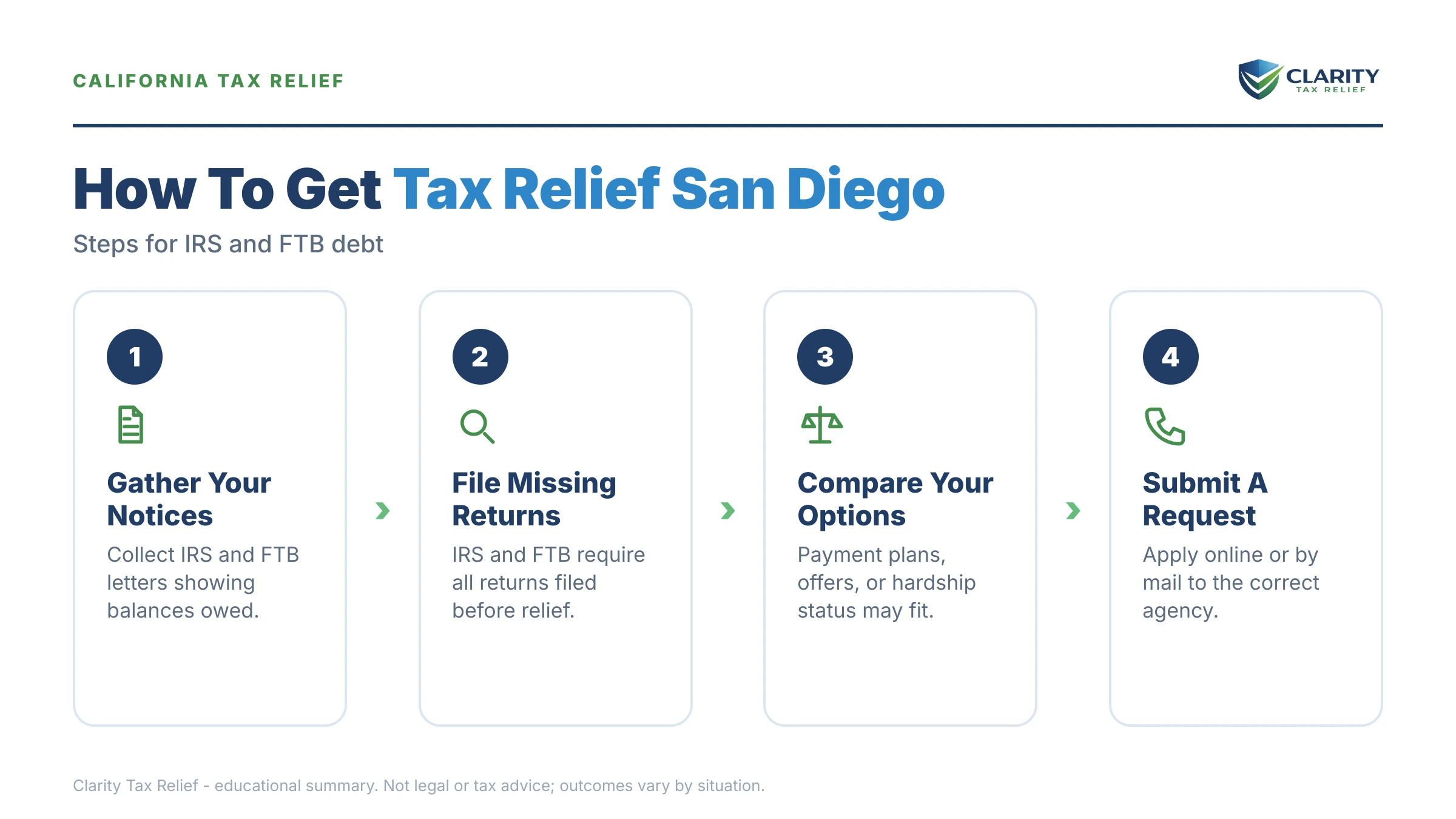
How to start tax relief in San Diego, step by step
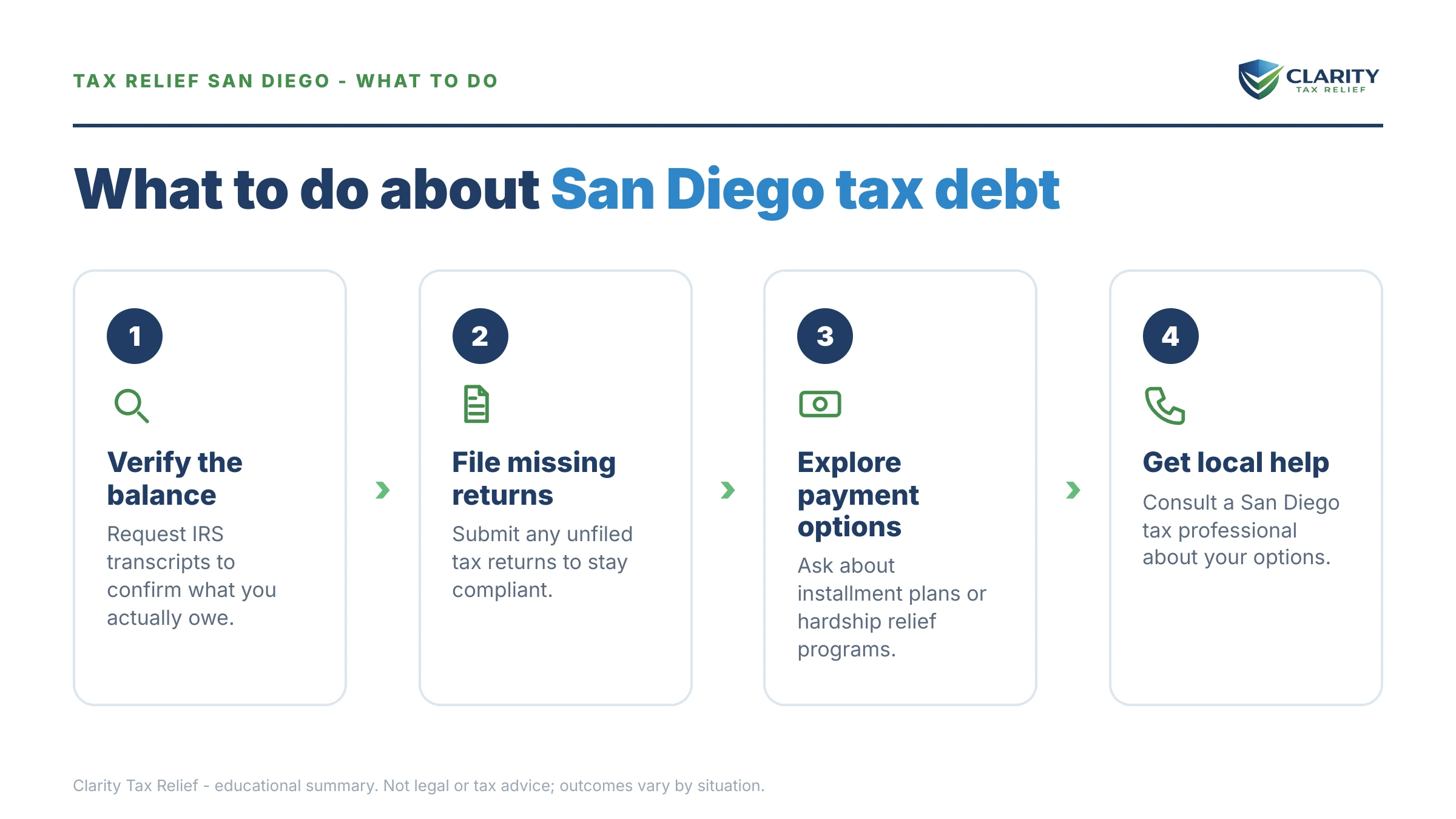
- Pull your IRS balance. Create or log into your IRS online account to see the exact balance, penalties, and notice stage for every tax year, before you talk to anyone.
- Get your FTB balance. Check MyFTB at ftb.ca.gov or your most recent FTB notice. The state and federal balances are separate debts and are resolved separately.
- File every missing return. The failure-to-file penalty runs ten times the failure-to-pay penalty — though in months where both apply, the failure-to-file portion drops to 4.5 percent (5 percent combined) — and neither agency will approve a payment arrangement while returns are outstanding.
- Choose the option that fits your numbers. Use the eligibility table above. At $7,400, that's usually a guaranteed or streamlined installment agreement you can set up online in under an hour.
- Request penalty relief. Ask the IRS for first-time abatement if your prior three years are clean, or watch for the automatic AEP rollout in summer 2026, and pursue the FTB's separate abatement rules on the state side.
When you can handle San Diego tax debt yourself
Plenty of San Diego tax problems don't need a paid firm, and you should know which is which before anyone quotes you a fee. You can very likely handle it yourself if:
- You owe under $10,000 to the IRS for a single year, agree with the amount, and have your returns filed — the guaranteed agreement is a form-filling exercise, not a negotiation.
- You can pay in full within 180 days — the short-term plan takes minutes online and costs nothing to set up.
- You got a first bill you agree with and just need to pick a payment method.
Our hub on how to settle tax debt yourself walks through every DIY path in detail. Experienced help genuinely changes outcomes when a levy or garnishment is already in motion, when you have multiple unfiled years, when a business owes payroll or sales tax alongside income tax, or when Offer in Compromise math is close enough that presentation decides it. If you do hire someone, read how to choose a tax relief company — sorry, correct link: see our buyer's checklist on how to choose a tax relief company — credentials, a written flat fee, and no outcome promises are the non-negotiables.
If money is tight, San Diego has free options too: a low income taxpayer clinic can represent qualifying taxpayers in IRS disputes at little or no cost. The Taxpayer Advocate Service is a free, independent office for cases causing hardship.
Terms on your notices, decoded
- Levy: the actual seizure of money or property — a bank account, a paycheck, or what a client owes you.
- Lien: a public legal claim against everything you own, securing the debt; it takes nothing by itself but clouds sales and refinances.
- CSED: the Collection Statute Expiration Date — the IRS's 10-year deadline to collect, which appeals, offers, and bankruptcy can pause and extend.
- CDP hearing: your Collection Due Process appeal right after a final levy notice, requested on Form 12153 within 30 days.
- Currently Not Collectible (CNC): IRS hardship status that pauses collection when your finances show you can't pay; the debt and interest remain.
- R&TC §19255: the California statute giving the FTB its 20-year collection window — twice the federal clock.
San Diego tax relief questions, answered
Do I need a San Diego tax relief company, or can a national firm help?
Tax representation before the IRS is federal, so an enrolled agent, CPA, or tax attorney can represent you from anywhere in the country — most cases are handled entirely by phone, mail. The IRS's own systems. For California FTB debt, you want a team that works FTB cases regularly, wherever they sit. What matters is credentials and a written flat-fee agreement, not a local zip code.
How long can California collect back taxes?
The FTB generally has 20 years from the date a liability becomes due and payable, under Revenue and Taxation Code §19255 — twice the IRS's 10-year window. That means a California balance you might outlast federally can follow you for two decades. If you owe both, this difference often changes which debt you attack first.
Can I settle my IRS debt for less than I owe in San Diego?
Sometimes — through an Offer in Compromise, which the IRS accepts only when your assets and future income genuinely can't cover the debt before the collection statute runs out. The IRS accepted roughly 1 in 5 offers in FY2024, so it's real but far from automatic. San Diego's high housing costs can actually help your offer math, because allowable living expenses reduce what the IRS counts as collectible.
Does the FTB have its own settlement program?
Yes — the FTB runs its own Offer in Compromise program, separate from the IRS version, with its own application and its own review of your income and assets. Acceptance by one agency does not bind the other. Many San Diego taxpayers resolve the federal side with a payment plan and pursue the FTB separately, or vice versa, depending on which balance is larger and which agency is closer to enforcement.
Will the IRS garnish my 1099 income?
The IRS can levy contractor pay, but differently than wages: a levy sent to a client typically grabs what that client owes you at that moment, while a W-2 wage levy is continuous until released. The IRS can also levy your bank account — the bank holds the funds for 21 days before sending them, which is your window to act. If clients owe you ongoing receivables, a levy can still choke your cash flow fast.
How much does tax relief cost in San Diego?
Straightforward payment plans you can often set up yourself for just the IRS setup fee — $0 for a short-term plan of up to 180 days. Professional representation is usually a flat fee that scales with complexity: a single-year balance with a payment plan costs far less than multiple unfiled years plus an Offer in Compromise across two agencies. Get the fee in writing before you pay anything, and be wary of anyone quoting a settlement outcome before reviewing your finances.
What if I owe both the IRS and the FTB and can't pay both?
You can run payment plans with both agencies at the same time, and each looks at your full financial picture when setting terms. Priority usually goes to whichever agency is closer to levying — an LT11 from the IRS or an intent-to-levy notice from the FTB moves that agency to the front of the line. An experienced tax professional will often sequence the two so one plan's payment is factored into the other agency's ability-to-pay math.
Is there free tax debt help in San Diego?
Yes. If your income is modest, an IRS-sponsored Low Income Taxpayer Clinic can represent you in IRS disputes at little or no cost. The Taxpayer Advocate Service is a free, independent office inside the IRS for cases causing hardship. These are strong options for smaller balances and hardship situations, though they can't take every case and generally don't handle complex multi-agency work.
Your next 24 hours
- Find every notice. Pull the most recent IRS letter and any FTB mail. The notice number in the corner and the amount-due box tell you exactly which stage each debt has reached.
- Gather three things. Last year's return, all your 1099s. A rough monthly income-and-expense picture — that's everything needed to know which option your numbers support.
- Get the free case review. Use the 2-minute form or call (888) 825-7779. An experienced tax professional will map both the IRS and FTB sides of your San Diego situation, and every month you wait, penalties and interest post to both balances.
Official resources: pay or set up a plan directly at IRS.gov/payments, review federal plan terms on the IRS payment plans page, handle California balances through the Franchise Tax Board, and find free advocate help at the Taxpayer Advocate Service.
This guide is general information, not tax or legal advice for your specific situation. Eligibility for IRS programs depends on individual facts and circumstances; no outcome is guaranteed.