
Tax Relief by City
Tax Relief San Jose: How to Resolve IRS and California FTB Tax Debt in 2026
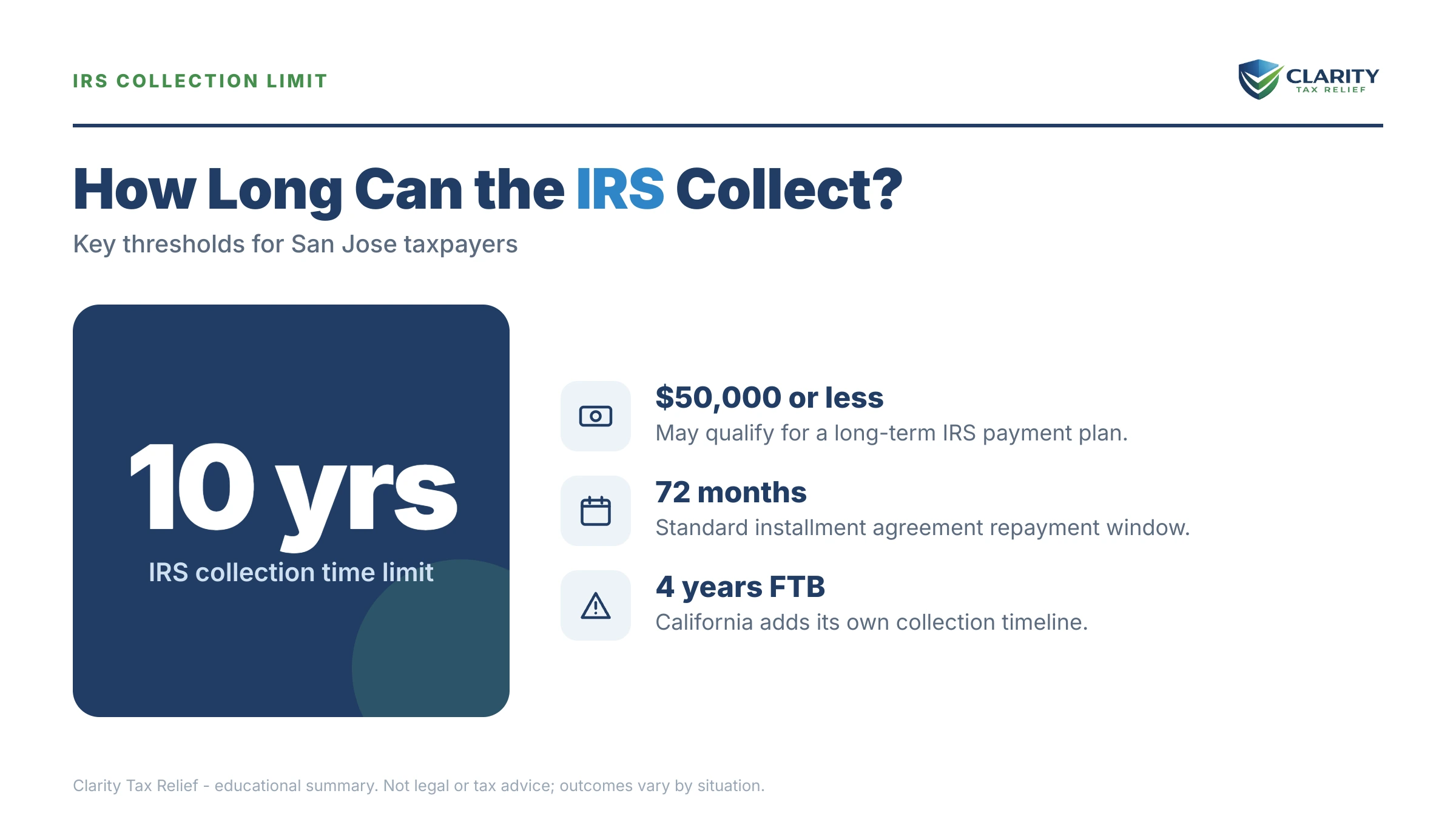
The short answer: tax relief in San Jose usually means resolving two debts at once — the IRS and California's Franchise Tax Board (FTB). IRS options include payment plans up to 72 months, an Offer in Compromise, hardship status, and penalty abatement. The FTB runs separate programs and can collect for 20 years, twice the IRS window.
Two envelopes arrived this spring — one from the IRS, one from Sacramento — and the joint return you filed from your place in Willow Glen somehow left you owing both. That double bill is the defining feature of tax debt in Santa Clara County, and it's why most generic advice you find for "tax relief San Jose" only solves half your problem. Both balances are fixable, and the order you fix them in matters more than either agency will tell you.
⏱ The real clock: there is no single deadline on a tax debt itself, but two meters run every month you wait. The IRS failure-to-pay penalty adds 0.5% of your balance per month plus compounding interest, and the FTB stacks its own penalties and interest on the state side at the same time.
Why San Jose tax debt usually means two bills, not one
San Jose taxpayers answer to two separate tax collectors — the IRS and the California Franchise Tax Board — and a deal with one does nothing to stop the other.
The way that debt gets created here is distinctly Silicon Valley. RSUs vest and your employer withholds federal tax at the flat 22% supplemental rate. But a two-earner household's real marginal rate is often well above that. Add an ESPP sale, a 1099 side project, or a bonus, and April produces balances owed to both Washington and Sacramento at once.
The two agencies do not coordinate. They send separate notices, run separate payment plans, apply different rules, and operate on very different collection clocks. Deciding which balance to attack first is a real strategic question. We break down the trade-offs in FTB vs IRS: which to resolve first.
If you run a business in San Jose, two more agencies can join the line: the CDTFA for sales and use tax and the EDD for state payroll tax. Both treat certain taxes as "trust fund" money that can follow owners personally — see California EDD payroll tax and our tax relief for small business buyer's guide.
| Agency | What it collects | The fact that changes your strategy |
|---|---|---|
| IRS | Federal income, self-employment, and payroll tax | 10-year collection statute (CSED); a fully automated notice-to-levy pipeline that never pauses for staffing shortages |
| California FTB | State personal and business income tax | 20-year collection statute under R&TC §19255 — twice the federal window, so waiting it out rarely works |
| CDTFA | Sales and use tax | Sales tax is trust-fund money — owners can be pursued personally even after the business closes |
| EDD | State payroll taxes (UI, SDI, withholding) | Can assess unpaid business payroll taxes against responsible individuals personally |
“An offer in compromise allows you to settle your tax debt for less than the full amount you owe. It may be a legitimate option if you can't pay your full tax liability or doing so creates a financial hardship.”
— Offer in compromise (IRS.gov)
What happens if you ignore IRS and FTB collections
Ignore a tax debt in San Jose and two enforcement machines advance at once, and the IRS side is entirely automated. The federal sequence runs in a fixed order:
- CP14 — the first bill. You typically have about 21 days before the sequence escalates.
- CP501 / CP503 — reminder notices. Still just bills, but penalties and interest are compounding monthly.
- CP504 — Notice of Intent to Levy under IRC §6331(d). The IRS can now seize your California state tax refund, and a federal tax lien becomes a live risk.
- LT11 / Letter 1058 — the final notice. It starts a 30-day clock to request a Collection Due Process hearing on Form 12153 before wages and bank accounts are on the table.
- Levy — a bank levy freezes funds with a 21-day hold before the money leaves; a wage levy is continuous until released.
The FTB doesn't offer that long a runway. After a demand for payment, it can record a state tax lien, send an Order to Withhold to your bank, intercept refunds, and issue an FTB wage garnishment straight to your employer. It has 20 years to keep doing it. The full state sequence is mapped in our California FTB back taxes guide.
Two more 2026 realities. If your federal debt reaches $66,000, the IRS can certify it to the State Department and block your passport — a real problem in a region where international travel is part of the job. And while IRS staffing fell roughly 27% in 2025, the levies are issued by computers that were not laid off: it is now harder to reach a human to fix a problem, but no harder for the system to create one.
Owe the IRS, the FTB, or both in San Jose?
Interest and monthly penalties are accruing on both balances right now. Get a free review of exactly where each account stands and which agency to address first, before either one moves to a levy.
Tax relief San Jose: your real options compared
Every IRS resolution program is means-tested — the right option for a San Jose household depends on the balance, your income, and what you can document, not on what an ad promises.
| Option | Typical eligibility | Cost and the catch |
|---|---|---|
| Short-term payment plan | Can pay in full within 180 days | $0 setup fee; penalties and interest keep accruing until paid |
| Guaranteed installment agreement | Balance of $10,000 or less with a clean recent filing history | The IRS is required to accept it; generally paid within three years |
| Streamlined installment agreement | Up to $50,000; can be set up online over up to 72 months | Setup fee applies (lower with direct debit); interest and the 0.5% monthly penalty continue |
| Offer in Compromise (Form 656) | Income and assets genuinely can't cover the debt before the collection statute runs | $205 fee plus 20% down on lump-sum offers (both waived with low-income certification); roughly 1 in 5 offers accepted in FY2024 |
| Currently Not Collectible | Paying would leave you unable to cover basic living expenses, documented on Form 433-F | Collection pauses, but the debt, penalties, and interest remain; refunds get kept |
| Penalty abatement | Clean compliance for the prior three years, or documented reasonable cause | Removes penalties, not tax; from summer 2026 the Automatic Exemption from Penalty (AEP) applies many first-time removals with no request needed |
One quirk that genuinely favors San Jose filers: IRS collection math runs on county-based allowable living expense standards, and Santa Clara County's housing allowance is among the highest in the country. That means hardship status or an Offer in Compromise can be within reach at income levels that would disqualify someone with the same debt in a cheaper county. It's one of the few times the local cost of living works in your favor.
None of the programs in the table touch your California balance. The FTB requires its own application on its own criteria — start with the FTB payment plan guide, and if you're considering settlement on the state side, the FTB offer in compromise is a separate program with its own math. Never assume an IRS threshold or timeline carries over to Sacramento; it almost never does.
A worked example: a San Jose couple who owes $6,200
Say you and your spouse file jointly and the return shows $6,200 due to the IRS — a classic RSU-underwithholding balance. Your employers withheld federal tax on vested stock at the flat 22% rate. But your combined W-2 income put you in a higher bracket. The gap landed on the return. This is hypothetical, but the math is real:
- Do nothing: the failure-to-pay penalty starts at about $31 per month (0.5% of $6,200), plus compounding interest, before the FTB side even enters the picture.
- 180-day short-term plan: roughly $1,034 a month for six months ($6,200 ÷ 6). $0 setup fee, and accruals shrink as the balance drops. The right call if a bonus or vesting event is coming.
- Guaranteed installment agreement: at $6,200 you're under the $10,000 threshold, so if your recent filing history is clean the IRS must accept a plan — generally paid over three years, about $172 a month ($6,200 ÷ 36) before interest.
- Offer in Compromise: honestly, no. With two Silicon Valley salaries, the IRS would conclude it can collect $6,200 in full, and an offer would waste the $205 fee. This is what "means-tested" looks like in practice.
You can estimate how fast penalties and interest grow on your own balance with our IRS penalty and interest calculator. And remember the same return probably produced a state balance too. That one needs its own FTB installment agreement, set up separately.
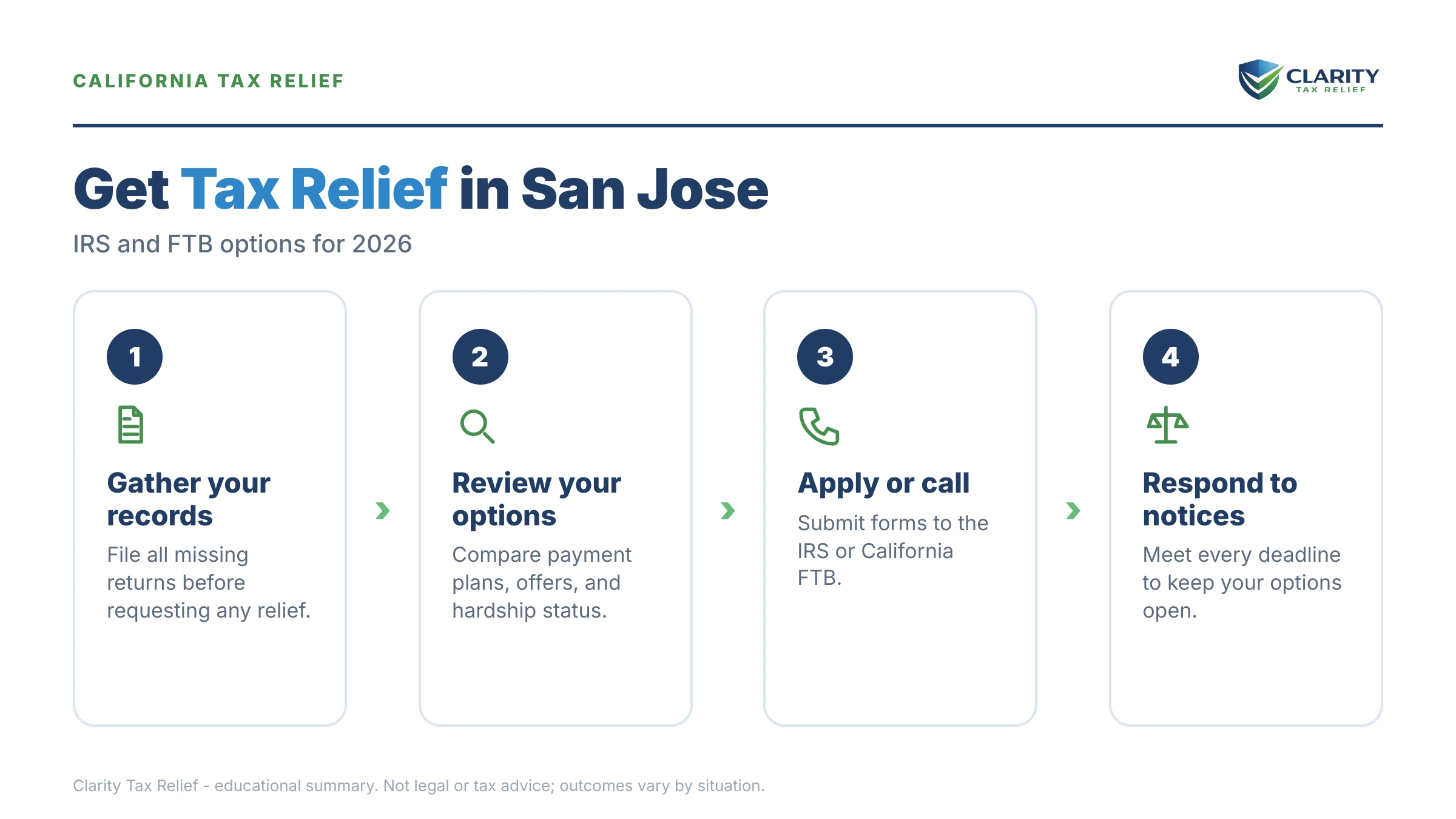
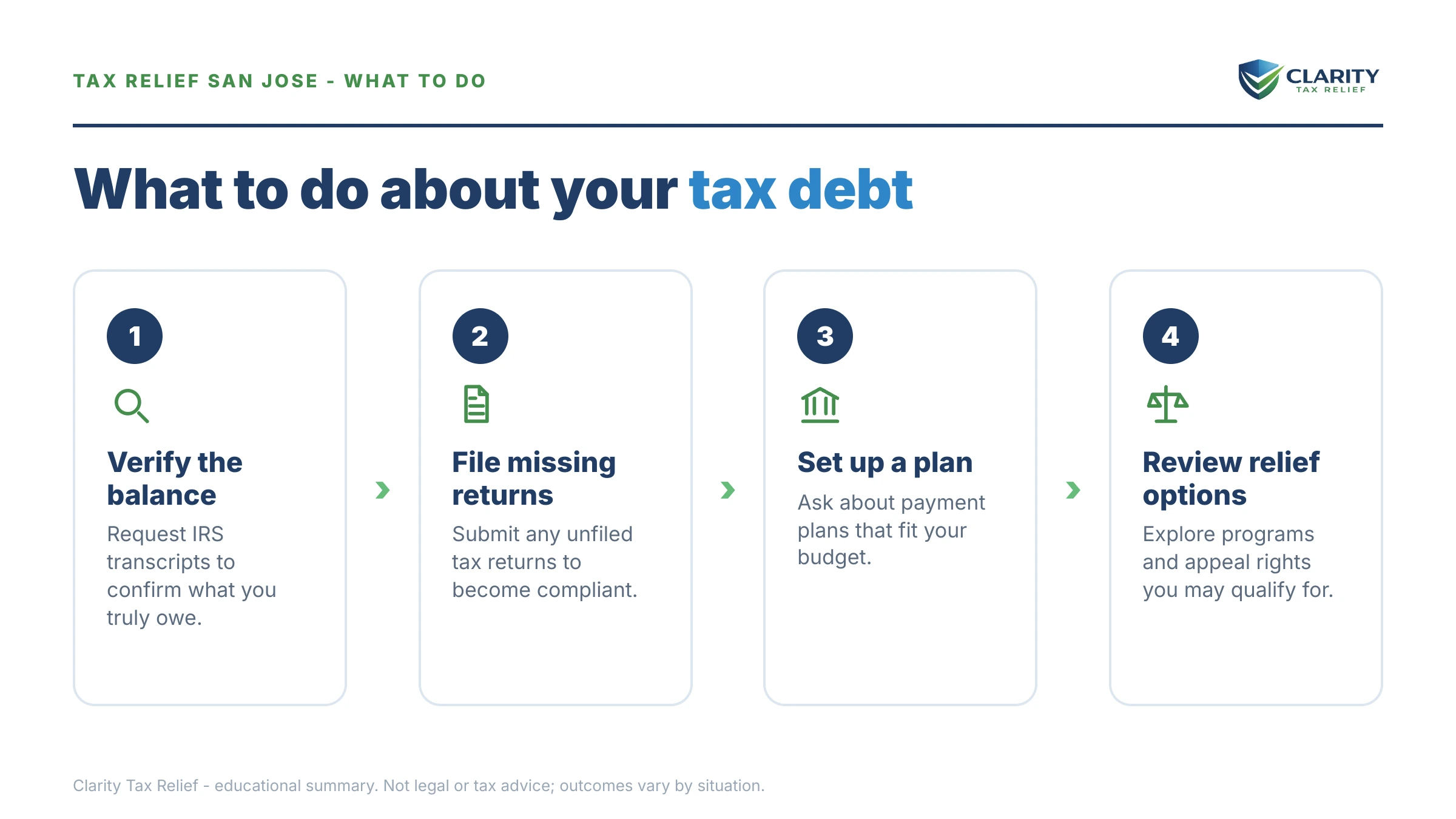
How to start resolving tax debt in San Jose, step by step
- Pull your records from both agencies. Create or log in to your IRS online account to see every balance, penalty, and notice on file, and register for a MyFTB account at ftb.ca.gov for the California side. You cannot pick the right fix until you know exactly what each agency claims you owe.
- File every missing return first. The IRS will not approve a payment plan or an offer while returns are unfiled. The FTB files its own estimated assessments, usually higher than reality, when you don't.
- Confirm both balances are actually correct. Compare each notice against your filed returns and payment records. Assessments built on missing withholding, misapplied payments, or an FTB estimate can often be reduced before you agree to pay anything.
- Set up a resolution with each agency separately. An IRS agreement does nothing for your FTB balance and vice versa. Apply for the IRS plan online at the IRS payment plans page (or by Form 9465), then request an FTB installment agreement on its own terms.
- Request penalty relief on both sides. Ask the IRS about first-time penalty abatement or the new automatic penalty exemption rolling out in summer 2026, and ask the FTB about its own reasonable-cause abatement. Removed penalties shrink the balance every later option is calculated on.
When you can handle this yourself, and when help changes the outcome
Most San Jose taxpayers with a single-year balance they agree with can resolve it themselves online in under an hour. If you can pay within 180 days, or the balance fits a streamlined plan you can afford, and no garnishment or levy is in motion, you don't need to hire anyone — our guide to how to settle tax debt yourself walks through every form and phone script.
Experienced help changes outcomes in specific situations: an FTB garnishment or bank order already in motion, multiple unfiled years across both agencies, business debt with personal-liability exposure (payroll or sales tax), Offer in Compromise calculations where Santa Clara County's expense standards make the math genuinely close, or a combined federal-and-state balance that your cash flow can't cover both sides of at once. Those cases turn on sequencing and documentation, and mistakes are expensive to unwind.
If you do hire someone, credentials and fee structure matter more than geography — here's how to choose a tax relief company without getting burned.
Terms on your IRS and FTB letters, decoded
- CSED — the IRS's 10-year deadline to collect, counted from assessment; certain events (an offer, bankruptcy, appeals) pause the clock.
- R&TC §19255 — the California statute that gives the FTB 20 years to collect a state tax debt.
- Lien — a recorded public claim against everything you own; it secures the debt but takes nothing by itself.
- Levy — the actual seizure: bank funds, wages, or your state refund.
- Earnings Withholding Order — the FTB's wage garnishment, sent directly to your employer with no court order required.
- Reasonable Collection Potential — the IRS's calculation of the most it could ever collect from you; the floor for any Offer in Compromise.
San Jose tax relief questions, answered
Do I need a tax relief company located in San Jose?
No. Representation before the IRS and the FTB happens by phone, mail, and secure document upload, so the professional's credentials matter far more than their zip code. Enrolled agents, CPAs, and tax attorneys can represent you in all 50 states. Be cautious with search results that look local but are lead-generation sites selling your information to the highest bidder.
Can the FTB garnish my wages in San Jose?
Yes. The FTB issues an Earnings Withholding Order for Taxes directly to your employer, no court judgment required. It continues until the debt is paid or released. It operates completely separately from any IRS levy, which means both agencies can reach the same paycheck. Setting up an FTB payment plan is usually the fastest way to stop one.
How long can California collect back taxes?
Generally 20 years from the date the tax was assessed, under Revenue and Taxation Code section 19255 — double the IRS's 10-year collection window. That makes waiting it out a far worse strategy for California debt than for federal debt. The IRS clock can also be paused by events like an Offer in Compromise or bankruptcy, so neither clock is as simple as it sounds.
Can I settle my IRS debt for less than I owe?
Sometimes, through an Offer in Compromise, but the IRS accepted only about 1 in 5 offers in fiscal year 2024. Acceptance turns on whether your income and assets show the IRS could never collect the full balance, not on how good your story is. The application costs $205 plus a 20% down payment on lump-sum offers, though both are waived if you qualify for low-income certification.
If I owe both the IRS and the FTB, which should I pay first?
Address whichever agency has active enforcement first — a garnishment or bank levy in motion beats everything else. If neither is levying yet, many taxpayers prioritize the FTB because its 20-year statute and faster enforcement make it the more persistent creditor, while putting the IRS balance on a payment plan. Both balances accrue penalties and interest either way, so neither should simply wait.
Will tax debt stop me from buying a home in Santa Clara County?
The debt alone usually won't, but a recorded tax lien can. Since 2018, tax liens no longer appear on credit reports, but they remain public records that lenders and title companies find during underwriting. Most lenders will work with buyers who have an established payment plan with several months of on-time history, so setting one up before you apply matters.
Is there free help with tax debt in San Jose?
Yes, for those who qualify. Low Income Taxpayer Clinics represent taxpayers below certain income limits in IRS disputes for free. The Taxpayer Advocate Service can step in when IRS delays or actions are causing hardship. These resources are excellent for smaller, simpler cases; complex dual-agency situations or business debt often exceed what they can take on.
Does the passport rule apply to California state tax debt?
No. Passport certification applies only to seriously delinquent federal tax debt — $66,000 or more in 2026, adjusted annually for inflation. The FTB cannot touch your passport, but California applies its own pressure, including public disclosure of its largest delinquent taxpayers and license suspension programs tied to that list.
If IRS delays or an enforcement action are causing genuine hardship and you can't get a human on the phone, the Taxpayer Advocate Service is an independent office inside the IRS built for exactly that situation.
Your next 24 hours
- Sort the mail. Pull every IRS and FTB envelope and note the notice number, tax year, and amount on each. Whether you're holding a first bill or a final notice determines how fast you need to move.
- Gather three things: your last filed federal and California returns, the notices themselves, and recent pay stubs or income records for both spouses. That's everything a resolution, DIY or professional, is built from.
- Get the free case review. Use the 2-minute form or call (888) 825-7779 and an experienced tax professional will map your IRS and FTB balances into one plan. Penalties and interest accrue on both accounts every month until a resolution is in place — that's the only clock, and it's already running.
This guide is general information, not tax or legal advice for your specific situation. Eligibility for IRS programs depends on individual facts and circumstances; no outcome is guaranteed.