
Tax Relief by City
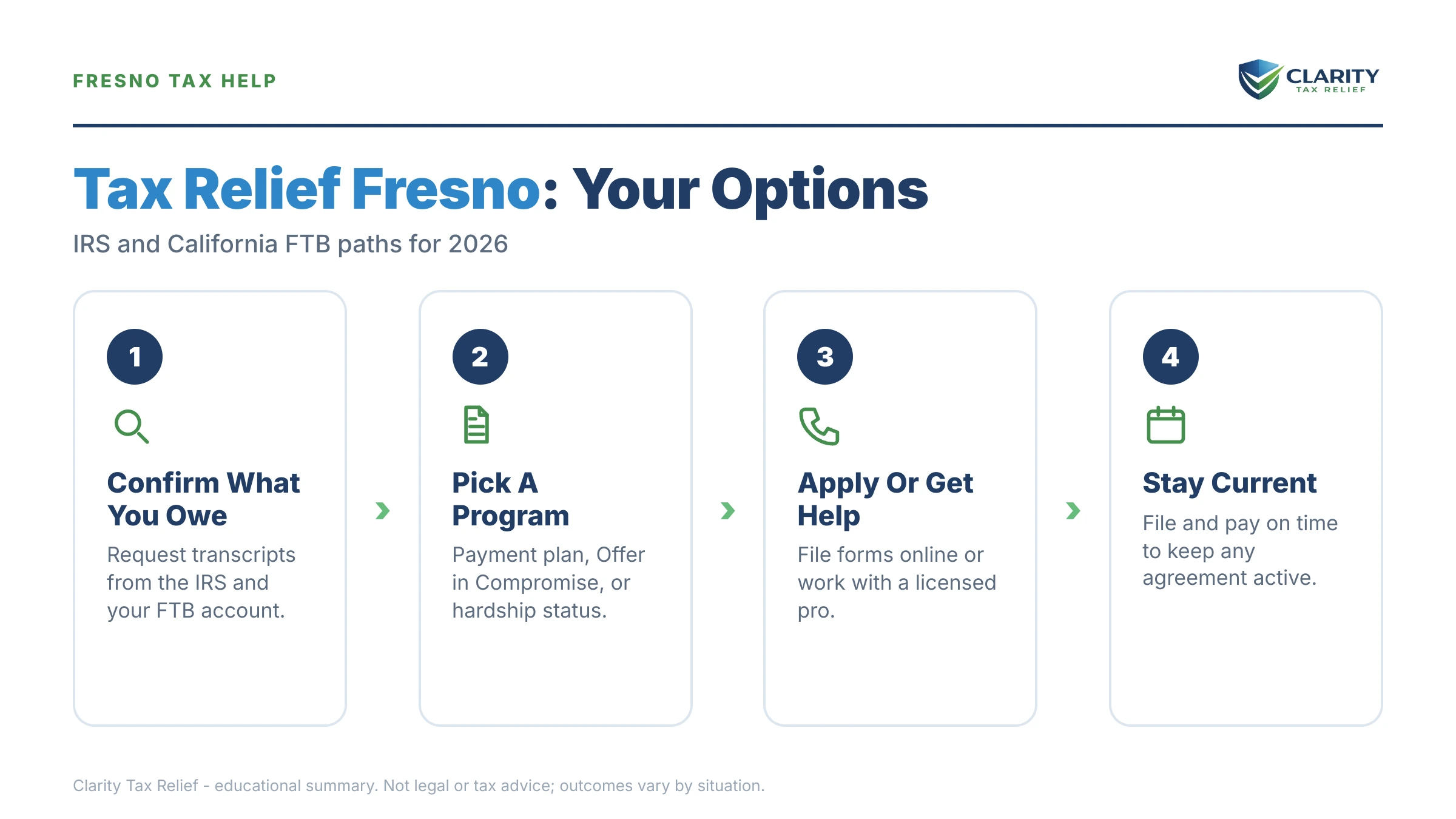
Tax Relief Fresno: Your IRS and California FTB Options for 2026
The short answer: tax relief in Fresno usually means resolving two debts, not one — the IRS balance and a California FTB balance. Payment plans, an Offer in Compromise, hardship status, and penalty abatement all exist at both agencies, but each requires a separate application, and the FTB can collect for 20 years, twice the IRS's window.
You've been searching "tax relief Fresno" between notices — one envelope from the IRS, maybe another from Sacramento — and every result is an 800 number promising a settlement before anyone has seen your numbers. That's not how this works. What actually resolves a Fresno tax debt is matching your balance and finances to the right program at each agency, in the right order.
This guide covers exactly that: every real option, what each costs, who qualifies, how the IRS and FTB tracks differ — and, because so many Fresno readers ask, how to keep a tax debt from killing a home refinance.
⏱ The real clock: there is no single deadline on a Fresno tax debt, but the meter never stops. The IRS adds a 0.5% failure-to-pay penalty every month plus daily-compounding interest, the FTB adds its own penalties and interest on the state side, and under R&TC §19255 the FTB can generally keep collecting for 20 years.
Why Fresno tax debt is almost always a two-agency problem
A Fresno taxpayer who owes back taxes typically owes both the IRS and the California Franchise Tax Board for the same years. If you underreported or underpaid on your federal return, the state return built on those same numbers is usually short too, and California routinely picks up federal adjustments and assesses its own balance on top.
Fresno's economy makes the problem more common than in most cities. The Central Valley runs on agriculture, trucking, construction, and small business — seasonal income, 1099 pay, and cash-heavy work where nothing is withheld. One strong harvest year without quarterly payments can produce a five-figure balance at both agencies at once. If most of your debt is on the state side, start with our California FTB back taxes hub.
The critical difference between your two collectors is time. The IRS generally has 10 years from assessment to collect. The FTB has 20 years under R&TC §19255. Waiting out the state is not a strategy — the full breakdown is in our guide to the FTB statute of limitations on collections.
“An offer in compromise allows you to settle your tax debt for less than the full amount you owe. It may be a legitimate option if you can't pay your full tax liability or doing so creates a financial hardship.”
— Offer in compromise (IRS.gov)
What happens if you ignore tax debt in Fresno
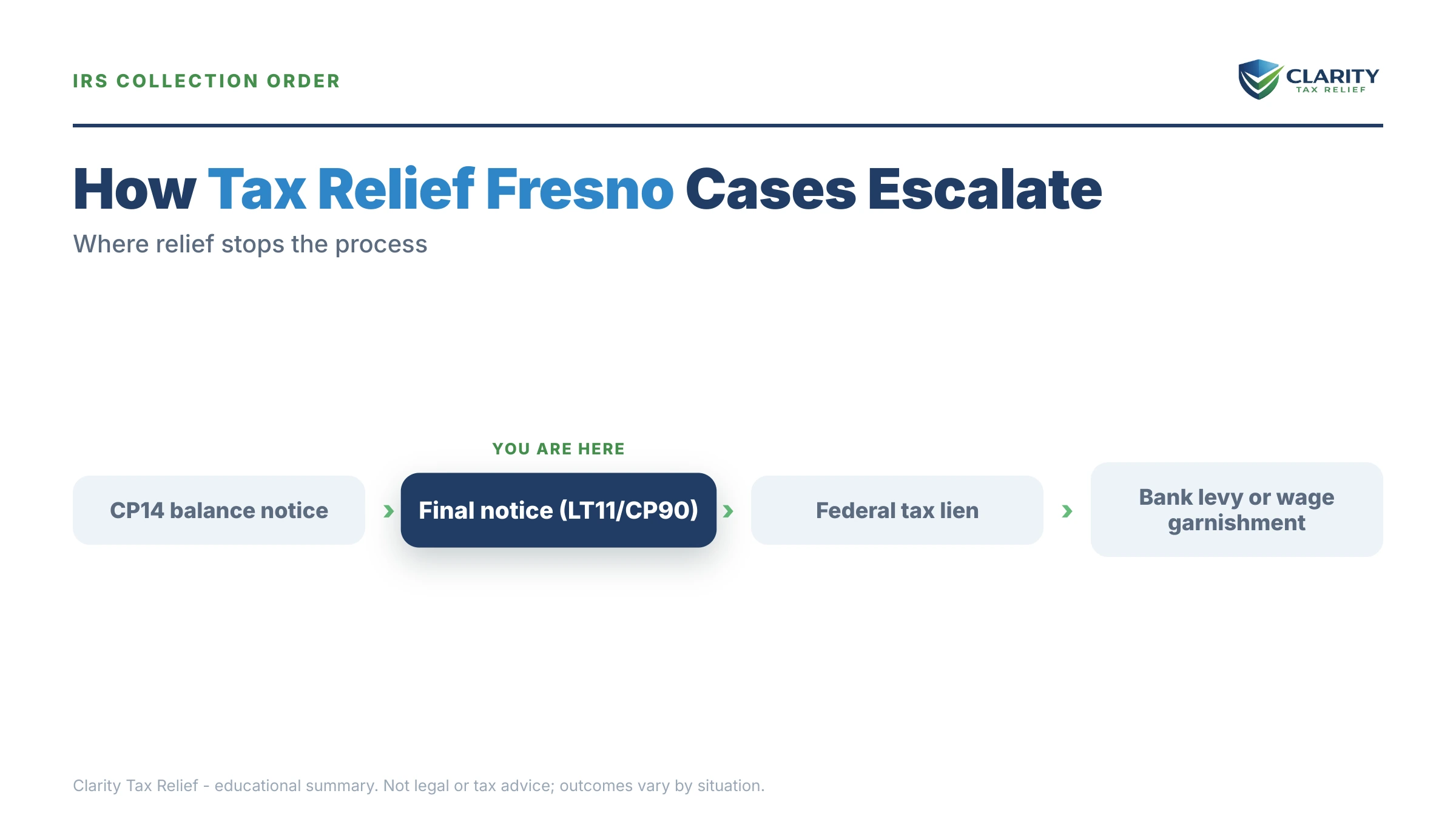
Unresolved tax debt in Fresno escalates on two independent tracks — the IRS's automated notice sequence and the FTB's own collection machine. Neither waits for the other, and neither needs a human to review your file before enforcing. Here is the federal sequence, stage by stage:
- CP14 — the first bill. You typically have about 21 days from the notice date before the sequence moves. No enforcement yet; this is the cheapest moment to act.
- CP501 / CP503 — reminders. Still just bills, but penalties and interest are compounding on the balance every month.
- CP504 — Notice of Intent to Levy. The IRS can now seize your California state tax refund under IRC §6331(d). A federal tax lien becomes a live risk — the exact thing that shows up on a title search when you try to refinance.
- LT11 / Letter 1058 — Final Notice. A 30-day clock starts, along with your Collection Due Process rights (requested on Form 12153). After it runs, the IRS can levy bank accounts and garnish wages.
- Levy and garnishment. A bank levy freezes funds for 21 days before they leave; a wage levy continues paycheck after paycheck until released.
The FTB runs its own parallel track: a demand notice, then bank levies and wage garnishment through an Earnings Withholding Order for Taxes, often on a shorter fuse than the IRS, plus a state lien recorded with the Fresno County Recorder that clouds your title just like a federal one. See FTB wage garnishment for how the state order works.
One 2026 reality worth knowing: the IRS workforce shrank roughly 27% in 2025, so reaching a human is harder than ever. But the notices, liens, and levies come from automated systems that never stopped running. Silence from the IRS does not mean your file is dormant.
Owe the IRS or the FTB in Fresno?
Send us your notices — federal, state, or both. An experienced tax professional will map exactly where each agency stands on your account and which program fits your numbers, free and confidential. Penalties and interest are accruing monthly either way; knowing your position costs nothing.
Your tax relief options in Fresno, compared
Every legitimate tax relief outcome in Fresno comes from one of five IRS programs, or their FTB equivalents, and eligibility for each is means-tested, not negotiated. If a salesperson quotes a settlement before reviewing your finances, they are guessing at best. The general playbook for working these programs on your own lives in our guide to how to settle tax debt yourself. Here is how each option lines up, including what it means for a homeowner trying to refinance:
| Option | Basic eligibility | Cost to set up | Effect on a refinance |
|---|---|---|---|
| Short-term IRS plan (up to 180 days) | Can pay in full within 180 days | $0 setup; interest and penalties continue | Usually resolved before a lien is ever filed |
| Long-term installment agreement | ≤ $50,000 → set up online, up to 72 months | Modest setup fee; lower with direct debit | Direct debit at ≤ $25,000 generally keeps a lien off record |
| Offer in Compromise (Form 656) | Assets + future income genuinely below the debt | $205 fee + 20% down (waived for low-income filers) | Plan the refinance timing around the offer review |
| Currently Not Collectible | Documented hardship — paying would break essentials | $0; balance remains and grows | A lien may still be filed, which lenders will see |
| Penalty abatement (FTA / AEP) | Clean compliance in the prior 3 years, or reasonable cause | $0 to request | Shrinks the balance you have to resolve |
| FTB payment plan / FTB OIC | Separate state standards — see the FTB guides below | Set by the FTB; separate from any IRS agreement | A state lien clouds title exactly like a federal one |
Two notes on that table. First, the Offer in Compromise is real but selective — the IRS accepted roughly 1 in 5 offers in FY2024 — and acceptance turns entirely on the IRS's math, not on negotiation skill. Second, the state programs are genuinely separate: the FTB payment plan and the FTB offer in compromise have their own applications, their own thresholds. Their own review standards. Resolving the IRS side does nothing for Sacramento.
Penalty relief deserves special attention in 2026. First-time abatement still works if your prior three years are clean, and starting in summer 2026, the IRS's new Automatic Exemption from Penalty (AEP) begins applying qualifying relief automatically, with no request needed. Details and a request walkthrough are in our first-time penalty abatement guide; the FTB has its own, separate abatement process.
How much do you owe? Realistic options by balance
Your IRS balance band determines which doors are open before anyone looks at your budget. Here is how the bands break for a typical Fresno taxpayer:
| IRS balance | Realistic options | What changes at this level |
|---|---|---|
| Under $10,000 | 180-day plan; guaranteed installment agreement; penalty abatement | Approval is close to automatic if returns are filed; DIY territory |
| $10,000 – $25,000 | Streamlined installment agreement online, up to 72 months | Direct debit generally keeps a federal tax lien off your record |
| $25,000 – $50,000 | Online agreement with direct debit; OIC if finances qualify | Lien risk rises; direct debit becomes effectively required |
| Over $50,000 | Financial-disclosure agreement; OIC or CNC candidacy review | Full financials required; at $66,000+ passport certification is possible |
Above $50,000 the case changes character: the IRS wants a full financial statement, a revenue officer may be assigned, and once the balance crosses $66,000 (the 2026 threshold) the IRS can certify the debt to the State Department, blocking passport issuance or renewal. Remember these bands are IRS-only — your FTB balance sits on top and moves through its own programs.
A worked example: $19,700 owed, with a refinance on the line
Say you own a home near Clovis, you owe the IRS $19,700 from two thin years in your trucking business, and you're planning to refinance this fall. Here's the math. At $19,700 you're under the $25,000 streamlined threshold, so you can set up a 72-month plan online with no financial disclosure: $19,700 ÷ 72 ≈ $274 a month at the minimum — in practice a little more is smart, because interest keeps accruing and every extra dollar shortens the payoff. You can estimate how the balance grows with our IRS Penalty & Interest Calculator.
The refinance is why the structure matters. On a direct-debit agreement under $25,000, the IRS generally does not file a Notice of Federal Tax Lien, so nothing appears on your title search, and most lenders will underwrite around a documented plan. Wait until a CP504 turns into a filed lien. The same $19,700 debt becomes a title problem that has to be paid, discharged, or subordinated before closing. If a lien already exists, a subordination on Form 14135's sibling, Form 14134 lien subordination, can let the new loan take priority so the refinance closes. The full lender-side picture is in can I refinance with an IRS lien.
One more angle for this hypothetical homeowner: if the refinance includes cash out, paying the $19,700 at closing converts an accruing IRS debt into mortgage debt at a fixed rate, sometimes the cheapest resolution available. Run both sets of numbers before choosing.
How to get tax relief in Fresno, step by step
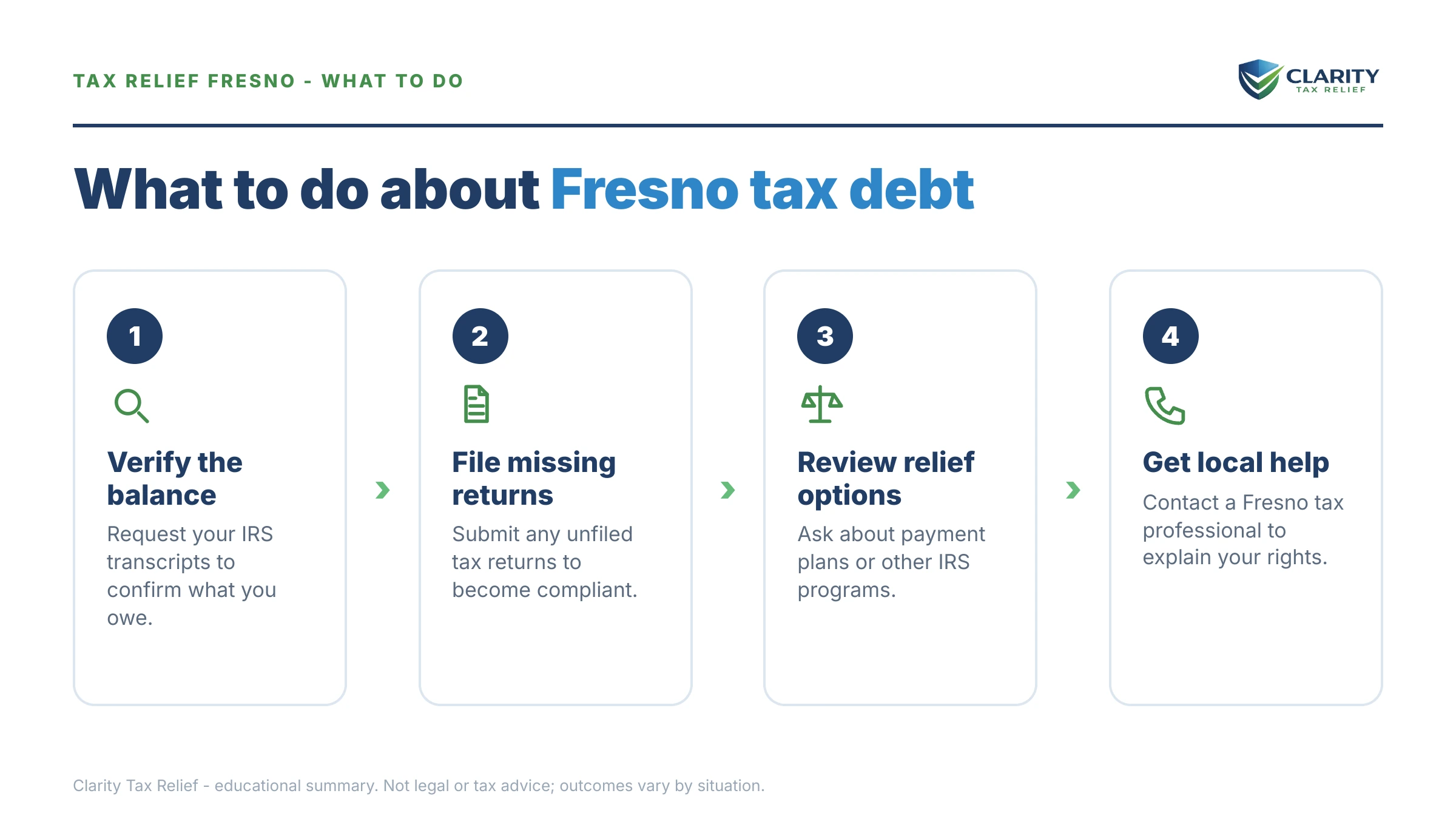
- Pull both balances — log into your IRS online account and MyFTB to see exactly what each agency says you owe, for which years, and whether a lien has been filed.
- File anything unfiled — neither the IRS nor the FTB will approve a payment plan or offer while returns are missing. Compliance comes before resolution.
- Match your balance to a program — use the amount-band table above to pick the realistic option for your IRS balance, then check the FTB's separate programs for the state side.
- Set it up before enforcement starts — IRS balances of $50,000 or less can usually be put on a plan online in one sitting. The FTB application is separate and must be done on its own.
- Request penalty relief — ask the IRS for first-time abatement if your prior three years are clean — and note the new Automatic Exemption from Penalty rolling out in summer 2026 — then pursue the FTB's own abatement process for state penalties.
When you can handle this yourself, and when help changes the outcome
Most single-agency Fresno tax debts under $25,000 can be resolved without paying anyone. If you agree with the balance, your returns are filed. The streamlined online agreement fits your budget, set it up yourself at IRS.gov and request first-time abatement by phone — an honest firm will tell you exactly that.
Experienced help earns its fee in specific situations: a garnishment or bank levy already in motion, both the IRS and FTB collecting at once, multiple unfiled years that have to be reconstructed and sequenced, business or payroll tax debt, Offer in Compromise math that has to be done right the first time, or a refinance deadline colliding with a filed lien. In those cases the order of operations — which agency first, which program, which form, before which date — changes what you ultimately pay. Fresno small-business owners juggling 941s alongside income tax should start with our guide to tax relief for small business.
Do you need a Fresno-based tax relief company?
Tax collection cases are resolved by phone, mail, and online portal, not across a desk, so the firm's zip code matters far less than its credentials. Enrolled agents, CPAs, and tax attorneys can represent you before the IRS from anywhere in the country, and before the FTB as well. What a Fresno case does demand is genuine California experience: a firm that has never worked an FTB file will miss the state half of your problem.
Whoever you consider, local or national, apply the same screen: named, credentialed people working the case. The total fee in writing before you pay. And no settlement promises before a financial review. Our how to choose a tax relief company checklist covers the exact questions, how much does tax relief cost breaks down fair pricing, and if you're comparing the big national advertisers, start with our Optima Tax Relief alternatives comparison.
Terms on your notices, decoded
- Lien vs. levy: a lien is a recorded claim against your property (what a refinance lender sees). A levy is the actual seizure of wages or bank funds.
- CSED: the Collection Statute Expiration Date — the end of the IRS's 10-year window, which can be paused by appeals, an OIC, or bankruptcy.
- R&TC §19255: the California law giving the FTB its 20-year collection window on state tax debt.
- EWOT: Earnings Withholding Order for Taxes — the FTB's wage garnishment order, sent straight to your Fresno employer.
- Subordination: the IRS agreeing (via Form 14134) to let a new mortgage jump ahead of its lien so a refinance can close.
Fresno tax relief questions, answered
Are tax relief companies that advertise in Fresno legitimate?
Some are, and some are not — the industry includes both credentialed firms and high-pressure sales operations. Check that actual enrolled agents, CPAs, or tax attorneys will work your case, get the full fee in writing before paying anything, and walk away from anyone promising a specific settlement before reviewing your finances. A legitimate firm will also tell you when you don't need them at all.
How much does tax relief cost in Fresno?
It depends on the work, not the city — a simple payment-plan setup may run a few hundred dollars, while a full Offer in Compromise or a two-agency case with unfiled returns can cost several thousand. The IRS's own fees are modest: $0 for a short-term plan and $205 to apply for an Offer in Compromise. Get any firm's total fee in writing before you sign.
Does the FTB have tax relief programs like the IRS?
Yes — the Franchise Tax Board runs its own payment plans, its own Offer in Compromise. Its own penalty-relief process, all with separate applications and separate standards. An IRS agreement does nothing for a state balance, and vice versa. The biggest difference is time: the FTB can generally collect for 20 years under R&TC §19255, roughly double the IRS's 10-year window.
Can I refinance my Fresno home if I owe back taxes?
Often, yes. If no tax lien has been filed, most lenders will close with a documented payment plan in place. If a lien has been filed, it shows on title and must be dealt with first, usually through payment, or a lien subordination on Form 14134 that lets the new loan take priority. Talk to your lender early; timing the resolution before underwriting saves the deal.
Is there still an IRS office in Fresno?
The IRS's large Fresno processing campus stopped processing paper returns in 2021, so never mail a payment or return to an old Fresno address — use the address printed on your current notice. Taxpayer Assistance Centers now work by appointment only, scheduled through the IRS's main line, and most collection cases are resolved entirely by phone, mail, or online without visiting any office.
Which should I resolve first — my IRS debt or my FTB debt?
Usually the agency closest to enforcement — a garnishment or levy in motion trumps everything else. Absent active enforcement, most Fresno taxpayers address the IRS balance first because it is typically larger and the financial documentation prepared for the IRS supports the FTB application too. But the FTB's faster collection pace means you cannot simply ignore the state while you work the federal side.
Do I need a tax attorney in Fresno, or can an enrolled agent handle it?
For collection cases — payment plans, Offers in Compromise, levy releases, penalty abatement — an enrolled agent or CPA can represent you before the IRS from anywhere in the country, and before the FTB as well. You would want a tax attorney for criminal exposure, fraud allegations, or Tax Court litigation. Credentials and collection experience matter far more than the office's zip code.
Your next 24 hours
- Find your exact balances. Log into your IRS online account and MyFTB at ftb.ca.gov, and note each agency's balance, years, and any lien indicator.
- Gather your paper. Pull your last filed federal and California returns, every IRS and FTB notice you've received. A rough picture of monthly income and expenses.
- Get your free case review. Call (888) 825-7779 or use the 2-minute form — an experienced tax professional will map both agencies' positions and the program that fits your Fresno situation. Neither balance shrinks on its own; penalties and interest accrue every month you wait.
If you'd rather work directly with the government first, the IRS's payment options live at IRS.gov/payments, and the Taxpayer Advocate Service can step in when the normal channels stall.
This guide is general information, not tax or legal advice for your specific situation. Eligibility for IRS programs depends on individual facts and circumstances; no outcome is guaranteed.