
Tax Relief by City
Tax Relief Austin: Your Real Options for IRS Debt in 2026
The short answer: tax relief in Austin almost always means resolving IRS debt — Texas has no state income tax. Your real options are federal programs: payment plans, an Offer in Compromise, hardship status, and penalty relief. Which one fits depends on how much you owe and what the IRS math says you can pay.
If you're searching for tax relief in Austin, you're likely holding an IRS notice, or watching a balance grow in your IRS online account, and wondering whether the ads promising settlement are real. Maybe the debt landed after a rough year: a divorce, a layoff, stock that vested and wasn't withheld right. The good news is that every legitimate option is a defined federal program with published rules, and this page maps all of them — including the three Texas-specific rules most Austin taxpayers get wrong.
⏱ The real clock: there's no single deadline on deciding, but the failure-to-pay penalty adds 0.5% per month and interest compounds daily until you act. And if your assessed balance is above $66,000 (the 2026 threshold), the IRS can certify your debt to the State Department and block your passport renewal until you're in a resolution.
Why Austin tax debt is almost always an IRS problem
Texas has no state income tax, so personal income tax debt in Austin is owed to exactly one agency: the IRS. There is no Texas version of California's FTB chasing your 1040 balance, no state payment plan to layer on top, and no second lien from Austin or Travis County over your income taxes. That simplifies your situation — one creditor, one set of rules — but it also means everything rides on federal law, which is less forgiving than most people assume.
The Austin economy produces tax debt in predictable ways. Tech workers get burned when RSUs vest and the employer withholds at a flat supplemental rate lower than their actual bracket. Contractors, musicians, and gig workers earn 1099 income with no withholding at all and miss quarterly payments. And divorce, one of the most common triggers we see, changes filing status, splits withholding, and often forces a retirement withdrawal to divide assets, each of which can create a five-figure surprise at filing time.
One carve-out: if you own a business, the state does come into play. The Texas Comptroller collects sales tax and franchise tax, and unpaid sales tax can follow you personally even after a business closes. That's a different problem with different rules — our guide to Texas Comptroller tax debt covers it, and business owners weighing help should start with our tax relief for small business buyer's guide. The rest of this page focuses on personal IRS debt.
“An offer in compromise allows you to settle your tax debt for less than the full amount you owe. It may be a legitimate option if you can't pay your full tax liability or doing so creates a financial hardship.”
— Offer in compromise (IRS.gov)
What happens if you ignore IRS debt in Texas
Texas creditor protections — the wage-garnishment ban, the homestead exemption — do not stop the IRS, because the IRS collects under federal law. This is the single most expensive misconception in Texas: people assume the protections that stop credit card collectors also stop federal tax collection. They don't. Here's the sequence if a balance goes unaddressed:
- CP14 and reminder notices (CP501/CP503) — bills, arriving weeks apart, each with more penalty and interest attached. No enforcement yet.
- CP504 — Notice of Intent to Levy — the IRS can now take your state tax refund (less relevant in Texas, since there's no income tax refund to take) and a federal tax lien becomes a live possibility.
- LT11 / Letter 1058 — Final Notice of Intent to Levy — this starts a 30-day clock and your Collection Due Process appeal rights. After it expires, levies are on the table.
- Enforcement — a bank levy freezes funds with a 21-day hold before the money leaves. A wage levy is continuous, hitting every paycheck until released; Social Security can be levied at up to 15% through the Federal Payment Levy Program. See how much the IRS can garnish from my paycheck — the answer in Texas is the same as everywhere else, because state law doesn't apply.
- Passport certification — at balances above $66,000, the IRS can certify your debt as "seriously delinquent," blocking passport issuance and renewal. Details in our guide to passport revoked for tax debt.
Two more Texas notes. First, a federal tax lien attaches to your homestead despite the Texas homestead exemption — forced sale of a primary home is rare and court-supervised. But the lien clouds your title the day it's filed. Second, don't count on IRS understaffing to save you: the 2025 workforce cuts made humans harder to reach. But the notices and levies above are issued by automated systems that never stopped running.
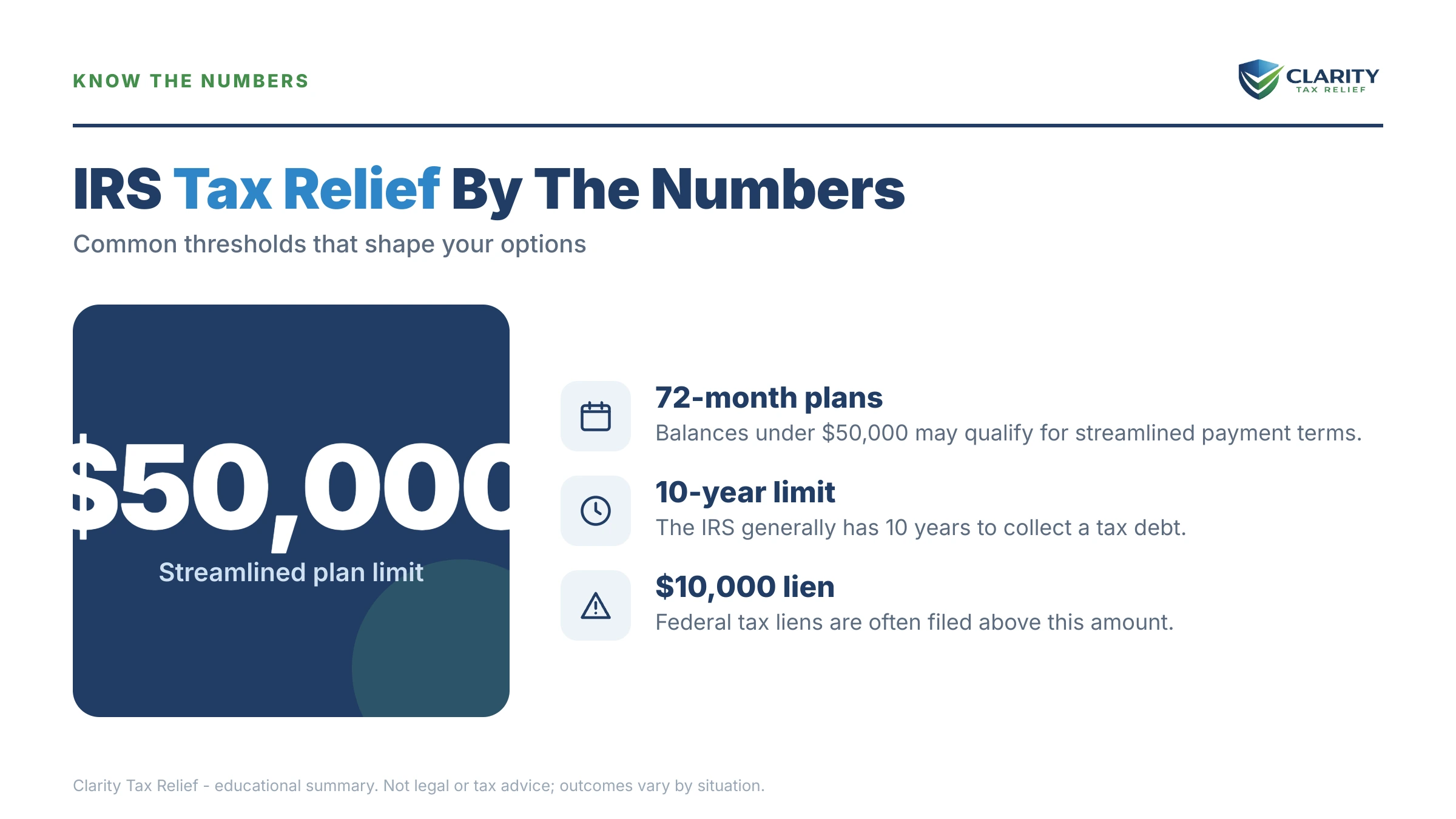
The one genuine limit on the IRS is time: it generally has 10 years from assessment to collect (the CSED), though appeals, offers, and bankruptcy pause that clock.
Facing an IRS balance in Austin?
Get your balance, transcripts, and options reviewed free by an experienced tax professional, before the automated notice sequence escalates. Interest and penalties accrue monthly either way; knowing your best program costs nothing.
Tax relief options in Austin: what you may qualify for
Every legitimate form of tax relief available in Austin is a federal IRS program with published eligibility rules — no company has access to anything special. The full DIY playbook lives in our guide on how to settle tax debt yourself. Here's the map of what exists and who each program actually fits:
| Program | Who may qualify | Cost & catch |
|---|---|---|
| Short-term payment plan | Can pay in full within 180 days | $0 setup; interest and penalties continue until paid |
| Streamlined installment agreement | Owe $50,000 or less (combined tax, penalty, interest); direct debit generally required above $25,000 | Modest setup fee; up to 72 months, set up online, no financial disclosure |
| Non-streamlined installment agreement | Owe more than $50,000 | Requires financial disclosure (Form 433-F); payment based on ability to pay — see IRS payment plan over $50,000 |
| Offer in Compromise (Form 656) | Assets + future income genuinely can't cover the debt before the CSED | $205 fee + 20% down on lump-sum offers (both waived with low-income certification, AGI ≤ 250% of poverty); ~1 in 5 accepted in FY2024 |
| Currently Not Collectible | Paying anything would leave you unable to cover basic living expenses | $0; pauses collection but the debt, interest, and lien risk remain |
| Penalty abatement | Clean compliance for the prior 3 years (first-time), or reasonable cause (illness, disaster) | $0 to request; removes penalties, not tax — see first time penalty abatement |
| Innocent spouse relief (Form 8857) | Debt caused by a spouse's or ex-spouse's errors on a joint return | $0 to request; fact-intensive — Texas community property rules add a layer |
Two of these deserve an Austin-specific note. On the Offer in Compromise, the IRS decides based on your Reasonable Collection Potential — roughly your asset equity plus a multiple of your monthly disposable income. Austin's home-price run-up cuts against many local applicants: if you own a home with six figures of equity, your RCP often exceeds the debt. An offer is dead on arrival no matter what an ad promised. If you rent or your equity is thin, the math can work. You can estimate your own offer with our Offer in Compromise Calculator before spending a dollar pursuing one.
On innocent spouse relief: because Texas is a community property state, income earned during marriage can be attributed to both spouses even on separate returns. If your debt traces to an ex's business income, gambling, or unreported earnings, relief under the innocent spouse rules, or the special community-property relief under §66 — may move the debt off your shoulders. Our guide to community property tax relief explains the tests, and divorce and IRS debt: who pays covers why your decree alone doesn't bind the IRS.
Which options are realistic at your balance
| Amount owed | Realistic paths | What changes at this level |
|---|---|---|
| Under $10,000 | Guaranteed installment agreement; short-term plan; pay in full | Approval is essentially automatic if returns are filed; professional help rarely needed |
| $10,000–$25,000 | Streamlined plan online; penalty abatement to shrink the balance | No financial disclosure; lien filing unlikely if you're in an agreement |
| $25,000–$50,000 | Streamlined plan with direct debit; OIC if finances qualify | Direct debit generally required; still no Form 433 needed |
| $50,000–$100,000 | Non-streamlined plan with Form 433-F; pay down below $50k; OIC; CNC | Financial disclosure required; passport certification risk above $66,000; lien likely without an agreement |
| Over $100,000 | Negotiated agreement, often with a revenue officer; OIC; partial-pay plans | Human collection involvement, asset review, aggressive lien policy — experienced representation earns its fee here |
A worked example: $76,400 after an Austin divorce
Say you owe $76,400 — a hypothetical Austin filer whose divorce finalized last year, leaving her with two joint-return balances plus this year's shortfall after a 401(k) withdrawal to buy out the house. Here's how the options actually price out:
- Streamlined plan (after a paydown): at $76,400 she's over the $50,000 online-plan ceiling. If she can pull together $26,500 — from the property settlement, a refinance, or savings — the balance drops to $49,900, which fits a streamlined 72-month direct-debit plan: $49,900 ÷ 72 ≈ $693/month. Interest and the 0.5% monthly penalty keep accruing, so the real payoff runs somewhat higher, but no financial disclosure is required and the IRS stops escalating.
- Non-streamlined plan (no paydown): she files Form 433-F showing income and allowable expenses, and the IRS sets a payment based on ability to pay. Slower to set up and the IRS may still file a lien, but it works when a $26,500 paydown isn't realistic.
- Offer in Compromise: if she kept the house with, say, $120,000 of equity, her Reasonable Collection Potential exceeds $76,400 and an offer fails on the math. If instead she's renting with $5,000 in assets and only $200/month of disposable income, her lump-sum RCP is roughly $5,000 + ($200 × 12) = $7,400 — a genuine OIC candidate.
- The passport wrinkle: $76,400 sits above the $66,000 certification threshold. Entering any installment agreement, streamlined or not, takes the debt out of "seriously delinquent" status and reverses certification.
- The allocation question: if a chunk of that $76,400 traces to her ex's unreported income on the joint years, innocent spouse or separation-of-liability relief could remove part of the balance entirely before she negotiates payment on the rest. Order matters: shrink the debt first, then set the plan.
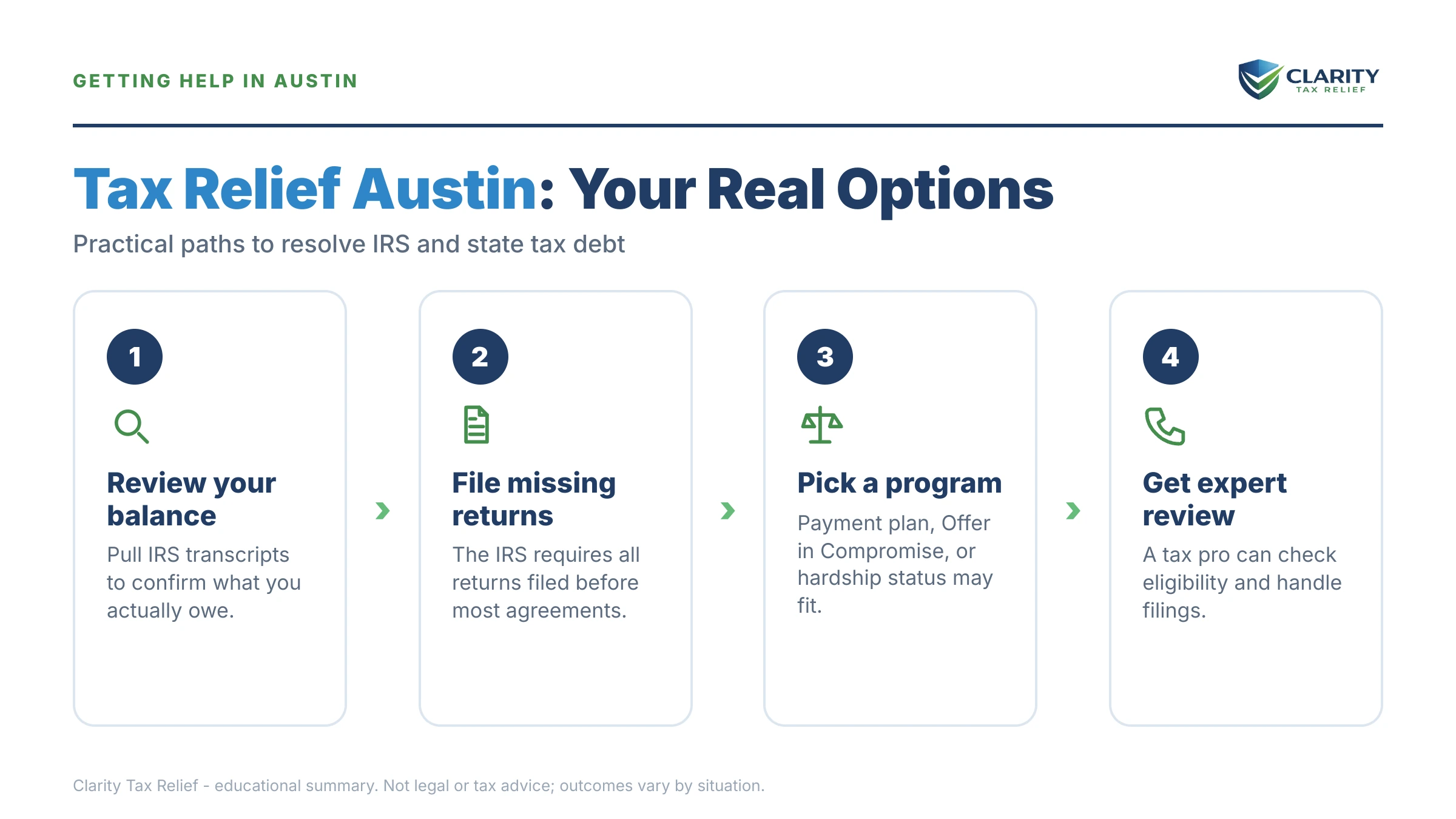
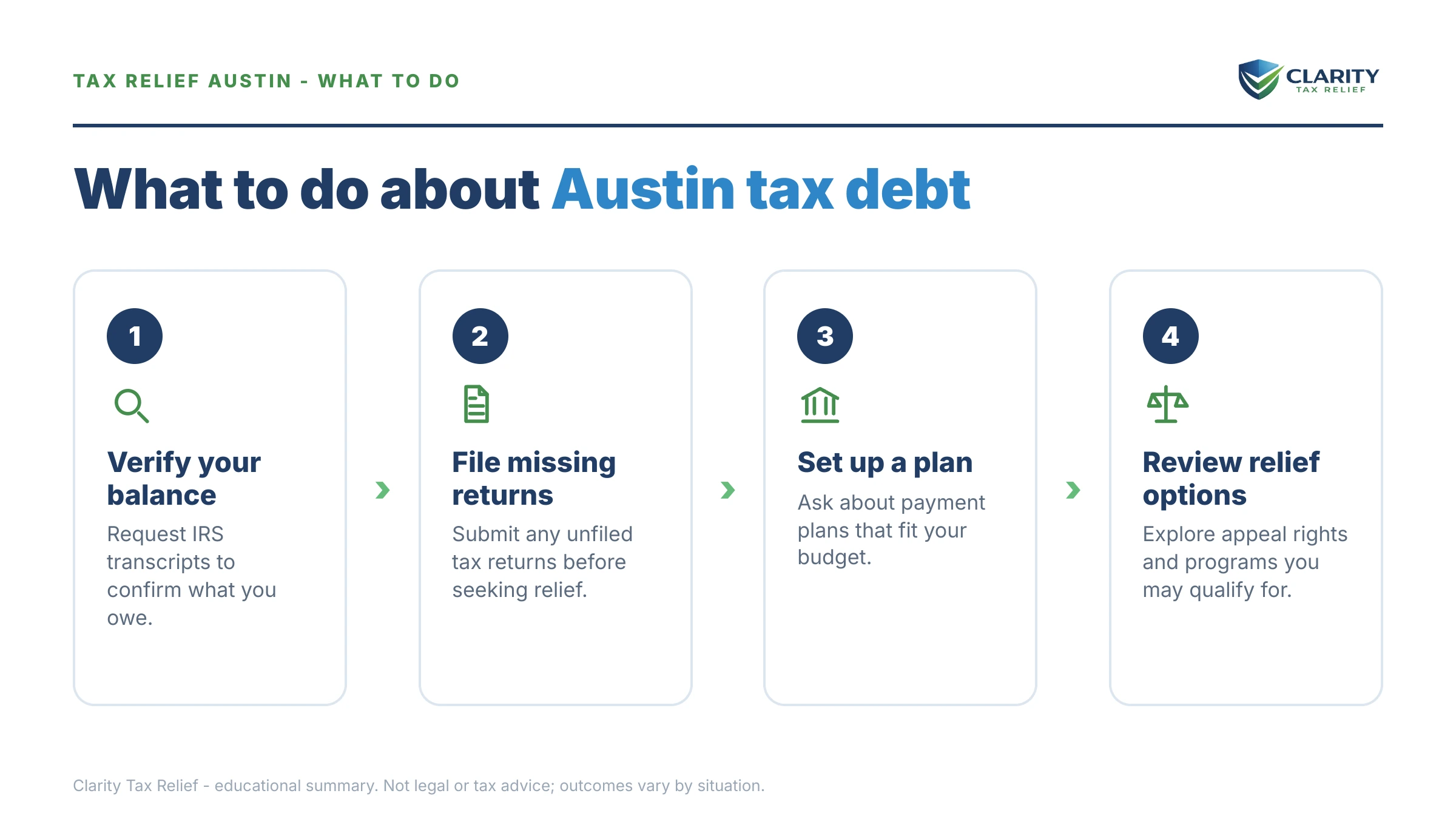
How to respond to IRS debt in Austin, step by step
- Pull your IRS records. Log into your IRS online account or request account transcripts to confirm exactly what you owe, for which years, and how much of it is penalty versus tax.
- File any missing returns. Nearly every IRS resolution program requires filing compliance first. A divorce-year return filed with the wrong status can overstate what you owe.
- Match your balance to a program. Use the options table above: under $50,000 usually points to a streamlined online plan. Over $50,000 means financial disclosure on Form 433-F or paying the balance down first.
- Set up the agreement before enforcement starts. An accepted payment plan stops the notice sequence and reverses passport certification. Waiting until a levy hits your paycheck or bank account removes your leverage.
- Request penalty relief. Once you're in an agreement, pursue first-time penalty abatement or reasonable-cause relief — removing penalties shrinks the balance that interest grows on.
When you can handle this yourself, and when Austin help pays off
Most Austin taxpayers who owe under $25,000 with all returns filed can resolve their debt online in under an hour, without paying anyone. If you agree with the balance and can afford the streamlined monthly payment, set the plan up yourself at IRS.gov and pocket the fee a firm would charge. The same goes for a first notice you agree with and can pay within 180 days.
Experienced help changes outcomes in specific situations: a levy already in motion, multiple unfiled years, balances over $50,000 where the Form 433-F presentation determines your payment, Offer in Compromise math (where one valuation mistake sinks the offer), innocent spouse and community-property cases, and any business or payroll tax debt. In those cases, the resolution you get depends heavily on how the financials are framed — which is exactly what collection-focused professionals do all day.
If you do hire someone, choose carefully. There's no shortage of national firms advertising into the Austin market, and quality varies enormously — our how to choose a tax relief company checklist covers the questions that expose weak firms, our breakdown of how much tax relief costs sets fair-price expectations, and if you're comparing the biggest advertiser, start with our Optima Tax Relief alternatives comparison. The rule of thumb: anyone who quotes a settlement number before seeing your transcripts and finances is selling, not analyzing.
Terms you'll hear, decoded
- Lien vs. levy: a lien is a legal claim on your property (including a Texas homestead). A levy is the actual taking of wages, bank funds, or assets.
- CSED: the Collection Statute Expiration Date — the IRS generally has 10 years from assessment to collect, paused by appeals, offers, and bankruptcy.
- Streamlined installment agreement: a payment plan approved without financial disclosure, available at balances of $50,000 or less over up to 72 months.
- Reasonable Collection Potential (RCP): the IRS's formula — asset equity plus a multiple of monthly disposable income — that decides whether an Offer in Compromise can be accepted.
- Currently Not Collectible (CNC): a hardship status that pauses collection when paying would leave you unable to meet basic living expenses. The debt itself remains.
- Community property: Texas's marital-property system, under which income earned during marriage can be attributed to both spouses for tax purposes — central to many post-divorce IRS cases here.
Tax relief in Austin: your questions, answered
Is tax relief legit in Austin, or is it a scam?
The programs are legitimate — they're federal IRS programs (installment agreements, Offers in Compromise, hardship status), not products any company invents. What's sometimes a scam is the marketing around them: firms promising "pennies on the dollar" before they've seen your finances. The IRS accepted roughly 1 in 5 Offers in FY2024, so anyone guaranteeing a settlement before reviewing your numbers is a red flag.
Do I owe Texas anything, or just the IRS?
For personal income tax, just the IRS — Texas has no state income tax, so there is no Texas agency chasing your 1040 balance. The exception is business owners: the Texas Comptroller collects sales tax and franchise tax, and unpaid sales tax can become a personal liability. If your debt comes purely from a personal return, every notice you receive will be federal.
Can the IRS garnish my wages in Texas?
Yes. Texas law blocks most private creditors from garnishing wages, but that protection does not apply to the IRS, which operates under federal law. An IRS wage levy in Texas is continuous — it stays on every paycheck until the debt is resolved or the levy is released — and the amount left to you is set by IRS exemption tables, not Texas law.
Does the Texas homestead exemption protect my house from the IRS?
No. The Texas homestead exemption protects your home from most private creditors, but a federal tax lien attaches to your homestead anyway. Actual seizure and sale of a primary residence is rare and requires court approval. But the lien itself clouds your title and complicates selling or refinancing until the debt is addressed.
Am I responsible for my ex-spouse's tax debt in Texas?
It depends on how the debt arose. Joint returns create joint liability no matter what your divorce decree says — the IRS is not bound by it. Texas is also a community property state, which can pull community income into the picture even on separate returns. Innocent spouse relief (Form 8857) and separation-of-liability rules can shift the debt to the spouse who caused it, if you qualify.
How much does tax relief cost in Austin?
Legitimate professional fees usually run from a few hundred dollars for a straightforward payment-plan setup to several thousand for an Offer in Compromise or a multi-year case with unfiled returns. The IRS's own charges are small by comparison — $0 for a short-term plan and a $205 application fee for an OIC, which is waived with low-income certification. Get a flat quote in writing before paying anyone.
Is there free tax relief help in Austin?
Yes, in limited situations. Low Income Taxpayer Clinics represent taxpayers below certain income limits in IRS disputes at no charge. The Taxpayer Advocate Service can step in when the IRS's process is causing hardship or isn't working as it should. Neither will negotiate a routine payment plan for you, but for hardship cases and disputes they are real, no-cost options worth checking before you hire anyone.
Should I hire a local Austin CPA or a national tax relief firm?
Hire based on collections experience, not zip code. IRS collection cases are resolved by phone, mail, and online. There is no in-person advantage, and the Austin Taxpayer Assistance Center handles account questions by appointment, not negotiations. A local CPA who touches two collection cases a year may be a worse fit than a remote team that handles them daily. Ask any candidate how many installment agreements and Offers they completed last year.
Your next 24 hours
- Find your exact balance. Log into your IRS online account (or pull out your most recent notice) and write down the total owed and the tax years involved — the number decides which programs are open to you.
- Gather three things: your last filed return, every IRS notice you've received. Your current income and monthly expense figures — post-divorce numbers, not the old household's.
- Get a free case review. Call (888) 825-7779 or use the 2-minute form and an experienced tax professional will map your balance to the right program, before another month of penalties and interest is added to it.
Primary sources: the IRS's official payment plans and installment agreements page, the IRS payments hub, the Taxpayer Advocate Service, and, for business taxes, the Texas Comptroller of Public Accounts.
This guide is general information, not tax or legal advice for your specific situation. Eligibility for IRS programs depends on individual facts and circumstances; no outcome is guaranteed.