
City Tax Relief Guides
Tax Relief in Billings, Montana: Your Real Options in 2026
Read the transcript
Host: You're in Billings, you've got an IRS balance you can't pay, and every ad you click promises to make it go away. So let's do the map version instead. Where do we start?
Tax specialist: Start with the fact that you probably answer to two collectors, not one. The IRS, and the Montana Department of Revenue. Separate rules, separate timelines. People lump them together and it costs them.
Host: Okay, but before the programs — the article makes a big deal about the notices. Why?
Tax specialist: Because the notice code you're holding tells you how close enforcement is. It's a ladder. CP14 is the first bill, roughly 21 days to respond, no enforcement behind it at all. Then CP501, then CP503. Those are reminders. Still just bills.
Host: CP501 and CP503. And then it changes?
Tax specialist: CP504 is where it changes. Notice of intent to levy. At that point the IRS can take your Montana state refund, and lien risk goes up.
Host: Wait. It can grab the state refund before it can touch my paycheck?
Tax specialist: Yes. There's a program for exactly that, the State Income Tax Levy Program, and it typically kicks in once CP504 has gone out. Paycheck comes later, at the final notice.
Host: Which is which letter?
Tax specialist: LT11, or Letter 1058. Same stage, two different letterheads. That one starts a 30-day clock, and inside those 30 days you can file Form 12153 to request a Collection Due Process appeal. After the 30 days, wage garnishment and bank levies are on the table.
Host: Form 12153. Say what that actually does, simply.
Tax specialist: It puts your case in front of Appeals and pauses the levy track while that's pending. It doesn't erase the balance. It buys you a forum and some time.
Host: Hm. And if a levy already landed?
Tax specialist: Bank levy holds the funds 21 days before they go to the IRS. A wage levy is continuous — every payday until it's released. Social Security can be hit up to 15 percent.
Host: Alright. Programs. There are five main ones?
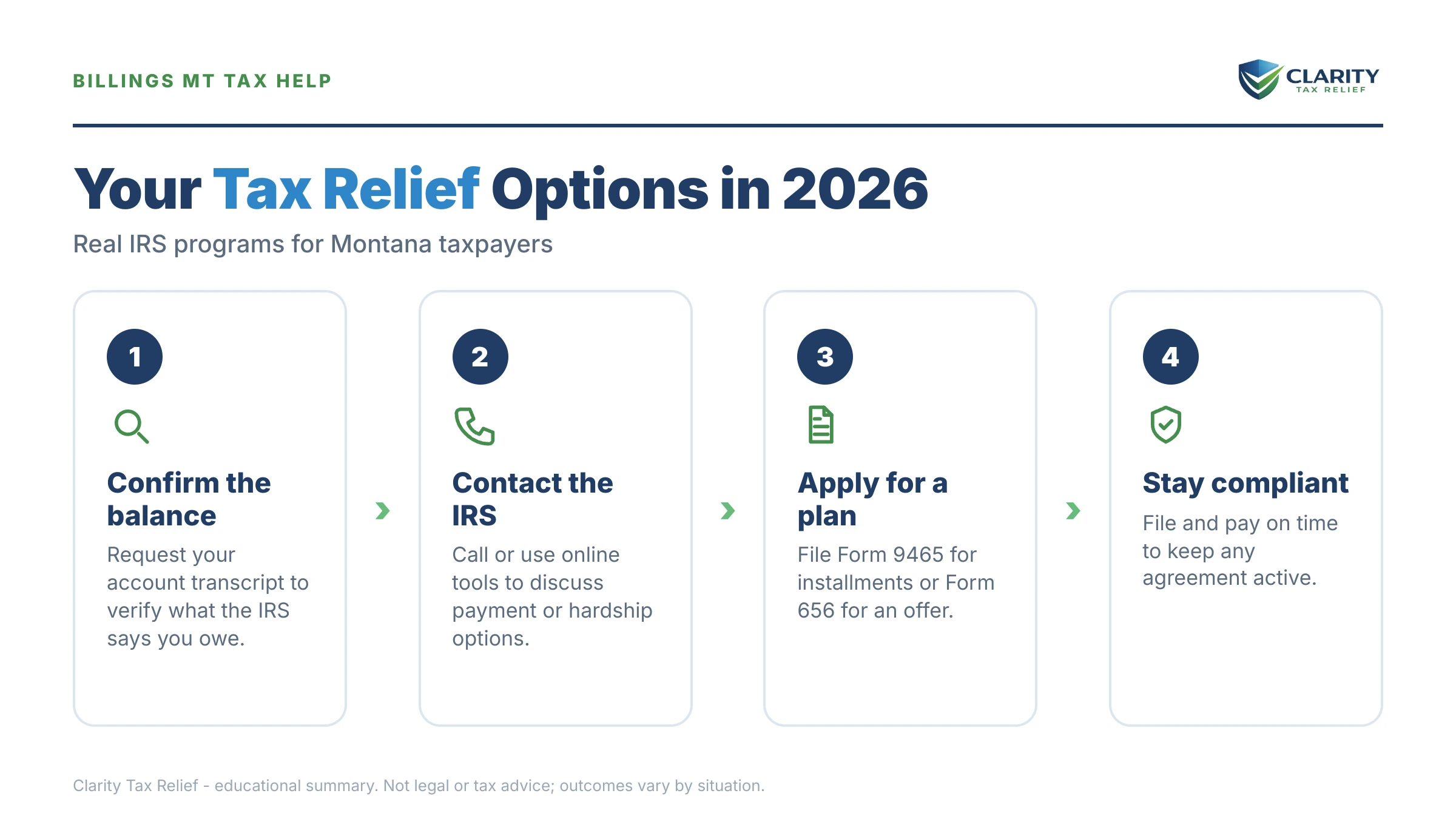
Tax specialist: Roughly, and here's the part that matters — eligibility is set by dollar thresholds and financial disclosure. Not by how well somebody argues on the phone. Short-term plan if you can pay in full within 180 days, no setup cost. There's the Guaranteed Installment Agreement, which is for ten thousand or less if you're current on filings, and it has to be paid inside three years.
Host: Guaranteed Installment Agreement — that's the actual name of the IRS program, not a promise anyone's making.
Tax specialist: Correct. It's the name in the statute. Then streamlined — fifty thousand or less, up to 72 months, you can set it up online. Above fifty thousand, you're into financial disclosure. Form 433-F, and the IRS sets the payment from your budget.
Host: So fifty thousand is the wall.
Tax specialist: It's the wall. There's also Currently Not Collectible — that's for when paying anything would create genuine hardship. Costs nothing, but you have to prove the finances, the debt stays there, liens are still possible, and the status gets reviewed.
Host: And the Offer in Compromise. The one everybody's heard of.
Tax specialist: Decided by a formula. Reasonable Collection Potential. Your asset equity, plus a multiple of your monthly disposable income. If that number covers the debt, the offer gets rejected regardless of who filed it. Roughly one in five were accepted in fiscal year 2024.
Host: One in five.
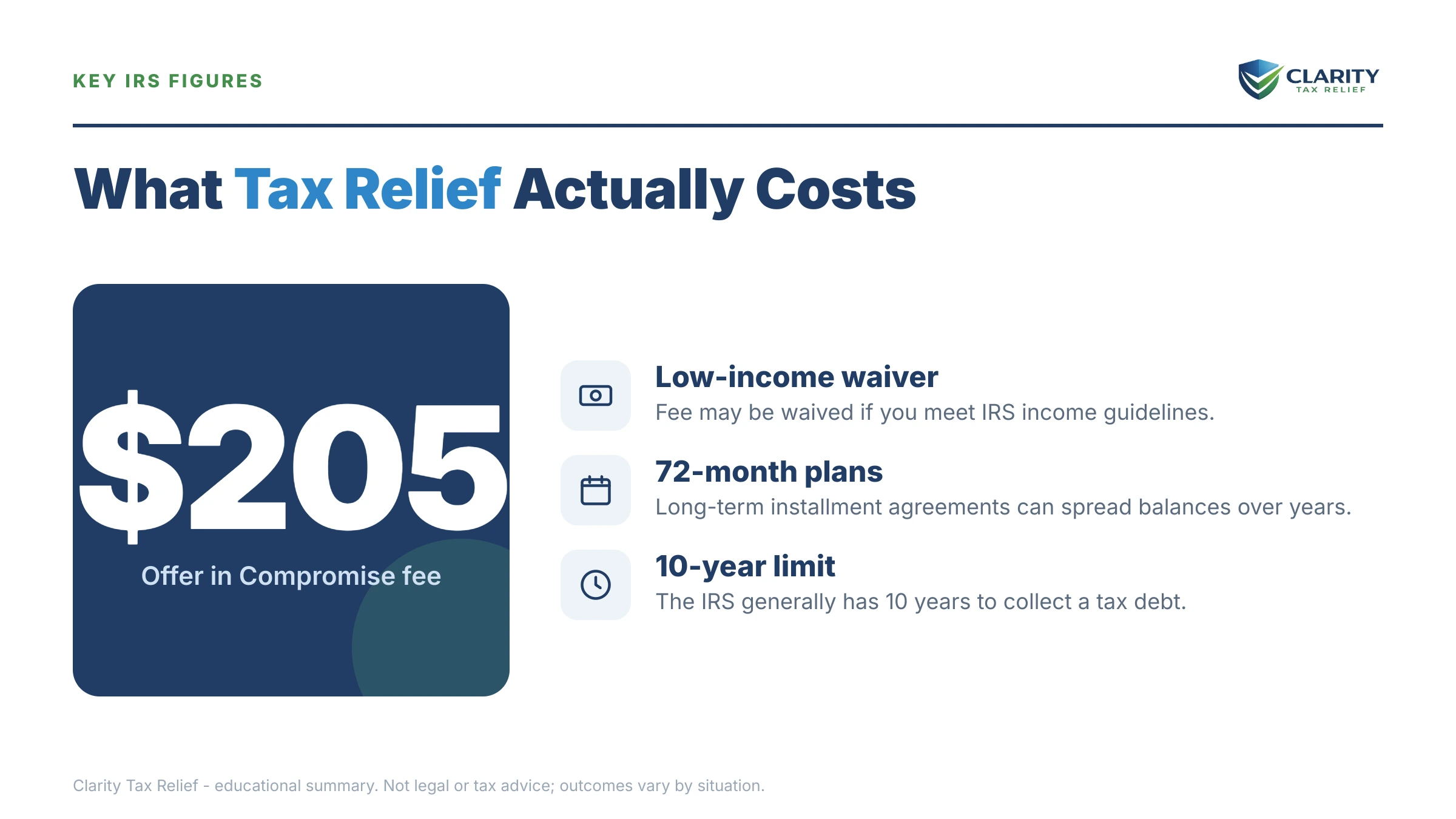
Tax specialist: One in five. Fee's 205 dollars plus 20 percent down, and that's waived for low-income filers — the certification is adjusted gross income at or below 250 percent of the poverty line.
Host: Let's do the example, because I think the numbers land harder than the theory.
Tax specialist: Sixty-one thousand two hundred, spread across three joint tax years after a divorce. You're above the streamlined line, so the online 72-month plan isn't available as-is. Two doors. Pay it down by eleven thousand three hundred to get to forty-nine nine. That sets up online around 693 a month, and real payoff runs higher because interest keeps accruing. Or keep the full balance and file the Form 433-F financials.
Host: And an offer on that?
Tax specialist: Depends entirely on equity. If the divorce left you with, say, forty-five thousand of equity in the house you kept, the collection potential likely exceeds the debt before future income is even counted. If you kept little equity and your income barely covers allowable expenses, the math can flip the other way. That's why you run the calculation before you spend the application fee.
Host: Okay, and — actually, back up. You said joint returns. My decree says he pays it.
Tax specialist: The IRS wasn't a party to your decree. Both signers are liable for the full balance. But there are two programs most articles skip. Innocent spouse relief, for tax your ex understated without your knowledge. And separation of liability, which for divorced or separated filers can split a joint balance so you're only on the portion tied to your own income and deductions.
Host: Both on Form 8857?
Tax specialist: Both on Form 8857, and both have time limits. Which is why in a divorce case they belong at the front, not after you've already signed up for a plan on the whole balance. In the example, if forty thousand traces to the ex's unreported side income, a granted claim could leave you resolving about twenty-one two, and that fits streamlined, around 295 a month.
Host: And doing nothing costs what?
Tax specialist: Failure-to-pay is half a percent a month, interest compounds daily. On sixty-one two, the penalty alone is about 306 dollars a month. That pushes the balance past the 2026 passport-certification threshold of sixty-six thousand in well under two years.
Host: Passport. Explain that.
Tax specialist: Once a federal balance crosses that threshold, the IRS can certify it to the State Department, which can deny or revoke a passport. A payment problem turns into a travel problem.
Host: What about the penalty side? Anything free on the table?
Tax specialist: First-time abatement, if your prior three years were clean it can remove a year's penalties. Often one phone call. And starting summer 2026 the IRS's Automatic Exemption from Penalty begins applying similar relief automatically, no request needed. Note it removes penalties, not the underlying tax.
Host: Montana side. Quickly.
Tax specialist: None of the IRS numbers carry over. Not the 72 months, not the ten-year collection statute. The department will generally work on payment arrangements, but the criteria and windows are its own. Get their current terms from them directly, because a state levy landing mid-way through a federal plan wrecks the budget the plan was built on.
Host: And that ten-year federal clock. It pauses sometimes?
Tax specialist: It pauses during a pending offer, certain appeals, and during bankruptcy. Bankruptcy sits outside what we handle here, so that's a conversation for your own counsel.
Host: Last thing — how does someone tell a real firm from a mill?
Tax specialist: One question. Ask what happens if the review shows you don't need them. A straight answer sounds like: this is a 20-minute IRS phone call, go do it. A mill signs you up anyway. And be wary of a settlement percentage quoted before anyone has looked at your transcripts.
Host: So next 24 hours.
Tax specialist: Log into your IRS online account or pull the newest notice. Write down the total balance, the tax years, and the last notice code. That code is your position on the ladder. Then gather your last filed return, every IRS and Montana letter, and if divorce is part of it, the decree plus anything showing whose income created the debt.
Host: And confirm the returns are filed, right? Because—
Tax specialist: Right, that's the gate. The IRS won't approve any plan or any offer while a required return is missing. Filing compliance first, always.
Host: Then call for the free case review — (888) 825-7779, or the two-minute form. Someone pulls your records, checks the Montana side, and maps the order of operations before you sign anything. Penalties and interest keep running until a resolution is in place. The review doesn't.
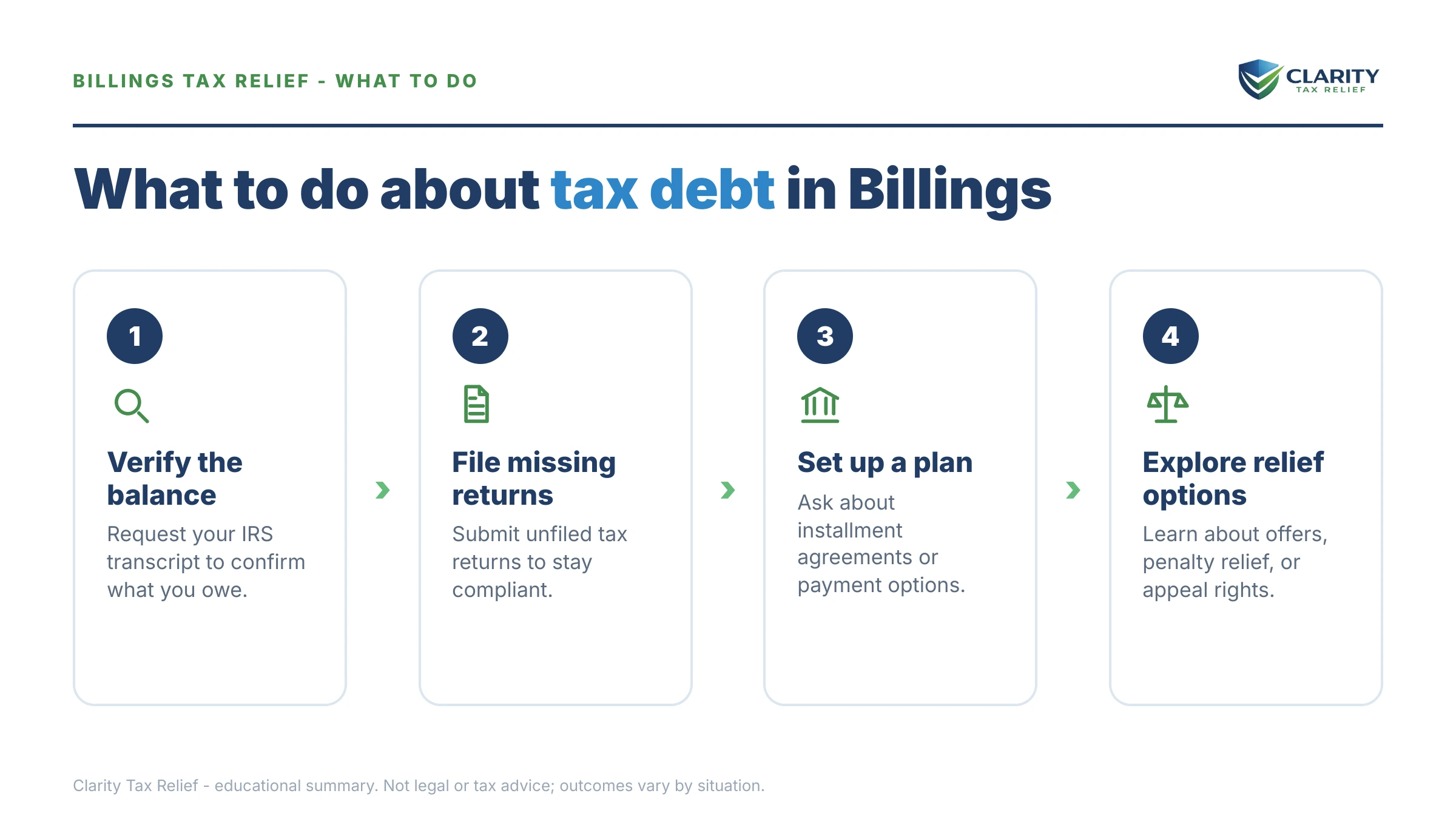
The short answer: tax relief in Billings works through the same federal programs the IRS runs everywhere — payment plans, hardship status, penalty relief, and (for a minority) an Offer in Compromise — plus separate arrangements with the Montana Department of Revenue for state debt. Which one fits depends on your income, assets, and filing history.
Maybe the divorce is final, the house in the Heights is refinanced into your name, and then the IRS letter arrives: the balance from the joint returns belongs to both of you, decree or not. Or maybe a year of 1099 work — oilfield, construction, travel nursing — landed with no withholding behind it. Either way, searching for tax relief in Billings puts you in front of a wall of national ads making promises no one can keep. This page is the map instead: every real program, its actual threshold, and the order to work them in.
⏱ The real clock: there's no single deadline on an unresolved tax debt, but the failure-to-pay penalty adds 0.5% every month, and interest compounds daily on top of it, until a resolution is in place. Every month of waiting makes the same debt cost more to fix.
Why Billings taxpayers end up owing
Billings taxpayers answer to two separate tax collectors: the IRS and the Montana Department of Revenue. Most people searching this query owe one or both for a handful of predictable reasons, and the reason shapes which relief program fits.
Divorce is one of the most common triggers. A joint return makes both signers liable for 100% of the balance. The IRS is not bound by what your decree says about who pays. That fight is covered in detail in divorce and IRS debt: who pays. Withholding problems compound it: the year you switch from married-filing-jointly to single, the same paycheck often covers less of your actual tax.
Self-employment is the other big driver here. Contractors, ranch operations, healthcare travelers, and owner-operators around Yellowstone County get paid on 1099s with nothing withheld. A missed year of quarterly estimates becomes a five-figure bill by the next April. If the debt sits inside a business — payroll, contractors, multiple entities — start with tax relief for small business, because business debt follows different rules than personal debt.
One more thing worth saying plainly: "tax relief" is not a secret government forgiveness program. It's the set of real IRS and state procedures below, and the honest version of each is more useful than any ad.
“An offer in compromise allows you to settle your tax debt for less than the full amount you owe. It may be a legitimate option if you can't pay your full tax liability or doing so creates a financial hardship.”
— Offer in compromise (IRS.gov)
What happens if you ignore a tax debt in Billings
The IRS collection sequence moves through four notice stages before it can reach your paycheck or bank account, and in 2026 that sequence is fully automated. The IRS workforce shrank roughly 27% in 2025, which makes a human harder to reach, but the notice-and-levy machine never stopped running. Ignoring the mail doesn't slow it down; it just spends your response windows.
- First bill (CP14) — the balance, penalties, and interest, with roughly 21 days to respond. No enforcement yet; the cheapest moment to act.
- Reminders (CP501, then CP503) — still just bills, arriving weeks apart while the balance grows monthly.
- Notice of Intent to Levy (CP504) — the IRS can now seize your Montana state tax refund. A federal tax lien becomes a live risk.
- Final Notice (LT11 / Letter 1058) — starts a 30-day clock and your Collection Due Process appeal rights (requested on Form 12153). After the 30 days, wage garnishment and bank levies are on the table.
- Enforcement — a bank levy freezes funds for 21 days before they're sent to the IRS. A wage levy is continuous until released; Social Security can be levied up to 15%.
| Stage | What it can do | Your window |
|---|---|---|
| CP14 first bill | Nothing yet — it's a bill | Typically 21 days from the notice date |
| CP501 / CP503 reminders | Balance keeps growing; no enforcement | The "pay by" date printed on each notice |
| CP504 intent to levy | Seize your Montana state refund; lien risk rises | The date on the notice (typically 30 days) |
| LT11 / Letter 1058 final notice | Opens the door to wage and bank levies | 30 days to pay, arrange, or file Form 12153 |
| Levy in force | Bank funds held 21 days; wage levy continuous | Release requires a resolution or hardship showing |
Two quieter consequences run alongside the notices. Refunds, federal and Montana, get captured every year until the debt resolves. And once your federal balance crosses $66,000 (the 2026 threshold), the IRS can certify the debt to the State Department, which can deny or revoke your passport — details in passport revoked for tax debt.
Owe the IRS or Montana from Billings and not sure which program fits?
Get a free case review before the next notice moves your case up the ladder. An experienced tax professional will pull your IRS records, check the Montana side, and map your real options — penalties and interest keep accruing every month a balance sits unresolved.
Tax relief options for Billings, Montana taxpayers
The IRS runs five main resolution programs, and eligibility for each is set by dollar thresholds and financial disclosure, not negotiation skill. Here's the full menu with the numbers that decide which door is open to you.
| Program | Who typically qualifies | Setup cost | Watch out for |
|---|---|---|---|
| Short-term payment plan | Can pay in full within 180 days | $0 | Interest and penalties still accrue |
| Guaranteed installment agreement | Owe $10,000 or less, current on filings | IRS setup fee applies | Must pay within 3 years |
| Streamlined installment agreement | Owe $50,000 or less — up to 72 months, set up online | Fee varies; lower with direct debit | Default if you miss payments or new filings |
| Non-streamlined agreement | Over $50,000 — requires financial disclosure | Fee plus Form 433-F review | IRS sets the payment from your financials |
| Currently Not Collectible | Paying anything would create genuine hardship | $0 (financial proof required) | Debt remains; liens possible; status is reviewed |
| Offer in Compromise | Assets + future income genuinely can't cover the debt | $205 fee + 20% down (waived for low-income filers) | Roughly 1 in 5 accepted in FY2024 |
| Penalty relief (FTA / AEP) | Clean compliance the prior 3 years, or reasonable cause | $0 | Removes penalties, not the underlying tax |
A few notes the table can't hold. On the settlement route, the IRS decides an Offer in Compromise by computing your Reasonable Collection Potential. Your asset equity plus a multiple of your monthly disposable income. If that number covers the debt, the offer gets rejected no matter who files it. If it doesn't, a well-documented offer has a real shot. You can estimate your own number with our Offer in Compromise Calculator before spending a dime. Low-income certification (AGI at or below 250% of the poverty line) waives the fee, the 20% down payment, and payments during review.
On penalties: first-time abatement can wipe a year's penalties if your prior three years were clean, and starting in summer 2026, the IRS's new Automatic Exemption from Penalty (AEP) begins applying similar relief automatically, with no request needed. Don't pay penalties that qualify for removal.
Divorce adds two programs most articles skip. Innocent spouse relief can remove your liability for tax your ex understated without your knowledge. Separation of liability relief goes further for divorced or separated filers: it can split a joint balance so you owe only the portion attributable to your own income and deductions. Both are filed on Form 8857 and both have time limits, so they belong at the front of a post-divorce case, not the end.
Say you owe $61,200 after a divorce: the math
Say you're recently divorced in Billings and the IRS shows $61,200 across three joint tax years. Here's how the options actually price out — hypothetical numbers, real thresholds.
- Payment plan: at $61,200 you're above the $50,000 streamlined line, so an online 72-month plan isn't available as-is. Two paths: pay the balance down by $11,300 to $49,900 — which sets up online at roughly $49,900 ÷ 72 ≈ $693 a month (interest keeps accruing, so real payoff runs higher) — or keep the full balance and submit Form 433-F financials for a payment plan over $50,000, where the IRS sets the payment from your budget.
- Offer in Compromise: if the divorce left you with, say, $45,000 of equity in the house you kept, your Reasonable Collection Potential likely exceeds $61,200 before future income is even counted — an offer would almost certainly be rejected. If you kept little equity and your income barely covers allowable expenses, the math can flip. This is why the calculation comes before the application fee.
- Separation of liability: if $40,000 of that balance traces to your ex's unreported side income, a granted Form 8857 claim could leave you resolving only your own ~$21,200 — which fits a streamlined plan at about $295 a month.
- Do nothing: at 0.5% per month, the failure-to-pay penalty alone adds about $306 a month, plus daily-compounding interest. That pushes $61,200 past the $66,000 passport-certification threshold in well under two years — turning a payment problem into a travel problem.
Montana state tax debt: the Department of Revenue side
The Montana Department of Revenue collects state income tax debt under its own rules — none of the IRS thresholds, timelines, or programs on this page apply to a Montana balance. Montana has no general sales tax, so for most Billings individuals the state exposure is income tax; business owners may also face withholding obligations.
The department will generally work with taxpayers on payment arrangements, but its criteria and windows are its own. Don't assume an IRS figure — like the 72-month plan or the 10-year collection statute — applies to Montana debt. Get the state's current terms directly from the department (linked below) or have whoever handles your IRS case coordinate both, because a state levy landing mid-way through a federal payment plan can wreck the budget the plan was built on. When you owe both, the sequencing question, which balance to attack first, usually turns on which agency is closer to enforcement.
How to choose tax relief help in Billings
Nearly every tax relief company advertising to Billings works cases remotely, from offices in other states, so you're choosing on substance, not proximity. That's not a problem by itself; IRS resolution is done by phone, mail, and upload everywhere. It does mean the vetting checklist matters more than the area code.
Before paying anyone, run the full checklist in how to choose a tax relief company, and screen against the tax relief red flags that repeat in every enforcement action: settlement percentages promised before anyone has seen your transcripts, "pennies on the dollar" pitches, pressure to pay a large fee today, and vague answers about who, by name and credential, will actually work your case. If you've been quoted by one of the big national brands, the Optima Tax Relief alternatives comparison shows what to weigh a quote against. And know the honest baseline for how much tax relief costs: a simple payment plan should never be priced like an Offer in Compromise with three unfiled years attached.
The one-question test: ask what happens if the review shows you don't need them. A legitimate firm will tell you when a 20-minute IRS phone call solves your problem. A mill signs you up anyway.
When you can handle this yourself
You do not need professional help for a first bill you agree with and can pay within 180 days. Plenty of Billings tax problems are genuinely DIY:
- You owe under $25,000, agree with the amount, and just need a monthly plan — the online setup takes minutes. The walkthrough in how to settle tax debt yourself covers every screen.
- You're due first-time penalty abatement — a single phone request often handles it.
- Your income is modest and the debt is small — a Low Income Taxpayer Clinic may represent you at no cost. The Taxpayer Advocate Service can help when the IRS itself is the obstacle.
Experienced help changes outcomes in specific situations: a levy already in motion, multiple unfiled years, a balance over $50,000 where the IRS demands financials, business or payroll debt, an Offer in Compromise where the RCP math is close, or a divorce case where innocent-spouse and separation-of-liability claims have to be sequenced with a payment plan. In those cases the order of operations — returns first, penalty relief second, balance resolution third — routinely changes what you pay.
How to start tax relief in Billings, step by step
- Pull your IRS records. Set up an IRS online account and confirm every year with a balance, the total assessed, and where you sit in the notice sequence.
- Confirm every required return is filed. The IRS will not approve any payment plan or offer while a required return is missing — filing compliance comes first.
- Check the Montana side. Contact the Montana Department of Revenue or review its correspondence so a state levy doesn't blindside your federal plan.
- Match your finances to one program. Run the Form 433-F math on your income, allowable expenses, and equity to see whether a payment plan, hardship status, or an offer fits.
- Get a free case review before you commit. Call (888) 825-7779 or use the 2-minute form so an experienced tax professional can confirm the right program and sequence before you sign anything.
The primary sources worth bookmarking: the IRS's official payment plans and installment agreements page for current terms and fees, the Montana Department of Revenue for anything on a state balance, and the Taxpayer Advocate Service if an IRS process has stalled and is causing you harm.
Tax relief in Billings: your questions answered
Is there an IRS office in Billings, Montana?
Yes — the IRS operates a Taxpayer Assistance Center in Billings. But it works by appointment only and staff there cannot negotiate settlements on the spot. Most resolutions, including payment plans and Offers in Compromise, are handled online, by mail, or by phone. Check irs.gov for the current Billings location and book an appointment before showing up.
Does Montana have tax relief programs like the IRS?
The Montana Department of Revenue runs its own collection process and will generally work with taxpayers on payment arrangements. But its rules, timelines, and thresholds are not the same as the IRS programs. Never assume an IRS figure applies to a Montana balance. Contact the department directly, or have your representative handle both debts in one coordinated plan.
Can the IRS garnish wages in Billings?
Yes. After a final notice of intent to levy (LT11 or Letter 1058) and the 30-day window that follows, the IRS can order your employer to withhold part of every paycheck. A wage levy is continuous until it is released. Only a portion of your pay is exempt, based on your filing status and dependents — the rest goes to the IRS each payday.
Am I responsible for tax debt from returns I filed with my ex-spouse?
If you signed a joint return, the IRS holds both spouses liable for the full balance. Your divorce decree does not change that, because the IRS was not a party to it. Two programs can shift liability: innocent spouse relief and separation of liability, which can divide a joint debt between divorced spouses. Both require applying on Form 8857 with supporting facts.
How much does tax relief cost in Billings?
The IRS's own fees are modest: short-term payment plans cost nothing to set up. An Offer in Compromise carries a $205 application fee that is waived for low-income filers. Professional fees vary with case complexity — unfiled years, state debt, and settlement work cost more than a simple payment plan. Be wary of any firm quoting a large flat fee before reviewing your transcripts.
Will the IRS settle my tax debt for pennies on the dollar?
Almost certainly not. That phrase is marketing, not a program. The IRS accepted roughly 1 in 5 Offers in Compromise in fiscal year 2024, and acceptance depends entirely on a formula comparing your assets and future income to the debt. If the math shows you can pay in full over time, no firm can settle it for less, no matter what its ads promise.
Can the IRS take my Montana state tax refund?
Yes. Through the State Income Tax Levy Program, the IRS can intercept your Montana refund and apply it to your federal balance. This typically begins once a CP504 notice has been issued. Montana can also offset refunds for its own debts. If you owe both agencies, expect refunds to be captured until a resolution is in place.
How long can the IRS collect a tax debt in Montana?
Generally 10 years from the date the tax was assessed — the Collection Statute Expiration Date, or CSED — and Montana residency doesn't change it. But the clock pauses during bankruptcy, a pending Offer in Compromise, and certain appeals, so the real end date is often later than the 10-year mark. Montana's own collection window for state debt runs on separate state rules.
Your next 24 hours
- Find your real numbers. Log into your IRS online account (or pull out the most recent notice) and write down the total balance, the tax years. The last notice code you received. That code tells you how close enforcement is.
- Gather three things: your last filed return, every IRS and Montana Department of Revenue letter you have, and, if divorce is part of the story, your decree and anything documenting whose income created the debt.
- Get the free case review. Call (888) 825-7779 or use the 2-minute form and an experienced tax professional will map your Billings case, federal and state, to the right program. Penalties and interest accrue monthly until a resolution is in place, so the review costs nothing and waiting doesn't.
This guide is general information, not tax or legal advice for your specific situation. Eligibility for IRS programs depends on individual facts and circumstances; no outcome is guaranteed.