
Gig Economy Tax Debt
DoorDash Driver Owes Taxes: What to Do About the Debt in 2026
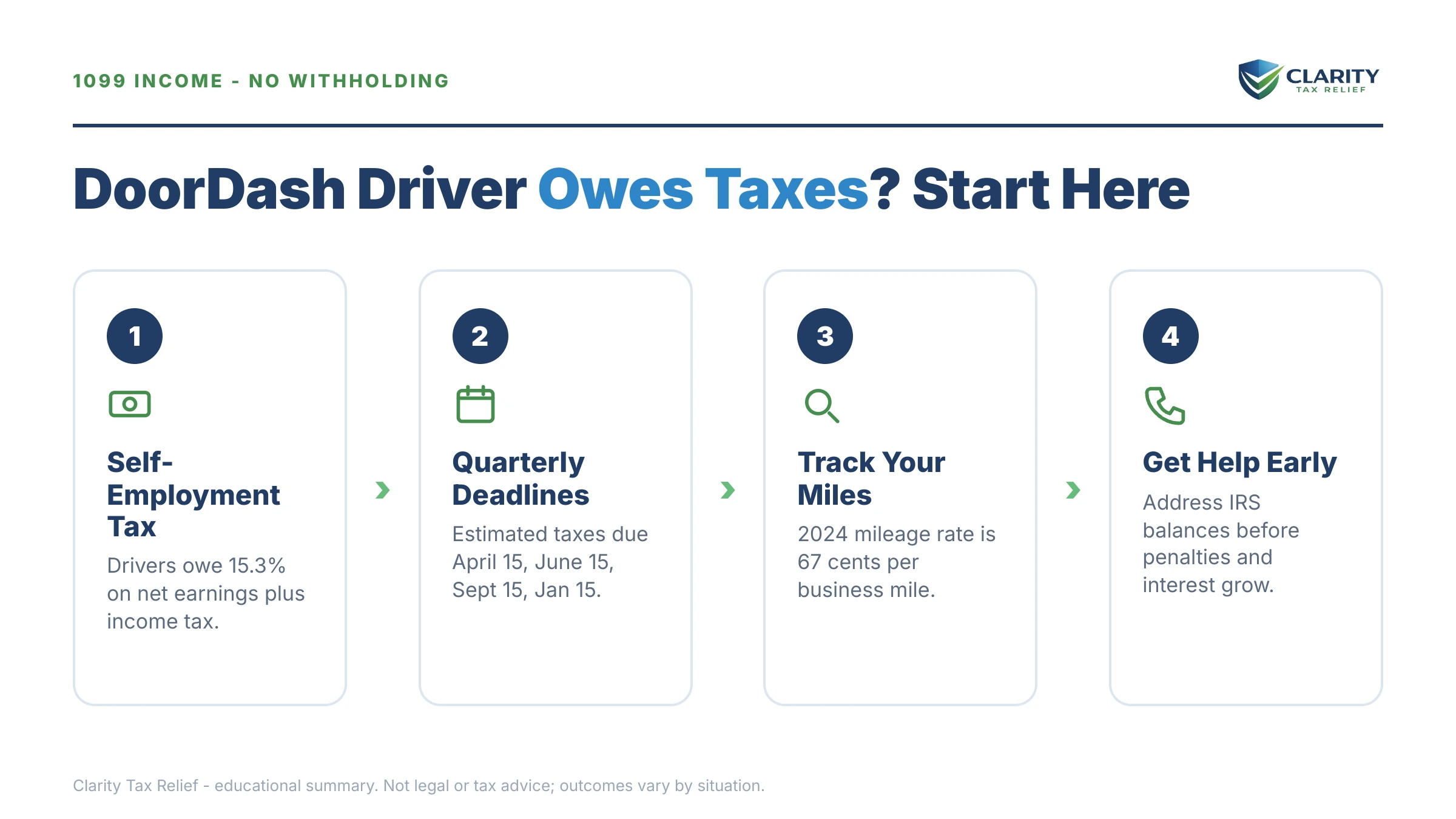
The short answer: if you're a DoorDash driver who owes taxes, the debt exists because DoorDash withheld nothing. You owe 15.3% self-employment tax plus income tax on your net profit. File any missing returns first, then set up an IRS payment plan before the notices reach levy stage.
You dashed nights and weekends all year, the app deposited every payout in full, and it felt like the money was yours. Then the return came back with a balance you never saw coming, and now the IRS letters are stacking up while rent is due on the first. This is one of the most common debts the IRS collects, and every piece of it has a fix.
Most Dashers in this spot are staring at a Form 1099-NEC and can't reconcile it with what actually hit their bank. The image below shows exactly what the 1099-NEC DoorDash files looks like and where to find the number driving your bill — worth a close look before you do anything else, because that figure is your gross pay, not your profit.
⏱ Your clock: if an LT11 or Letter 1058 is in your pile, you have 30 days from the date printed on that notice to request a Collection Due Process hearing before the IRS can levy your bank account or your Dasher pay. No final notice yet? The clock is still running — penalties and interest accrue every month the balance sits.
Why DoorDash drivers owe taxes: the app withholds $0
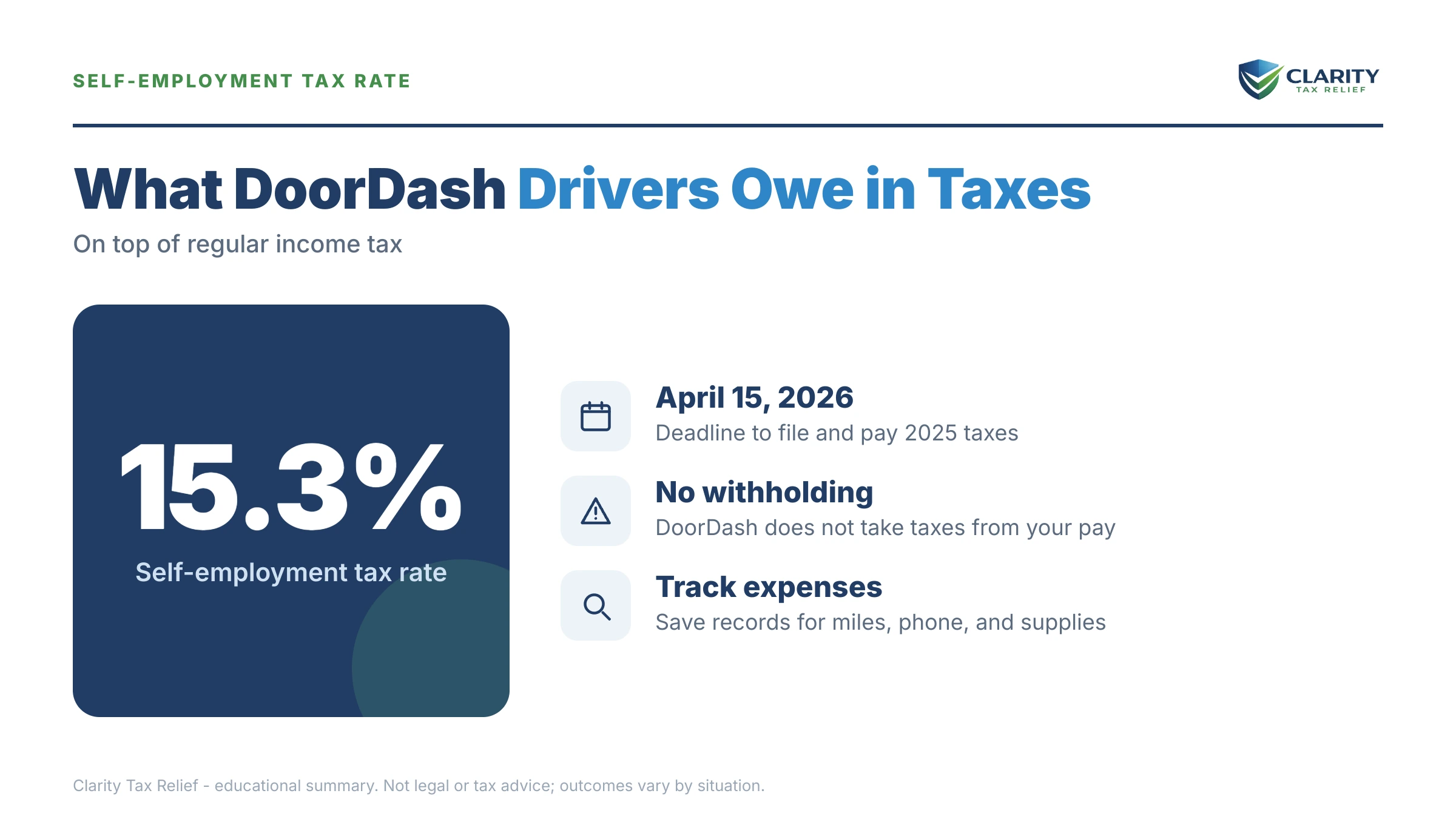
DoorDash withholds nothing from your payouts because Dashers are independent contractors, and contractors owe 15.3% self-employment tax on net profit before income tax even starts. A W-2 employer would have paid half of that and withheld the rest from every paycheck. As a Dasher, both halves are yours, reported on Schedule SE.
Three DoorDash-specific traps make the bill bigger than it had to be:
- The 1099-NEC reports gross pay. DoorDash files a 1099-NEC with the IRS showing everything it paid you, before gas, before miles, before your phone plan. If you filed without a Schedule C full of deductions, you paid tax on money you spent driving. And unlike marketplace sellers who hide behind the 1099-K's $20,000 threshold, Dasher pay gets reported to the IRS on the NEC regardless.
- No quarterly payments. Self-employment tax is due four times a year, not once in April. Skip the quarterlies and an underpayment penalty stacks on top of the tax itself — the mechanics are in our guide to how quarterly estimated taxes work.
- Untracked miles. Mileage is almost always a Dasher's largest deduction, and delivery drivers rack up far more deductible miles than most gig workers because every trip between restaurants and drop-offs counts. If you never kept a log, the deduction often isn't lost — see didn't track miles doordash taxes for how to reconstruct one the IRS will accept.
The same anatomy applies whether you dash full-time or stack apps — the details shift slightly for grubhub driver taxes and lyft driver back taxes. But the engine of the debt is identical: gross-reported income, zero withholding, missed quarterlies.
“Short-term payment plan: You owe less than $100,000 in combined tax, penalties and interest. If you are a sole proprietor or independent contractor, apply for a payment plan as an individual.”
— Online payment agreement application (IRS.gov)
What happens if you ignore DoorDash tax debt
Unpaid gig tax debt ends in a levy that can freeze your bank account and intercept the money DoorDash owes you on the day the levy is served. The path there is a fixed, automated sequence of notices, and in 2026, with the IRS workforce down roughly 27%, the humans are harder to reach but the automated notices and levies never paused.
- CP14 — the first bill, typically giving you about 21 days (10 business days when the balance is $100,000 or more) before the system queues the next notice.
- CP501 / CP503 — reminder bills. No enforcement yet, but the balance grows monthly.
- CP504 — notice of intent to levy your state tax refund under IRC §6331(d). Serious, but not the final notice.
- LT11 / Letter 1058 — the final notice. A 30-day clock starts, along with your right to a Collection Due Process hearing via Form 12153.
- Levy — after the 30 days, the IRS can freeze your bank account or serve a levy on DoorDash itself.
Two levy details matter specifically to a renter who dashes for a living:
Your bank account is the soft target. You don't own a house for a lien to sit on, so the IRS reaches for what it can see: the checking account your payouts land in. When a bank levy hits, the bank freezes the balance and holds it for 21 days before sending it to the IRS — including the rent money sitting there on the 28th. That hold window is your one chance to get the funds back. Our guide to the IRS bank levy 21 days rule covers exactly how a hardship release works.
Your Dasher pay can be levied too, but differently than a paycheck. Because you're a 1099 contractor, a levy served on DoorDash grabs only what DoorDash owes you at that moment, rather than running continuously like a W-2 wage garnishment. The catch: the IRS can serve fresh levies over and over. The full mechanics are in irs levy independent contractor.
| Notice | What it means | Your window |
|---|---|---|
| CP14 | First bill for the balance due | Typically 21 days from the notice date (10 business days when the balance is $100,000 or more) |
| CP501 / CP503 | Reminder bills; penalties and interest still accruing | No enforcement yet — cheapest time to act |
| CP504 | Intent to levy your state tax refund (§6331(d)) | State refund at risk; not yet the final notice |
| LT11 / Letter 1058 | Final notice of intent to levy | 30 days to request a CDP hearing (Form 12153) |
| Levy | Bank freeze or levy served on DoorDash | Bank funds held 21 days before transfer — the release window |
IRS letters piling up over your DoorDash taxes?
If an LT11 is in the stack, the 30-day window to protect your bank account and Dasher pay is already running. An experienced tax professional will review your notices free and map the fastest way to stop a levy — no pressure, no obligation.
Your options when you can't pay the DoorDash tax bill
A DoorDash tax debt under $10,000 qualifies for a guaranteed installment agreement — the IRS must accept it if you're compliant and can pay the balance within three years. That's the official program name, not a promise about your outcome, and it's just one of several paths. The full DIY playbook for each lives in our pillar guide on how to settle tax debt yourself. Here's how the options line up for a typical Dasher balance:
| Option | Who qualifies | Cost & effect |
|---|---|---|
| Short-term payment plan | Anyone who can pay in full within 180 days | $0 setup; interest and 0.5%/mo penalty continue, enforcement stops |
| Guaranteed installment agreement | Balance ≤ $10,000, returns filed, payoff within 3 years | Setup fee applies; IRS must accept; no financial disclosure |
| Streamlined online payment plan | Balance ≤ $50,000; up to 72 months | Setup fee (lower with direct debit); set up online, no Form 433 |
| Currently Not Collectible | Paying anything would leave you unable to cover rent, food, utilities | $0; collection pauses, debt and interest remain, levies stop |
| Offer in Compromise | Means-tested — assets + future income can't cover the debt | $205 fee + 20% down (both waived if AGI ≤ 250% of poverty level) |
| Penalty relief (FTA / AEP) | Clean compliance the prior 3 years | $0; removes penalties, and starting summer 2026, the new Automatic Exemption from Penalty applies without a request |
Two option-specific notes for gig drivers. First, Currently Not Collectible status is realistic when dashing income barely covers rent — the IRS compares your income to allowable living expenses. A lean gig year often passes the test. Second, an offer in compromise is real but means-tested: the IRS accepted roughly 1 in 5 offers in FY2024. It says yes only when the math shows it could never collect the full balance. Nobody can promise you a settlement, and anyone who does before seeing your finances is selling, not advising.
Worked example: a Dasher who owes $6,200
Say you owe $6,200 from a year of full-time dashing — a hypothetical, but a common shape. Here's how a bill like that gets built: roughly $30,000 in net profit generates about $4,240 in self-employment tax (30,000 × 92.35% × 15.3%), plus roughly $2,000 in income tax after the standard deduction. Skip the quarterlies and file late, and penalties push the total past $6,200 fast. You can estimate what's accrued on your own balance with our IRS Penalty & Interest Calculator.
Now the resolution math on that $6,200:
- 180-day short-term plan: $0 setup. The 0.5%/month failure-to-pay penalty (~$31/month) plus interest keeps running, but levies stop the day it's approved.
- Guaranteed installment agreement: $6,200 over 36 months is roughly $172/month, and the IRS must accept it because the balance is under $10,000.
- 72-month streamlined plan: roughly $86/month — easier on a lean dashing budget, though accruing interest means the real payoff runs somewhat longer.
- If even $86 breaks the budget: CNC pauses collection entirely while you get back on your feet — the debt waits, but so do the levies.
One more lever: if this is your first missed year after three clean ones, first-time abatement, or the new automatic exemption replacing it — can strip the penalties off that $6,200 before you ever set up the plan. Details in our first time penalty abatement guide.
How to respond when you owe the IRS from DoorDash, step by step
- Confirm the damage. Log into your IRS online account to see every year with a balance, what DoorDash reported, and which notices have gone out.
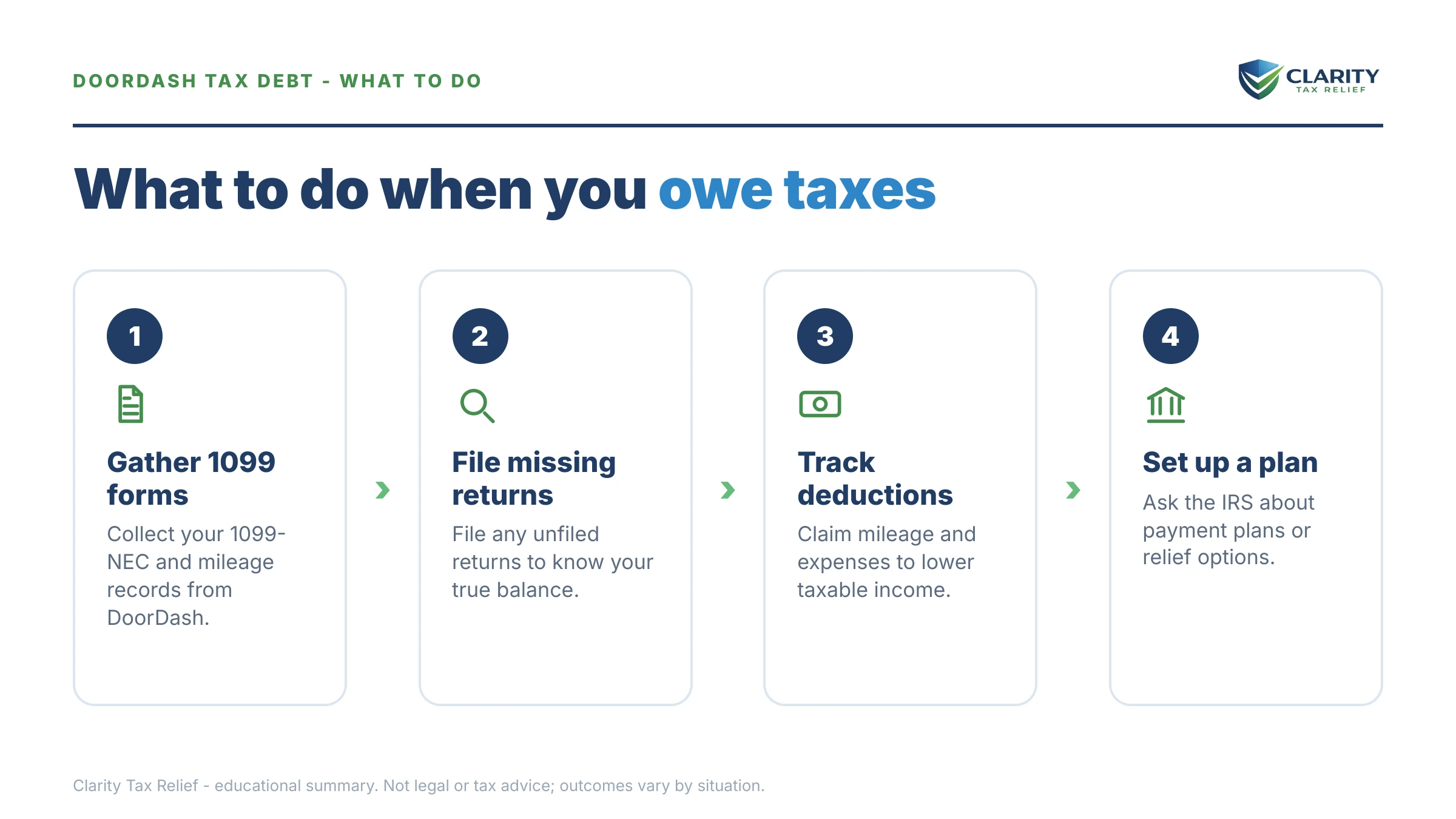
- File any missing returns. The failure-to-file penalty (5% per month) is 10 times the failure-to-pay penalty (0.5% per month) — filing stops the biggest bleed even if you can't pay a dime.
- Protect your levy rights. If an LT11 or Letter 1058 is in your stack, mail Form 12153 within 30 days of its date to request a Collection Due Process hearing and pause levy action.
- Set up the resolution that fits. Pick the payment plan, hardship status, or offer that matches your balance and budget from the table above, and put it in place before the next notice lands.
- Plug the leak going forward. Start a mileage log today, set aside 25–30% of net profit, and make quarterly estimated payments so next April doesn't rebuild the debt.
That last step is the one that keeps you off this page next year. The set-aside percentage and the withholding trick for Dashers with a W-2 day job are covered in side hustle taxes how much to save.
When you can handle this yourself, and when help changes the outcome
Most single-year DoorDash debts under $10,000 are genuinely a do-it-yourself fix. If you've filed the return, you agree with the balance, and no final notice has arrived, setting up a payment plan online takes about 20 minutes and needs no professional. The same goes for a short-term plan you can clear within 180 days.
Experienced help earns its cost in four situations: a levy is already in motion and the 21-day bank hold or a served DoorDash levy needs an emergency release. You have multiple unfiled years and the IRS may have filed substitute returns without your mileage deduction. You're rebuilding a mileage log to amend a return and materially shrink the debt. Or your finances genuinely fit the offer-in-compromise math, where the forms and valuation rules decide the result. In those cases the order of operations — returns first, penalties second, balance last — changes what you ultimately pay.
Terms on your notices, decoded
- 1099-NEC — the form DoorDash files with the IRS reporting your gross pay for the year. It shows what you were paid, not what you profited.
- Self-employment tax — the 15.3% Social Security and Medicare tax contractors pay on net profit, calculated on Schedule SE.
- Schedule C — the form where your dashing income and expenses (miles, phone, hot bags) meet. Its bottom line is what you're actually taxed on.
- Levy vs. lien — a levy takes money (bank funds, Dasher pay). A lien is a legal claim against property that secures the debt without taking anything yet.
- CDP rights — your right to a Collection Due Process hearing after a final notice, which pauses levy action while an appeals officer reviews your case.
- CSED — the collection statute expiration date: the IRS generally has 10 years from assessment to collect, though appeals, offers, and bankruptcy pause the clock.
DoorDash tax debt questions, answered
Why do DoorDash drivers owe so much in taxes?
Because DoorDash withholds nothing and Dashers owe self-employment tax on top of income tax. Self-employment tax alone is 15.3% of your net profit — money a W-2 employer would have split with you and withheld all year. Add income tax, skipped quarterly payments, and penalties, and a modest dashing year can produce a four- or five-figure bill. Untracked mileage makes it worse, because your single biggest deduction goes unclaimed.
Can the IRS take my DoorDash earnings directly?
Yes. The IRS can serve a levy on DoorDash and take the money DoorDash owes you on the day the levy arrives. Because you're a contractor, that levy is one-time — it grabs what's payable at that moment rather than running continuously like a W-2 wage garnishment — but the IRS can serve new levies again and again until you set up a resolution. It can only do this after sending a final notice, usually an LT11, and letting 30 days pass.
Can the IRS take my bank account for DoorDash tax debt?
Yes, after it has sent a final notice of intent to levy and 30 days have passed. When a bank levy hits, your bank freezes the balance and holds it for 21 days before sending it to the IRS. That 21-day hold is your window: proving the levy takes money you need for rent, utilities, or food can get it released for economic hardship, and setting up a payment plan can stop the next one.
What if I never got a 1099 from DoorDash?
Your dashing income is taxable whether or not a form reached your mailbox. DoorDash files its copy of the 1099-NEC directly with the IRS, so the government usually knows the number even when you don't. Pull your earnings history from the Dasher app or your bank deposits, and request your IRS wage and income transcript to see exactly what was reported before you file or fix a return.
Can I still claim mileage if I didn't keep a log?
Often yes. You can reconstruct a reasonable mileage record instead of forfeiting the deduction. The Dasher app's delivery history, Google Maps timeline data, oil-change records, and odometer readings can rebuild a defensible log, and mileage is usually a Dasher's largest deduction by far. This matters most if you're amending a return or answering the IRS about an old year. Our guide on rescuing gig deductions when you didn't track miles walks through the reconstruction step by step.
Do DoorDash drivers qualify for an offer in compromise?
Only if the math works — an offer in compromise is means-tested, not a discount program. The IRS accepted roughly 1 in 5 offers in FY2024. It says yes only when your assets and future income genuinely can't cover the debt before the collection statute runs out. A low-income Dasher with no assets can be a real candidate. The $205 application fee and 20% down payment are waived if your AGI is at or below 250% of the poverty level.
How much should I set aside from DoorDash pay for taxes?
A safe rule for most Dashers is 25–30% of net profit, earnings minus mileage and other expenses, moved to a separate account every payout. Then send four estimated payments a year so the balance never builds. If dashing is a side gig on top of a W-2 job, you can instead raise the withholding at your day job to cover the gig tax, which avoids the quarterly deadlines entirely.
Your next 24 hours
- Find your newest IRS notice and check the top-right corner for the notice number and date. If it says LT11 or Letter 1058, count 30 days from that date — that's your levy-protection deadline.
- Gather three things: your DoorDash 1099-NECs (in the Dasher app or Stripe Express), your last filed return. A rough monthly budget — rent, car, phone, food. Every option above starts from these.
- Get a free case review. An experienced tax professional will tell you which years are actually owed, whether your mileage can shrink the debt, and which plan stops the levy risk — use the 2-minute form or call (888) 825-7779. If a final notice is in your stack, do this before the 30-day window closes.
Official references: the IRS's payment options are at IRS.gov/payments, plan details at the IRS payment plans page, and if a levy is causing hardship you can't resolve through normal channels, the Taxpayer Advocate Service is an independent path inside the IRS.
This guide is general information, not tax or legal advice for your specific situation. Eligibility for IRS programs depends on individual facts and circumstances; no outcome is guaranteed.