
IRS Notices
IRS CP92 Notice: The IRS Levied Your State Tax Refund, What to Do in 2026
The short answer: a CP92 notice means the IRS already levied, took, your state tax refund and applied it to federal back taxes. It also starts a 30-day clock to request a Collection Due Process hearing on Form 12153. Miss it, and the IRS can move on to your wages and bank accounts.
You filed your state return, watched the refund tracker for weeks, and the money never came. Instead, an IRS envelope did — telling you your state refund was seized for a federal balance you may have thought was still in "we'll figure it out later" territory. It isn't, but this is the exact moment where it's still cheap and simple to fix.
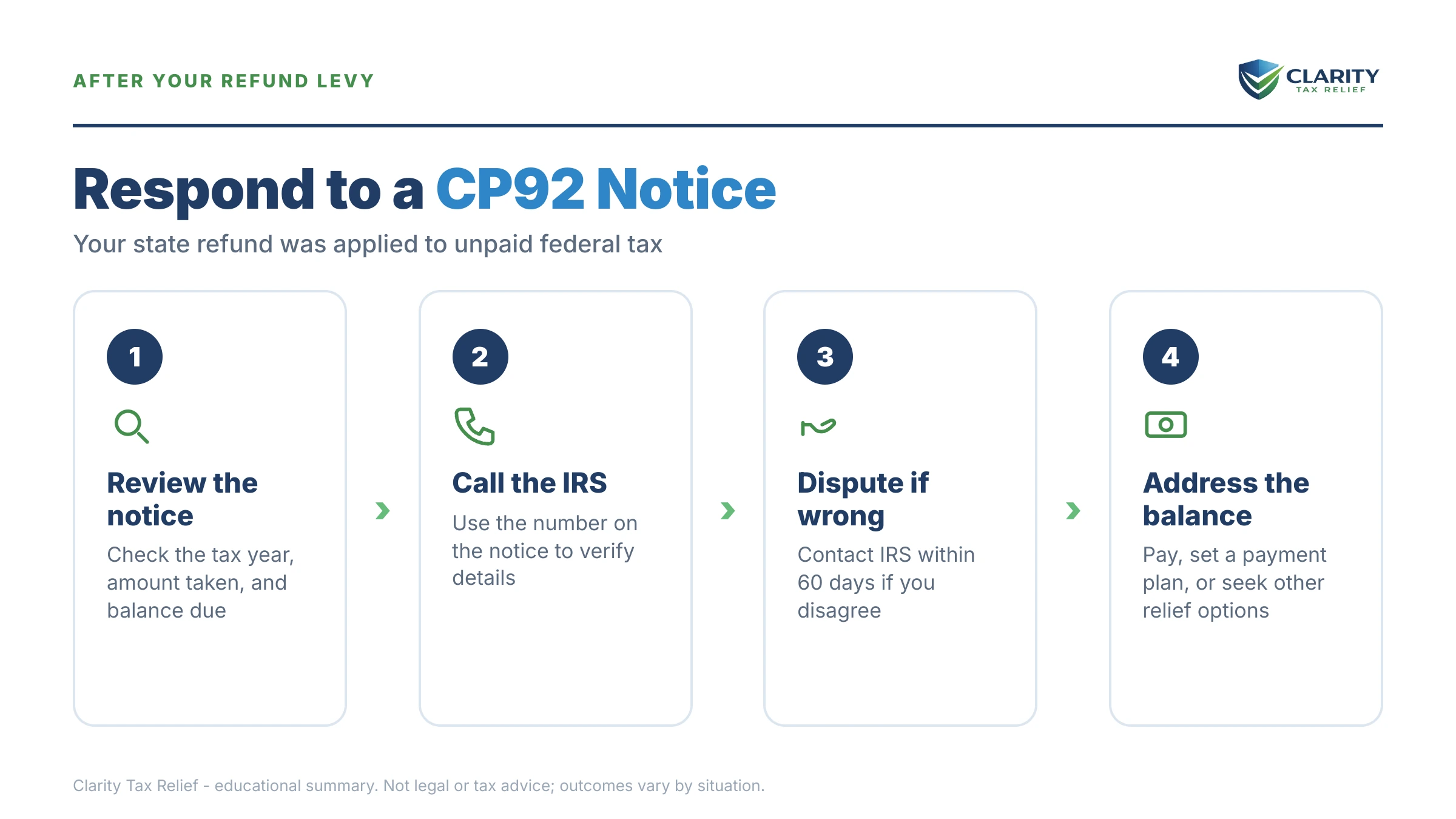
A CP92 is unusual among IRS notices in one important way: it reports an action that already happened. Most collection letters warn; this one confirms. The image below shows what a CP92 looks like and where to find the two numbers that matter — the amount taken from your refund and the deadline to request a hearing.
⏱ Your deadline: you have 30 days from the date on your CP92 to request a Collection Due Process hearing using Form 12153. That date is printed on the notice itself. After day 30, the IRS can levy other property — wages, bank accounts — for the tax years listed without sending you another hearing notice first.
Why you got a CP92 notice
A CP92 notice is issued when the IRS intercepts your state income tax refund through the State Income Tax Levy Program (SITLP) and applies it to a federal tax debt. Your state revenue agency didn't make a mistake. It forwarded your refund to the IRS because federal law requires it to honor the levy.
Here's the sequence that led here. Months ago, a CP504 notice warned that the IRS intended to levy your state refund under IRC §6331(d). Federal law contains a specific exception that lets the IRS take a state refund before offering you a hearing — most levies require the hearing offer first. That exception is why the CP92's hearing right arrives after the money is already gone, not before.
Your CP92 shows the tax year involved, the exact amount levied from your state refund. The balance that remains after the levy was applied. That remaining number, not the original debt, is what you're solving for now. For general background on how IRS letters work and why they arrive in a fixed order, see why did I get a letter from the IRS.
“If your federal payments, state income tax refund, or Alaska Permanent Fund Dividend have been levied, this section will give you information on who to call and what to do to resolve the problem.”
— Levy (IRS.gov)
What makes the CP92 different from every notice before it
The CP92 is the first notice in your case that carries formal Collection Due Process (CDP) rights — the same appeal rights an LT11 notice grants. That makes it legally heavier than the CP504 that preceded it, even though the CP504 sounds scarier.
The practical consequence: for the tax years listed on your CP92, this notice satisfies the IRS's legal duty to offer you a hearing before levying your other property. If the 30 days pass without a Form 12153, the IRS does not need to send another hearing notice before levying your paycheck or bank account for those years. Many people file the CP92 away as "old news — the refund's already gone" and are blindsided when a wage levy follows. The refund seizure is the past; the hearing deadline is the live issue.
What happens if you ignore a CP92
Ignoring a CP92 converts a small, contained levy into open season on your wages and accounts. The escalation is automated and runs in this order:
- Days 1–30: your CDP window is open. You can request a hearing, dispute the debt, or set up a resolution — all enforcement alternatives are still on the table.
- Day 30 passes: your CDP rights for the listed years expire. You can still request an "equivalent hearing" within one year. But you lose the right to take a disagreement to Tax Court. The equivalent hearing doesn't block levy action while it's pending.
- Bank levy: the IRS can freeze the funds in your account, which are held for 21 days before they're sent to the Treasury — your one narrow window to get a levy released.
- Wage levy: unlike a bank levy, a wage levy is continuous — it attaches to every paycheck until the debt is paid or the levy is released. You can estimate what a wage levy would leave you with using our IRS Wage Garnishment Calculator.
- Other federal payments: if you receive Social Security, up to 15% can be taken through the Federal Payment Levy Program. Future state and federal refunds keep getting intercepted every year the balance survives.
Through all of this, the balance grows: the failure-to-pay penalty adds 0.5% per month and interest compounds on top. In 2026, IRS staffing is down roughly 27%, reaching a human is harder than ever, but the levy systems are automated and never paused. The machine escalates on schedule whether or not anyone reviews your file.
Holding a CP92 with the 30-day clock running?
Send us a photo of it. An experienced tax professional will confirm what was taken, what's left, and whether a hearing request or a direct resolution is the smarter move — free, before your Form 12153 window closes.
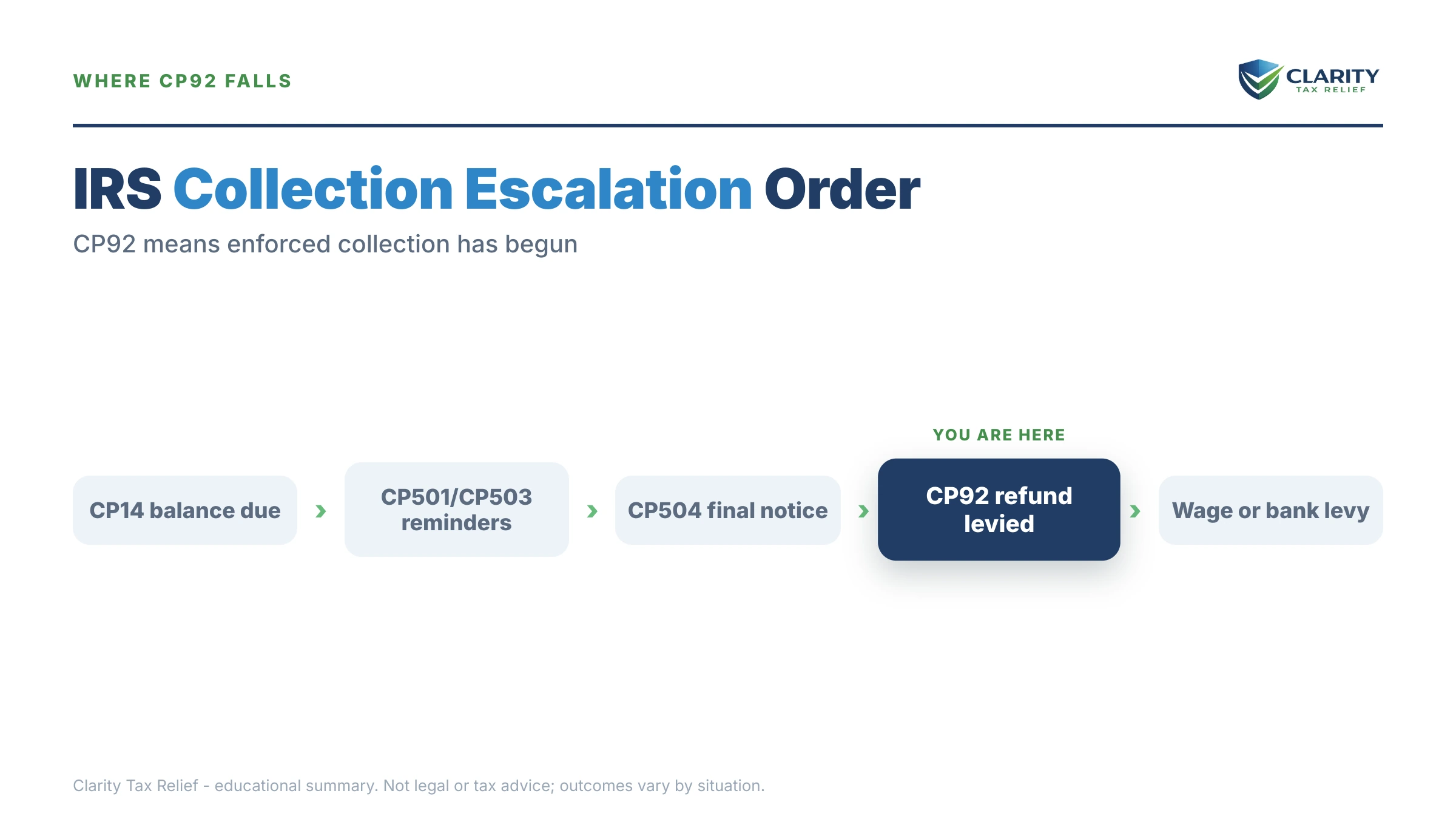
Where the CP92 sits in the IRS levy sequence
A CP92 rarely arrives out of nowhere — it's the confirmation step in a chain that started with your first bill. Here's the full sequence and the window each notice gives you:
| Notice | What it means | Your window |
|---|---|---|
| CP14 | First bill for the balance due | Typically 21 days from the notice date |
| CP501 / CP503 | Reminder bills — no enforcement yet | The pay-by date printed on each notice |
| CP504 | Intent to levy your state tax refund | 30 days before the refund can be taken |
| CP92 | State refund seized + CDP hearing rights granted | 30 days to file Form 12153 |
| Bank / wage levy | Enforcement on other property for the listed years | Bank funds held 21 days; a wage levy runs until released |
Two close cousins worth knowing: the CP91 Social Security levy notice is the parallel warning for benefit income, and if a federal refund was kept instead of a state one, that's an offset — a different mechanism covered in our guide to a state refund taken for IRS debt.
Your options for the remaining balance
The refund levy almost never clears the whole debt. The CP92 itself only offers "pay now." The IRS actually runs several resolution programs — which one fits depends on your balance and your finances:
| Option | Who qualifies | What it costs |
|---|---|---|
| Pay in full | Anyone — stops all escalation immediately | The balance; penalties and interest stop accruing |
| Short-term plan (180 days) | Can pay in full within about 6 months | $0 setup; interest and penalties continue until paid |
| Guaranteed installment agreement | Owe $10,000 or less; full pay within 3 years; returns filed | Setup fee applies; failure-to-pay penalty rate is cut in half while active |
| Streamlined installment agreement | Owe $50,000 or less; up to 72 months, set up online | Setup fee applies; no detailed financial disclosure required |
| Currently Not Collectible | Financials show paying anything creates hardship | $0 — collection pauses, but the debt and interest remain |
| Offer in Compromise | Strictly means-tested; assets and income can't cover the debt | $205 fee + 20% down on lump-sum offers (both waived with low-income certification) |
| Penalty relief | Clean compliance for the prior 3 years (FTA), or automatic under AEP starting summer 2026 | $0 to request; removes penalties, not tax or interest |
A few notes for a typical CP92-scale balance. If you're under $10,000 with your returns filed, the guaranteed installment agreement is the path of least resistance — the IRS must accept it when you meet the criteria. If paying anything would genuinely break your budget, Currently Not Collectible status pauses collection while your situation improves. An Offer in Compromise is real but rarely the answer at this balance size — the IRS accepted roughly 1 in 5 offers in FY2024. It only makes sense when your finances truly can't cover the debt before the collection statute runs out. And if this is your first slip in years, first-time penalty abatement can strip the penalties off the balance, with the new Automatic Exemption from Penalty (AEP) making that relief automatic for many taxpayers starting summer 2026.
A worked example: $4,800 owed, refund seized
Say you're a single W-2 employee who owed $4,800 from last year's return — a second job under-withheld and you couldn't pay in April. In the fall, your $650 state refund is levied through SITLP and a CP92 arrives showing a remaining balance of $4,150, still growing at 0.5% per month in failure-to-pay penalty (about $21/month at first) plus interest.
Your realistic paths: a 180-day short-term plan at roughly $4,150 ÷ 6 ≈ $692/month with no setup fee, or a guaranteed installment agreement paying it over 36 months at roughly $4,150 ÷ 36 ≈ $115/month, with the monthly failure-to-pay penalty cut from 0.5% to 0.25% once the agreement is active. Either one, set up inside the 30-day window, stops the escalation to wage and bank levies entirely. This is a hypothetical illustration, your numbers will differ, but the shape of the decision is the same for most CP92 balances under $10,000.
Should you request the CDP hearing?
A Collection Due Process hearing is a right, not a requirement, and it's most valuable when something about the debt is actually wrong. File Form 12153 within the 30 days when:
- You dispute the amount — the balance doesn't match your records, or it comes from a return you never saw.
- You already paid — a payment posted to the wrong year or wasn't credited at all.
- The debt belongs to a spouse or ex-spouse — innocent spouse claims can be raised in the hearing.
- The automated system rejected a reasonable resolution — an Appeals officer can approve payment plans, hardship status, and offers that the collection machine won't.
Filing on time also preserves your right to take an unresolved dispute to Tax Court — a right the later "equivalent hearing" doesn't carry. But if you agree with the balance and just need time to pay, skip the hearing: it adds months to your case without changing the outcome. You can set up a payment plan directly today.
How to respond to a CP92 notice, step by step
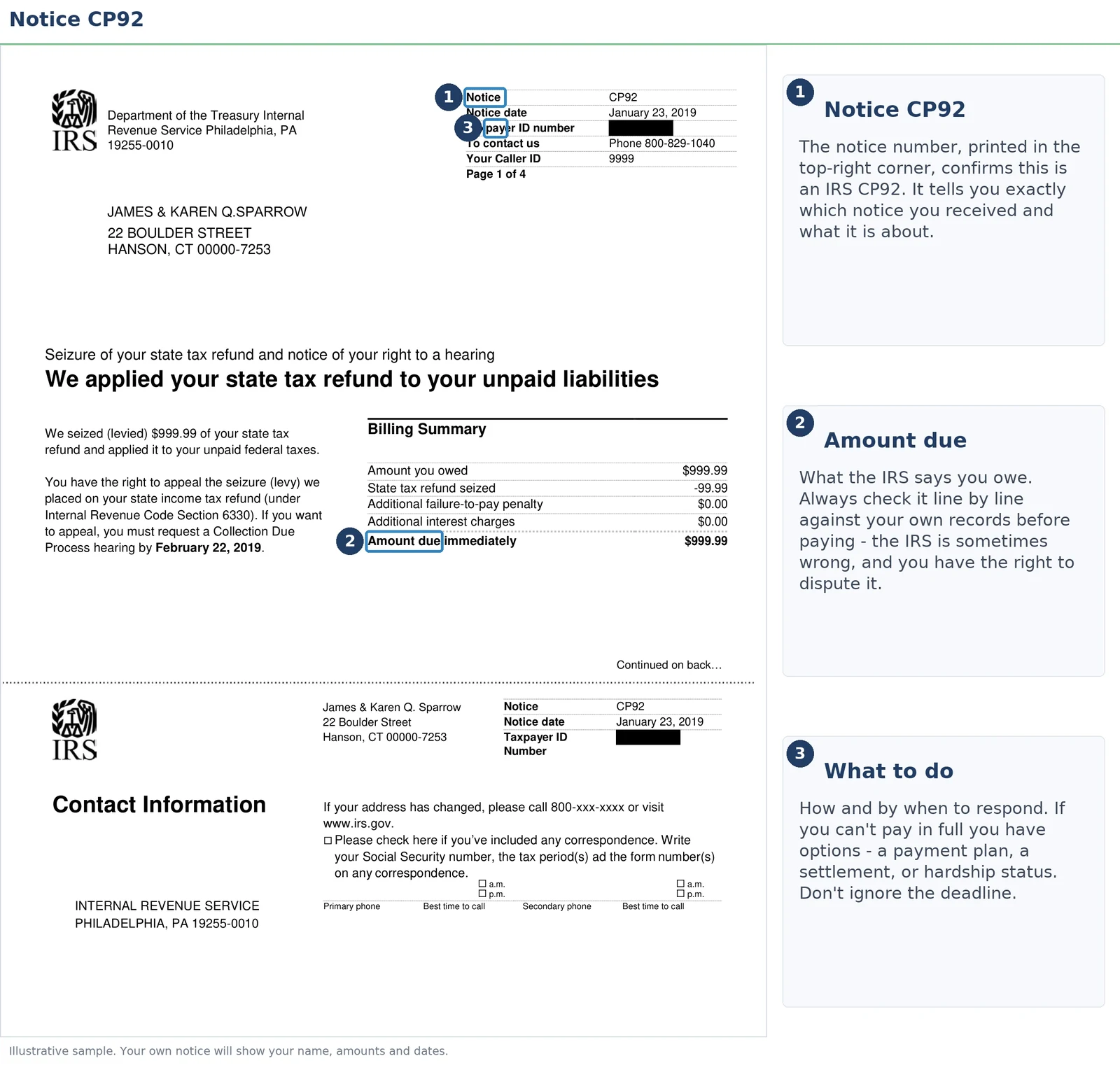
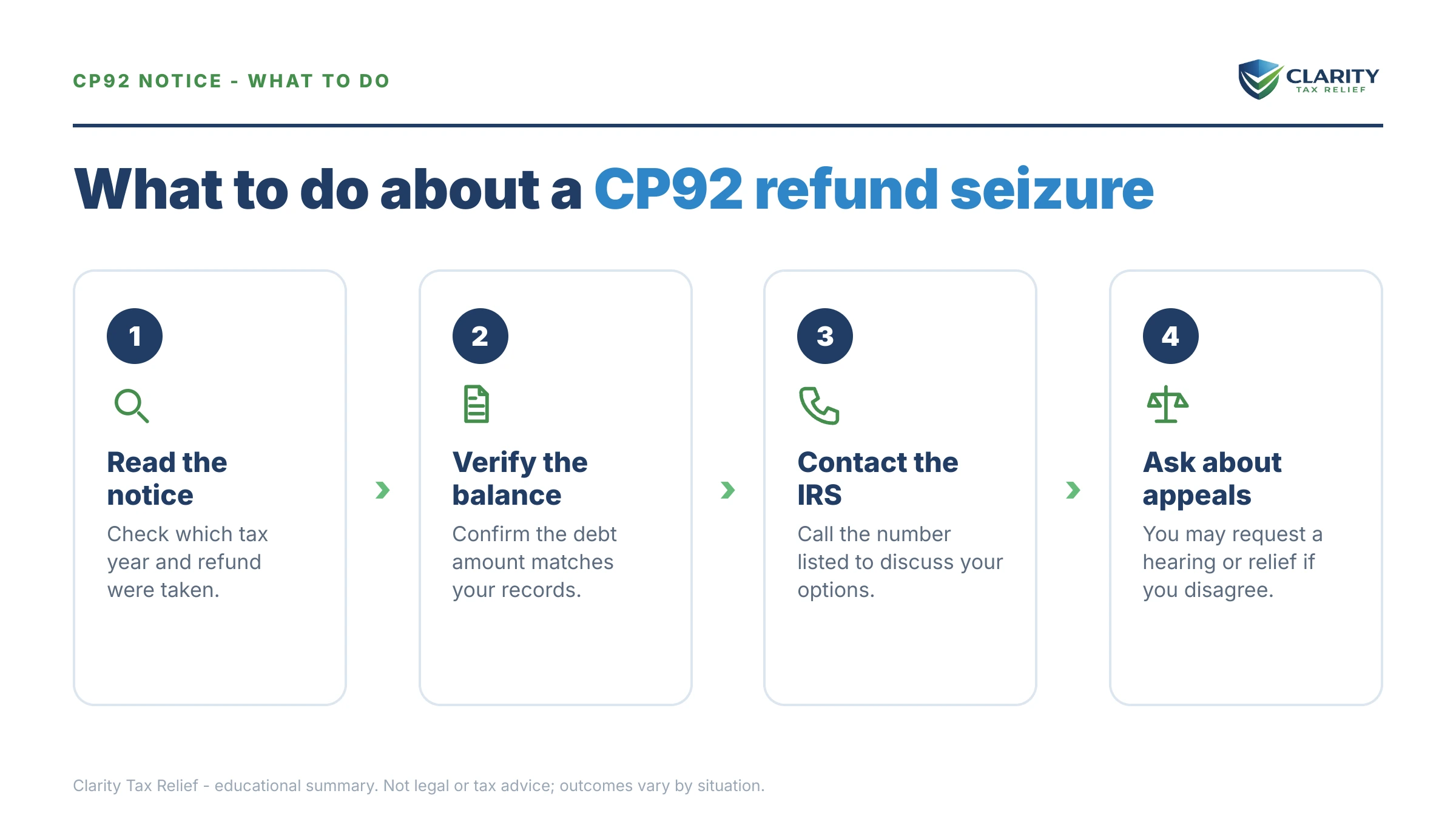
- Read the two numbers on the notice — the amount levied from your state refund and the remaining balance. That remainder is what you're solving for now.
- Verify the debt in your IRS online account — match the tax year and balance on the CP92 against your account and your own records before you pay or agree to anything.
- Decide on the hearing before day 30 — file Form 12153 within 30 days of the notice date if you dispute the debt, already paid it, or need Appeals to consider an alternative. Skip it if you agree and can arrange payment directly.
- Set up a resolution for the remaining balance — full payment, a 180-day short-term plan, a monthly installment agreement, hardship status, or an offer if you genuinely qualify — and put it in place before the window closes.
- Fix what caused the balance — adjust your W-4 withholding so next April doesn't produce another balance due. A repeat balance restarts the entire notice-and-levy cycle.
When you can handle a CP92 yourself
Plenty of CP92 situations don't need professional help. If the balance is correct, it's under $10,000, your returns are all filed. You can manage a monthly payment, you can set up a plan online at IRS.gov in under an hour. The escalation stops. If the remaining balance is small enough to pay within 180 days, the short-term plan costs nothing to set up.
Experienced help changes outcomes in a narrower set of cases: you dispute the debt and the 30-day Tax Court clock is running. You have multiple unfiled years behind the balance (the IRS won't approve most agreements until returns are in). A wage or bank levy is already in motion. The debt traces to a spouse or ex-spouse. Or the balance is large enough that the difference between a payment plan, hardship status. An offer is measured in thousands of dollars. In those cases, the sequence you fix things in — returns first, then penalties, then the balance — often determines what you actually pay.
Terms on your CP92, decoded
- Levy — the actual seizure of property or money to pay a tax debt; your state refund was levied.
- Lien — a legal claim against your property that secures the debt; separate from a levy, and not automatic with a CP92.
- Collection Due Process (CDP) — your legal right to an independent Appeals hearing before (or in this case, right after) the IRS levies.
- Form 12153 — the one-page form you file to request that CDP hearing; it must be postmarked within 30 days of the notice date.
- Equivalent hearing — a similar hearing available up to one year after the notice, but without Tax Court review rights and without blocking levy action.
- SITLP — the State Income Tax Levy Program, the automated system that matches federal tax debtors against state refund files and intercepts the refunds.
- CSED — the Collection Statute Expiration Date. The IRS generally has 10 years from assessment to collect, though appeals and certain filings pause that clock.
CP92 notice questions, answered
What is an IRS CP92 notice?
A CP92 notice means the IRS already levied, took, your state tax refund and applied it to federal back taxes. It also starts a 30-day clock to request a Collection Due Process hearing on Form 12153. Miss it, and the IRS can move on to your wages and bank accounts.
Why did the IRS take my state tax refund?
Your state refund was seized through the State Income Tax Levy Program, which lets the IRS intercept state refunds to pay federal tax debt. The CP504 you received earlier was the legally required advance warning that let the IRS take your state refund without further notice — the CP92 itself is what now gives you your appeal (CDP hearing) rights, so the clock that matters is the one on this notice. Federal law allows the IRS to take a state refund before offering you a hearing — which is exactly why the CP92's hearing right arrives after the money is already gone.
Can I get my state refund back after a CP92?
Usually no, if the underlying debt is valid, the refund is applied to your balance and stays there. You can pursue return of the money if the levy was wrong: the debt isn't yours, you already paid it, or identity theft created the balance. The Collection Due Process hearing you can request within 30 days is the fastest formal venue to raise those disputes.
Do I still owe the IRS after a CP92 notice?
Almost always, yes. State refunds are typically a few hundred to a couple thousand dollars, so they rarely cover a full federal balance. Your CP92 shows the amount seized and the remaining balance. That remainder keeps growing with the 0.5% monthly failure-to-pay penalty plus interest until you resolve it.
What is the difference between CP504 and CP92?
A CP504 is the warning; a CP92 is the confirmation. The CP504 says the IRS intends to levy your state refund. The CP92 says it already happened, and unlike the CP504, it grants formal Collection Due Process hearing rights with a 30-day deadline to request one on Form 12153. In terms of legal rights, the CP92 is the more consequential notice.
What happens if I ignore a CP92 notice?
Once the 30-day window closes, your Collection Due Process rights for the tax years listed expire. The IRS can levy your bank account or wages for those years without sending another hearing notice first. You can still request an equivalent hearing within one year, but you lose the right to take a disagreement to Tax Court. Interest and penalties keep accruing the entire time.
Will the IRS take my state refund every year until I pay?
As long as the balance is unresolved, yes — the State Income Tax Levy Program runs automatically each year. Your federal refunds are offset too. Getting into an installment agreement or hardship status generally stops new levy actions, though the IRS can still keep refunds and apply them to the balance even while you're on a payment plan.
Does a CP92 mean the IRS filed a lien against me?
No. A levy takes property; a lien is a legal claim against property, and they're separate actions. A CP92 confirms a levy on your state refund. It doesn't mean a Notice of Federal Tax Lien was filed. That said, a lien can still be filed separately while the balance is unpaid, so resolving the debt quickly protects you on both fronts.
Should I file Form 12153 if I agree that I owe the money?
Usually not. If the balance is correct and you can set up a payment plan or hardship status directly, a hearing adds months without changing the outcome. File Form 12153 when you dispute the amount, already paid it, have an innocent spouse claim, or need an Appeals officer to consider a resolution the automated system won't. Filing on time also preserves your right to Tax Court review.
Your next 24 hours
- Find the notice date on your CP92, top right corner, and count 30 days forward. Write that date down; it's your Form 12153 deadline and the day the IRS's hand strengthens.
- Gather three things: the CP92 itself, your federal return for the tax year listed, and proof of any payments you've made toward that year.
- Get a free case review before the hearing window closes. Submit the 2-minute form at claritytaxrelief.com/#consult or call (888) 825-7779. An experienced tax professional will tell you in one conversation whether you need the hearing, which resolution fits the remaining balance, and what it should cost.
For the IRS's own explanation of this notice, see Understanding your CP92 notice. Payment plans and payoff options are at IRS.gov/payments, and if IRS delays or errors are causing you hardship, the independent Taxpayer Advocate Service can intervene at no cost.
This guide is general information, not tax or legal advice for your specific situation. Eligibility for IRS programs depends on individual facts and circumstances; no outcome is guaranteed.