
City Tax Relief Guides
Tax Relief San Antonio: Every Real Option for IRS Tax Debt (2026)
The short answer: tax relief in San Antonio means matching your IRS balance to the right federal program — a payment plan (up to 72 months under $50,000), hardship status, penalty abatement, or an Offer in Compromise. Texas has no state income tax, so for most San Antonians the IRS is the only collector to resolve.
If you searched "tax relief San Antonio," you're probably sitting at the kitchen table with an IRS notice, a balance you didn't expect, and a dozen ads promising to erase it. Take a breath: every legitimate relief option is an IRS program with published rules, and this guide walks through each one — eligibility, cost, and the catch — so you can pick the one that actually fits your numbers.
⏱ The clock that's actually running: there's no application deadline for tax relief, but IRS debt grows every month it sits — a 0.5% monthly failure-to-pay penalty plus interest that compounds daily at a rate the IRS resets quarterly. The cheapest day to resolve a San Antonio tax debt is always today; each notice in the automated sequence adds cost and subtracts options.
Why San Antonio taxpayers end up owing the IRS
In San Antonio, an income-tax debt is almost always a federal debt, because Texas collects no personal income tax. That shapes everything about your case: there is no state income-tax agency to negotiate with, no state refund to protect, and no second bill to juggle unless you own a business.
The balances we see from Bexar County follow the local economy. Military households around Joint Base San Antonio hit surprise bills after a PCS year with income in two states, a working spouse's under-withheld W-2, or taxable bonus pay. The city's huge hospitality, medical, and trades workforce carries heavy 1099 income — serving, home health, HVAC, rideshare — where nobody withholds anything and the first tax return lands like a punch. Add early retirement withdrawals and side businesses, and a five-figure balance builds fast.
Business owners are the one group with two collectors: the IRS for income and payroll tax. The Texas Comptroller for sales, franchise, and mixed-beverage tax. Those are separate systems with separate rules, and the Comptroller usually moves faster — more on that below.
“An offer in compromise allows you to settle your tax debt for less than the full amount you owe. It may be a legitimate option if you can't pay your full tax liability or doing so creates a financial hardship.”
— Offer in compromise (IRS.gov)
What happens if you ignore IRS tax debt in San Antonio
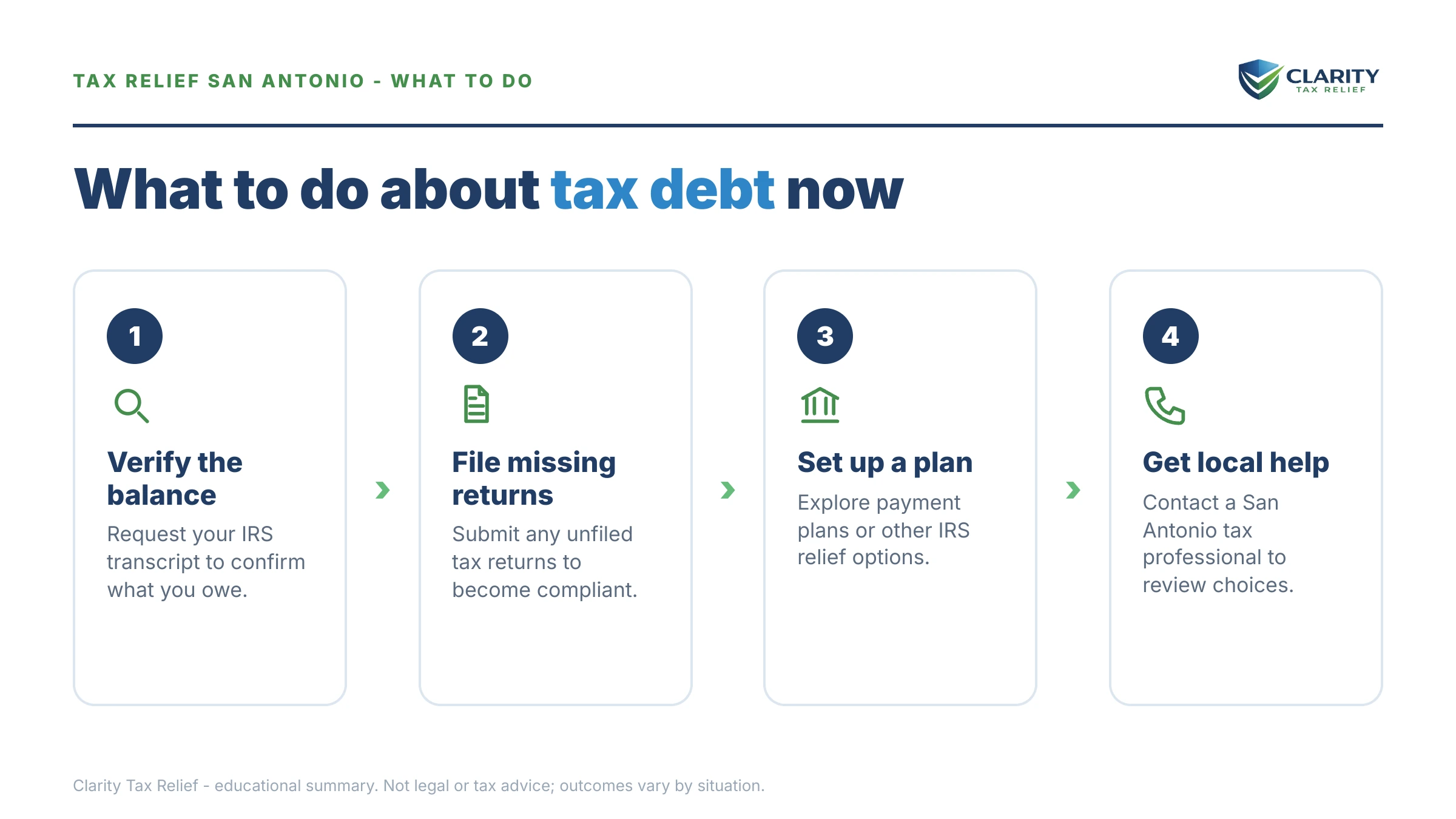
IRS collection runs on an automated notice sequence that escalates whether or not a human ever reviews your file. In 2025 the IRS workforce was cut roughly 27% — which makes people harder to reach. But the computers that issue liens and levies never stopped. The sequence looks like this:
- CP14 — the first bill. The balance, penalties, and interest for one tax year. No enforcement yet; the cheapest moment to act.
- CP501 / CP503 — reminders. Still just bills, but the balance is compounding monthly while they arrive.
- CP504 — intent to levy your state refund. Here's a San Antonio quirk: with no Texas income tax, there's usually no state refund to seize. But the CP504 still signals that a federal tax lien, filed in the Bexar County public records, is now a real possibility.
- LT11 / Letter 1058 — final notice of intent to levy. This starts a 30-day clock and your Collection Due Process rights (requested on Form 12153). It is the last exit before enforcement.
- Levy. A bank levy freezes funds with a 21-day hold before the money leaves. A wage levy is continuous until released, and Texas's ban on creditor garnishment does not stop it. Social Security can be levied up to 15% through the Federal Payment Levy Program.
Two more consequences arrive quietly at higher balances: a federal tax lien attaches to your home and complicates any sale or refinance, and once your certified debt passes $66,000 (the 2026 threshold), the IRS can certify you to the State Department for passport denial or revocation.
Facing IRS collection in San Antonio right now?
Whether you're holding a CP14 or a final notice, an experienced tax professional can decode exactly where you are in the sequence and which program fits your numbers — free, confidential, before another month of penalties and interest posts to your balance.
Tax relief San Antonio options, compared
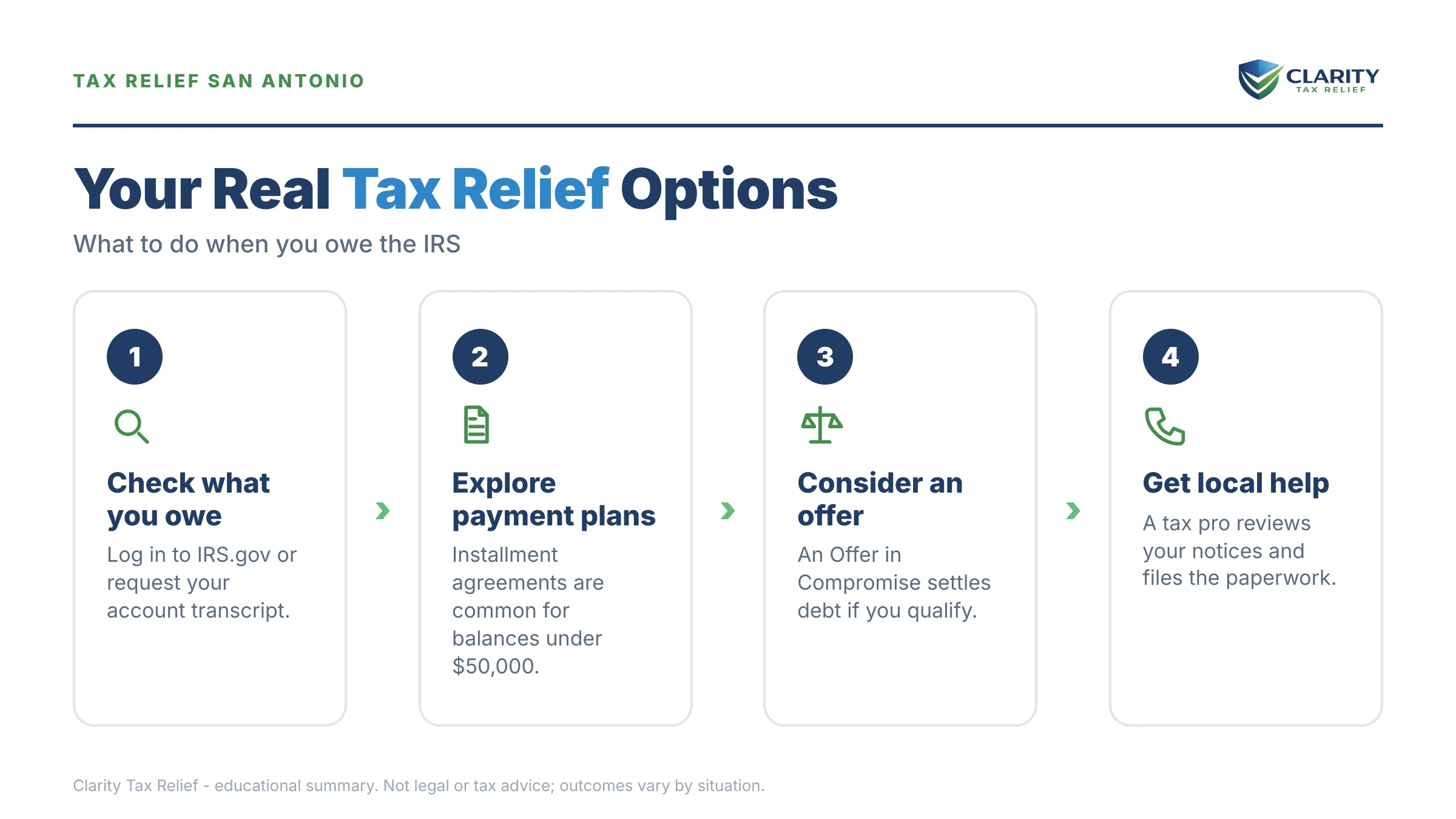
Every legitimate form of tax relief is an IRS program with a published eligibility test — nothing is negotiated on charm. Here's the full menu:
| Option | Who typically qualifies | Cost & the catch |
|---|---|---|
| Short-term payment plan (up to 180 days) | Anyone who can pay in full within 180 days | $0 setup; penalties and interest keep accruing until paid |
| Guaranteed installment agreement | Balance $10,000 or less, returns filed, full pay within 3 years | Setup fee applies; approval is required by law if you meet the tests |
| Streamlined installment agreement | Up to $25,000, or up to $50,000 with direct debit — over up to 72 months | No detailed financial disclosure; interest and a reduced penalty continue |
| Non-streamlined agreement (over $50,000) | Larger balances after submitting Form 433 financials | The IRS reviews assets and may file a lien while you pay |
| Currently Not Collectible (CNC) | Paying anything would prevent basic living expenses (shown on Form 433-F) | Collection pauses; the debt, interest, and possible lien remain |
| Offer in Compromise (OIC) | Assets plus future income genuinely can't cover the debt | $205 fee + 20% down on lump-sum offers (both waived for low-income filers); ~1 in 5 accepted in FY2024 |
| Penalty abatement (FTA / AEP) | Clean compliance the prior 3 years, or reasonable cause | Free to request; removes penalties, not the underlying tax |
A few of these deserve a closer look. A streamlined installment agreement is the workhorse for most San Antonio balances: under $50,000 with direct debit, you can set it up online without handing over a financial statement. If money is genuinely too tight for any payment, Currently Not Collectible status pauses collection entirely while the 10-year collection statute keeps running in the background.
The Offer in Compromise is the program the billboards oversell. The IRS calculates your Reasonable Collection Potential — your asset equity plus a multiple of your monthly disposable income — and accepts an offer only when that number comes in below your balance. You can estimate your own offer with our Offer in Compromise Calculator before anyone charges you a dime, and read how an offer in compromise works for the full mechanics. One genuinely useful 2026 rule: an offer is automatically accepted if the IRS fails to decide within 2 years.
Penalty relief stacks with any of the above. First-time penalty abatement wipes penalties for one year if your prior three years are clean, and starting summer 2026, the IRS's new Automatic Exemption from Penalty (AEP) applies similar relief automatically, no request needed. If you're comfortable working your own case, our step-by-step guide to how to settle tax debt yourself covers the forms and phone scripts for each program.
How much do you owe? Realistic options by balance
The size of your balance largely decides which doors are open. Here's the honest map:
| Amount owed | Realistic options | Watch out for |
|---|---|---|
| Under $10,000 | Short-term plan or guaranteed installment agreement; penalty abatement often cuts the balance meaningfully | Penalties can be a big share of small balances — request abatement before paying them |
| $10,000–$25,000 | Streamlined plan online, no financials; OIC or CNC only with genuine hardship | Ignoring notices at this level is how liens start appearing in county records |
| $25,000–$50,000 | Streamlined plan with direct debit up to 72 months | Without direct debit, the IRS may want financial disclosure |
| $50,000–$100,000 | Non-streamlined agreement with Form 433 financials; OIC/CNC if the math supports it | Passport certification once the certified debt passes $66,000 |
| Over $100,000 | Full financial review, likely revenue officer assignment; every option stays on the table but nothing is automatic | Liens are near-certain; asset decisions made now affect what the IRS can demand later |
Say a San Antonio couple owes $16,400: the real math
A hypothetical to make the options concrete. Say a married couple filing jointly — she's a W-2 nurse at the Medical Center, he picked up $38,000 of 1099 HVAC work with no quarterly payments — files and owes $16,400 for the year. Their doors:
- Short-term plan (180 days): $16,400 ÷ 6 ≈ $2,733 a month — realistic only if a bonus or savings can cover it. $0 setup, and accruals stop the day it's paid.
- Streamlined 72-month plan: $16,400 ÷ 72 ≈ $228 a month of principal alone. Interest and a reduced failure-to-pay penalty keep accruing on the shrinking balance, so paying more — say $350 a month, clearing it in roughly four years — meaningfully cuts the total cost.
- Penalty abatement first: if roughly $1,200 of that balance is failure-to-pay penalty and their prior three years are clean, first-time abatement drops the debt to about $15,200 before they set up anything.
- Offer in Compromise: probably not. If they have $40,000 of home equity, their Reasonable Collection Potential already exceeds $16,400, and the IRS won't accept less than it can collect. That's not a failure — the payment plan is simply the right tool at this balance.
This is the ordering that saves money at almost any balance: abate penalties first, then put the smaller number on the right plan.
How to get tax relief in San Antonio, step by step
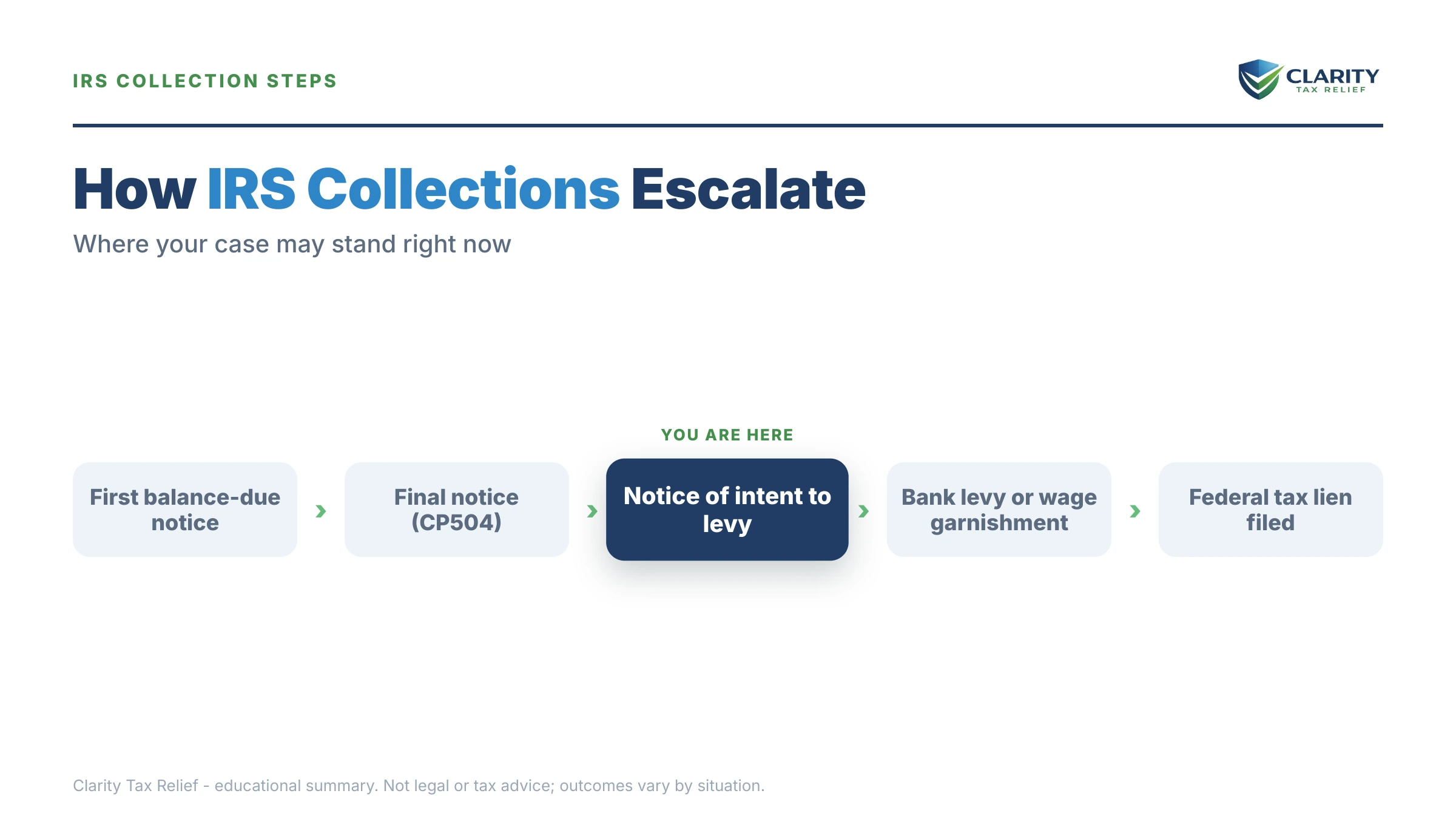
- Pull your IRS records — Create or log into your IRS online account to confirm every year with a balance and every unfiled return before you choose a program.
- File anything missing — The IRS won't approve a payment plan or offer while required returns are unfiled — and the failure-to-file penalty is ten times the failure-to-pay penalty, so filing always comes first.
- Match your balance to a program — Use the options table above: under $25,000 usually means a streamlined plan, genuine hardship points to CNC or an Offer in Compromise, and over $50,000 means financial disclosure.
- Set it up before the next notice, Apply online for payment plans at IRS.gov, enforcement generally pauses while an agreement or offer is pending, and every notice you wait through adds accrued penalties and interest.
- Ask for penalty relief — Request first-time abatement if your prior three years are clean. Starting summer 2026, the IRS's Automatic Exemption from Penalty applies some relief without any request.
- Bring in help if the case is layered — A levy in motion, multiple unfiled years, or Texas Comptroller debt stacked on an IRS balance are the situations where experienced tax professionals change outcomes.
What's different about tax debt in Texas
Texas's lack of a state income tax simplifies most San Antonio cases to a single federal negotiation. But it changes the picture in three specific ways.
Business owners answer to the Texas Comptroller. Sales tax, franchise tax, and mixed-beverage taxes are state debts with their own payment agreements, their own penalties. A faster enforcement temperament than the IRS. Sales tax you collected from customers is treated as trust money, and the Comptroller can pursue owners personally for it. If you're carrying both, our guides to Texas Comptroller tax debt and Texas back taxes cover the state side, and our buyer's guide to tax relief for small business covers how to sequence a two-agency case. Don't apply IRS thresholds or timelines to the Comptroller — the state runs its own rulebook, published at the agency's site linked below.
Military households have extra protections. With tens of thousands of service members and retirees around JBSA-Lackland, Fort Sam Houston, and Randolph, combat-zone rules come up constantly here: a designated deployment suspends filing and payment deadlines for the tour plus 180 days. See our full guide to combat-zone collection relief for what pauses and what doesn't.
In-person IRS help exists but requires an appointment. San Antonio has an IRS Taxpayer Assistance Center, but walk-ins aren't accepted — you'll need to book through the IRS appointment line, and with 2026 staffing levels, slots run weeks out. Most payment plans are faster to set up online than in person.
When you can handle this yourself, and when help changes the outcome
Most San Antonio taxpayers with a single balance under $25,000 can resolve it themselves in an afternoon. If your returns are filed, you agree with the number. A streamlined plan payment fits your budget, set it up online — no firm, ours included, adds enough value there to justify a fee.
Experienced help earns its cost in specific situations: a levy or garnishment already in motion, multiple unfiled years that need reconstructing before anything else can happen, IRS debt stacked on Texas Comptroller debt, payroll tax exposure that can attach to you personally, and Offer in Compromise math — where how assets and expenses are presented on the 433 forms legitimately moves the accepted number. The honest test: if your case is one program and one balance, do it yourself. If it's three problems tangled together, representation usually pays for itself.
Tax relief in San Antonio: your questions, answered
How does tax relief work in San Antonio?
Tax relief means resolving your IRS balance through one of the agency's own programs — a payment plan, hardship status, penalty abatement, or an Offer in Compromise — not a special local program. Because Texas has no state income tax, most San Antonio cases involve only the IRS. Business owners are the exception: sales and franchise tax debts run through the Texas Comptroller and follow separate rules.
How much does tax relief cost in San Antonio?
The IRS's own fees are modest: short-term plans cost $0 to set up, installment agreements carry a setup fee that drops with direct debit. An Offer in Compromise costs $205 to file — waived if your AGI is at or below 250% of the federal poverty level. Professional representation is the bigger cost and varies with case complexity, so read our guide to how much tax relief costs before you sign anything.
Does Texas have a state tax relief program?
Texas has no state income tax, so there is no state income-tax relief program to apply for. If you owe business taxes — sales, franchise, or mixed-beverage tax — the Texas Comptroller has its own payment-agreement and voluntary-disclosure options. It typically enforces faster than the IRS. Individual wage earners in San Antonio usually only need to resolve their federal balance.
Can the IRS garnish wages in Texas?
Yes. Texas law blocks most private creditors from garnishing wages, but that protection does not apply to the IRS, which levies under federal law. Before a wage levy the IRS must send a final notice (LT11 or Letter 1058) and give you 30 days to respond or request a Collection Due Process hearing — which is why acting at the first notice matters so much.
Do I need a San Antonio tax attorney, or can any firm help?
IRS collection cases are federal, so an enrolled agent, CPA, or tax attorney anywhere in the country can represent you with a signed Form 2848 — nothing is filed in a local courthouse. Location matters most when a case turns criminal or heads to litigation, which is rare. Vet any firm the same way: real credentials, transparent pricing, and no promised outcome before anyone has pulled your IRS transcripts — our guide to how to choose a tax relief company has the full checklist.
Will the IRS really settle my tax debt for less?
Sometimes, but it's a means test, not a negotiation. The IRS accepted roughly 1 in 5 Offers in Compromise in FY2024, and acceptance depends on whether your assets and future income genuinely cannot cover the balance before the collection statute runs. If a company promises a settlement before reviewing your finances, walk away.
I'm stationed at Joint Base San Antonio — do I get special IRS relief?
Possibly. Service members in a designated combat zone get filing and payment deadlines suspended for the deployment plus 180 days, with interest and penalties paused for that window. Stateside duty at JBSA doesn't pause collection by itself. But the Servicemembers Civil Relief Act can cap certain interest on debts you incurred before entering active duty, and base legal assistance offices can point you to free help.
How do I spot a tax relief scam in San Antonio?
The red flags are universal: promised settlements before anyone has seen your finances, "pennies on the dollar" pitches, large upfront fees before your IRS transcripts are pulled, and pressure to sign today. No honest firm can know your outcome in advance, because every IRS program is means-tested. Our tax relief scams guide lists the warning signs in detail.
Your next 24 hours
- Find your most recent IRS notice — the notice number in the top corner and the amount due tell you exactly where you sit in the collection sequence. No notice? Log into your account at IRS.gov and check the balance directly.
- Gather three things: your last filed return, every IRS letter you've received. A rough picture of monthly income and expenses — that's all any program (or any honest reviewer) needs to map your options.
- Get a free case review — send us what you found at the 2-minute form or call (888) 825-7779. Every month you wait adds another 0.5% penalty plus compounding interest to your balance. Nothing about a San Antonio tax debt gets cheaper with time.
Primary sources worth bookmarking: the IRS's official payment plans and installment agreements page, the Taxpayer Advocate Service for cases stuck in IRS processing, and the Texas Comptroller of Public Accounts for state business taxes.
This guide is general information, not tax or legal advice for your specific situation. Eligibility for IRS programs depends on individual facts and circumstances; no outcome is guaranteed.