
Tax Relief by City
Tax Relief Anaheim: Your IRS and California Options in 2026
The short answer: tax relief in Anaheim means matching each debt — IRS, California FTB, CDTFA, or EDD — to the program its owner runs: a payment plan, an Offer in Compromise, hardship status, or penalty abatement. There is no city-level program. Eligibility is means-tested by each agency, and filing every overdue return always comes first.
Maybe you run a catering kitchen a mile from the resort district and a slow winter meant the payroll deposits didn't all get made. Maybe the letters arriving at your house in West Anaheim now come from two different governments — one from Ogden, Utah, one from Sacramento. Either way, the balances are growing and nobody has told you the order to fix things in.
That order is the whole game. This guide maps every real option for tax relief in Anaheim in 2026, federal and state, with what each costs, who qualifies, and where the traps are.
⏱ The clock that's actually running: there's no single deadline printed on a tax debt itself, but the price rises monthly — the federal failure-to-pay penalty accrues at 0.5% per month plus compounding interest, and California adds its own penalties, interest, and collection fees on top. Every month of waiting makes every option below more expensive.
Why Anaheim tax debt usually means two collectors, or four
Anaheim taxpayers can owe up to four separate agencies at once: the IRS, the Franchise Tax Board, the CDTFA, and the EDD. That's the single biggest difference between fixing a tax problem here and fixing one in a no-income-tax state — resolving your federal balance does nothing to your California balances, and vice versa.
Anaheim's economy makes the multi-agency problem common. Hospitality, restaurants, and event businesses around the resort area and the convention center run on seasonal revenue, tipped and part-time payrolls, and taxable sales — exactly the profile that falls behind on four different tax types in the same bad year.
| Agency | What it collects | What makes it different |
|---|---|---|
| IRS | Federal income tax, self-employment tax, 941 payroll taxes | 10-year collection statute; passport certification once a seriously delinquent balance passes $66,000 (2026) |
| California FTB | State personal income tax, LLC/franchise amounts | 20-year collection statute (R&TC §19255); DMV registration holds and license suspension — see California FTB back taxes |
| CDTFA | Sales and use tax | Collected-but-unremitted sales tax can become a personal liability, even after the business closes; plans run through a CDTFA payment plan |
| EDD | California payroll taxes | Issues its own assessments and can pursue responsible individuals personally — see California EDD payroll tax |
If you're a W-2 employee who simply owes on a couple of 1040s and their state equivalents, your problem is two agencies, not four — simpler, but still two separate resolutions.
What happens if you ignore IRS and FTB collection notices
The IRS has 10 years to collect a tax debt; California's FTB has 20 years under R&TC §19255 — waiting it out is not a plan (the state clock is covered in depth in California's 20-year collection statute). Both systems escalate automatically, and in 2026 that matters more than ever: the IRS cut roughly 27% of its workforce in 2025, so humans are hard to reach. But the notices, liens, and levies come from automated systems that never stopped.
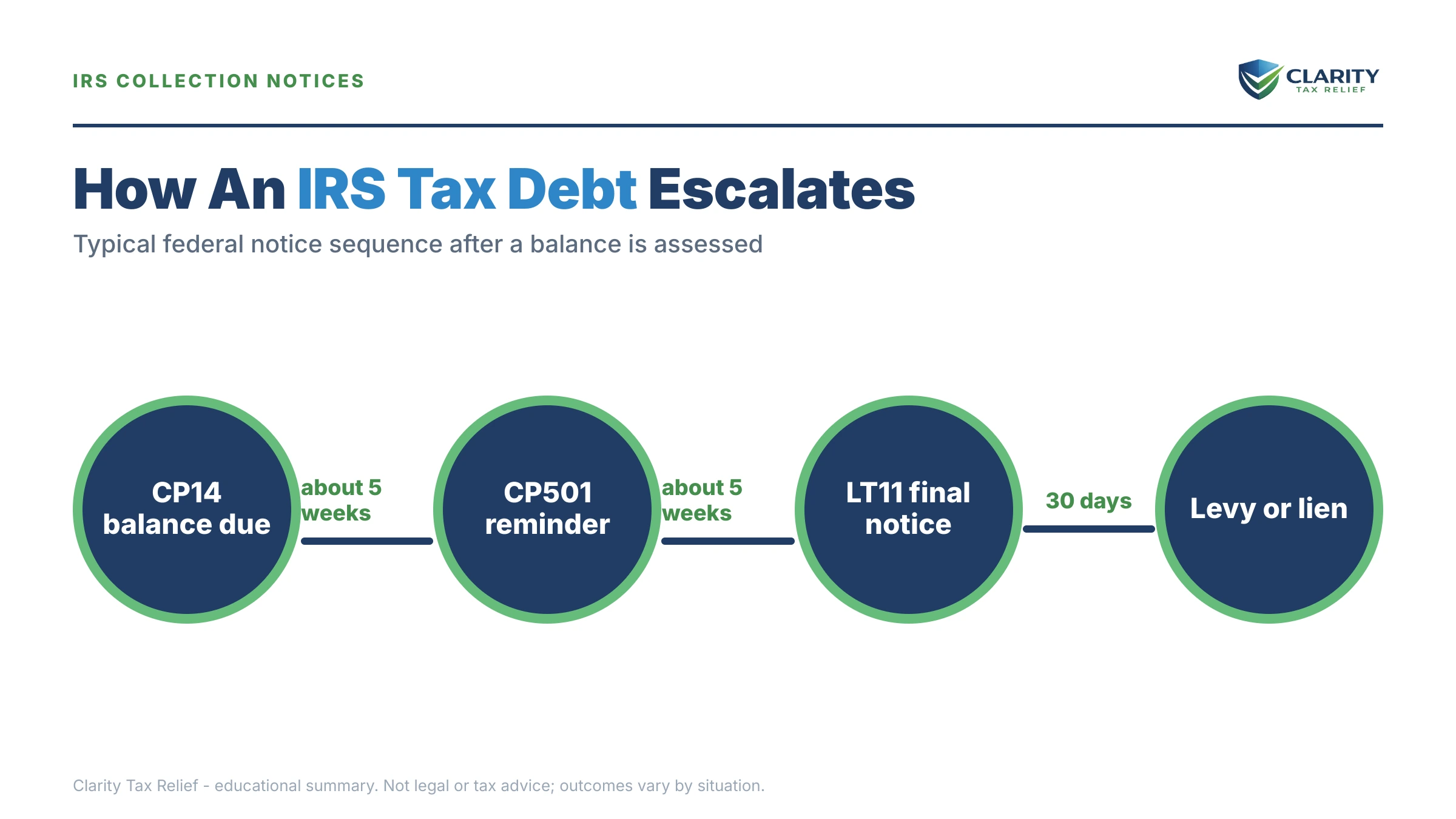
Here is the sequence on the federal side, with the state track running in parallel:
- First bill (CP14). A balance-due notice, typically giving about 21 days before the next stage. No enforcement yet, and the cheapest moment to act.
- Reminders (CP501/CP503). Still just bills, but penalties and interest have been compounding the whole time.
- CP504 — intent to levy your state refund. The IRS can now take your California refund. A federal tax lien becomes a live possibility.
- LT11 / Letter 1058 — final notice. A 30-day clock starts, along with your Collection Due Process appeal rights. After it runs, the IRS can levy bank accounts (funds are held 21 days before they leave) and garnish wages continuously until released. At a $92,700-scale balance, you're also above the $66,000 passport-certification threshold.
- The state track. The FTB moves from demand notices to adding collection fees, then to bank levies and wage garnishment, plus tools the IRS doesn't have: DMV registration holds, suspension of professional and business licenses, FTB-suspended LLCs. A public delinquent-taxpayer list for the largest balances.
Nothing in either sequence requires a human to review your file first. The escalation is the default; stopping it requires an affirmative step from you.
Owe the IRS or California from Anaheim?
Interest is compounding on every balance this month — federal and state. Send us your notices and we'll pull your transcripts, map exactly who's collecting what, and lay out your real options. Free, confidential, no pressure.
Tax relief in Anaheim: every option, compared
The IRS lets most individuals set up a payment plan online for balances up to $50,000, and California's FTB runs a completely separate plan with its own rules. The full do-it-yourself playbook lives in our guide to how to settle tax debt yourself. Here's how each option applies when you owe federal and state at the same time.
| Option | Who typically qualifies | Key terms |
|---|---|---|
| Short-term payment plan | Can pay in full within 180 days | $0 setup; interest and penalties continue |
| Guaranteed installment agreement | Individual income tax of $10,000 or less, returns filed | Approval is essentially automatic if you can pay within 3 years |
| Streamlined installment agreement | Up to $25,000, or up to $50,000 with direct debit | No detailed financial statement required |
| Online long-term plan | Balance up to $50,000 | Up to 72 months, set up through your IRS online account |
| Non-streamlined / business payroll agreement | Above the thresholds, or 941 payroll debt | Financial disclosure (Form 433-B for businesses) required |
| Offer in Compromise | Reasonable Collection Potential genuinely below the balance | $205 fee + 20% down on lump-sum offers (both waived with low-income certification) |
| Currently Not Collectible | Allowable living expenses meet or exceed income | Collection pauses; the debt and interest remain |
| Penalty abatement | Clean 3-year compliance history (FTA) or reasonable cause | Removes penalties, not the underlying tax |
Three notes that matter for an Anaheim reader specifically:
The Offer in Compromise is math, not mercy. The IRS computes your Reasonable Collection Potential — your equity in assets plus what it could take from future income — and accepts only when your offer meets or beats that number. The IRS accepted roughly 1 in 5 offers in FY2024, so it's real but never guaranteed. You can estimate your own number with our Offer in Compromise Calculator before anyone charges you a dime. And remember: an accepted IRS offer does not touch your FTB balance — the state has its own separate offer program.
Penalty relief is changing in 2026. First-Time Abate still works if your prior three years are clean, but starting summer 2026, the IRS's new Automatic Exemption from Penalty (AEP) applies qualifying relief automatically, with no request needed. Don't pay anyone to "file" something the IRS now does on its own.
The state needs its own arrangement. An FTB payment plan is applied for separately, on the FTB's terms, and if you're deciding which government to satisfy first, our guide to state tax debt vs IRS walks through the trade-offs.
| Option | Upfront cost | Typical timeline |
|---|---|---|
| Short-term IRS plan (≤180 days) | $0 | Set up online the same day |
| Long-term installment agreement | Setup fee varies (lowest with direct debit; reduced or waived for low income) | Online approval is usually immediate; up to 72 months to pay |
| Offer in Compromise | $205 + 20% of the offer for lump-sum (both waived with low-income certification) | Months of IRS review; auto-accepted by law if the IRS doesn't decide within 2 years, with narrow exceptions — a returned or rejected offer stops the clock, and time during court disputes does not count |
| Currently Not Collectible | $0 | Financial review up front; status revisited when income changes |
| Penalty abatement (FTA / reasonable cause) | $0 | Often resolved by a phone call or letter; AEP relief becomes automatic starting summer 2026 |
| FTB payment plan | State sets its own terms | Applied for through the FTB, entirely separate from any IRS agreement |
A worked example: an Anaheim business owner who owes $92,700
Say you own a small catering company near the resort corridor and the total damage is $92,700, split the way these cases usually split: $57,400 in unpaid federal 941 payroll taxes across four quarters, $26,800 on two personal 1040s, and $8,500 to the FTB. This is a hypothetical, but the structure is what matters:
- The personal $26,800 fits under the $50,000 online threshold: a 72-month plan works out to $26,800 ÷ 72 ≈ $372 a month, before the interest and 0.5%-per-month penalty that keep accruing (so the real payoff runs a bit richer or longer).
- The $57,400 in 941s can't go on that individual online plan. Business payroll debt at this size means financial disclosure on Form 433-B. The bigger issue is that roughly $40,000 of it is withheld income tax and the employee share of FICA. That trust-fund portion can be assessed against you personally through the Trust Fund Recovery Penalty, surviving even if the business closes. Our guide to 941 back taxes covers the whole sequence.
- The $8,500 FTB balance needs its own state payment plan. It doesn't ride along on either federal arrangement.
- The trap: none of these agreements gets approved unless this quarter's payroll deposits and estimated payments are current. Sending an extra $5,000 at old debt while missing a new deposit actually moves you backward.
One more consequence of the size: at $92,700 total federal debt, you're above the $66,000 passport-certification threshold for 2026 — getting into an agreement is also what keeps that off the table.
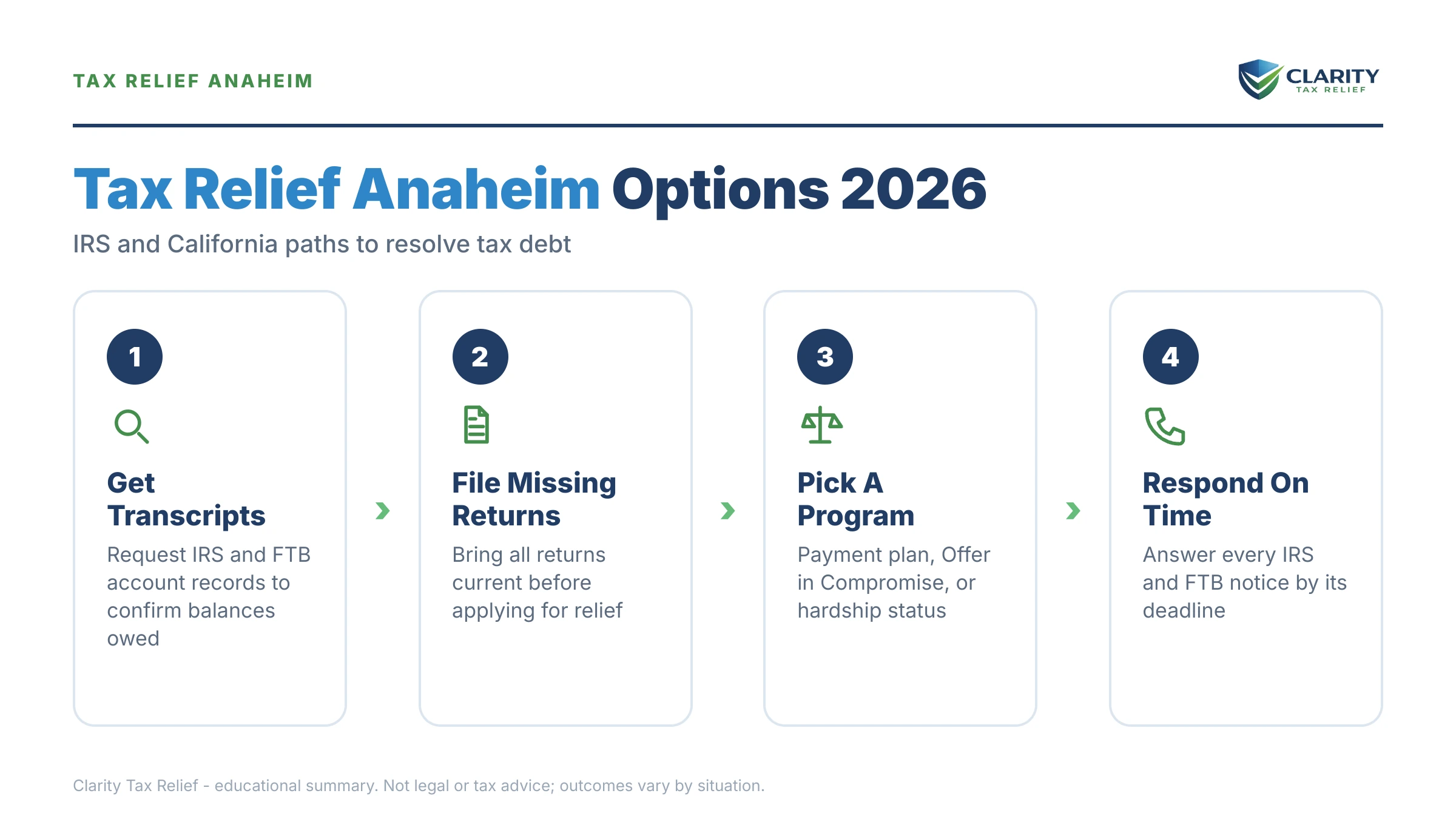
How to get tax relief in Anaheim, step by step
The sequence below is the same one an experienced tax professional would run — compliance first, then arrangements, because every agency requires the first before it will grant the second.
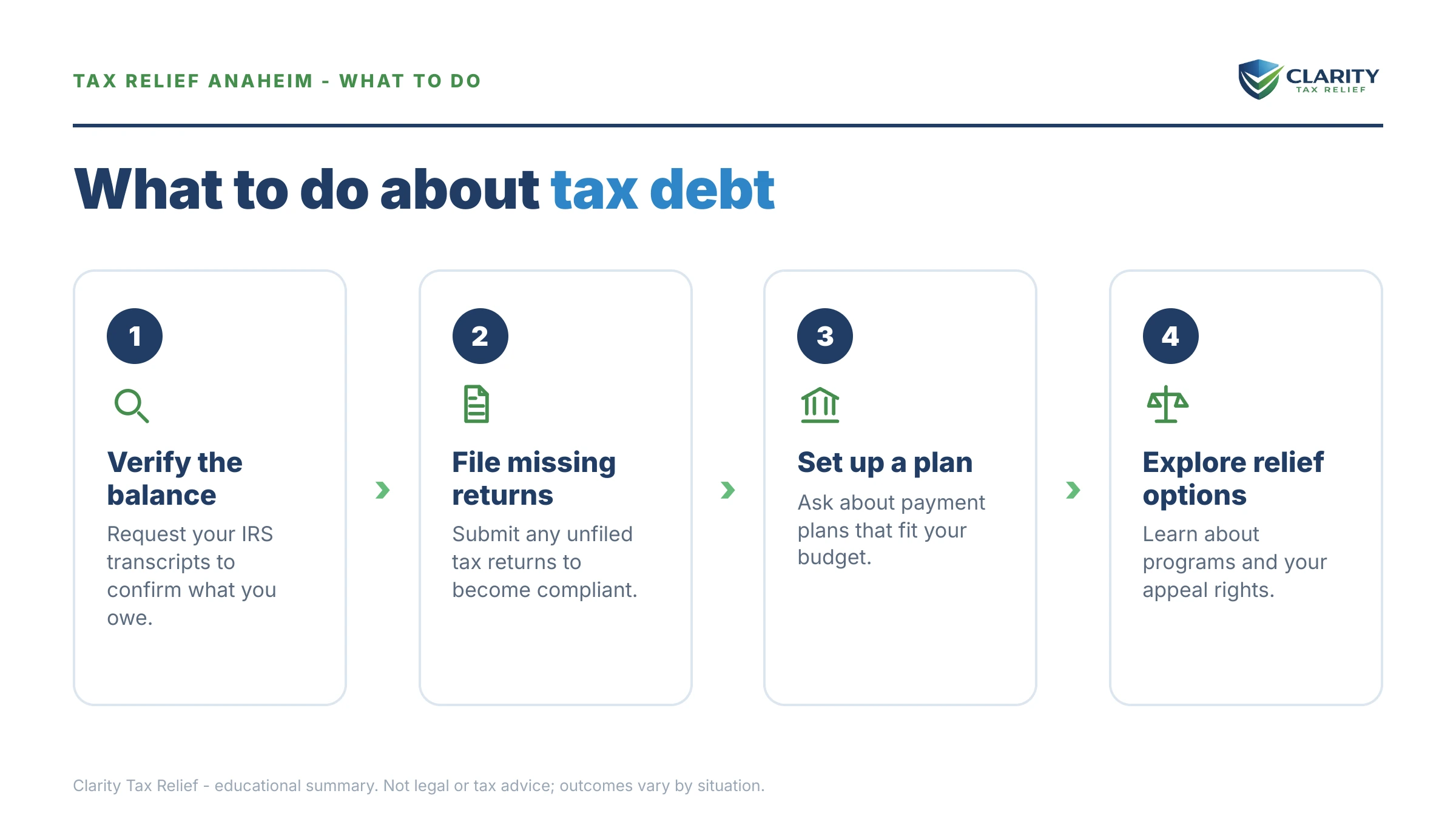
- Pull your records from every agency. Create an IRS online account to see balances and transcripts, register for MyFTB, and check your CDTFA and EDD portals if you run a business. You can't pick a program until you know exactly who says you owe what.
- File every missing return. No agency will approve a payment plan or offer while returns are outstanding. The federal failure-to-file penalty runs 5% per month — ten times the 0.5% failure-to-pay rate.
- Get current on this quarter. Restart federal payroll deposits and state withholding now if you have employees, or make this quarter's estimated payment — current compliance is a hard prerequisite for every resolution program.
- Match each balance to a program and apply. Set up an IRS plan online for personal balances up to $50,000, request an FTB payment plan separately, and use the options table above to pick the right fit for anything larger.
- Bring in experienced help for payroll debt or large balances. Trust-fund payroll exposure, multiple agencies, or six-figure totals are where an experienced tax professional changes the outcome — the order you resolve things in changes what you pay.
When you can handle it yourself, and when help changes the outcome
Most Anaheim taxpayers with a single-agency personal balance under $25,000 can resolve it themselves online in under an hour. If you agree with the amount, all your returns are filed, and it's one government collecting, set up the plan yourself and skip every fee.
Experienced help earns its cost in specific situations, not all of them:
- Payroll or trust-fund debt — the personal-liability rules mean a wrong statement in one interview can convert business debt into your debt.
- Multiple agencies at once — sizing an IRS agreement and an FTB plan against one budget, in the right order, is where cases most often go sideways. Business owners should start with our tax relief for small business guide.
- A levy or garnishment already in motion — release paths exist, but they're time-sensitive and paperwork-heavy.
- Offer in Compromise math — a mispriced offer wastes months and payments. Roughly 4 in 5 offers were rejected in FY2024, mostly for fixable math and compliance errors.
If you do hire someone, us or anyone, vet them first with our how to choose a tax relief company checklist. Any firm that quotes a settlement figure before pulling your transcripts is guessing, and guessing is not a service worth paying for.
Terms on your notices, decoded
- CSED — the Collection Statute Expiration Date: the end of the IRS's 10-year window to collect, pausable by appeals, offers, and bankruptcy.
- R&TC §19255 — the California law giving the FTB 20 years to collect a state balance.
- Trust Fund Recovery Penalty — the IRS's tool for assessing a business's withheld payroll taxes against the responsible people personally.
- Lien vs. levy — a lien is a legal claim against what you own; a levy is the actual taking of money or property.
- Reasonable Collection Potential — the IRS's calculation of the most it could ever collect from you, which sets the floor for any Offer in Compromise.
- Currently Not Collectible — hardship status that pauses IRS collection while the debt (and interest) remains on the books.
Official resources: apply for a federal plan on the IRS payment plans page, pay directly at IRS.gov/payments, and handle state balances through the Franchise Tax Board and the CDTFA.
Anaheim tax relief questions, answered
Do I need a local Anaheim tax relief company, or can any firm help?
No — IRS and FTB cases are handled by mail, phone, and online portals, so a firm's street address matters far less than its credentials and its California experience. What Anaheim taxpayers actually need is someone who works both federal and state cases, because most owe more than one agency. Vet any firm, local or national, on credentials, fee structure, and whether they review your transcripts before quoting a price.
How long can California collect back taxes compared to the IRS?
The IRS generally has 10 years from assessment to collect a tax debt; California's FTB has 20 years under R&TC §19255. That means a state balance can legally follow you twice as long as the federal one. Both clocks can be paused by events like an Offer in Compromise or bankruptcy, so neither debt reliably expires on schedule — waiting it out is rarely a real strategy.
Can I settle California tax debt the way an IRS Offer in Compromise works?
Yes — the FTB runs its own Offer in Compromise program. But it is a separate application with its own criteria. An accepted IRS offer does not settle your state balance. Like the IRS, the FTB looks at whether you could realistically ever pay the debt from income and assets. If you owe both governments, the two offers are usually coordinated but must be filed and negotiated separately.
What happens if my Anaheim business owes payroll taxes?
Unpaid 941 payroll taxes are the most dangerous debt a business can carry, because the withheld portion is trust-fund money the IRS can assess against you personally through the Trust Fund Recovery Penalty, even if the business closes. California's EDD can pursue responsible people the same way on state payroll taxes. Getting current on this quarter's deposits immediately is the single step that keeps resolution options open.
How much does tax relief cost in Anaheim?
Legitimate fees depend on the work: setting up a payment plan costs far less than an Offer in Compromise or a payroll-tax defense across multiple agencies. Be wary of any firm quoting a large flat fee before anyone has reviewed your transcripts, or promising to settle for a specific amount. The IRS itself charges $205 to apply for an offer (waived with low-income certification), and short-term payment plans cost nothing to set up.
Can the FTB garnish my wages or levy my bank account in Anaheim?
Yes — the FTB issues wage garnishments and bank levies. It also uses tools the IRS doesn't, like DMV registration holds and professional or business license suspension. Once an account leaves the notice stage, FTB collection often moves faster than IRS collection. If a state levy is already in motion, ask about hardship-based release and get a payment plan in place quickly to stop the next one.
Should I pay the IRS or California first?
It depends on who is closer to enforcement and which balance is growing faster. There is no universal answer. The FTB's 20-year statute, license suspensions, and DMV holds often make the state the more immediate threat, while the federal balance is usually the larger one. Most Anaheim taxpayers end up with parallel arrangements: an IRS installment agreement and a separate FTB payment plan sized so both fit one budget.
Is the IRS Fresh Start program something Anaheim residents can apply for?
"Fresh Start" is marketing shorthand for the IRS's existing programs — payment plans, Offers in Compromise, and lien policies — not a separate application anyone fills out. A caller who says Anaheim residents were "approved for Fresh Start" is selling, not advising. Every underlying program is means-tested against your actual income, expenses, and assets, and none of them touch your separate California balance.
Your next 24 hours
- Sort every letter by agency. Make one pile each for IRS, FTB, CDTFA, and EDD, and note the most recent date and amount on each. That tells you who's closest to enforcement.
- Gather three things: your last two filed returns, your payroll records if you have employees, and a rough picture of monthly income and expenses. That's everything needed to size your options.
- Get the free case review. Interest and penalties are compounding on every balance, federal and state, this month — the review costs nothing and maps your exact path. Use the 2-minute form or call (888) 825-7779.
This guide is general information, not tax or legal advice for your specific situation. Eligibility for IRS programs depends on individual facts and circumstances; no outcome is guaranteed.