
City Tax Relief Guides
Tax Relief Atlanta: Your Real Options for IRS and Georgia Tax Debt (2026)
The short answer: tax relief in Atlanta usually means resolving balances with two agencies — the IRS and the Georgia Department of Revenue. Your real options are payment plans, hardship status, penalty relief, and, when the math qualifies, settlement through an offer in compromise. Nothing is automatic, and both balances grow monthly until you act.
If you typed "tax relief Atlanta" into a search bar tonight, chances are the letters on your table come from two directions at once, the IRS and the Georgia Department of Revenue, because one bad tax year in Georgia almost always creates two separate debts. That's unnerving, but it's a solvable problem with a known map. This guide walks every real option, what each one costs and requires, and where to find honest help — including the free kind.
⏱ The clock that matters: if any IRS or Georgia DOR letter in your stack names a response date, that date controls — find it before you do anything else. Otherwise, your clock is accrual: the IRS failure-to-pay penalty adds 0.5% every month, interest compounds on top of it, and Georgia adds its own penalties and interest to the state balance.
Why Atlanta tax debt usually means two collectors
Georgia taxes income at the state level, so the same shortfall that creates an IRS balance typically creates a Georgia Department of Revenue balance for the identical year. The two agencies share information about filers. But they collect completely independently: a payment plan with one never pauses the other, and each charges its own penalties and interest.
The state side has teeth of its own. When a Georgia balance goes unresolved, the DOR can record a Georgia state tax lien, called a state tax execution, in county records, where it becomes public and attaches to property in Fulton, DeKalb, Cobb, Gwinnett, or wherever you own real estate. Georgia can also intercept your state refund and garnish wages under its own procedures, on its own timeline.
That's why the first strategic question for any Atlanta case is sequencing: which agency is closer to enforcement, and which arrangement to set up first. Our guide to state tax debt vs IRS covers the general framework; the sections below apply it to Georgia specifically.
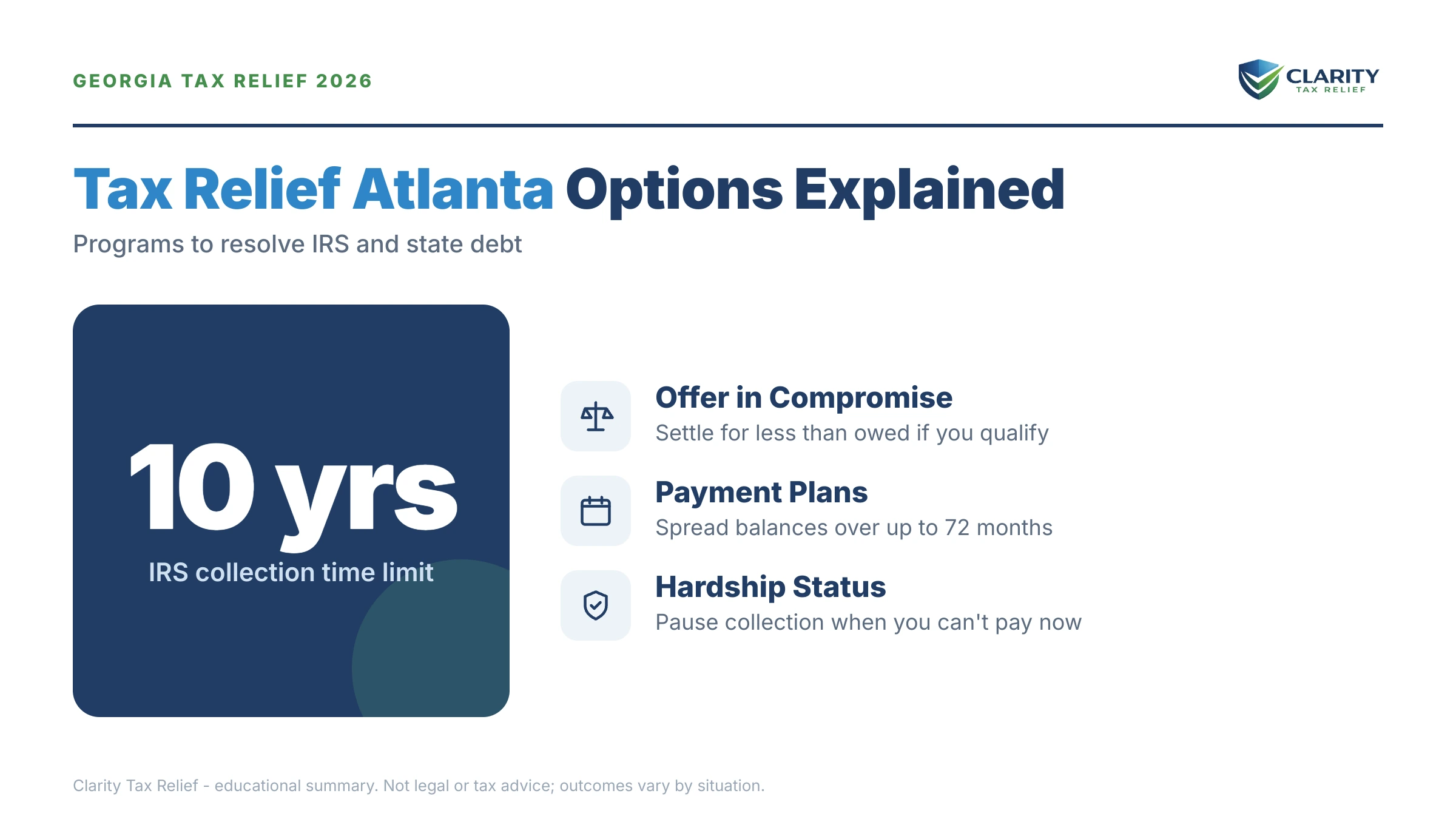
“An offer in compromise allows you to settle your tax debt for less than the full amount you owe. It may be a legitimate option if you can't pay your full tax liability or doing so creates a financial hardship.”
— Offer in compromise (IRS.gov)
What happens if you ignore IRS and Georgia tax debt
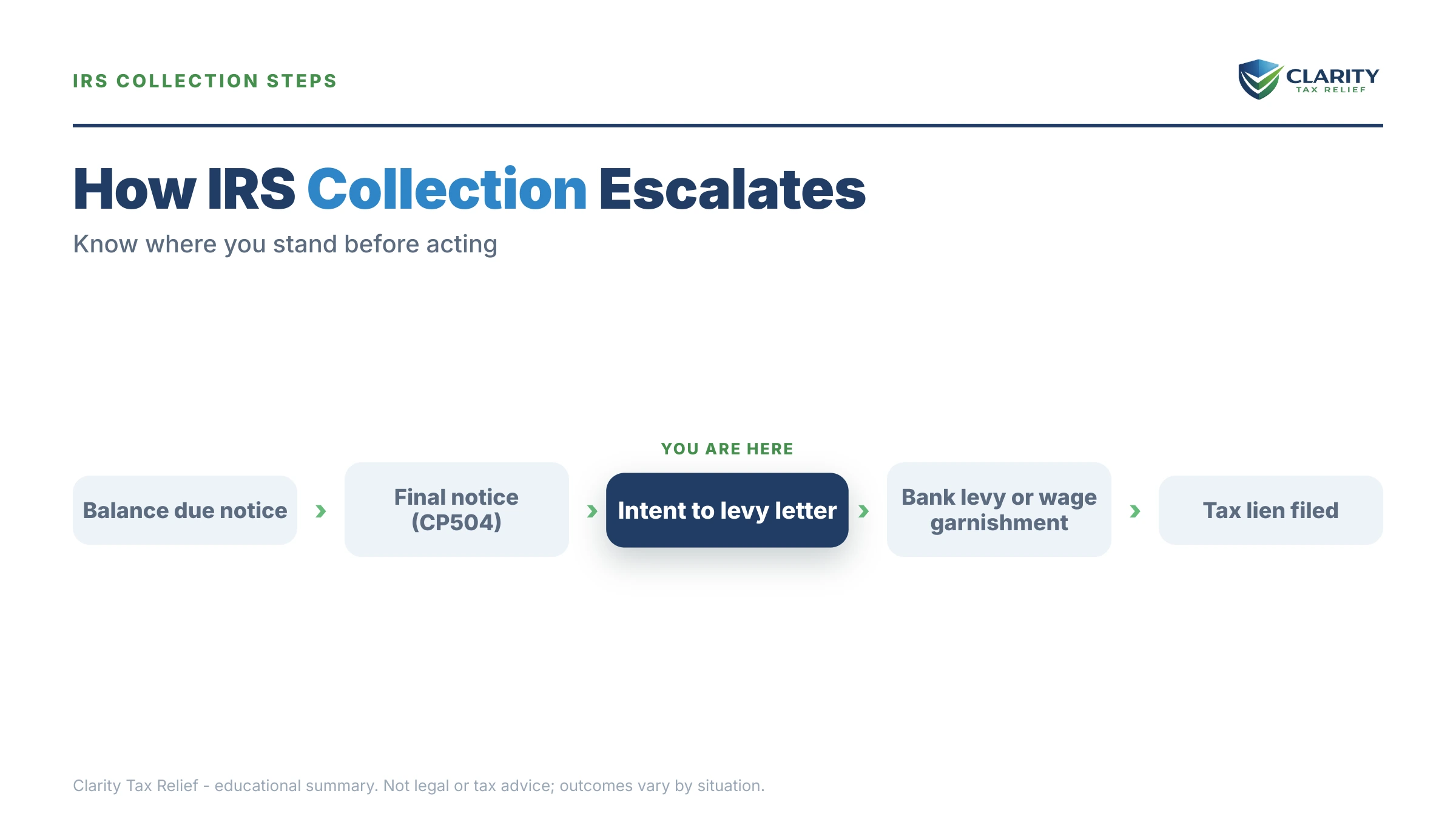
Unresolved tax debt in Atlanta escalates on two automated tracks at once, and neither track waits for the other. The federal sequence runs in a fixed order:
- CP14 — the first IRS bill. No enforcement yet; this is the cheapest stage to fix anything.
- CP501 / CP503 — reminder notices. Still just bills, but the balance compounds monthly.
- CP504 — Notice of Intent to Levy. The IRS can now seize your Georgia state tax refund, and a federal tax lien becomes a real possibility.
- LT11 / Letter 1058 — Final Notice of Intent to Levy. A 30-day clock starts, along with your Collection Due Process appeal rights (Form 12153).
- Levy — after the 30 days, the IRS can freeze a bank account (funds are held 21 days before they leave), garnish wages continuously, and, critical for retirees, take up to 15% of Social Security benefits through the Federal Payment Levy Program. Our guide to whether the IRS can garnish Social Security covers that levy in detail.
The Georgia DOR track runs in parallel: an official assessment, collection notices, then a recorded state tax execution, followed by garnishment or levy under state procedures. Georgia does not publish its stages as a tidy notice ladder the way the IRS does, which is exactly why state letters deserve immediate attention. There are fewer warning shots.
One 2026 reality worth naming: the IRS workforce was cut roughly 27% in 2025, so reaching a human is harder than ever. But the notices, liens, and levies are generated by automated systems that never stopped running. Silence from the IRS is not the same as safety.
Facing the IRS and the Georgia DOR at once?
Get your Atlanta tax situation reviewed free. An experienced tax professional will pull both balances, map which agency is closest to enforcement, and lay out your realistic options, before another month of penalties and interest posts to either account.
Tax relief Atlanta options: what each program requires
Every legitimate tax relief outcome in Atlanta comes from a specific government program with published eligibility rules. There is no negotiating trick outside them. Here is the full menu, federal and state:
| Program | Basic eligibility | Cost & what to expect |
|---|---|---|
| IRS short-term payment plan | Can pay in full within 180 days | $0 setup; interest and penalties continue, but enforcement stops |
| Guaranteed installment agreement | Individuals only; owe $10,000 or less in income tax (excluding penalties and interest); all returns filed; timely filing and payment for the past 5 years with no installment agreement in that period; and full payment within 3 years | Approval is required by law when the criteria are met; small setup fee |
| Streamlined installment agreement | Owe $50,000 or less; set up online for up to 72 months | Setup fee (reduced with direct debit); no financial disclosure needed |
| Currently Not Collectible (CNC) | Form 433-F shows income can't cover IRS allowable living expenses | $0; collection pauses, the debt remains, and the 10-year clock keeps running |
| Offer in compromise (OIC) | Offer must equal or exceed what the IRS calculates it could ever collect | $205 fee + 20% down on lump-sum offers — both waived with low-income certification |
| Penalty relief (FTA / AEP) | Clean compliance for the prior 3 years | Free to request; removes penalties, not the underlying tax |
| Georgia DOR payment agreement | Requested through the Georgia Tax Center | State terms differ from the IRS's 72 months — confirm current limits with the DOR |
| Georgia DOR offer in compromise | The state's own means-tested financial review | Separate application from the federal OIC; one does not resolve the other |
A few notes the table can't hold. The offer in compromise is real but heavily means-tested: the IRS computes your reasonable collection potential — equity in assets plus what your future income can pay — and only accepts offers at or above that number. It accepted roughly 1 in 5 offers in FY2024. You can get a preliminary sense of your own numbers with our Offer in Compromise Calculator before anyone charges you a dime to "evaluate" you.
On penalties: first-time abatement can erase a year's penalties if your prior three years were clean, and starting summer 2026 the IRS is rolling out the Automatic Exemption from Penalty (AEP), which applies similar relief automatically — no request needed. Don't pay a firm for penalty relief the IRS may grant on its own.
The step-by-step mechanics of applying for each federal program yourself are in our hub guide on how to settle tax debt yourself. This page stays focused on what's specific to an Atlanta case.
What owing $5,000 vs $50,000 changes for Atlanta taxpayers
Your IRS balance determines which doors are open, because the program thresholds are hard numbers, not judgment calls.
| IRS balance | Realistic options | What to watch |
|---|---|---|
| Under $10,000 | Guaranteed installment agreement; 180-day short-term plan | Don't pay a firm thousands to set up what takes one afternoon online |
| $10,000–$25,000 | Streamlined online plan up to 72 months; penalty relief | The $23,800 worked example below sits in this band |
| $25,000–$50,000 | Streamlined plan (direct debit above $25k); CNC or OIC if income won't stretch | Federal lien filing grows more likely as the balance ages |
| $50,000–$66,000 | Financial-disclosure agreements (Form 433-F); OIC | You're approaching the passport-certification line |
| Over $66,000 | Negotiated agreements, OIC, possible revenue officer assignment | At $66,000+ (the 2026 threshold) the IRS can certify your passport for denial or revocation |
Remember the Georgia balance rides on top of whichever band you're in. A $40,000 IRS debt plus a $9,000 DOR debt means two monthly payments, and any plan you propose to the IRS has to leave room in your budget for the state — a detail DIY filers routinely miss until one agreement defaults.
A worked example: an Atlanta retiree owing $23,800
Say you're retired in Decatur, living on $1,900 a month in Social Security. A retirement-account withdrawal from a few years back left you owing the IRS $23,800. Here's how the options actually price out — hypothetically, with the math shown:
- Do nothing: once the IRS notice sequence runs, the Federal Payment Levy Program can take 15% of your benefit — 15% × $1,900 = $285 a month, continuously, without ever touching the growing interest. On disability or fixed income? See IRS hardship on Social Security.
- 72-month streamlined plan: $23,800 ÷ 72 ≈ $331 a month as a floor — the real payment runs somewhat higher because interest and the 0.5% monthly failure-to-pay penalty keep accruing until the balance is gone. On $1,900 of income, that likely fails the affordability test.
- Currently Not Collectible: if a Form 433-F shows your rent, food, medical costs, and utilities consume the full $1,900, the IRS can pause collection entirely. The debt doesn't vanish, but levies stop and the 10-year collection statute keeps running (though certain actions pause it).
- Offer in compromise: with no home equity, no meaningful savings, and income fully consumed by allowable expenses, your reasonable collection potential could be far below $23,800. Better still, an AGI around $22,800 a year almost certainly falls at or below 250% of the poverty level, so low-income certification would waive the $205 fee, the 20% down payment, and payments during review. Acceptance is never guaranteed, but this is exactly the profile the program exists for.
The honest takeaway: for this retiree, CNC or an OIC beats a payment plan. A firm that pushes the payment plan because it's easiest to bill is doing you a disservice. Our full guide for retirees who owe back taxes goes deeper on fixed-income strategy.
How to start resolving your tax debt, step by step
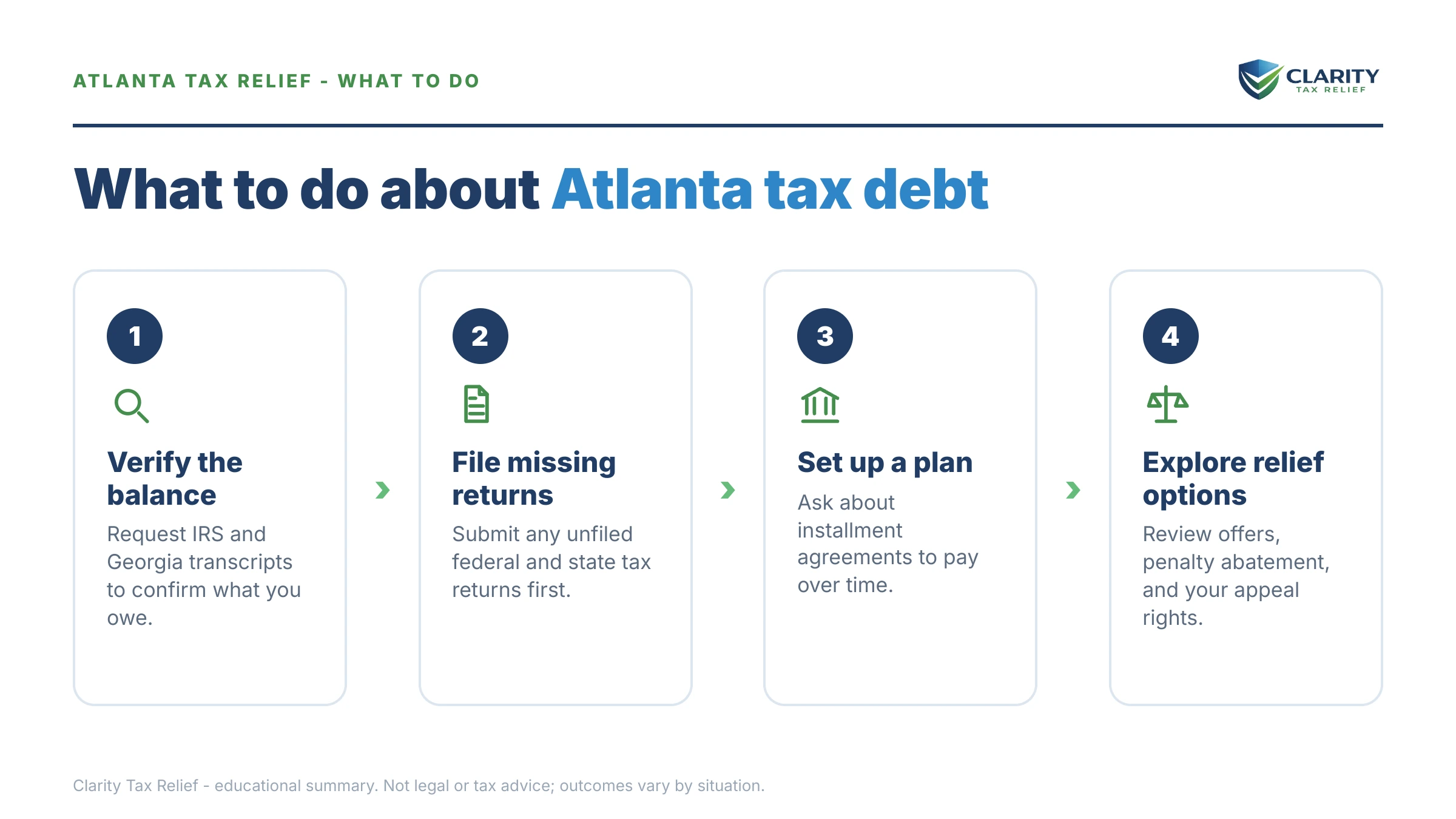
- Pull your records from both agencies. Log into your IRS online account for balances and transcripts, and into the Georgia Tax Center for any state balance. You need exact figures for each year before you can choose a program.
- File every missing return. Neither the IRS nor the Georgia DOR will approve a payment plan or an offer while returns are unfiled. Compliance comes first, and filing stops the worst penalty from growing.
- Match your numbers to a program. Use the eligibility table above. Your balance, monthly income, and assets determine whether a payment plan, hardship status, penalty relief, or an offer is realistic.
- Set it up before the next notice lands. IRS balances under $50,000 can go on a plan online in one sitting. Hardship status and offers require Form 433-F financials. Handle whichever agency is closest to levy first.
- Get a professional review if enforcement has started. A levy in motion, multiple unfiled years, or both agencies collecting at once are the situations where an experienced tax professional genuinely changes the outcome.
Free and low-cost tax debt help in Atlanta
Atlanta has genuinely free, credentialed help that most tax relief advertising never mentions. If your income qualifies, start here before paying anyone:
- Georgia State University's Philip C. Cook Low-Income Taxpayer Clinic represents lower-income taxpayers in disputes with the IRS at no charge — real representation, not just advice. Here's how low income taxpayer clinics work and who qualifies.
- The Taxpayer Advocate Service, an independent organization inside the IRS with a Georgia office, steps in when IRS delays or actions are causing financial hardship — details at taxpayeradvocate.irs.gov.
- The IRS Taxpayer Assistance Center in Atlanta handles in-person account questions by appointment only — call 844-545-5640 to schedule.
- VITA sites across metro Atlanta prepare tax returns free for qualifying taxpayers, which matters if unfiled years are blocking your resolution.
- Both agencies' self-service tools are free: IRS payment plans set up directly at IRS.gov/payments, and Georgia balances and payment agreements handled through the Georgia Department of Revenue's Georgia Tax Center.
When you can handle this yourself, and when help changes the outcome
Most Atlanta taxpayers with a single, modest balance do not need to hire anyone. Handle it yourself when you owe under $25,000 with steady income (the streamlined online plan takes about an hour), when you're holding a first notice you agree with, or when your only issue is a penalty that first-time abatement or the new AEP can remove. The DIY playbook in how to settle tax debt yourself covers each of those start to finish.
Experienced help earns its fee in a narrower set of situations: a levy or garnishment already in motion, the IRS and the Georgia DOR collecting simultaneously, multiple unfiled years that need reconstructing, offer-in-compromise math on a fixed income, or a business balance — where the analysis changes enough that we wrote a separate guide to tax relief for small business.
If you do hire, vet before you pay. Insist on a credentialed person (enrolled agent, CPA, or attorney) assigned to your case, a written flat fee tied to a defined scope, and no settlement promises before anyone has seen your financials — any firm quoting an outcome first is selling, not analyzing. Our checklist on how to choose a tax relief company lists the exact questions to ask, and if you're comparing the big national advertisers, start with our Optima Tax Relief alternatives breakdown. Realistic pricing benchmarks are in how much does tax relief cost.
Not sure which side of that line you're on? Send us both stacks of letters — an experienced tax professional will tell you honestly, free, whether your case is a DIY afternoon or a representation case: request your free review.
Tax relief in Atlanta: questions people ask
Do I need a local Atlanta tax relief company, or can a national firm handle my case?
For IRS debt, location doesn't matter — representation happens by phone, mail, and fax through Form 2848, and IRS collections are run from centralized campuses, not an Atlanta office. What matters is the credential (enrolled agent, CPA, or attorney), a written flat-fee scope, and whether the firm actually works Georgia DOR cases if you have a state balance too.
Can the IRS garnish Social Security in Georgia?
Yes. Through the Federal Payment Levy Program, the IRS can take up to 15% of your monthly Social Security benefit, and Georgia residency doesn't change that. The levy is continuous until the debt is resolved or your account is placed in hardship status. If losing 15% leaves you unable to cover basic living expenses, you can request a release for economic hardship.
Does Georgia have its own tax relief programs?
Yes, and they are completely separate from the IRS's. The Georgia Department of Revenue offers installment payment agreements set up through the Georgia Tax Center and runs its own offer-in-compromise program with its own forms and financial review. An IRS payment plan does nothing for a Georgia balance, and a Georgia agreement does nothing to stop IRS collection.
Should I resolve my IRS debt or my Georgia DOR debt first?
Prioritize whichever agency is closest to enforcement — a final intent-to-levy letter beats a first bill from the other side. The two agencies don't coordinate, so a payment plan with one never pauses the other, and in most cases you end up setting up arrangements with both. If neither has issued a final notice, most people start with the IRS because the balance is usually larger and grows faster.
Can I settle IRS tax debt for less while living on Social Security?
Possibly — an offer in compromise is means-tested. A fixed Social Security income with no significant assets can produce a low reasonable collection potential. If your AGI is at or below 250% of the federal poverty level, low-income certification waives the $205 application fee, the 20% down payment, and payments during review. The IRS accepted roughly 1 in 5 offers in FY2024, so qualifying is real but never guaranteed.
How much does hiring tax relief help in Atlanta cost?
It depends on the work: a simple payment-plan setup should cost little or nothing to do yourself, while representation on levies, offers in compromise, or multi-year cases is priced by scope. Insist on a written flat fee tied to specific deliverables before paying anything. Be wary of any firm that quotes a settlement amount before reviewing your financials — the IRS's math, not a sales pitch, decides what you can settle for.
How long can the IRS and Georgia collect back taxes?
The IRS generally has 10 years from the date a tax is assessed to collect, though appeals, offers in compromise, and bankruptcy pause that clock. Georgia runs its own collection timeline under state law. It is not the same as the federal rule — never assume a Georgia balance expires on the IRS's schedule. Confirm your state dates directly with the Georgia Department of Revenue.
Is there free tax debt help in Atlanta?
Yes. Georgia State University's Philip C. Cook Low-Income Taxpayer Clinic represents lower-income taxpayers in IRS disputes at no charge, the Taxpayer Advocate Service helps when IRS delays are causing hardship, and VITA sites prepare returns free if unfiled years are part of your problem. These are real, credentialed resources, if your income qualifies, try them before paying anyone.
Your next 24 hours
- Sort your letters into two stacks, IRS and Georgia DOR, and find the most recent date and amount on each. Any letter with the word "levy" or "execution" goes to the top.
- Gather three things: your last filed tax return, your income records (for a retiree, the Social Security benefit statement). A rough list of your monthly living expenses. Every program decision starts from those numbers.
- Book your free Atlanta case review — the 2-minute form at claritytaxrelief.com/#consult or a call to (888) 825-7779 — before another month of penalties and interest posts to either balance.
This guide is general information, not tax or legal advice for your specific situation. Eligibility for IRS programs depends on individual facts and circumstances; no outcome is guaranteed.