
Tax Liens
Does an IRS Tax Lien Expire? Self-Release, the 10-Year Rule, and Refiling (2026)
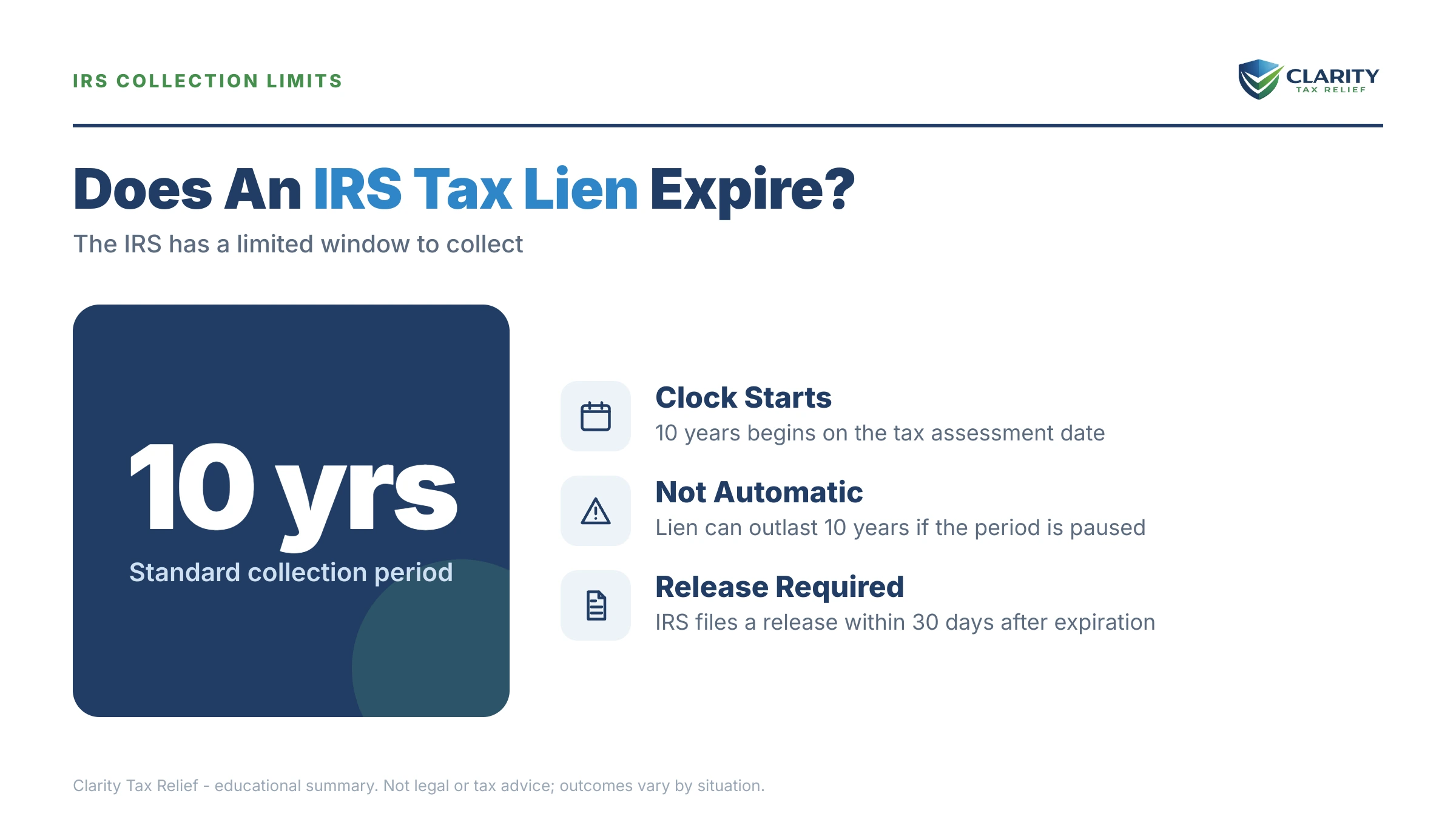
The short answer: yes — an IRS tax lien does expire. It ends when the 10-year collection statute (CSED) on the underlying tax runs out, and the filed lien notice contains a self-release clause: if the IRS doesn't refile it by the "Last Day for Refiling" printed on the form, the lien releases automatically. Tolling events can push that date back.
Maybe a lender's title search surfaced it, or you looked yourself up at the county recorder and found a Notice of Federal Tax Lien with your name on it. Your first instinct, can I just outlast this thing?, is a fair question with a real answer. The answer is yes, eventually, but the expiration date is trickier than "ten years," and if you have unfiled returns, part of your clock may never have started at all.
The expiration date isn't a secret, either — it's printed on the lien document itself. The image below shows exactly what a filed Notice of Federal Tax Lien looks like and where to look for the refile date that controls when it ends.
⏱ The real clock: An IRS tax lien generally ends 10 years after the tax was assessed — the collection statute expiration date. But offers in compromise, bankruptcy, and appeals pause that clock, and the IRS can refile the lien before the "Last Day for Refiling" date printed on your notice. Find that date before you decide to wait.
Does an IRS tax lien expire? The 10-year rule and the self-release clause
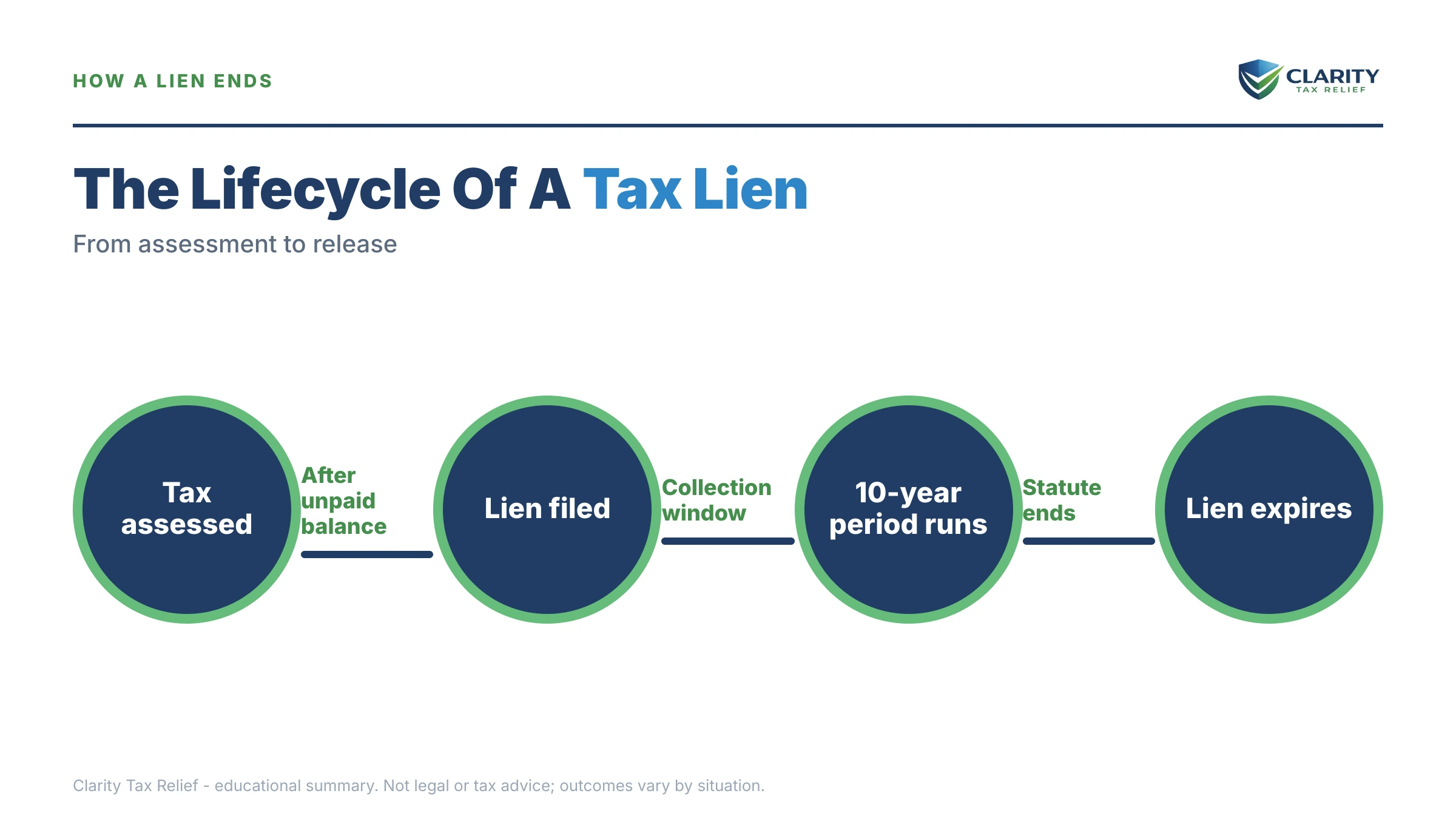
A federal tax lien becomes legally unenforceable when the 10-year collection statute on the underlying tax debt expires. The lien exists because of the debt: under IRC §6321, it arises automatically once the IRS assesses a tax, sends a demand for payment. You don't pay. Under IRC §6322, it lasts until the debt is satisfied, or becomes unenforceable "by reason of lapse of time." That lapse is the 10-year collection statute (CSED), which starts on each year's assessment date.
The public filing works the same way. When the IRS records a Notice of Federal Tax Lien — Form 668(Y), announced to you by Letter 3172 — the form itself contains built-in release language. In plain terms it says: unless the IRS refiles this notice by the date shown in the "Last Day for Refiling" column, the filing operates as a certificate of release the very next day. No court, no request, no new paperwork. The document expires on its own face.
Three details matter before you circle a date on the calendar:
- Each tax year has its own clock. One lien filing often covers several years, each with its own assessment date and its own CSED. Part of a lien can expire while the rest stays enforceable.
- The clock starts at assessment, not the tax year. A 2021 tax assessed in 2024 runs to roughly 2034, not 2031.
- The clock can pause. More on tolling below; it's the single most common reason people miscalculate their date.
If you're already doing this math in your head, you can estimate your own dates with our CSED Calculator. It estimates the baseline expiration for each assessment and flags the events that commonly move it.
“Paying your tax debt - in full - is the best way to get rid of a federal tax lien. The IRS releases your lien within 30 days after you have paid your tax debt.”
— Understanding a federal tax lien (IRS.gov)
Why your federal tax lien may not expire on schedule
Tolling events pause the 10-year statute, and a paused statute means a lien that outlives its expected expiration date. When you take an action that legally blocks the IRS from collecting — a pending offer in compromise, a bankruptcy, a Collection Due Process hearing, an innocent spouse request, extended time living abroad — the clock stops while it's pending, often with extra time added afterward. The full list lives in our guide to what pauses the 10-year clock.
When tolling extends the CSED past the original refile deadline, the IRS can refile the lien notice within a limited statutory window. It does, especially on larger balances. A refiled lien keeps the public claim alive through the extended date. If the IRS misses that window, the lien self-releases even if some collection time technically remains on the debt itself.
Here is which date controls what — pulled together in one place, because these get confused constantly:
| The date | What it controls | Your right or the effect |
|---|---|---|
| Letter 3172 response deadline (printed on the letter) | Your window to appeal the lien filing itself | Collection Due Process hearing, requested on Form 12153 |
| Assessment date (transcript code 150 or 290) | Starts the 10-year collection statute for that year | Baseline CSED — when that year's lien becomes unenforceable |
| "Last Day for Refiling" (Form 668(Y), column e) | The IRS's deadline to refile and keep the lien alive | No refile by this date = the notice self-releases the next day |
| Date of full payment | Ends the lien early, regardless of the CSED | Certificate of Release (Form 668(Z)), typically within about 30 days |
One more wrinkle if you also owe a state: state liens run on state clocks, not the IRS's. California's Franchise Tax Board, for example, can collect for 20 years under R&TC §19255 — an FTB tax lien can outlive a federal one on the same income by a decade.
Never filed? Then the lien clock hasn't started
An unfiled tax year has no assessment, and with no assessment, the 10-year countdown never begins. This is the trap for anyone hoping to wait out old gig income, contractor pay, or side-hustle years they never reported. You can't outlast a clock that isn't running.
What usually happens instead: the IRS eventually files a substitute for return (SFR) using your 1099s, assesses the result, and that assessment starts the 10 years, often several years after the return was due. Worse, an SFR ignores your deductions: no mileage, no supplies, no business expenses, usually single filing status. For a gig worker, the SFR balance is routinely far higher than what a real Schedule C return would show.
So if your lien situation includes unfiled years, filing those returns isn't just a compliance chore — it's the move that starts the clock, usually shrinks the debt, and unlocks every resolution program (the IRS won't approve payment plans or offers while required returns are missing).
What happens if you just wait out the lien
Waiting out a federal tax lien means living with active IRS collection for every remaining year on the clock. The lien is the claim, not the weapon, and the two operate on separate tracks. Here's the sequence you're signing up for, stage by stage:
- The lien keeps attaching. It covers everything you own now and everything you acquire later — a car, a first home, an inheritance all pick up the lien on arrival.
- Sales and refinances stall. The filing sits in the county's tax lien public record, so any title search surfaces it and closings freeze until it's addressed — including on a house with an IRS lien you try to sell.
- Collection runs in parallel. The lien doesn't replace levies. The IRS can still take your bank account, issue levies on 1099 payments from your gig platforms, and keep every tax refund until the debt is gone.
- The balance keeps growing. Interest compounds and the failure-to-pay penalty accrues monthly, so the number the lien secures gets bigger every month you wait. (And if it ever grows past $66,000, the 2026 threshold, passport certification enters the picture.)
- Near the 10-year mark, the IRS checks the refile question. If tolling extended your CSED, expect a refiled notice rather than a quiet expiration.
- Only then: self-release. If nothing tolled the statute and no refile lands by the printed date, the lien releases by operation of law.
In 2026, don't count on staffing chaos to save you. The IRS workforce shrank roughly 27% in 2025, but lien filings, refiles, and levies run on automated systems that never took a furlough.
Want to know your lien's real expiration date?
Interest and penalties are accruing on the balance behind that lien every month it sits on the record. Send us your lien notice — an experienced tax professional will pull your transcripts, map every CSED, and tell you whether waiting or resolving is cheaper. Free and confidential.
Your options: end the lien before it expires on its own
Every path below ends the lien sooner than the CSED, and several also clean up the public record in ways expiration alone never will. Which one fits depends on your balance, your income, and whether you're current on filings:
| Option | What happens to the lien | Who it fits |
|---|---|---|
| Pay in full | Released — Certificate of Release typically issues within about 30 days | Anyone who can pay; fastest clean ending |
| Direct-debit installment agreement + withdrawal request | Lien notice can be withdrawn (erased from the record, not just released) | Balance of $25,000 or less (or paid down to it), typically after three consecutive direct-debit payments |
| Standard streamlined installment agreement | Lien stays until payoff, then releases; enforcement stops meanwhile | Balances up to $50,000, up to 72 months, set up online |
| Offer in compromise | Released after you complete all offer terms | Means-tested; the IRS accepted roughly 1 in 5 offers in FY2024. You may qualify only if income and assets genuinely can't cover the debt |
| Currently Not Collectible status | Levies pause, but the lien remains, and may be filed if it hasn't been yet | Documented financial hardship; the CSED keeps running |
| Discharge of specific property | Lien removed from one asset so a sale can close | Selling a home or other property; IRS is usually paid from equity |
| Subordination | Lien steps behind a new loan so a refinance can fund | Refinancing when the new loan helps the IRS get paid |
| Wait for self-release at the CSED | Lien ends by operation of law if no refile by the printed date | Debts genuinely near the 10-year mark with no tolling events |
A few of these deserve a closer look. Withdrawal beats release when you care about the record: a release says "debt satisfied or expired," while a withdrawal — requested on Form 12277 — pulls the notice as if it shouldn't stand, the cleanest outcome for future lenders. Discharge runs through Form 14135 and subordination through Form 14134; both are property-specific fixes, not debt fixes. And note the CNC row carefully — hardship status pauses levies but does not stop a tax lien from being filed or staying filed. Once any path ends the lien, our hub on getting a lien released after payment covers the timing and paperwork.
Worked example: $13,600, three unfiled years, one lien
Say you drove delivery and did app gigs from 2021 through 2023, never filed. The IRS eventually built returns for you and filed a lien. Purely hypothetically, your account might look like this:
| Tax year | Status | Expiration clock |
|---|---|---|
| 2021 | SFR assessed June 2024 — $5,900 | Baseline CSED ≈ June 2034 |
| 2022 | SFR assessed June 2025 — $7,700 | Baseline CSED ≈ June 2035 |
| 2023 | Never assessed | No clock running at all |
Waiting out this lien means carrying it until at least mid-2035 — nine more years of blocked refinances, refund offsets, and levy exposure on a $5,900 + $7,700 = $13,600 balance that grows monthly. And 2023 would still be sitting there, clockless, waiting to be assessed and lien-ed on top.
Now the alternative. You file real returns for all three years with your mileage and expenses, SFRs claimed none of them, and suppose the assessed total drops from $13,600 to about $9,200 (hypothetical, but directionally typical for gig SFRs). On a 72-month plan, $9,200 ÷ 72 ≈ $128/month before accruing interest and penalties (your actual payment runs somewhat higher to cover them). Because you're under $25,000 on direct debit, after typically three consecutive payments you can request withdrawal of the lien notice on Form 12277. Realistic outcome: the lien off the record in months, versus on the record until 2035.
How to respond to an IRS tax lien, step by step
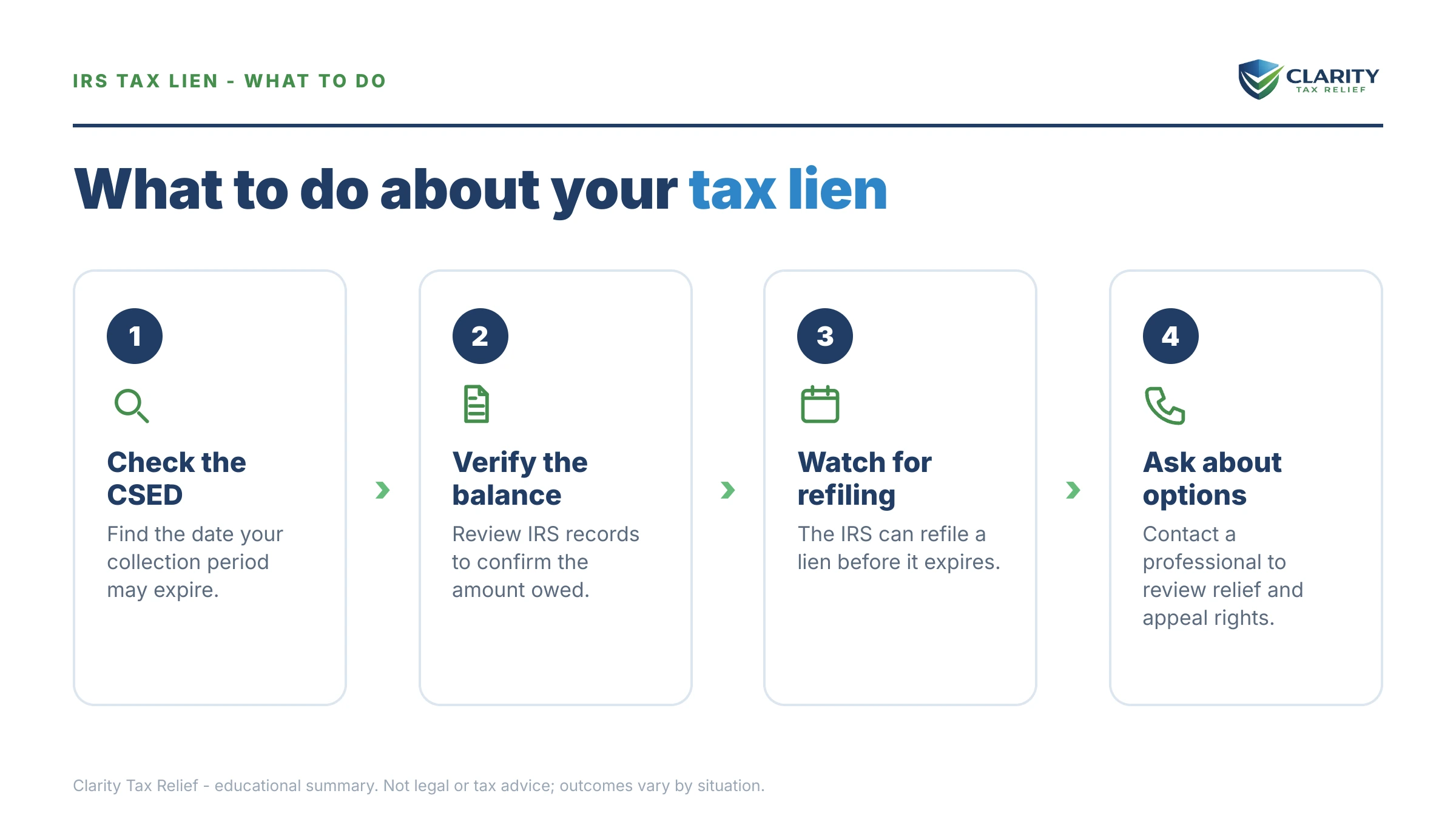
- Pull your IRS account transcripts. The assessment date for each balance-due year (transaction code 150 or 290) plus 10 years is your baseline expiration date.
- Find the "Last Day for Refiling" on your lien notice. Column (e) of Form 668(Y) shows the date that controls whether the lien self-releases or can be extended.
- File any unfiled returns. A year with no assessment has no clock running at all, and replacing an SFR with a real return often lowers the balance the lien secures.
- Map your tolling events. Note any offer in compromise, bankruptcy, or collection appeal on your transcript — each one pushed your expiration date back.
- Choose the path that ends the lien soonest. Compare a direct-debit payment plan with withdrawal, an offer in compromise, or a documented wait to self-release.
- Confirm the release in county records. Once the lien ends, verify the release was recorded and request a Certificate of Release if anything is missing.
When you can handle this yourself
Plenty of lien-expiration questions don't need professional help. You can confidently go it alone when:
- You can pay in full. Pay at IRS.gov/payments, wait for the release, and confirm it recorded. Done.
- You have one assessed year, a clean transcript. A balance under $25,000. A direct-debit plan set up online plus a Form 12277 withdrawal request is genuinely DIY-able.
- Your CSED is months away with zero tolling events. If the transcript is clean and the refile date is about to pass, documented patience is a legitimate plan.
Experienced help changes the outcome when the facts get layered — which, with a lien plus unfiled years, they usually are:
- Multiple SFR years to reconstruct. Replacing IRS-built returns with real ones (and getting the reduced balances accepted) is where most of the dollar savings in a case like the example above actually live.
- Tolling events muddy the math. An old bankruptcy, a withdrawn offer, or a CDP hearing can shift a CSED by years. Miscounting means waiting a decade for a date that isn't coming.
- A sale or refinance is on a deadline. Discharge and subordination packages have real lead times, and a fumbled application can kill a closing.
- The lien has company. If a levy is already in motion or a revenue officer is assigned, the lien is the least urgent item on the list.
The IRS's own overview is worth reading too: Understanding a federal tax lien. If lien paperwork is stuck in processing and causing hardship, the Taxpayer Advocate Service can intervene at no cost.
Terms on your lien notice, decoded
- CSED — Collection Statute Expiration Date: the day the 10-year collection window closes for a given assessment. The lien tied to it becomes unenforceable.
- Self-release clause — language printed on Form 668(Y) making the filing operate as its own release if the IRS doesn't refile by the stated date.
- Refile — a new filing of the lien notice, made within a limited window, that keeps the lien alive when the CSED has been extended.
- Release vs. withdrawal — a release (Certificate of Release of tax lien, Form 668(Z)) says the lien ended. A withdrawal removes the notice from the record entirely, as if it shouldn't stand.
- Discharge — removal of the lien from one specific property so it can be sold; the debt and the lien on everything else remain.
- Subordination — the IRS agreeing to let a new lender's claim jump ahead of the lien, usually so a refinance can close.
If your transcripts show SFR assessments or tolling events you can't decode, a free review with an experienced tax professional can map every date in one pass — call (888) 825-7779 or use the 2-minute form.
IRS tax lien expiration: your questions, answered
Does an IRS tax lien expire after 10 years?
Generally yes. The lien is tied to the 10-year collection statute (CSED), which starts on the date each tax was assessed. The filed lien notice self-releases if the IRS doesn't refile it by the 'Last Day for Refiling' printed on the form. The catch: tolling events like an offer in compromise, bankruptcy, or a collection appeal pause the clock and push the date back. The IRS can refile when they do.
Does the 10-year lien clock run if I never filed my returns?
No. The CSED starts at assessment, and an unfiled year has no assessment, so the clock never starts. If the IRS files a substitute for return (SFR) for you, that assessment starts the 10 years, usually with a balance higher than you'd owe on a real return because it ignores your deductions. Filing your own returns is almost always the faster, cheaper path.
Can the IRS refile a tax lien before it expires?
Yes, but only within a limited statutory window that ends shortly after the original 10-year date — the exact deadline appears in the 'Last Day for Refiling' column on your Notice of Federal Tax Lien. The IRS typically refiles only when the CSED has been extended by tolling events. If it doesn't refile by that date, the lien self-releases by operation of law the next day.
Does an expired tax lien come off public records automatically?
The lien releases automatically, but the paperwork trail remains. The self-release clause on Form 668(Y) means the original filing operates as its own release once the refile date passes — no new document is required. County recorders, however, keep the historical filing on record, so title searches may still surface it. You can request a Certificate of Release, or in some cases a withdrawal, to clean up the record.
Is an IRS tax lien still on my credit report?
No. The three major credit bureaus removed all tax liens from consumer credit reports in 2018, so a lien no longer directly lowers your credit score. But it never left the public record — mortgage lenders, landlords, and employers who run public-records or title searches will still find it, which is why liens still block refinances and home sales.
Can I sell or refinance my house while waiting for a lien to expire?
Yes, but not by ignoring the lien. For a sale, you can apply for a discharge with Form 14135, which removes the lien from that specific property (the IRS usually gets paid from your equity at closing). For a refinance, Form 14134 asks the IRS to subordinate — let the new loan jump ahead of the lien so it can close.
What pauses the 10-year collection statute?
The main tolling events are a pending offer in compromise, bankruptcy, a Collection Due Process hearing, an innocent spouse request, and extended time living outside the U.S. Each one stops the clock while it's pending, often plus extra time afterward, so a lien you expected to expire in 2026 can quietly run years longer. Your IRS account transcripts show the events; the math takes care.
Is waiting out the 10 years a real strategy?
Sometimes, but only when the CSED is genuinely close, no tolling events have moved it. You can live with a lien and active collection in the meantime. The lien doesn't stop levies: the IRS can still take your bank account, levy 1099 payments, and offset every refund while the clock runs. For most people more than a few years from the CSED, resolving the debt costs less than waiting.
How do I find out exactly when my tax lien expires?
Start with your IRS account transcripts: the assessment date for each year (transaction code 150 or 290) plus 10 years is the baseline CSED. Then check the 'Last Day for Refiling' column on your copy of the lien notice, and account for any tolling events shown on the transcript. You can also ask the IRS directly, in writing, for your CSED dates.
Does bankruptcy remove an IRS tax lien?
No — bankruptcy can discharge your personal liability for qualifying tax debt. But a lien filed before the bankruptcy survives against property you owned at filing. That means the IRS can't pursue you personally, yet it still holds a claim on your pre-bankruptcy equity. Bankruptcy also pauses the 10-year clock, pushing the lien's expiration date further out.
For more on how liens interact with bankruptcy specifically, see does bankruptcy remove a tax lien.
Your next 24 hours
- Find the date that controls everything. Pull your copy of the lien from the county recorder (or your Letter 3172 packet) and locate the "Last Day for Refiling" in column (e) of Form 668(Y).
- Gather your paper trail. Your last filed return, the lien notice, and the 1099s or income records for any unfiled years — that's everything needed to map your real clocks.
- Get the free case review. Interest and penalties accrue on the balance behind that lien every month it stands. Use the 2-minute form or call (888) 825-7779 and an experienced tax professional will map every CSED and price your fastest path off the record.
This guide is general information, not tax or legal advice for your specific situation. Eligibility for IRS programs depends on individual facts and circumstances; no outcome is guaranteed.