
Self-Employed & 1099 Taxes
Zelle Taxes in 2026: Is Money Received Through Zelle Taxable?
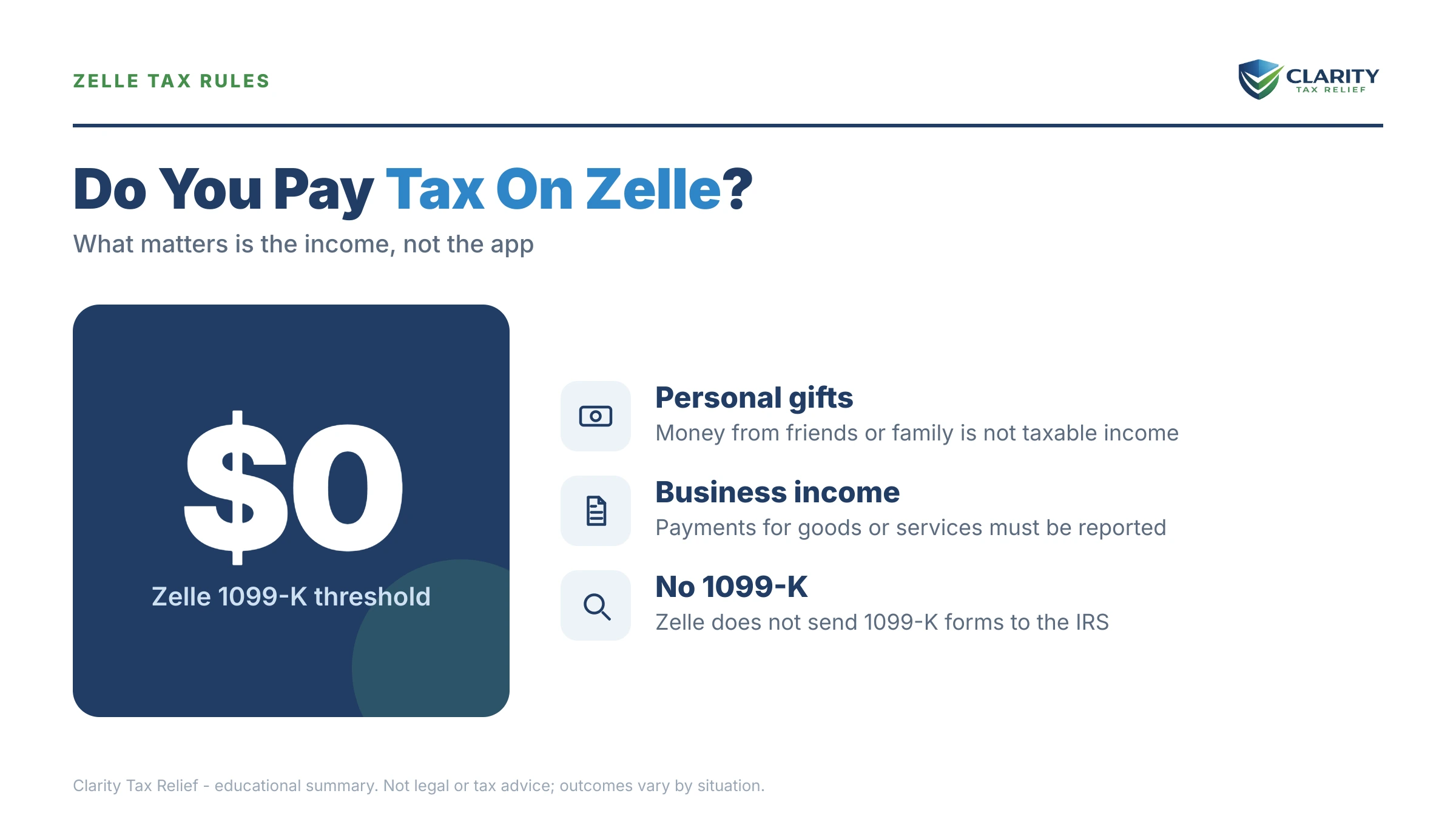
The short answer: yes. You have to pay tax on Zelle payments that are income, like payments from clients or customers. But Zelle itself never issues Form 1099-K at any dollar amount, because it's a bank-to-bank transfer network, not a payment app under IRC §6050W. Personal transfers — gifts, rent splits, repayments — are never taxable.
A client just Zelle'd you $120 for a cut and color, a co-worker at the salon swears Venmo money "gets reported" but Zelle doesn't, and now you're wondering whether you've been quietly building a tax problem all year. So — do you have to pay tax on Zelle? If the money is payment for your work, yes, every dollar. What you'll never get is a form: Zelle is the one major payment name that files zero Forms 1099-K, and most articles online get that half of the answer wrong. This guide covers both halves — why no form arrives, and why the tax is still real.
⏱ The real clock: Zelle sets no deadline — the tax code does. If you net $400 or more from self-employment in a year, you must file a return, and any unpaid tax accrues a 0.5% monthly failure-to-pay penalty plus interest until it's paid. Expect to owe $1,000 or more? Estimated payments come due four times a year.

Why Zelle never sends a Form 1099-K: at any amount
Zelle has never issued a Form 1099-K to any user, for any dollar amount, in any tax year, and that's by legal design, not oversight. Form 1099-K reporting under IRC §6050W applies to payment card processors and third-party settlement organizations (TPSOs) — companies like PayPal that stand in the middle of a transaction, hold the money, and settle it between buyer and seller.
Zelle doesn't do that. It's a messaging network operated by Early Warning Services (a company owned by several of the largest U.S. banks) that instructs your bank to move money directly into someone else's bank account. Zelle never holds or settles funds, so it never meets the legal definition of a TPSO. A company that isn't a TPSO has no 1099-K to file, whether you receive $500 or $500,000.
Two things follow from that, and both matter:
- No threshold applies to Zelle, not $600, not $20,000. Thresholds only matter for platforms that file 1099-Ks. Zelle files none, so there is no amount that "triggers" a form.
- Zelle's exemption doesn't transfer to your clients. A business that pays you $600 or more for services in a year is still required to send you a Form 1099-NEC, even if every payment came through Zelle. A salon owner paying booth renters through Zelle, for example, still has 1099-NEC duties.
“Reminder: Whether or not you receive a Form 1099-K, you must still report any income on your tax return. This includes payments for any goods you sell (including personal items such as clothing or furniture sold at a gain) or services you provide.”
— Understanding your Form 1099-K (IRS.gov)
Do you have to pay tax on Zelle if you never get a form?
The IRS taxes what you received, not which forms showed up in January. Income is taxable the moment you earn it — the 1099 system is just the IRS's cross-checking tool. So the absence of a Zelle 1099-K changes exactly one thing: the IRS doesn't get an automatic report of your Zelle receipts. It does not change what you owe.
And "no automatic report" is not the same as "invisible." Here's what the IRS can still see:
- Forms 1099-NEC from business clients. Any business that paid you $600+ for services should file one. The IRS matches those against your return by Social Security number; a mismatch can generate a CP2000 notice proposing extra tax automatically.
- Your bank records. Zelle payments land as ordinary deposits in your checking account. In an audit, an examiner runs an IRS bank deposit analysis — totaling every deposit and presuming each one is income unless you can document otherwise.
- Other filings that don't add up. A Schedule C showing $9,000 of income alongside rent, car payments, and card spending that require three times that is a classic audit-selection signal.
The pattern to understand: Zelle income isn't reported to the IRS proactively, but it's fully reconstructable retroactively, and once the IRS is reconstructing it, you've lost control of the numbers. (Related: once you owe, collection reaches your accounts too — see can the IRS take money from PayPal or Venmo.)
What happens if you don't report Zelle business income
Unreported self-employment income doesn't fail quietly. It compounds through a predictable sequence, and each stage is more expensive than the last:
- The return goes in short (or doesn't go in at all). Nothing happens right away — the IRS's matching programs run months after filing season. This silence is why people believe it "worked."
- Document matching catches a mismatch. If any client filed a 1099-NEC covering payments you left off, the automated underreporter program flags it and mails a CP2000 proposing the tax plus, typically, a 20% accuracy-related penalty.
- An audit widens the net. An examiner isn't limited to 1099s. Through bank deposit analysis, every Zelle deposit becomes presumed income, including the genuinely personal ones, unless you prove each one isn't. If you omitted more than 25% of your gross income, the IRS gets six years to audit instead of three. If you never filed, the clock never starts at all.
- Assessment becomes collection. The balance turns into a bill (a CP14), then the standard collection notice sequence toward liens and levies, with the 0.5%-per-month failure-to-pay penalty and daily interest accruing the entire time. Deposits that dramatically exceed reported income, done deliberately year after year, can also push the file from penalty territory toward civil fraud.
The math on stage order is simple: fixing this before the IRS finds it means tax plus interest. Fixing it after usually means tax plus interest plus penalties — on the IRS's reconstruction of your deposits, not your actual net income.
Took Zelle payments you never reported?
Every month it sits, the late-payment penalty and interest grow, and correcting it before the IRS contacts you is the cheapest version of the fix. Get a free, confidential review of exactly where you stand and the right order to clean it up.
Zelle vs. PayPal, Venmo, and Cash App: 1099-K rules for 2026
In 2026, PayPal, Venmo, and Cash App issue Form 1099-K only when business payments exceed $20,000 AND 200 transactions, and Zelle issues none at any amount. Congress killed the planned $600 rule and restored the original threshold. The full back-and-forth is covered in our guide to the 1099-K $20,000 threshold in 2026. What matters here is how the platforms compare today:
| Platform | Issues Form 1099-K? | 2026 federal threshold | Why |
|---|---|---|---|
| Zelle | Never — at any amount | None (no 1099-K exists for Zelle) | Bank-to-bank transfer network; not a TPSO under IRC §6050W |
| PayPal | Yes, for goods-and-services payments | $20,000 and 200 transactions | Holds and settles funds — a TPSO |
| Venmo | Yes, for goods-and-services / business payments | $20,000 and 200 transactions | Holds and settles funds — a TPSO |
| Cash App | Yes, for Cash App for Business accounts | $20,000 and 200 transactions | Business accounts are settled payments — TPSO reporting applies |
Two caveats. First, a handful of states set their own, lower 1099-K reporting thresholds, so a platform may send a form for state purposes even below the federal line. Second, and this is the trap — the taxability of your income is identical on all four platforms. The table above is about paperwork, not about what you owe.
Which Zelle payments are taxable, and which aren't
Only payments for goods, services, or rent are taxable when they arrive through Zelle — personal transfers never are. The IRS cares about the purpose of the money, not the app that carried it:
| Zelle payment you received | Taxable? | Where it's reported |
|---|---|---|
| Client pays $85 for a haircut and color | Yes — business income | Schedule C, gross receipts |
| Client sends a $20 tip after the appointment | Yes — tips are income | Schedule C, gross receipts |
| Tenant pays monthly rent (you're the landlord) | Yes — rental income | Schedule E |
| Customer pays for an item you sold at a profit | Yes — the gain is taxable | Schedule C or capital gain, depending on facts |
| Roommate sends half the rent | No — cost sharing, not income | Nothing to report; keep a note |
| Friend repays their share of dinner or a trip | No — reimbursement | Nothing to report |
| Parent sends you $500 as a gift | No — gifts aren't income to the recipient | Nothing to report |
| Sold your old couch for less than you paid | No — a personal-use loss (and it's not deductible either) | Nothing to report |
If your one checking account mixes both kinds, the fix is habit, not software: tag business Zelle payments as you receive them — a running note on your phone works, so that at tax time (or in an audit) you can separate the $85 color client from the $85 dinner repayment without guessing.
How much tax would you owe on $8,500 of Zelle income?
Say you're a self-employed hairdresser renting a chair, and clients Zelle'd you $8,500 this year. This is a hypothetical, but the math is real. Assume $1,300 of deductible costs (color, supplies, your share of booth rent) and that your other income puts you in the 12% bracket:
- Net profit: $8,500 − $1,300 = $7,200
- Self-employment tax: $7,200 × 92.35% = $6,649 × 15.3% ≈ $1,017
- Income tax: $7,200 − $509 (deduction for half the SE tax) = $6,691 × 12% ≈ $803
- Total federal tax: roughly $1,820 — about 21 cents of every Zelle dollar, before any state income tax
Now the cost of not reporting it. If the IRS finds that $8,500 through matching or an audit, the same $1,820 comes back with a 20% accuracy-related penalty (about $364), plus the 0.5%-per-month late-payment penalty and interest running from the original due date. The tax was always owed; silence only adds a surcharge.
Notice something else in the math: the $1,300 of expenses saved about $330 of tax. Untracked supplies and mileage are how Zelle-paid stylists overpay — our guides on hair stylist taxes owed on 1099 income and self-employment tax owed to the IRS go deeper on both sides of that ledger, and side hustle taxes and how much to save covers the set-aside habit that prevents the April surprise.
Already left Zelle income off a return? Your options
An amended return filed before the IRS contacts you is the cheapest fix for omitted Zelle income. The realistic menu, in the order most people should consider it:
- Amend with Form 1040-X. Add the income, claim the expenses you're entitled to, and pay what you can with the amendment. Voluntary correction typically means tax plus interest plus the late-payment penalty, without the 20% accuracy-related penalty an IRS-initiated correction usually carries.
- File any unfiled years first. If you skipped filing entirely because of the Zelle income, filing is step one. It starts the statute of limitations and stops the far larger failure-to-file penalty, which runs at ten times the failure-to-pay rate (5% per month versus 0.5%, capped at 25% of the unpaid tax. In months where both penalties apply, the failure-to-file portion is reduced to 4.5%).
- Set up a payment plan for the balance. Under current IRS rules, up to 180 days costs nothing to set up. Balances of $50,000 or less can generally go on a monthly agreement online — plans have commonly run up to 72 months, though the IRS sets the exact term based on your balance and the collection deadline, so check current terms at IRS.gov. Interest and penalties keep accruing on a plan, but enforcement stops.
- Ask for penalty relief. With a clean three-year compliance history, first-time penalty abatement can remove the late penalties, and starting summer 2026, the IRS's new Automatic Exemption from Penalty (AEP) applies some of that relief automatically, no request needed.
Before you decide anything, put a number on the problem: our IRS Penalty & Interest Calculator estimates what penalties and interest have added to an unreported balance so far.
How to report Zelle income, step by step
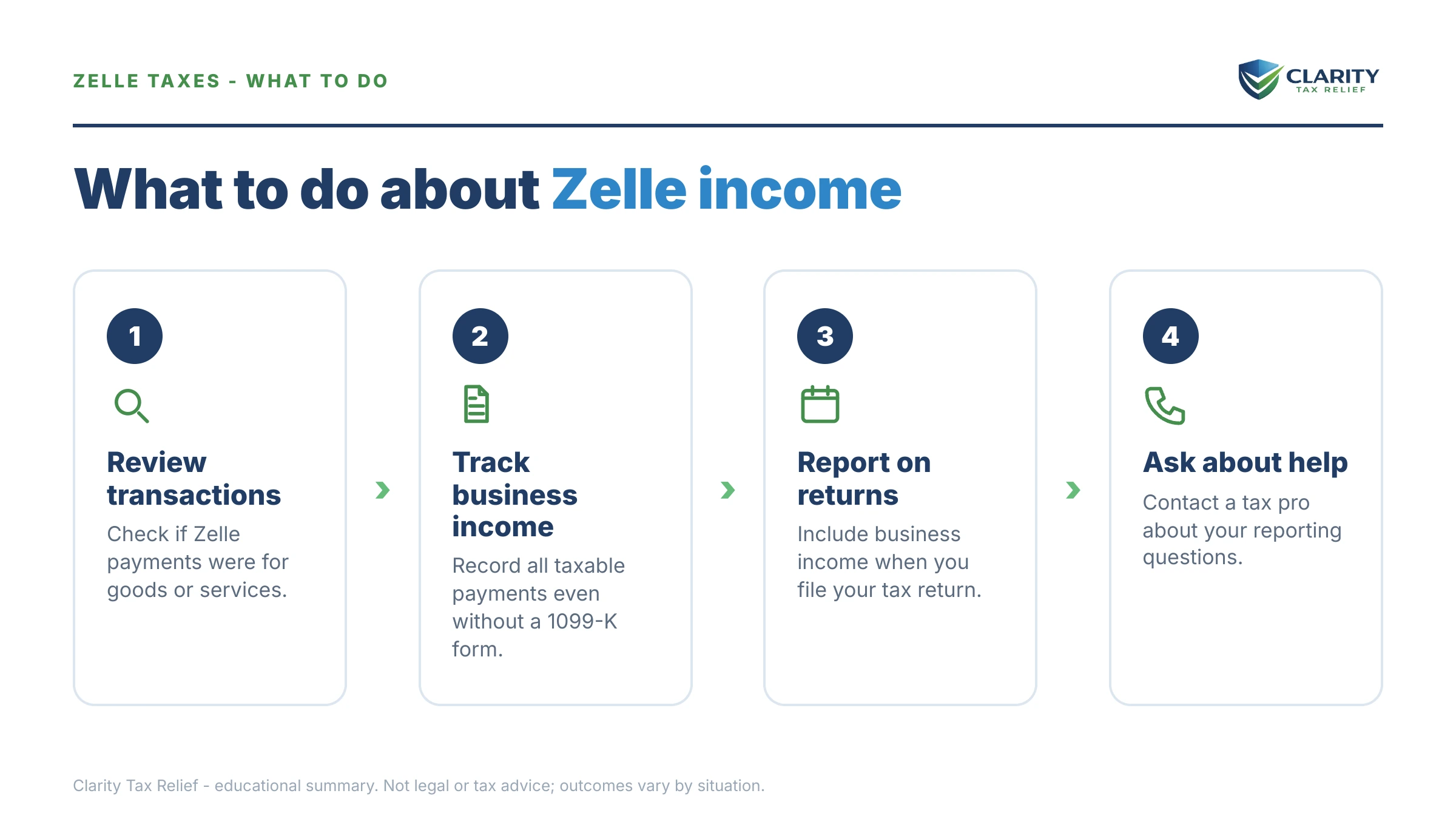
- Total your Zelle business receipts. Pull your bank statements or Zelle activity for the year and add up every payment that was for your work — separate out gifts, repayments, and personal transfers.
- Tally your deductible expenses. Gather receipts for supplies, booth or chair rent, tools, and business mileage — every legitimate expense lowers both income tax and self-employment tax.
- Report the net profit on Schedule C. Enter your gross Zelle receipts on Schedule C, line 1, subtract expenses, and attach it to your Form 1040 — no 1099 is needed to report income.
- Calculate self-employment tax on Schedule SE. If your net profit is $400 or more, complete Schedule SE. You owe 15.3% self-employment tax on 92.35% of net earnings. You can deduct half of it.
- Set up quarterly estimated payments. If you expect to owe $1,000 or more for the year, pay quarterly with Form 1040-ES so an underpayment penalty doesn't stack on top next April.
The quarterly piece trips up almost every first-year Zelle earner — how quarterly estimated taxes work walks through the dates and the safe-harbor math, and first year self-employed and owe taxes covers the April surprise if it already happened.
When you can handle Zelle taxes yourself, and when to get help
Most current-year Zelle reporting is a do-it-yourself job. If your records are intact, it's one tax year. You can pay what the return shows, any decent tax software handles Schedule C and Schedule SE. You don't need to hire anyone to type in $8,500 of receipts.
Experienced help changes the outcome in a narrower set of situations: multiple unfiled years, where filing order and penalty strategy matter. A CP2000 or audit letter already in hand, where the IRS's proposed numbers usually ignore your expenses. Deposits that far exceed reported income across several years, where anything you say can worsen the exposure. Or a balance you genuinely can't pay, where the right resolution program depends on financial analysis. In those cases, an experienced tax professional's review before you respond is worth far more than after.
Terms in this guide, decoded
- Form 1099-K — the information return payment platforms and marketplaces file when business payments cross the reporting threshold; Zelle never files it.
- Third-party settlement organization (TPSO) — a company that holds and settles payments between buyers and sellers. Only TPSOs have 1099-K duties, and Zelle isn't one.
- IRC §6050W — the tax-code section that created 1099-K reporting and defines who must file it.
- Schedule C — the form where sole proprietors report business income and expenses on their personal return.
- Bank deposit analysis — the audit technique where every deposit into your accounts is presumed taxable income unless you prove otherwise.
- Accuracy-related penalty — a 20% penalty on tax understated through negligence or a substantial understatement, commonly proposed on unreported income.
Zelle tax questions, answered
Does Zelle report to the IRS?
No. Zelle does not report your payments to the IRS and does not issue Form 1099-K at any dollar amount, because it is a bank-to-bank transfer network rather than a third-party settlement organization under IRC §6050W. That said, your bank records still exist — in an audit, the IRS can review every deposit — and any business that paid you $600 or more for services may still file a Form 1099-NEC reporting what it sent you.
Do you have to pay taxes on Zelle payments over $600?
You owe tax on Zelle business income from the very first dollar. There is no $600 free zone. The $600 rule people remember was a 1099-K reporting threshold that Congress repealed before it ever applied to a full year. It never covered Zelle in the first place. Reporting thresholds only control which forms get filed; they never change what income is taxable.
Is money from friends and family on Zelle taxable?
No. Gifts, reimbursements, splitting rent or dinner, and repayment of personal loans are not income, so they are not taxable no matter how much moves through Zelle. The distinction is purpose, not platform: the same $500 is tax-free when your roommate sends their share of rent and fully taxable when a client sends it for your services. Keep a short note on large personal transfers so you can explain them if ever asked.
How does the IRS find unreported Zelle income if there's no 1099-K?
Mostly through documents other people file and through your own bank records. Business clients that paid you $600 or more for services should file Form 1099-NEC, which the IRS matches against your return. In an audit, examiners run a bank deposit analysis that treats every unexplained deposit, including Zelle transfers, as income unless you prove otherwise. A visible gap between lifestyle and reported income also drives audit selection.
What if I already filed without reporting my Zelle income?
Amend the return with Form 1040-X before the IRS contacts you. That is by far the cheapest path. You will owe the extra tax plus interest and a 0.5%-per-month late-payment penalty, but voluntary correction typically avoids the 20% accuracy-related penalty a CP2000 or audit would propose. If you owe more than you can pay, an installment agreement can be set up at the same time.
Should I switch my business payments to Zelle to avoid taxes?
Switching to Zelle avoids the paperwork, not the tax — every dollar of business income is taxable whether or not a form reports it. Deliberately routing income through Zelle and then leaving it off your return is not a loophole. If discovered in an audit it looks like intentional concealment, which raises the stakes from penalties toward civil fraud. Use Zelle if it fits your business, but keep clean records and report it all.
Do I have to pay quarterly estimated taxes on Zelle income?
Yes, if you expect to owe $1,000 or more in tax for the year after any withholding. Self-employment income has no employer withholding, so the IRS expects payments four times a year using Form 1040-ES. Skip them and you face an underpayment penalty on top of the tax, even if you pay in full by April 15. A W-2 day job can cover this instead if you raise its withholding.
Your next 24 hours
- Total your Zelle deposits. Open your banking app, filter Zelle transfers for the year, and mark which ones were payments for your work versus personal transfers. That one number tells you the size of the question.
- Gather three things: last year's tax return, your expense records (supplies, booth or chair rent, mileage), and any 1099-NECs clients sent you.
- Get a free case review. If your Zelle deposits don't match what you've reported, or you haven't filed at all — call (888) 825-7779 or use the 2-minute form. Penalties and interest on unreported income grow every month until it's fixed; correcting it on your terms is the cheap version.
For the IRS's own explanations, see Understanding your Form 1099-K and the IRS Gig Economy Tax Center. Balances and estimated payments can be made directly at IRS.gov/payments.
This guide is general information, not tax or legal advice for your specific situation. Eligibility for IRS programs depends on individual facts and circumstances; no outcome is guaranteed.