
City Guides
Tax Relief Long Beach: IRS and California FTB Options (2026)
The short answer: tax relief in Long Beach means resolving debt with two separate agencies — the IRS and California's Franchise Tax Board. Federal options include payment plans up to 72 months, offers in compromise, hardship status, and penalty relief; the FTB runs its own parallel programs, and it can collect for 20 years, twice the IRS's 10.
Maybe it started with a CP14 from the IRS, or maybe the envelope came from Sacramento with the Franchiseue Tax Board's return address, and now you're doing math at the kitchen table, wondering whether a second letter from the other agency is coming. It probably is. But the tax relief Long Beach residents actually qualify for is procedural, not mysterious: both agencies run published programs with published thresholds, and this guide maps every one of them.
⏱ The clock that matters: the response date printed on your newest notice — check the letterhead, because IRS and FTB deadlines run separately. Even before enforcement, the IRS failure-to-pay penalty adds 0.5% per month, and both agencies compound interest on top. Doing nothing has a monthly price.
Why tax debt in Long Beach is a two-agency problem
Long Beach taxpayers answer to two tax collectors — the IRS and the California Franchise Tax Board — and the FTB can pursue a state balance for 20 years under R&TC §19255, double the IRS's 10-year window. Resolving one debt does nothing to the other. An accepted IRS payment plan doesn't pause the FTB, and an FTB plan doesn't stop an IRS levy.
The debts also tend to arrive together. The FTB receives federal return data, so the same underreported 1099 or underwithheld year that produced your IRS balance usually produces a smaller state bill a few months later. If you owe the IRS today and haven't heard from Sacramento, budget as if you will. Our California FTB back taxes hub covers the state side in depth.
The city's economy shapes what we see locally. Port-adjacent work — owner-operator trucking, drayage, logistics — runs heavily on 1099 pay with no withholding. Belmont Shore and downtown are dense with restaurants and salons, where payroll debt pulls in the EDD and sales tax pulls in the CDTFA on top of the IRS and FTB. And plenty of two-income households in Bixby Knolls or Los Altos simply underwithhold across two W-2 jobs and get a joint bill they never saw coming. Business owners juggling payroll or sales tax should start with our guide to tax relief for small business.
One more 2026 reality: the IRS workforce was cut roughly 27% in 2025, so reaching a human is harder than ever. But the notices, liens, and levies come from automated systems that never stopped running. Slow phones do not mean slow enforcement.
“An offer in compromise allows you to settle your tax debt for less than the full amount you owe. It may be a legitimate option if you can't pay your full tax liability or doing so creates a financial hardship.”
— Offer in compromise (IRS.gov)
What happens if you ignore IRS or FTB tax debt
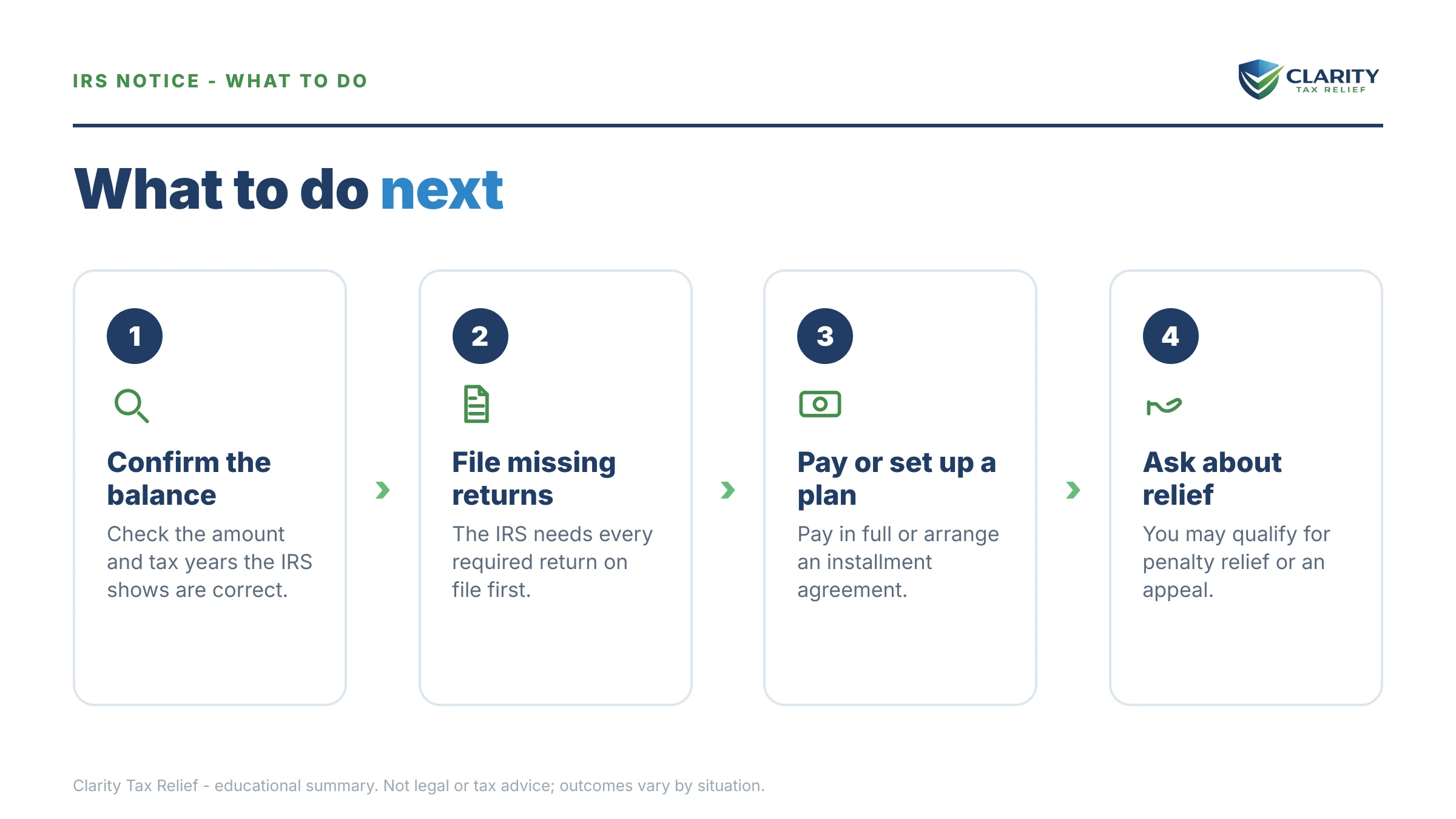
An ignored IRS balance moves through four notice stages before wage garnishment, and the final stage gives you just 30 days. The sequence is automated, and each step arrives with a bigger balance and fewer options:
- CP14 — first bill. Typically about 21 days to pay or arrange something before the reminder cycle starts. No enforcement yet; the cheapest moment to act.
- CP501 / CP503 — reminders. Still just bills, but penalties and interest are compounding monthly while they cycle.
- CP504 — intent to levy your state refund. Under IRC §6331(d), the IRS can now take your California refund. A federal tax lien becomes a live possibility. This is not yet the final notice.
- LT11 / Letter 1058 — final notice of intent to levy. A 30-day clock starts, along with your Collection Due Process rights (requested on Form 12153). After it runs, the IRS can garnish wages (continuous until released), levy bank accounts (a 21-day hold before funds leave), take up to 15% of Social Security, and — once a balance passes $66,000 in 2026 — certify your passport for denial or revocation.
The FTB runs its own parallel track, and it does not wait for the IRS. After its billing and final-notice stages, the FTB can levy bank accounts, record a lien with the Los Angeles County recorder, intercept refunds, and send your employer an Earnings Withholding Order for Taxes. See FTB wage garnishment for how that order works and how to get it released.
Holding an IRS or FTB letter in Long Beach right now?
Penalties and interest are compounding on your balance every month it sits unresolved, and the two agencies escalate on separate tracks. Send us what you received and an experienced tax professional will map both balances and your realistic options. Free, confidential, no pressure.
Tax relief options in Long Beach: what you may qualify for
Most Long Beach tax debts resolve through one of five IRS programs, and each has a separate FTB counterpart you apply for on its own. Eligibility is means-tested for every one of them; anyone promising you'll "settle for a fraction" before seeing your finances is selling, not advising. The full do-it-yourself playbook lives in our guide to how to settle tax debt yourself; here is the map for this situation.
| Option | Who may qualify | Cost & key notes |
|---|---|---|
| Short-term payment plan | Can pay in full within 180 days | $0 setup; interest and penalties continue, enforcement stops |
| Guaranteed installment agreement | Owe $10,000 or less, all returns filed, can pay within 3 years | The IRS must accept it if conditions are met; apply online or via Form 9465 |
| Streamlined / online installment agreement | Up to $25,000 without financials; up to $50,000 with direct debit; up to 72 months online | Setup fee varies by method; failure-to-pay rate drops to 0.25%/month while the plan is active |
| Offer in Compromise (Form 656) | Assets and income genuinely can't cover the debt before the collection statute runs | $205 fee + 20% down on lump-sum offers (both waived with low-income certification, AGI ≤ 250% of poverty); roughly 1 in 5 offers accepted in FY2024 |
| Currently Not Collectible | Paying anything would prevent basic living expenses | $0; collection pauses, debt remains, interest accrues, IRS reviews periodically |
| First-time penalty abatement | Clean compliance history for the prior 3 years | $0; removes eligible penalties. Being replaced by the Automatic Exemption from Penalty (AEP) starting summer 2026 — automatic, no request needed |
The state side works differently enough that you can't assume any federal number carries over. The comparison below is the part most Long Beach guides skip, and the part that decides your strategy when you owe both.
| Question | IRS | California FTB |
|---|---|---|
| How long can they collect? | 10 years from assessment (pausable by appeals, an OIC, or bankruptcy) | 20 years under R&TC §19255 |
| Payment plans | Online up to $50,000 over up to 72 months | Separate program with its own terms — see FTB payment plan |
| Settlement for less | Offer in Compromise ($205 fee; means-tested) | Its own FTB offer in compromise — separate application, separate standards |
| Wage garnishment | Continuous levy until released; exempt amount based on filing status | Earnings Withholding Order for Taxes (EWOT) sent to your employer |
If you owe both agencies and can't fund two plans at once, the sequencing question has real money attached — our guide to FTB vs IRS which first walks through it.
A worked example: a Long Beach couple owing $6,200
Say you and your spouse filed jointly and owe the IRS $6,200 — a common result when two W-2 jobs plus a 1099 side gig underwithhold for a year. This is clearly hypothetical, but the math is real:
- Do nothing: the failure-to-pay penalty alone starts at 0.5% of $6,200, about $31, every month, plus compounding interest, while the notice sequence above marches toward levy.
- Short-term plan (180 days): roughly $1,034/month for six months, $0 setup fee. Accruals continue but stay small because the balance dies fast.
- Guaranteed installment agreement: because the balance is under $10,000, the IRS must accept a plan that pays it off within 3 years if all your returns are filed — about $172/month on a 36-month schedule, plus the interest and reduced 0.25%/month penalty that accrue along the way.
- Offer in Compromise: almost certainly not a fit here. A couple with steady wages and 10 years of collection runway ahead can nearly always full-pay $6,200 in the IRS's math. The roughly 1-in-5 acceptance rate reflects how strictly that math is applied. Skip the $205 fee.
Want to see what your own balance is accruing? Our IRS penalty and interest calculator estimates the monthly cost of waiting. And remember the second track: if the same year produced an FTB balance — say $1,100 — that needs its own separate arrangement, because the IRS plan doesn't touch it.
How to respond, step by step
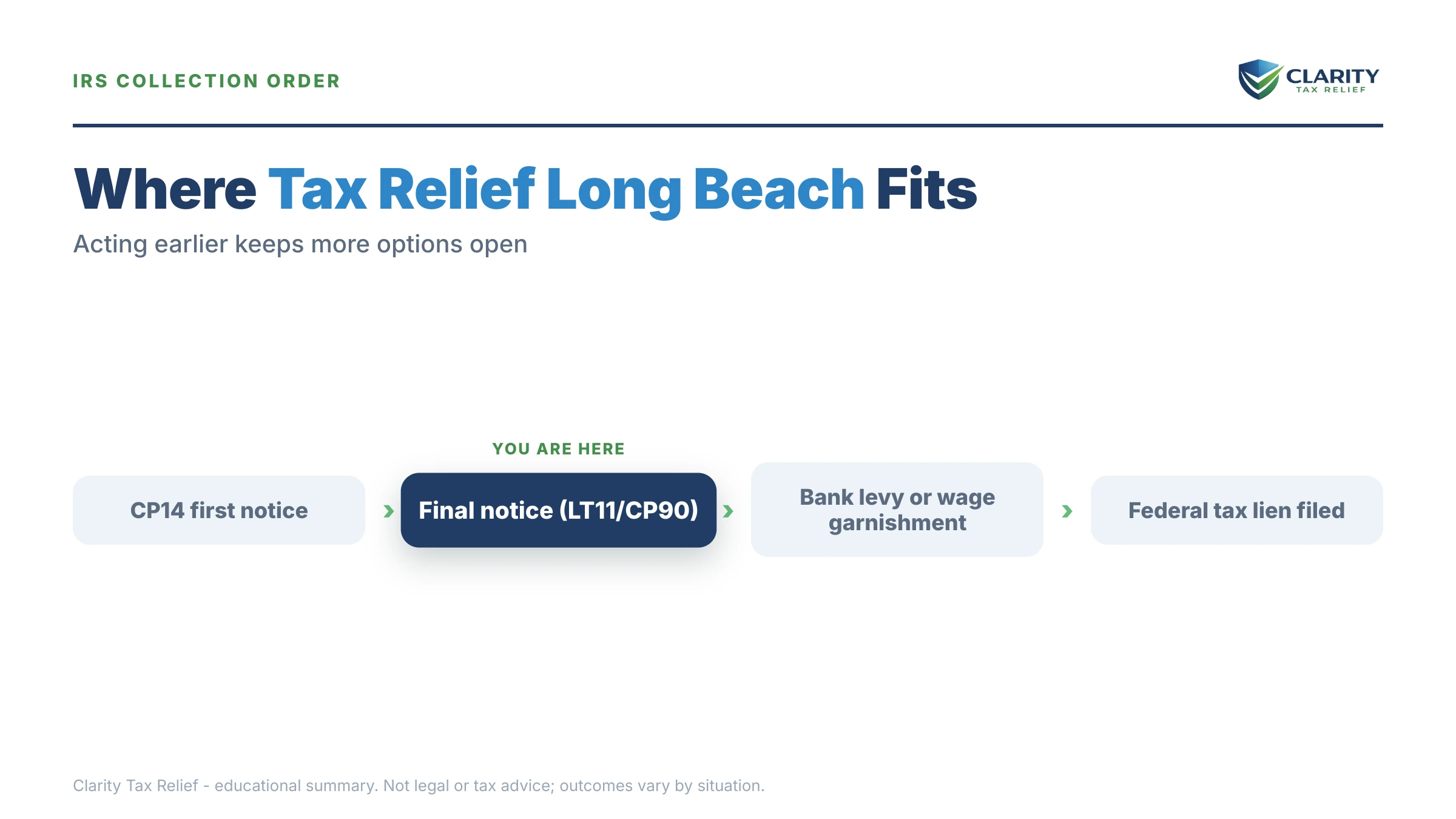
- Identify the agency. Check the letterhead of every letter you've received — IRS notices and California FTB notices look similar but run on different systems, and each prints its own deadline near the top.
- Pull your official balances. Log into your IRS online account and your MyFTB account to see exactly what each agency shows you owe, including penalties and interest through today.
- Confirm every return is filed. Neither the IRS nor the FTB will approve a payment plan or settlement while required returns are missing, so file any unfiled years first.
- Match your balance to a program. Use the options table above: full pay, a 180-day short-term plan, a monthly installment agreement, hardship status, or an offer in compromise — based on what you can actually afford.
- Set it up before the next notice. Apply online for IRS plans, apply separately with the FTB, or get a free professional review first if you owe both agencies, have unfiled years, or a levy is already in motion.
When you can handle this yourself, and when help changes the outcome
A Long Beach couple with a balance under $10,000, all returns filed, and only one agency involved can usually resolve it themselves, online, in under an hour. That describes the $6,200 example above: the IRS online agreement is self-service, the FTB has its own online application, and no firm, including ours, adds much value to a case that simple. The same is true if you can full-pay within 180 days or you received a first notice you agree with.
Experienced help starts changing outcomes when the case has moving parts: an EWOT or IRS levy already in motion, multiple unfiled years that have to be reconstructed before either agency will talk, business debt involving the EDD or CDTFA alongside the IRS, balances over $50,000 where financial disclosure is required, or offer-in-compromise math where one wrong asset valuation sinks the application. In those cases the order of operations — returns first, penalties second, balance last — often matters more than any single form.
If you do hire someone, hire on evidence, not on ads. Our checklist on how to choose a tax relief company lists the questions that expose weak firms in one phone call, and if you're comparing the big national brands you've heard on the radio, start with our Optima Tax Relief alternatives breakdown. The "pennies on the dollar" pitch you'll hear from some of them is a sales script, not a program — settlement exists, but it's means-tested and the IRS accepted only about one in five offers in FY2024.
Terms on your IRS and FTB letters, decoded
- Levy vs. lien: a levy takes property (wages, bank funds); a lien is a recorded claim against property that clouds title but takes nothing directly.
- CSED: the Collection Statute Expiration Date — the day the IRS's 10-year collection window closes; appeals, offers, and bankruptcy pause it.
- EWOT: the FTB's Earnings Withholding Order for Taxes — a wage garnishment order sent straight to your Long Beach employer.
- CDP rights: your Collection Due Process rights after an IRS final notice — 30 days to request an appeal hearing on Form 12153 before levy.
- Offer in Compromise: a means-tested settlement of a tax debt for less than the full balance; the IRS and FTB each run their own.
Long Beach tax relief questions, answered
Do I need a tax relief company located in Long Beach?
No. IRS representation is federal — an enrolled agent, CPA, or attorney can represent you before the IRS from anywhere in the country, and professionals authorized to practice before California agencies can handle the FTB the same way. What matters is verifiable credentials, a written flat-fee quote, and real experience with both the IRS and the FTB, not a local office address. Judge any firm by its answers, not its zip code.
Can the California FTB really collect for 20 years?
Yes. California law (Revenue & Taxation Code §19255) gives the FTB a 20-year collection window — double the IRS's 10-year statute. That is why an old state balance can still be actively collected long after the matching federal debt has expired. Certain events can extend or pause either clock, so pull your FTB records before assuming a balance has died of old age.
I owe both the IRS and the FTB — which should I resolve first?
There is no universal rule — the right order depends on which agency is closer to enforcement. As a rule of thumb, deal first with whichever one has sent a final intent-to-levy notice, because that clock is the shortest. Many taxpayers set up an IRS plan and an FTB plan in the same week. Each agency will expect to see the other payment accounted for in your budget.
Is there an IRS office in Long Beach?
The IRS operates Taxpayer Assistance Centers in the Long Beach and greater Los Angeles area, and all TACs are appointment-only — call 844-545-5640 to schedule and confirm the current location at IRS.gov before you go. A TAC can take payments, verify identity, and answer account questions. But it will not negotiate an offer in compromise or hardship status. Those go through separate IRS units by mail and phone.
How much does tax relief cost for a typical Long Beach case?
Professional fees scale with complexity: setting up a straightforward payment plan costs far less than preparing an offer in compromise, which requires full financial disclosure. For a balance like $6,200 with all returns filed, many couples need no paid help at all — the IRS online application takes minutes. Get any fee in writing as a flat total before you sign, and walk away from anyone who quotes a price before reviewing your IRS and FTB records.
Can the FTB garnish my wages if I work in Long Beach?
Yes. The FTB can issue an Earnings Withholding Order for Taxes (EWOT) to your employer, which keeps taking a portion of every paycheck until the debt is resolved. It typically arrives after the FTB's final notice stage, and it can run at the same time as an IRS wage levy. Setting up an FTB payment plan before the order issues is almost always cheaper and less painful than fighting one after.
Does California have its own offer in compromise?
Yes, and it is completely separate from the IRS program. The FTB evaluates its own offers with its own application and its own financial standards — an accepted IRS offer does not settle your California balance. An accepted FTB offer does not touch your federal one. The FTB generally settles only when you truly cannot pay in full now or in the foreseeable future. With meaningful equity or steady income, expect a payment plan instead.
Your next 24 hours
- Sort your mail by agency. Put IRS letters in one stack and FTB letters in another, and circle the notice date and amount box on the newest letter in each. Those two dates are your real deadlines.
- Gather three things: your most recent federal and California returns, every notice you've received, and a rough monthly income-and-expenses picture for your household.
- Get both balances reviewed free. Call (888) 825-7779 or use the 2-minute form at claritytaxrelief.com/#consult — an experienced tax professional will map your IRS and FTB options side by side before another month of penalties and interest posts.
Official resources: pay or verify a federal balance at IRS.gov/payments, review federal plan terms at the IRS payment plans page, and handle the state side directly at the California Franchise Tax Board.
This guide is general information, not tax or legal advice for your specific situation. Eligibility for IRS programs depends on individual facts and circumstances; no outcome is guaranteed.