
City Guides
Tax Relief in Charlotte, NC: Every Real Option in 2026
The short answer: tax relief in Charlotte runs through two separate systems — IRS programs (payment plans up to 72 months, Offer in Compromise, hardship status, penalty abatement) and NCDOR's own state programs. Which you qualify for is means-tested: it depends on your balance, filing compliance, and finances, not on which company you hire.
Maybe it started with one busy year driving for Uber or delivering across Mecklenburg County, and the 1099s piled up while the returns didn't. Now three tax seasons have gone by unfiled, the letters have started, and every "tax relief Charlotte" search returns the same vague promises. This is fixable — here is the actual map, agency by agency, program by program.
⏱ The clock that matters: unfiled years have no printed deadline — instead, the failure-to-file penalty grows at 5% per month, up to 25% of the unpaid tax on every open year. That's 10 times the late-payment rate. Filing your returns stops the biggest penalty even if you can't pay a dollar today.
Tax relief in Charlotte means dealing with two collectors
Charlotte taxpayers answer to two separate tax agencies: the IRS and the North Carolina Department of Revenue (NCDOR). They don't share your payment plan, they don't honor each other's settlements, and each can collect independently — at the same time.
The state side is easy to underestimate. NCDOR can send an Attachment and Garnishment notice straight to your employer or bank without a court order. It can record a Certificate of Tax Liability with the county — a public lien against you in Mecklenburg County records. If you owe both agencies, you need a plan that covers both, not one that quietly ignores the state.
Charlotte's economy also shapes who ends up owing. A city full of 1099 contractors — rideshare and delivery drivers, real estate agents, consultants serving the banking sector — means a steady stream of people with no withholding, missed quarterly payments, and eventually unfiled years. If that's you, the state guide to North Carolina back taxes covers NCDOR's side in depth; this page covers the whole picture.
| Question | IRS (federal) | NCDOR (North Carolina) |
|---|---|---|
| Wage garnishment | Continuous levy; leaves you only an exempt amount and takes the rest | Attachment and Garnishment, generally capped at 10% of gross wages for tax debt |
| Court order needed? | No — administrative levy after required notices | No — garnishment notice goes directly to employer or bank |
| Public lien | Notice of Federal Tax Lien filed with the county | Certificate of Tax Liability recorded in county records |
| Settlement program | Offer in Compromise (Form 656; means-tested) | Separate NC Offer in Compromise; apply independently |
| Payment plans | Up to 180 days short-term; up to 72 months on qualifying balances | Installment agreements available; terms set by NCDOR |
What happens if you do nothing
Unfiled returns don't sit quietly — the IRS eventually files a substitute return for you, with no business deductions, and bills you for its own inflated number. From there, collection runs on autopilot. The 2026 IRS is running with roughly a quarter fewer staff than a year ago. But the notice stream, liens, and levies are generated by automated systems that never got cut.
For a Charlotte gig worker with unfiled years, the federal sequence looks like this:
- CP59 — the IRS flags that no return was filed. No dollar amount yet; this is the cheapest moment to act.
- Substitute for Return (SFR) — the IRS builds a return from your 1099s: single filing status, zero mileage, zero expenses. For a driver, that can double or triple the real tax.
- CP3219N — a notice of deficiency proposing that assessment, with 90 days to respond or petition Tax Court.
- CP14 — the first bill once tax is assessed, typically giving about 21 days.
- CP501 / CP503 — automated reminders while penalties and interest compound.
- CP504 — intent to levy your state tax refund; a federal lien becomes a live possibility.
- LT11 / Letter 1058 — final notice: 30 days to request a Collection Due Process hearing (Form 12153) before bank levies and wage garnishment begin. A bank levy freezes funds for 21 days before the money leaves; a wage levy runs continuously until released.
NCDOR runs its own parallel track — a Notice of Collection, then garnishment and the Certificate of Tax Liability — and it often moves faster than the IRS on smaller balances. You can estimate how much three years of accruals have already added with our IRS penalty and interest calculator.
| Notice | What it means | Your window |
|---|---|---|
| CP59 | IRS has no return on file for a year | File before the IRS files for you |
| CP3219N | Proposed SFR assessment (deficiency) | 90 days to respond or petition Tax Court |
| CP14 | First bill on the assessed balance | Typically 21 days before escalation |
| CP501 / CP503 | Reminder notices; balance still growing | Pay or arrange before CP504 |
| CP504 | Intent to levy your state refund | Act now; NC refund can be seized |
| LT11 / Letter 1058 | Final notice of intent to levy | 30 days to request a CDP hearing (Form 12153) |
Behind on filing in Charlotte and the letters are stacking up?
An experienced tax professional will pull your IRS transcripts, tell you exactly what the IRS and NCDOR have on file, and map your real options — free and confidential. Penalties and interest are accruing monthly; the review costs nothing.
Your tax relief options in Charlotte, compared
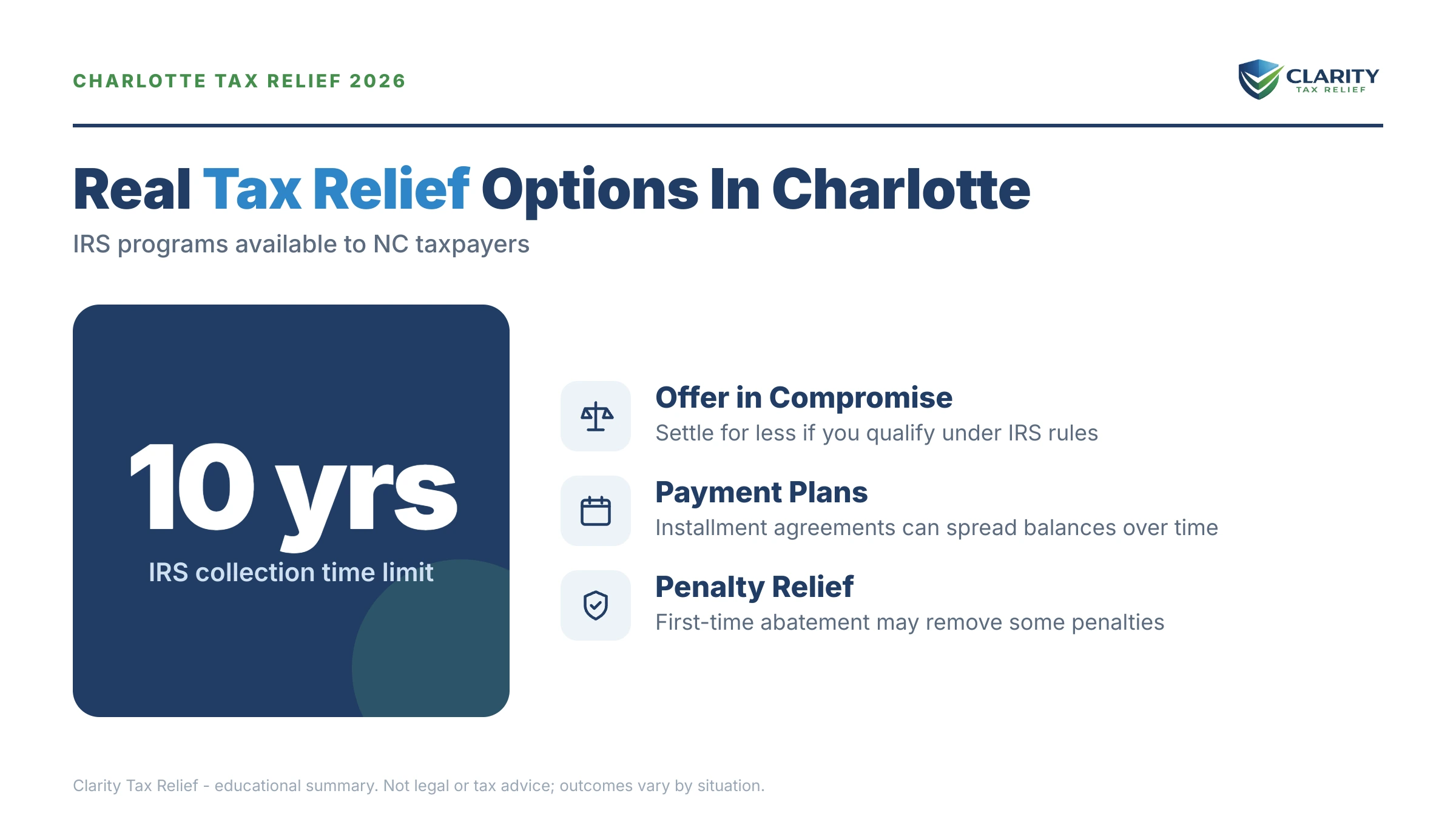
Every IRS relief program has a hard eligibility line, and most are means-tested — no company can talk the IRS past its own math. The full DIY playbook lives in our guide to how to settle tax debt yourself. Here's how each option lines up against real thresholds:
| Option | Who qualifies | Cost to set up | Key limit |
|---|---|---|---|
| Short-term payment plan | Can pay in full within 180 days | $0 setup fee | Interest and penalties keep accruing |
| Guaranteed installment agreement | Balance of $10,000 or less | Standard setup fee; low-income waivers | Must pay within 3 years; returns filed |
| Long-term installment agreement | Up to $50,000 — online, up to 72 months | Setup fee varies; lower with direct debit | All returns must be filed first |
| Non-streamlined agreement | Over $50,000 | Setup fee + Form 433-F financial disclosure | IRS reviews income, expenses, assets |
| Offer in Compromise | Means-tested: assets + income can't cover the debt | $205 fee + 20% down (both waived if AGI ≤ 250% of poverty) | IRS accepted roughly 1 in 5 offers in FY2024 |
| Currently Not Collectible | Paying would leave you unable to cover basic living expenses | $0; financial disclosure required | Debt remains and interest accrues; reviewed periodically |
| Penalty abatement (FTA / AEP) | Clean compliance the prior 3 years; AEP becomes automatic starting summer 2026 | $0 | Removes penalties, not the underlying tax |
Two Charlotte-specific notes. First, every option in that table requires filing compliance, with three years unfiled, the returns come before anything else. Second, none of these programs touches your NCDOR balance. The state needs its own arrangement. Its garnishment power doesn't pause while you negotiate with the IRS.
A worked example: $54,600 owed, three years unfiled
Say you drove rideshare and delivered food across Charlotte for three years without filing, and after preparing all three returns, with your real mileage and expenses deducted, the combined IRS balance lands at $54,600 in tax, penalties, and interest. This is hypothetical, but the math is how it actually works:
- The online 72-month plan has a $50,000 ceiling. At $54,600 you're $4,600 over it. Pay that $4,600 down and the remaining $50,000 divides into roughly $695 a month ($50,000 ÷ 72 ≈ $694.44) — a floor, not a target, since interest continues and faster payments cost less overall.
- Can't pay anything down? A non-streamlined agreement on the full $54,600 is available. But it requires a Form 433-F financial disclosure. The IRS, not you, decides what payment your budget supports. See I owe the IRS $50,000 for how cases at this level typically resolve.
- Offer in Compromise, if the math works. If gig income has dropped and, after IRS allowable expenses, you have about $300 a month left over and no equity, a lump-sum offer would be calculated around $300 × 12 = $3,600. But eligibility is strictly means-tested. The IRS accepted roughly 1 in 5 offers in FY2024 — a $695/month plan is the realistic outcome for most people at this balance.
- Penalty relief on the earliest year. If the three years before your first unfiled year were clean, first-time penalty abatement can strip that year's penalties — up to 25% of its tax in failure-to-file alone. Starting summer 2026, the new Automatic Exemption from Penalty (AEP) applies some of this relief automatically.
- Passport warning. At $54,600 you're below the 2026 passport-certification threshold of $66,000. But a growing balance can cross it, and certification blocks passport issuance and renewal.
How to get tax relief in Charlotte, step by step
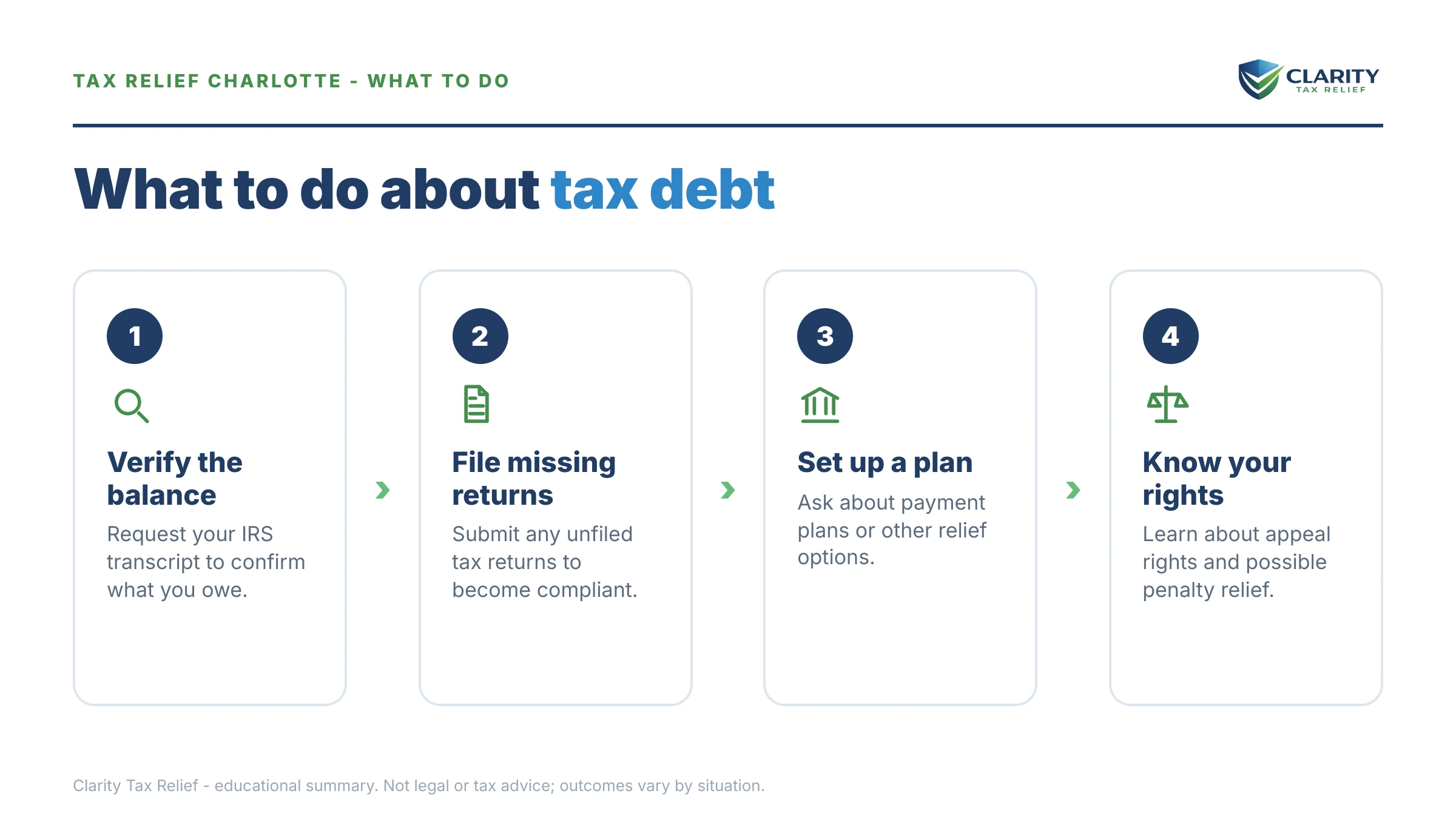
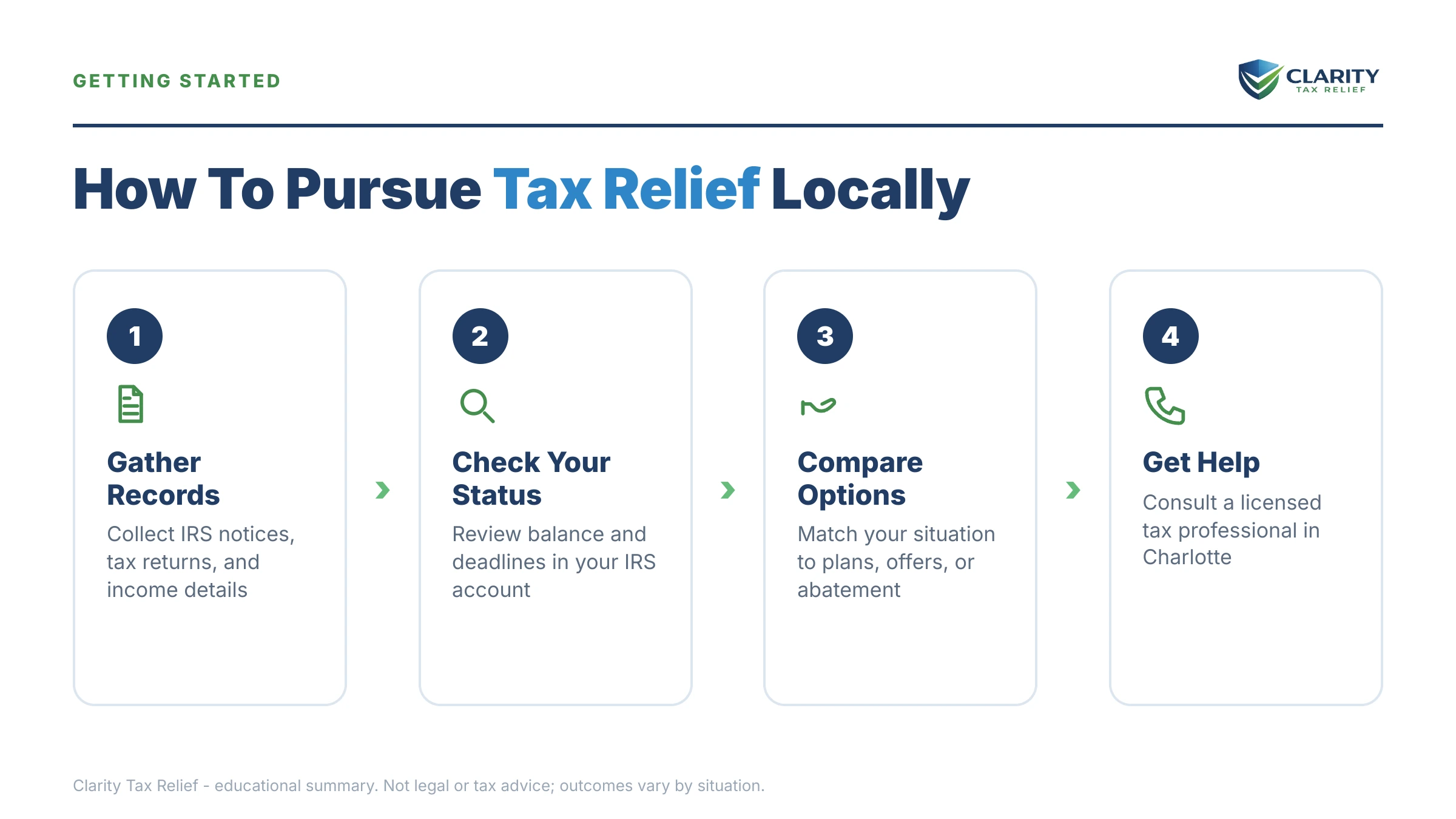
- Pull your IRS transcripts. Create an IRS online account and download your wage and income transcripts for every unfiled year — they show every 1099 and W-2 the IRS already has on you.
- File the missing returns. Prepare real returns with your actual mileage, expenses, and deductions — the IRS generally requires the last six years. Your real numbers almost always beat an IRS substitute return.
- Check your NCDOR balance. Contact the North Carolina Department of Revenue or review any Notice of Collection you've received — the state side is a separate debt with separate programs.
- Match your numbers to a program. Use your total balance and monthly budget to pick the fit: 180-day plan, installment agreement, Currently Not Collectible, or an Offer in Compromise if the math genuinely supports one.
- Set it up before the next notice. Submit the plan or offer online or by phone now, or get a free professional review first if you owe over $10,000, have levy notices, or want the sequencing handled for you.
When you can handle this yourself, and when help changes the outcome
Plenty of Charlotte tax problems don't need a professional. If you owe under $10,000, agree with the balance, and can set up a plan online, do it yourself this afternoon — a guaranteed installment agreement on balances of $10,000 or less is essentially a formality once your returns are filed. The same goes for a first notice you agree with and can pay within 180 days.
Experienced help earns its fee in specific situations: multiple unfiled years where the return preparation itself drives the final balance, an SFR assessment that needs to be replaced with real returns, a garnishment or bank levy already in motion, business or payroll tax debt, and Offer in Compromise math — where a miscalculated offer wastes months and the deposit. If you haven't filed in years, our guide to what happens when you haven't filed taxes in 3 years walks through the catch-up sequence in detail. And if money is tight, a Low Income Taxpayer Clinic may represent you free if you qualify.
Choosing a tax relief company in Charlotte
The biggest risk in searching "tax relief Charlotte" isn't the IRS — it's hiring the wrong firm. National advertisers dominate these search results, and some charge thousands before ever looking at a transcript. Debunk the sales pitch on sight: anyone promising to settle your debt for "pennies on the dollar" before reviewing your finances is describing a program that is strictly means-tested as if it were guaranteed. It isn't.
What to verify before signing anything: the person actually handling your case is an enrolled agent, CPA, or tax attorney. The fee is flat and the scope is in writing. And the first step is a transcript investigation, not a payment. Our full buyer's checklist on how to choose a tax relief company covers the questions to ask, and if you're already comparing the big advertisers, see our breakdowns of Optima Tax Relief alternatives and this Precision Tax Relief alternative comparison. Wondering what a legitimate first call sounds like? Here's what happens at a free tax relief consultation when it's done right.
Terms you'll see on your notices, decoded
- SFR (Substitute for Return): a return the IRS files for you from 1099s and W-2s, with no deductions — almost always higher than your real return.
- CSED: the Collection Statute Expiration Date — the IRS generally has 10 years from assessment to collect, though certain events pause the clock.
- Attachment and Garnishment: NCDOR's tool for taking wages or bank funds directly, without a court order.
- Certificate of Tax Liability: NCDOR's recorded lien in county records — public, and visible to lenders.
- CDP hearing: the Collection Due Process appeal you can request within 30 days of a final levy notice, using Form 12153.
- Levy vs. lien: a levy takes property (wages, bank funds); a lien is a legal claim against property that clouds title until resolved.
Tax relief in Charlotte: your questions, answered
Do I need a Charlotte-based tax relief company, or can a national firm help?
Federal tax work isn't local — an enrolled agent, CPA, or attorney anywhere in the country can represent you before the IRS with Form 2848, and NCDOR handles most cases by phone and mail too. What matters is the representative's credentials and a written flat-fee scope, not the zip code. The one exception: if a revenue officer has been assigned to your case locally, a firm that can appear in person can be an advantage.
How much does tax relief cost in Charlotte?
Professional fees track the complexity of the case, not the city. A simple payment-plan setup commonly runs a few hundred dollars, while an Offer in Compromise with multiple unfiled years can run into the low thousands. Get the full scope in a written flat fee before paying anything, and walk away from any firm that prices as a percentage of promised savings. That pricing model is a classic red flag.
Can North Carolina garnish my wages for back taxes?
Yes. NCDOR uses an Attachment and Garnishment notice sent directly to your employer or bank — no court order required. For wage garnishment on tax debt, North Carolina law generally caps the take at 10% of gross wages, which works differently from the IRS system that leaves you only an exempt amount and takes the rest. Both can run at the same time as separate debts.
What happens if I haven't filed taxes in three years in North Carolina?
Eventually the IRS files a substitute return for you — single status, no business deductions — and assesses tax on the inflated number, and NCDOR can assess the state side as well. Filing your real returns almost always lowers the bill, and the IRS generally requires only the last six years to get back into compliance. Filing is also the gate to every relief program: no payment plan or offer is approved with returns missing.
Does NCDOR have an Offer in Compromise program?
Yes — North Carolina runs its own Offer in Compromise program, completely separate from the IRS version. You must apply to each agency on its own forms with its own financial disclosure. An acceptance by one does not bind the other. If you owe both, most people resolve the IRS side first because the federal balance is usually larger, then use the same financial package for the state application.
Will the IRS take my house in Charlotte?
Home seizures are rare and require multiple levels of approval, including court involvement for a primary residence. The realistic risk to your Charlotte home is a federal tax lien, which attaches to the property and complicates selling or refinancing until it's resolved. Bank accounts and wages get levied long before real estate — which is why acting during the notice stage matters so much.
Is there free tax debt help in Charlotte?
Yes, for people who qualify. Low Income Taxpayer Clinics represent income-eligible taxpayers in IRS disputes at no charge. The Taxpayer Advocate Service helps when IRS processes are causing hardship. Charlotte also has an IRS Taxpayer Assistance Center, which sees taxpayers by appointment. Setting up your own IRS online account and a standard payment plan costs nothing but the setup fee, and low-income fee waivers exist.
How long can the IRS collect back taxes in North Carolina?
Ten years from the date each balance was assessed — the Collection Statute Expiration Date, or CSED. The clock pauses during an Offer in Compromise, bankruptcy, or certain appeals, so it often runs longer than ten calendar years. Unfiled years have no clock at all until a return is filed or the IRS assesses one for you. North Carolina runs its own separate collection rules — verify your state timeline with NCDOR directly.
Your next 24 hours
- Find your notices. Gather every IRS and NCDOR letter you've received and note which one is most recent. That tells you exactly where you sit in the collection sequence above.
- Gather your income records. Pull your 1099s (or create an IRS online account to download wage and income transcripts), your last filed return. A rough monthly budget — that's everything a resolution plan is built from.
- Get the free case review. Call (888) 825-7779 or use the 2-minute form. With three years unfiled, penalties and interest compound every month you wait — an experienced tax professional can tell you in one call which program your numbers actually fit.
Primary sources: the IRS's official payment plans and installment agreements page, the North Carolina Department of Revenue. The independent Taxpayer Advocate Service.
This guide is general information, not tax or legal advice for your specific situation. Eligibility for IRS programs depends on individual facts and circumstances; no outcome is guaranteed.