
IRS Notices
IRS Notice 703 in 2026: The Worksheet That Tells You If Your Social Security Is Taxable
The short answer: IRS Notice 703 is a worksheet that arrives with your Form SSA-1099 — not a bill, audit, or collection notice. It runs one test: if half of your Social Security benefits plus all your other income, including tax-exempt interest, exceeds the base amount for your filing status, some of your benefits may be taxable.
This guide explains why Notice 703 came with your SSA-1099, how its one test works, what counts as other income, two worked examples, and what to do if past years' benefits should have been reported.
You slit open the envelope from the Social Security Administration expecting your yearly SSA-1099, and out slides a second page headed "Notice 703" with lines, boxes, and the word "taxable" all over it. That flash of dread is normal, and it's misplaced. Nobody is billing you, and nothing is overdue. This page is a five-minute math check, and you can finish it before your coffee cools.
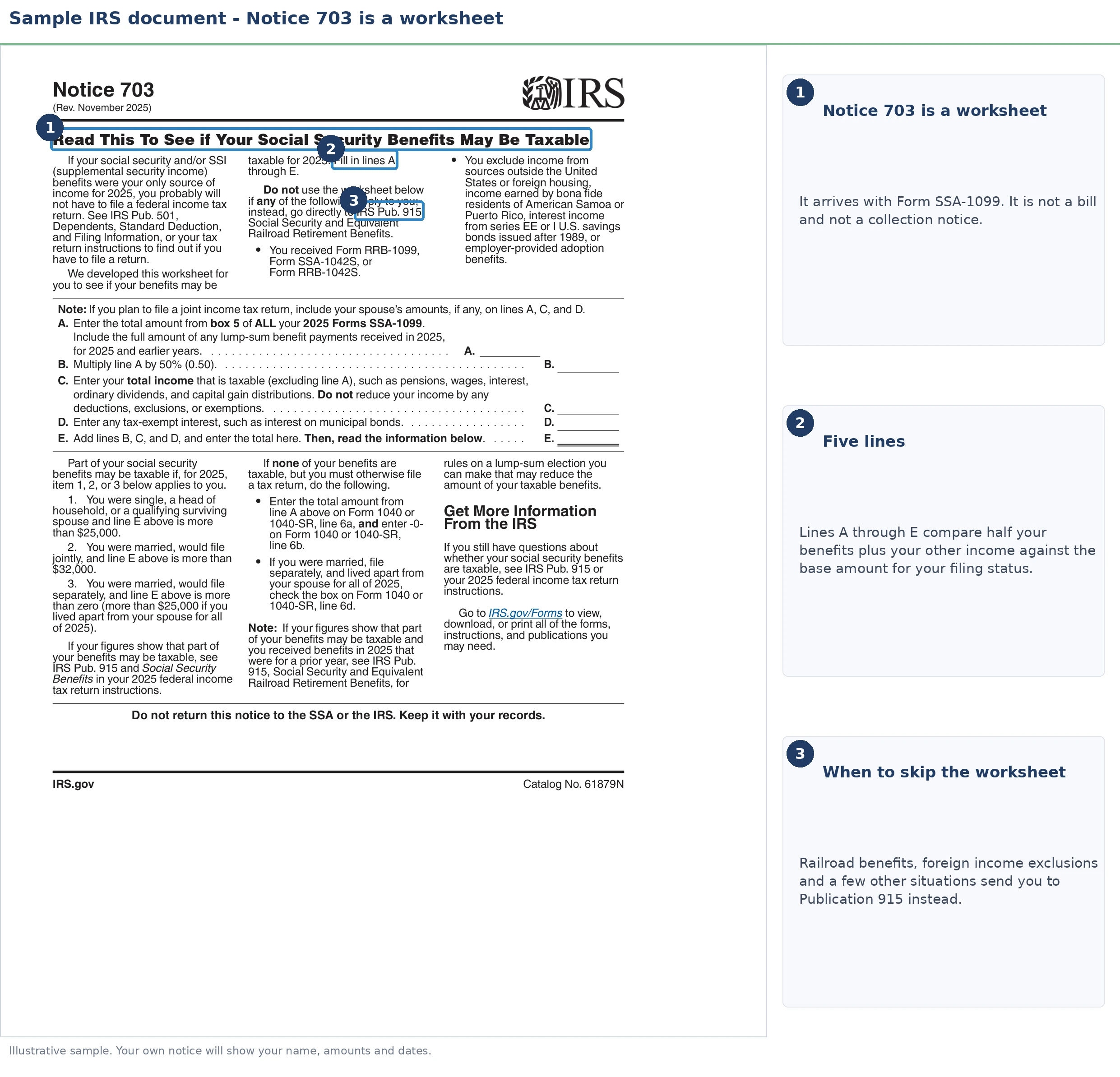
The image below shows exactly what Notice 703 looks like, so you can match each line of the worksheet to the one in your hand before you run the numbers.
⏱ No response deadline: Notice 703 is not a bill. There is nothing to pay and no date to miss on the notice itself. The only clock that matters is your tax filing deadline for the year the SSA-1099 covers. And if earlier years' benefits were taxable but never reported, interest accrues monthly on any balance the IRS later assesses, so that clock is already running.
Why did you get Notice 703?
Notice 703 goes out with the Form SSA-1099 the Social Security Administration mails each January. Receiving it says nothing about whether you owe anything. It is a standard insert, the same page every benefit recipient gets, and it answers one question before you file. Do any of your Social Security benefits need to be reported as taxable income?
Two clarifications up front. First, "Social Security benefits" here means monthly retirement, survivor, and disability benefits, the amounts that appear in Box 5 of your SSA-1099. Second, Supplemental Security Income (SSI) is not taxable and is not part of this calculation at all. If SSI is your only payment from the SSA, you can stop reading and file the notice away.
There is nothing to sign, nothing to mail back, and no IRS employee waiting on your answer. The worksheet exists because the answer differs from retiree to retiree. As the examples below show, the same benefit check can be 0% reportable one year and partly taxable the next because of a single CD or IRA withdrawal.
How does the Notice 703 worksheet work?
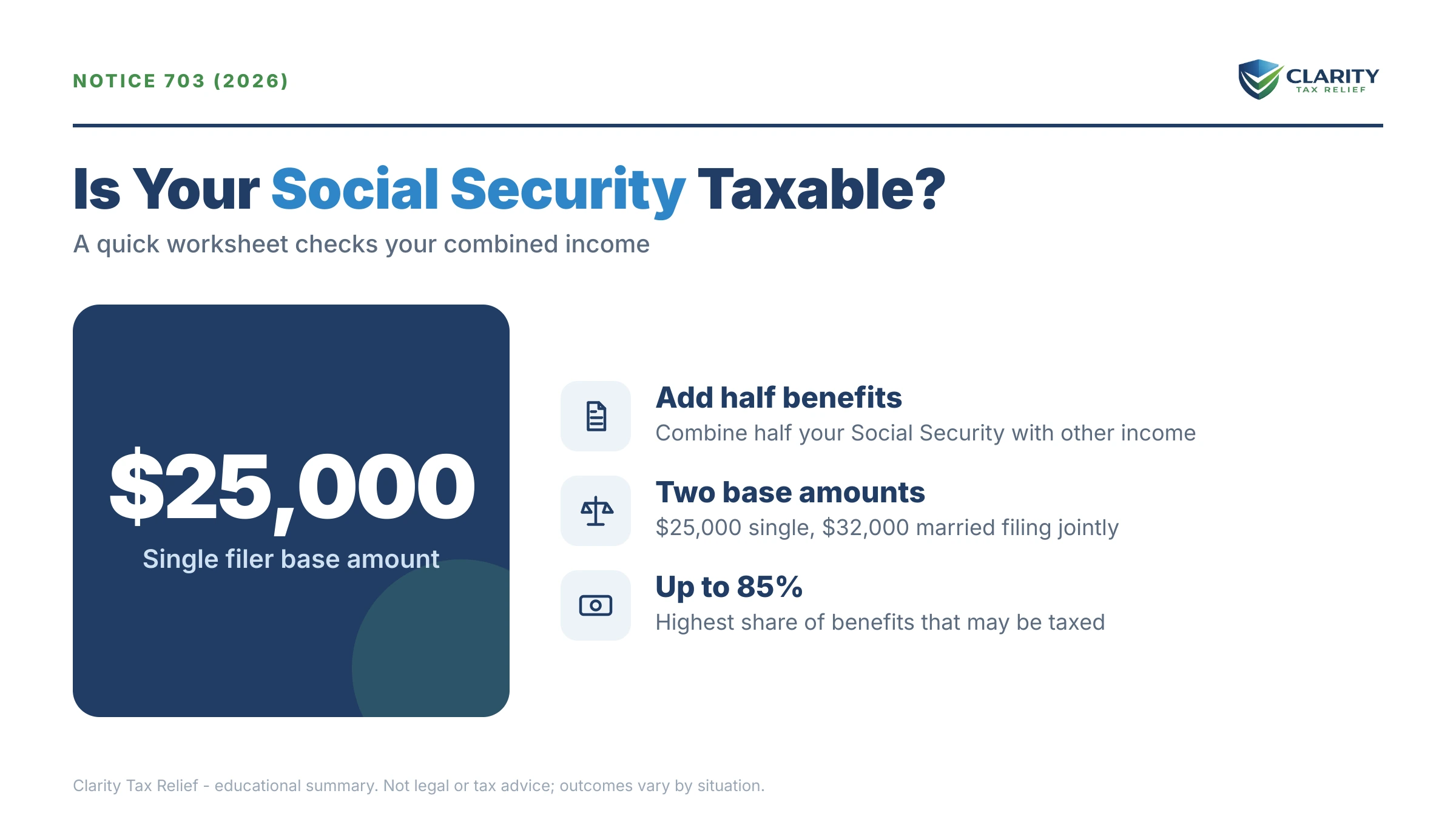
Notice 703 runs a single comparison: one-half of your Social Security benefits, plus all of your other income, measured against a base amount of $25,000, $32,000, or $0 depending on your filing status. If your total lands at or below the base amount, none of your benefits are taxable. If it lands above, some portion may be. The exact portion comes from the longer worksheet in Publication 915 or your tax software, never from Notice 703 itself.
As the worksheet image shows, the whole calculation fits on a few lines. The only inputs you need are Box 5 of your SSA-1099 and a rough total of everything else you received during the year.
| Filing status | Base amount |
|---|---|
| Single, head of household, or qualifying surviving spouse | $25,000 |
| Married filing separately, lived apart from your spouse the entire year | $25,000 |
| Married filing jointly | $32,000 |
| Married filing separately, lived with your spouse at any time during the year | $0 |
Two statuses deserve a closer look. On a joint return, you combine both spouses' benefits and both spouses' other income against the single $32,000 base, even if only one of you collects Social Security. And the $0 base amount for married-filing-separately couples who lived together is not a typo. At that status, some benefits may be taxable at nearly any income level, which is one reason separated-but-cohabiting couples get blindsided. If you're unsure which filing status applies, Publication 501 is the IRS's own guide to that question.
What counts as "other income" on the worksheet?
Every kind of income counts toward the Notice 703 test except SSI, and that includes tax-exempt interest. That last part is the trap that catches the most careful savers. Municipal bond interest is untaxed on its own, yet it still gets added to the total that decides whether your Social Security is taxed.
"Other income" for this test means the usual list: pension and annuity payments, IRA and 401(k) withdrawals, wages from a part-time job, self-employment earnings, bank and CD interest, dividends, capital gains, and rental income. A required minimum distribution counts. A one-time gain from selling stock counts. This is why the answer can flip year to year. The benefits didn't change. The other income did.
What does not count: SSI payments, and the half of your Social Security benefits you didn't already include. You only ever add one-half of Box 5 (never the full amount) on the income side of the test.
How does the math look with $19,000 of Social Security and a $14,000 pension?
For a single retiree with $19,000 of Social Security and a $14,000 pension, the Notice 703 total is $23,500. That is $1,500 below the $25,000 base amount, so none of the benefits are taxable. Here is the arithmetic, plus two variations that show how quickly the answer changes. All three are hypothetical.
Say you're single with $19,000 in Box 5 and a $14,000 pension. Half of your benefits is $9,500. Add the $14,000 pension: $9,500 + $14,000 = $23,500. That's under $25,000, so line 6b of your Form 1040 is zero, though you still report the full $19,000 on line 6a.
Now say the same retiree also earned $3,700 of CD interest. The total becomes $9,500 + $14,000 + $3,700 = $27,200, which is $2,200 over the $25,000 base amount. The worksheet's verdict is that some of your benefits may be taxable. That does not mean you owe tax on $2,200, and it certainly doesn't mean your whole $19,000 benefit is taxed. Only a portion of your benefits becomes taxable (never the full amount), and the exact figure comes from the calculation in Publication 915 or your tax software. On numbers like these, the taxable slice is modest, and the actual tax on it is smaller still at typical retiree rates.
| Hypothetical scenario | Half of benefits + other income | Base amount | Worksheet result |
|---|---|---|---|
| Single: $19,000 Social Security + $14,000 pension | $9,500 + $14,000 = $23,500 | $25,000 | Under by $1,500: none taxable |
| Single: same, plus $3,700 CD interest | $9,500 + $17,700 = $27,200 | $25,000 | Over by $2,200: some may be taxable |
| Married filing jointly: $28,000 combined benefits + $22,000 pension/IRA withdrawals | $14,000 + $22,000 = $36,000 | $32,000 | Over by $4,000: some may be taxable |
Look at row two. A single new income source, such as one maturing CD, one IRA withdrawal or one part-time W-2, is often what pushes a retiree over the line for the first time. If that happened to you this year, it may well have happened in earlier years too. More on that below.
What if the worksheet says some benefits may be taxable?
When your total tops the base amount, the Box 5 figure goes on line 6a of your Form 1040 or 1040-SR, and the taxable portion goes on line 6b. Your tax software or preparer computes line 6b using the full worksheet. Notice 703 only tells you whether that computation is needed.
If you'd rather not meet a surprise balance every April, you have two levers. You can file Form W-4V with the Social Security Administration to have federal income tax voluntarily withheld from each monthly benefit payment, or you can make quarterly estimated payments on your other income. Either approach also protects you from an underpayment penalty on top of the tax itself.
And if you're just under the line, timing matters: spreading a planned IRA withdrawal across two tax years, rather than taking it all in one, can keep each year's worksheet total below the base amount. That's ordinary planning, because the test runs year by year.
What happens if taxable benefits went unreported for years?
The Social Security Administration reports your Box 5 amount directly to the IRS every year, so a return that leaves lines 6a and 6b blank, or understates them, almost always surfaces through automated document matching. Nothing about that process requires a human to notice you. It is how the system works for everyone. Here is the sequence when it runs:
- Automated matching. The IRS computer compares the SSA's Box 5 figure against what your return reported. A gap gets queued for the underreporter program, often for more than one year at once.
- CP2000 proposal. A CP2000 notice arrives proposing additional tax on the unreported benefits, plus interest and, in some cases, an accuracy-related penalty. This is a proposal rather than a bill, and it can be answered and corrected.
- Notice of deficiency. Ignore the CP2000 and it hardens into a CP3219A notice of deficiency, your last formal chance to dispute before the amount is assessed.
- Assessed balance and collection notices. Once assessed, the balance accrues interest plus a 0.5%-per-month failure-to-pay penalty, refunds get offset, and the standard collection notice sequence begins.
- Levy on the benefits themselves. Left unresolved, the IRS can take up to 15% of each monthly Social Security payment through the Federal Payment Levy Program. That means collecting the tax on your benefits out of your benefits. Our guide on the IRS taking 15 percent of Social Security covers how that levy starts and stops.
The stages matter more than the speed. In 2026 the IRS workforce is roughly 27% smaller than it was, which makes a human hard to reach. The matching, notices, and levies above are automated, though, and they never stopped. The cheapest point to fix an unreported year is before stage two. Every stage after adds interest and narrows your options. If you want a rough sense of what penalties and interest have added to an old balance, our IRS penalty and interest calculator can estimate it.
Just realized past years' benefits should have been reported?
Don't wait for the matching notices to price it for you. An experienced tax professional will review the affected years free, tell you what you'd actually owe, and map the cleanest way to fix it — before interest and penalties grow the number.
What are your options if you already owe on unreported benefits?
An assessed balance from unreported Social Security benefits qualifies for the same IRS resolution programs as any other tax debt, and retirees on fixed incomes often qualify for the gentler ones.
- Answer the CP2000 first. If the proposal is right but you can't pay, agreeing and arranging payment beats silence (see CP2000 agree but can't pay). If the IRS's math is wrong (it sometimes double-counts or misses basis), dispute it before it's assessed.
- Short-term plan: up to 180 days to pay in full, with no setup fee. Interest and the monthly penalty continue, but collection stops.
- Installment agreement: balances of $50,000 or less can generally be set up online for up to 72 months. On a hypothetical $2,200 CP2000 balance, even a small monthly payment resolves it long before it can escalate.
- Currently Not Collectible: if paying anything would leave you unable to cover basic living expenses, collection can be paused. Our guide to IRS hardship while on Social Security explains how fixed-income retirees qualify.
- Penalty relief: a clean compliance history for the prior three years supports first-time abatement. Starting summer 2026, the IRS's Automatic Exemption from Penalty (AEP) applies some of that relief automatically, with no request needed.
- Unfiled years: if some years were never filed at all, get current first. Our guide on how many years of back taxes you have to file covers the IRS's standard look-back. Voluntarily filed returns are treated better than IRS-prepared substitutes.
If several years are involved or a levy notice has already arrived, a free case review can sequence these options so you fix the cheapest problem first.
How to use Notice 703, step by step
- Find Box 5 on your Form SSA-1099. That's your net Social Security benefits for the year.
- Add one-half of your Box 5 amount to all of your other income, including tax-exempt interest.
- Compare that total to the base amount for your filing status: $25,000, $32,000, or $0 (table above).
- Report the Box 5 amount on line 6a of Form 1040 or 1040-SR, and enter the taxable portion, if any, on line 6b.
- Keep Notice 703 with your tax records. The IRS does not want it mailed back.
Lost the SSA-1099 itself? You can get a replacement through your my Social Security account at the Social Security Administration's website rather than waiting on hold.
Red flags to check
For most people Notice 703 is a quick check. These are the signs it deserves more of your time:
- Your filing status is married filing separately and you lived with your spouse at any time in the year, so your base amount is $0.
- You took a one-time IRA withdrawal, a maturing CD or a stock gain this year.
- You hold municipal bonds and left their interest out of the total.
- Earlier returns left lines 6a and 6b blank in years your total was over the base amount.
- A CP2000 has arrived proposing tax on unreported benefits.
- Your monthly benefit is already smaller because of a levy.
Can you handle this yourself?
Most people can finish Notice 703 in five minutes with no help at all. If your total lands under the base amount, you're done. Report line 6a, put zero on 6b, and file the notice away. If you're modestly over the line for the current year, any mainstream tax software or a VITA/AARP volunteer preparer will compute line 6b correctly for free or nearly free. None of that requires a tax-relief firm, and anyone who tells a comfortably-under-the-line retiree otherwise is selling something.
Experienced help changes the outcome in fewer cases. Think of multiple past years of unreported benefits, a CP2000 or notice of deficiency already in hand, a levy already taking a slice of your monthly check, or a balance you cannot pay on a fixed income. Then the order of operations matters a lot: dispute or agree, file or amend, penalty relief before a payment plan. It changes the final number, and getting it wrong is expensive to unwind.
What do the terms on your notice mean?
- Box 5 (net benefits): the total Social Security benefits paid to you for the year, after adjustments. It is the only SSA-1099 number the worksheet uses.
- Base amount: the filing-status threshold ($25,000, $32,000, or $0) your combined total is measured against.
- Combined income: the informal name for the worksheet total: half your benefits plus all other income, including tax-exempt interest.
- Tax-exempt interest: interest (typically from municipal bonds) that isn't taxed itself but still counts in this test.
- SSI: Supplemental Security Income, a needs-based payment that is not taxable and is excluded from the worksheet entirely.
- Lines 6a and 6b: the Form 1040 lines for your total benefits (6a) and the taxable portion (6b).
Common questions
Do I have to send Notice 703 back to the IRS?
No. Notice 703 is a worksheet for your own use, and the IRS does not want it back. Fill it out, keep it with your tax records, and use the result when you complete lines 6a and 6b of your Form 1040 or 1040-SR. There is no response deadline and no penalty attached to the notice itself.
Does Notice 703 apply to survivor and SSDI benefits?
Yes. Social Security benefits for this test include monthly retirement, survivor, and disability (SSDI) benefits. All of them show up in Box 5 of an SSA-1099 and run through the same worksheet. Only SSI is excluded. If SSDI is your sole income, half of it alone rarely tops the $25,000 single base amount, so many SSDI-only recipients owe nothing.
Where do Social Security benefits go on Form 1040?
The full amount from Box 5 of your SSA-1099 goes on line 6a of Form 1040 or 1040-SR, and the taxable portion (the number the worksheet produces) goes on line 6b. If none of your benefits are taxable, line 6b is zero, but you still report the Box 5 total on line 6a so your return matches what the SSA reported to the IRS.
Bottom line
Notice 703 is a worksheet that comes with your SSA-1099. Add half of Box 5 to all your other income, tax-exempt interest included, and compare the total with the base amount for your filing status. Under it, report line 6a and put zero on 6b. Over it, let the full worksheet or your software figure line 6b, and look back at earlier years too.
Your next 24 hours
rong>Find Box 5 on your SSA-1099 and write down half of it. That single number is the whole starting point of the Notice 703 test.For the official details, see the IRS's Publication 915, Social Security and Equivalent Railroad Retirement Benefits (the full worksheet that computes the exact taxable amount) and IRS.gov/payments if a balance from a prior year needs paying.
This guide is general information, not tax or legal advice for your specific situation. Eligibility for IRS programs depends on individual facts and circumstances; no outcome is guaranteed.