
IRS Transcripts
IRS Transcript Myths Reddit Gets Wrong: Codes 570, 971, 846 and the "As Of" Date, Debunked (2026)
The short answer: most IRS transcript rules repeated on Reddit are wrong. Code 570 is a temporary hold, not an audit; the "as of" date is an interest-calculation date, not your deposit date; and only code 846 sets a real refund date. Your transcript's own codes, dates, and dollar amounts beat any thread's theory.
Your transcript finally updated, a code you've never seen — 570, maybe a 971 — appeared under your withholding line, and you did what everyone does: searched it and landed in a Reddit thread where forty confident strangers gave forty different answers. This guide separates the IRS transcript myths Reddit recycles every filing season from what the entries on your account actually mean — myth by myth, with the numbers to check yourself.
If you've never seen one laid out in full, the image below shows you exactly what a real IRS account transcript looks like and where the codes everyone argues about actually sit — keep it in mind as you read each myth.
⏱ The real clock: there is no hidden refund-release deadline buried in your transcript, but if a balance due ever posts to your account, interest plus a 0.5% monthly failure-to-pay penalty accrue on it every month while you wait. Refund myths cost you sleep; an ignored balance costs you money.
Why IRS transcript myths spread on Reddit
IRS account transcripts are written in internal transaction codes designed for IRS employees, and the transcript itself explains almost none of them. The official decoder is an internal reference called Document 6209 — dense, technical, and never meant for taxpayers. Reddit fills that vacuum, and during refund season it fills it fast.
Two forces make the threads unreliable. The first is survivorship bias: people whose 570 cleared in a week post "mine released, yours will too," while people whose hold turned into a document request stop posting. One person's timeline becomes everyone's rule.
The second is context-stripping. The same transaction code can mean different things depending on its dollar amount, its date. The codes posted around it. A 971 next to a 570 usually means a review letter is coming. A 971 alone can be as mundane as a notice confirming an address change. Threads compare codes without comparing context.
None of this means the transcript is unreadable. It means you need the layout, not the folklore. For the full walkthrough of every section, start with our guide to how to read an IRS account transcript. This article handles what the threads get wrong.
What happens if you trust a myth instead of your transcript
The real cost of transcript myths isn't the 3 a.m. refreshing — it's the genuine signals people wait out because a thread said "it clears on its own." Some codes really do resolve themselves. These don't, and each one escalates in a fixed sequence if ignored:
- An identity-verification hold sits unanswered. A code 810 refund freeze paired with a verification letter never self-releases — the refund stays frozen until you verify, no matter how many cycles pass.
- An exam signal gets waited out. If a code 420 posts and the audit letter goes unanswered, the exam proceeds without you and the IRS's proposed changes become the default outcome.
- An assessment posts. A code 290 adds tax to your account. A balance-due notice follows, and interest plus the 0.5% monthly failure-to-pay penalty start compounding immediately.
- The balance enters the collection stream. An unpaid assessment moves through the automated notice sequence — first bill, reminders, intent to levy, then final notice — the same machine that handles every IRS debt.
In 2026 there is a real asymmetry here: the IRS workforce shrank roughly 27% in 2025, so getting a human to fix a problem is slower than ever. But the systems that freeze refunds, assess balances, and issue notices are automated and never slowed down. Myths tell you to wait; the machine doesn't.
Staring at a 570, an 810, or a balance you don't recognize?
Send us the transcript. An experienced tax professional will decode exactly what's on your account and what, if anything, you need to do about it. Free, confidential, no pressure, and no Reddit guesswork; if a balance is real, interest is accruing on it right now.
The biggest IRS transcript myths on Reddit, debunked one by one
Every myth below traces back to one habit: reading a single code in isolation and assigning it a meaning it doesn't have. Start with the code table, then the myths that aren't about codes at all.
| Code | The Reddit myth | What it actually means | Your move |
|---|---|---|---|
| 570 | "You're being audited." | Temporary account hold — additional action pending. Most release with a 571. | Check the amount: $0.00 usually means verification, not a proposed change. Wait for a 571 or a letter. |
| 971 | "Something bad is coming." | A notice was issued — could be a review letter, an adjustment, or a routine confirmation. | Wait for the letter and respond to what it actually asks. |
| 810 | "Refund gone; nothing you can do." | Refund freeze, often identity verification or a credit under review. Reversible via 811. | Watch for a verification letter and act on it fast; this freeze never clears on its own. |
| 420 / 424 | "Guaranteed full audit." | 420 is the exam indicator; 424 is only an exam request, often closed with no audit. | If a letter arrives, respond by its printed deadline. No letter yet? Nothing to answer. |
| 806 / 766 | "The negative number means I owe." | Negative amounts are credits — withholding and refundable credits in your favor. | Nothing. That's your money being counted. |
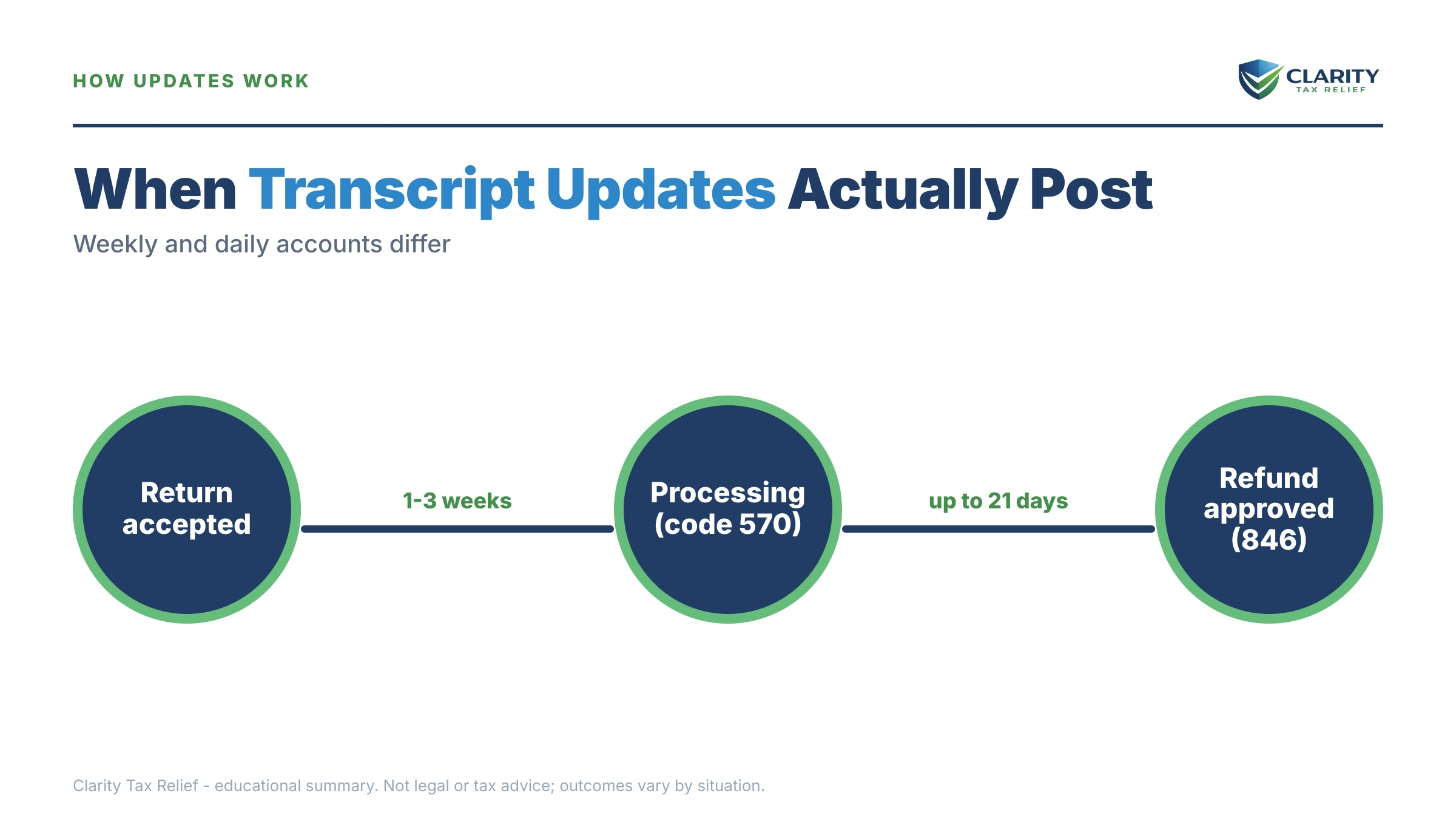
| 846 | "The date isn't real until WMR says so." | Refund issued — the printed date is the actual issue date. | Trust it. Direct deposits typically arrive on or within days of that date. |
| 150 | "That amount is my refund." | Your return posted; the amount is the tax your return calculated, not a refund. | Subtract it from your credits to see the real refund or balance (worked example below). |
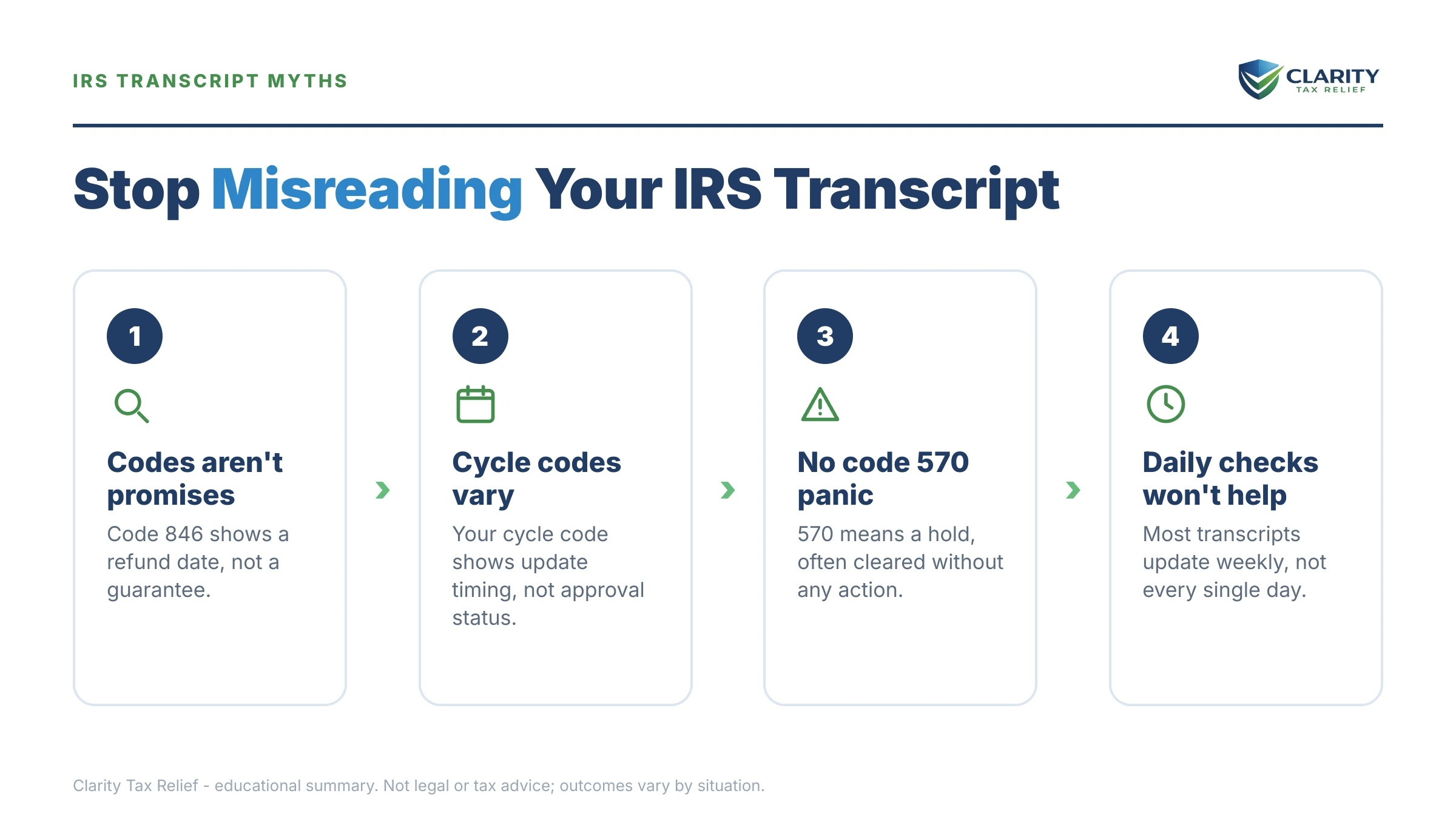
Myth: "Code 570 means you're being audited"
Code 570 is a hold, not an examination. It pauses your refund while the IRS checks something — most commonly that your reported withholding matches what employers filed, or that a refundable credit is supported. The transcript's actual audit signal is code 420 on an IRS transcript, and even a code 424 exam request is routinely closed by a classifier without a full audit ever opening. If your fear is specifically "is this an audit," the full breakdown lives at code 570 on an IRS transcript.
Myth: "The 'as of' date is your deposit date"
The "as of" date is bookkeeping, not a promise. It's the date the IRS system uses to compute interest and penalties to a point in time. It rolls forward automatically whenever the account recalculates — for refund accounts and balance-due accounts alike. Threads that track it as a countdown are tracking noise. The only entry that sets a deposit date is code 846. Everything else about that date is covered in our guide to the "as of" date on an IRS transcript.
Myth: "A cycle code ending in 05 means you're flagged"
A cycle code is a batch assignment, nothing more. Accounts ending in 05 update weekly; others update daily. Neither track is a flag, a penalty, or a predictor of refund size, and refreshing an 05 account every hour surfaces nothing, because the account physically updates once per weekly cycle. The digit-by-digit breakdown is in our IRS cycle code meaning guide, and what day IRS transcripts update covers the update windows themselves.
Myth: "Checking your transcript triggers an audit"
Pulling your transcript is a read-only lookup. It doesn't score your return, route it to a human, or leave any mark that influences processing. Audit selection runs on the return's contents through entirely separate systems. The related myth — that creating an IRS online account "puts you on a list" — is equally false. The account shows you records the IRS already has.
Myth: "A blank or N/A transcript means your return was rejected"
N/A almost always means "not processed yet", or that you pulled the wrong transcript type for the year. A rejected e-file never reaches the IRS master file at all, and you'd know from your software, not your transcript. Before assuming the worst, work through what an N/A or blank transcript means.
Myth: "Where's My Refund is more accurate than the transcript"
It's the opposite. WMR is a simplified front-end that lags the account database, sometimes by days. Only code 846 sets a refund date, and once it posts, that date controls even if WMR still shows "processing." See the code 846 refund issued date for how to read it, and transcript updated but WMR didn't if the two tools disagree on your account right now.
Myth: "Calling the IRS gets the hold released early"
For systemic review holds, phone reps generally can't release anything before the review window runs. They can see the same hold you can. Calling helps in three specific cases: a letter's stated timeframe has fully passed with no movement, the IRS asked for something you already sent, or the delay is causing genuine financial hardship (that's Taxpayer Advocate territory, not the main line). Everything else is hold music for information your transcript already gave you.
What actually follows a transcript hold: the real sequence
A transcript signal is the first domino, and each one has a predictable next step — a specific letter, not a mystery. Here's the sequence Reddit threads guess at:
| Transcript signal | What typically follows | Your move |
|---|---|---|
| 570 alone, $0.00 | Often nothing — the hold releases with a code 571 and processing resumes. | Give it a weekly cycle or two before assuming a problem. |
| 570 + 971 pair | A review letter (commonly a CP05 or Letter 4464C) explaining what's being verified. | Read it. Respond only if it requests documents; many require nothing from you. |
| 810 freeze | An identity-verification letter (such as a 5071C) or routing to a specialized unit. | Verify immediately. This is the one hold where speed is entirely in your hands. |
| 420 exam indicator | An audit opening letter with a printed response deadline. | Respond by that deadline; silence means the IRS's version wins by default. |
| 290 with a dollar amount | An adjustment notice showing the new balance, then collection notices if unpaid. | Verify the assessment is right, then pay or arrange payment before penalties stack. |
A $41,800 W-2 example: doing the transcript math yourself
The fastest way to kill a transcript myth is arithmetic the transcript already contains. Say you're a W-2 employee filing single who earned $41,800 last year, and your account transcript shows three lines:
- Code 150 — $3,050: your return posted, and $3,050 is the tax it calculated. (Not your refund — see code 150 on an IRS transcript.)
- Code 806 — −$4,180: the federal withholding from your paychecks, credited to the account.
- Code 570 — $0.00: a hold, with no dollar change attached.
A Reddit thread reads that as "audit, refund seized." The transcript's own math says otherwise: $4,180 in credits minus $3,050 in tax = $1,130 in your favor, and the $0.00 on the 570 means no additional tax has been proposed. Negative numbers on an IRS transcript are money on your side of the ledger. The likely ending is a 571 releasing the hold and an 846 for $1,130.
Now the version that matters: suppose a code 290 later posts for $600 because the IRS adjusted a credit. New math: $1,130 − $600 = a $530 refund — smaller, but still a refund. The notice that follows will show the same figures. And if the 290 had exceeded your credits, the difference would be a balance accruing interest and the monthly failure-to-pay penalty from the assessment date. You can estimate what a posted balance is really costing with our IRS penalty and interest calculator.
Run this same subtraction on your own account before believing any thread's verdict. It takes two minutes and it's the exact math the IRS system runs.
How to fact-check a transcript rumor, step by step
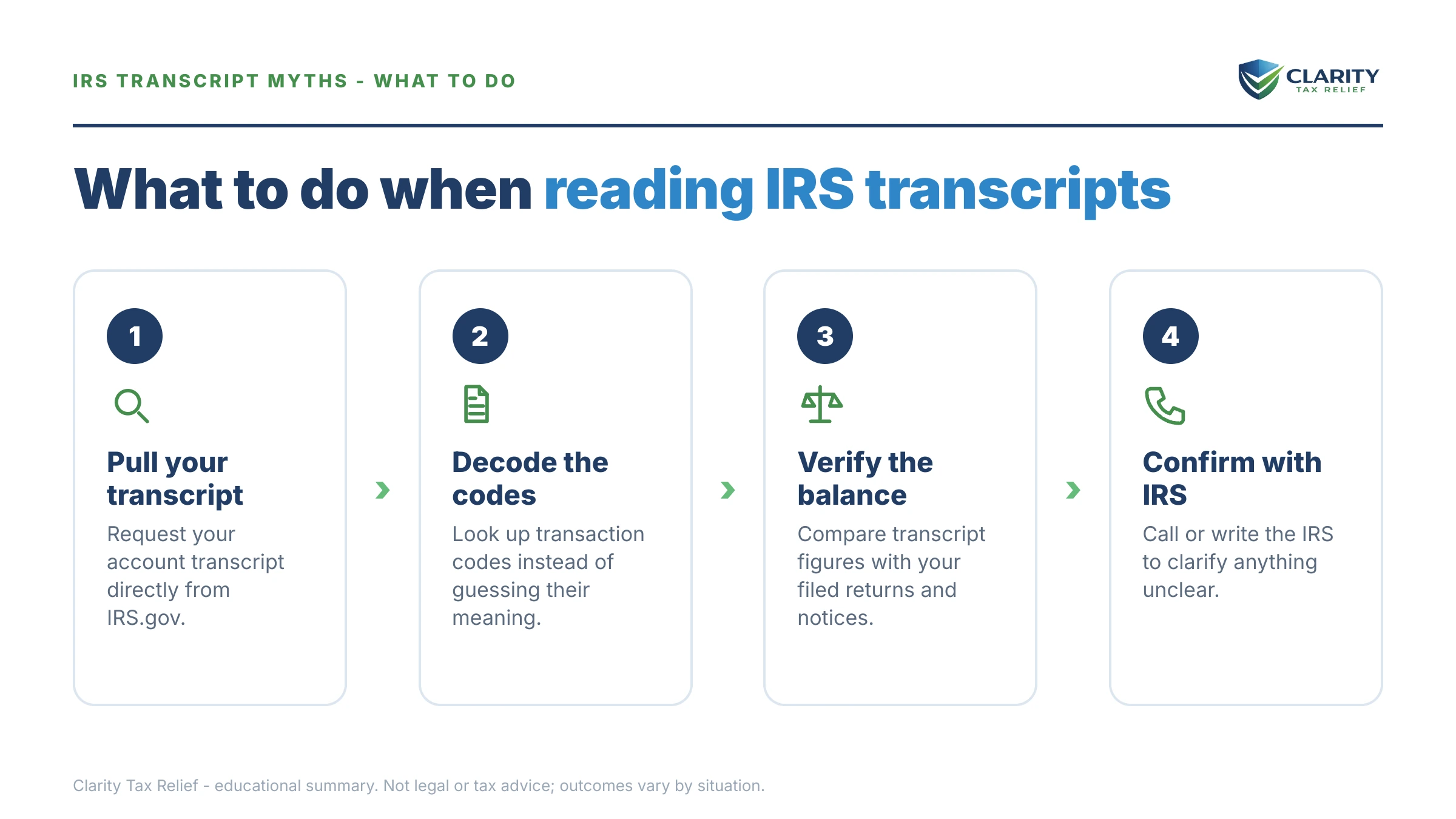
- Pull your own account transcript. Log into your IRS online account and download the account transcript for the exact tax year in question, not a screenshot from a stranger's thread. Codes only mean something in the context of your own dates and dollar amounts.
- Find the code's context on your account. Locate the exact transaction code, its posted date, and its dollar amount. A code 570 with $0.00 reads very differently than a 570 with a dollar figure — the amount tells you whether the IRS is proposing a change or just pausing.
- Do the math the transcript already shows. Add your credits — the negative numbers like withholding on code 806 — against the tax on code 150. If credits exceed tax, the difference is your refund; if tax exceeds credits, that gap is a balance due.
- Match any code 971 to the actual letter. Code 971 means a notice was issued. Wait for the letter, read what it actually asks, and respond to that, not to what a thread predicted the letter would say.
- Act only on codes with consequences. Verify your identity if a letter asks, answer any exam letter by its printed deadline, and address a posted balance before penalties compound. Skip the date-guessing games — no amount of refreshing changes a processing cycle.
Primary sources beat threads every time: get your transcript directly from the IRS's Get Transcript page, check refund status at the official IRS refunds page, and if a frozen refund is causing genuine financial hardship, the Taxpayer Advocate Service exists precisely for cases the normal channels are failing.
When you can handle this yourself, and when it's more than refund-watching
Most transcript situations need no professional at all. If your account shows a 570 with $0.00, a 570/971 pair with a letter that asks for nothing, or you're simply waiting on an 846, the correct move is the free one: check once per weekly cycle and answer any letter that arrives. Paying someone to watch a routine hold buys nothing.
Experienced help changes outcomes when the transcript stops being about a refund: an 810 freeze that won't clear after you've verified, a 420 with an audit letter you're not sure how to answer, a 290 assessment you believe is wrong, balances stacked across multiple years, or unfiled years where the IRS filed a substitute return for you. In those cases, the order you fix things in — returns first, then penalties, then the balance — genuinely changes what you end up paying. A review before you respond is worth having. If your transcript shows any of those, a free case review will tell you in one conversation whether you need help or just patience.
Terms on your transcript, decoded
- "As of" date: the point-in-time date used to calculate interest and penalties on the account — it moves routinely and predicts nothing.
- Cycle code: an eight-digit batch stamp showing the year, week, and day your account processes — daily or weekly, never a flag.
- Transaction code (TC): the three-digit entries (150, 570, 846...) recording every action posted to your account, in order.
- Account transcript vs. return transcript: the account transcript shows activity (holds, payments, assessments); the return transcript just mirrors what you filed. Codes live on the account transcript.
- Freeze: a condition (like an 810) that stops refunds or other actions until a matching release code (like an 811) posts.
- Module balance: the running total for one tax year — negative means the IRS owes you; positive means you owe the IRS.
IRS transcript myth questions, answered
Are the IRS transcript code explanations on Reddit accurate?
Sometimes, but the most-repeated claims are wrong or over-interpreted. Reddit threads often identify what a code is called, then invent rules around it — turning a routine hold like code 570 into 'an audit' or a bookkeeping date into a deposit date. Verify any claim against your own account: the codes, dates, and dollar amounts on your transcript are the only version that applies to you.
Is code 570 on my transcript an audit?
No. Code 570 is a temporary hold on your account while the IRS reviews something, often withholding verification or a credit check. Most 570 holds release with a code 571 and no change to your refund. The transcript's actual examination indicator is code 420, and even a code 424 exam request is frequently closed without a full audit.
Does the 'as of' date on my transcript tell me my refund date?
No. The 'as of' date is the date the IRS uses to compute interest and penalties on your account balance. It moves forward routinely as the system recalculates, whether you are owed a refund or owe money. The only transcript entry that sets a real refund date is code 846, which prints the exact date your refund is issued.
Does checking or ordering my IRS transcript trigger an audit?
No. Pulling your transcript is a read-only lookup of records the IRS already has. It does not flag, score, or route your return anywhere. Audit selection happens through separate processes based on the return itself. You can check your transcript daily without affecting your account, though most accounts only actually update once a week.
What does a cycle code ending in 05 actually mean?
It means your account updates weekly rather than daily — nothing more. Reddit threads treat an 05 cycle code as a flag or a slower 'penalty' track. But it is simply the processing batch your account was assigned to. Weekly accounts typically see transcript movement once a week, and the cycle code has no connection to audit risk or refund size.
Why does my transcript show something Where's My Refund doesn't?
The transcript updates first. Where's My Refund is a simplified status tool that lags behind the account database, sometimes by days. If your transcript shows code 846 with a date, that date controls. Your refund is scheduled even if WMR still says processing. When the two disagree, trust the transcript.
Can my transcript show a balance I didn't know about?
Yes, and this is the one place Reddit under-reacts. A code 290 (additional tax assessed), 276 (failure-to-pay penalty), or 196 (interest) can post a balance from an old year, and interest plus a 0.5% monthly late-payment penalty keep accruing until it is addressed. If you see an unexplained positive balance, investigate it now instead of waiting for a letter.
Your next 24 hours
- Pull your account transcript and find three things: the code 150 amount, any negative credit lines (806/766), and any hold codes (570, 810) with their dollar amounts. That's your whole picture in one look.
- Gather your last return and every IRS letter you've received this year, so any 971 on the transcript can be matched to the notice that explains it.
- If the transcript shows a freeze that won't clear, an exam code, or a balance you don't recognize, get it decoded free — the 2-minute form at claritytaxrelief.com/#consult or (888) 825-7779. Holds resolve with patience; balances only grow with it.
This guide is general information, not tax or legal advice for your specific situation. Eligibility for IRS programs depends on individual facts and circumstances; no outcome is guaranteed.