
Unfiled Returns & Expats
Expat Hasn't Filed US Taxes: What to Do Now (2026 Guide)
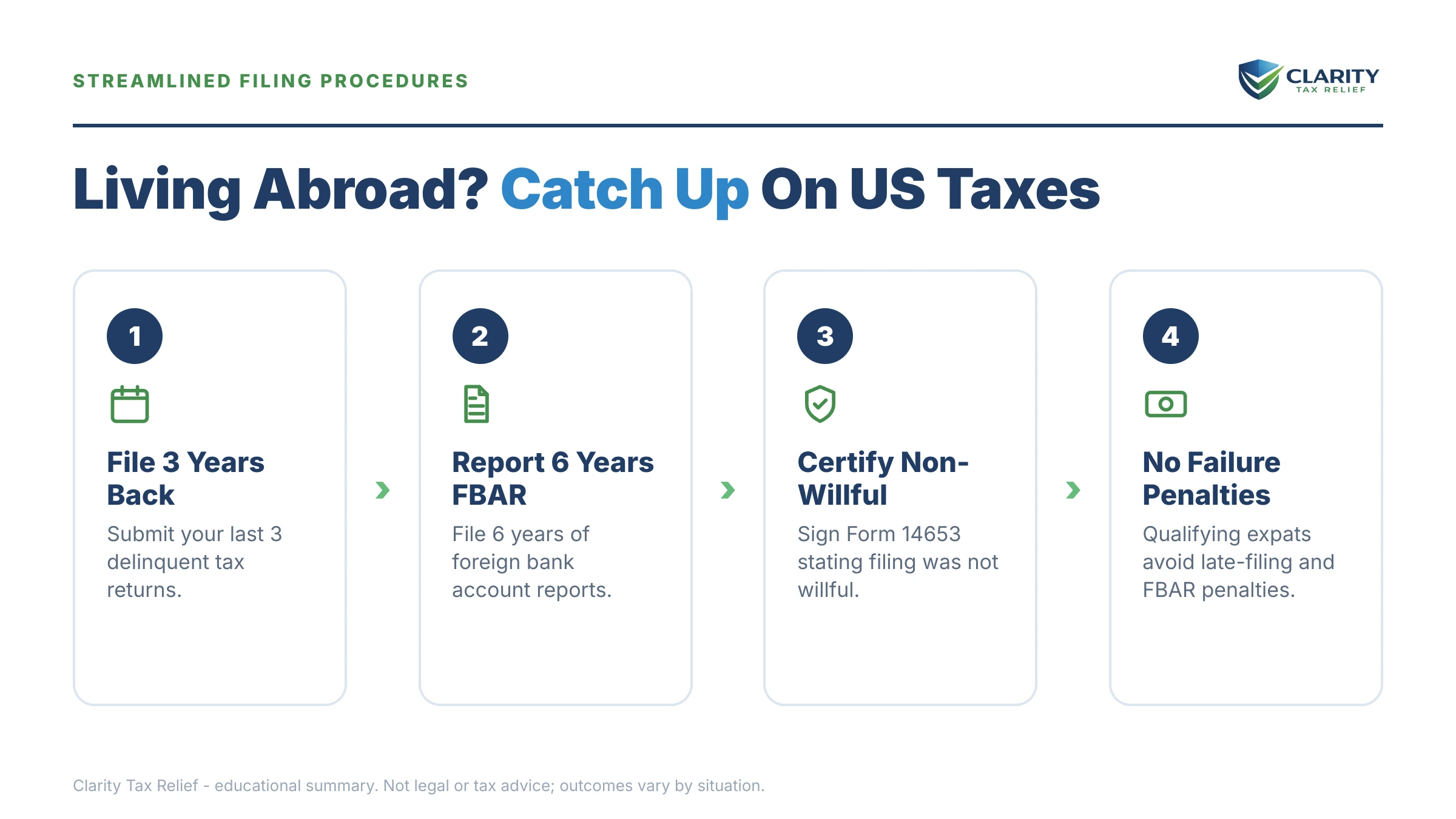
The short answer: if you're an expat who hasn't filed US taxes, the Streamlined Foreign Offshore Procedures usually let you catch up with just 3 years of returns and 6 years of FBARs — with every late-filing, late-payment, and FBAR penalty waived — as long as your failure was non-willful and the IRS hasn't contacted you first.
Maybe your bank in Lisbon or Toronto asked whether you're a "US person." Maybe a passport renewal appointment mentioned tax compliance, or a friend abroad just told you Americans have to file no matter where they live, and your stomach dropped, because you haven't filed in years. Take a breath: the IRS built a specific, penalty-free door for exactly your situation, and most expats who use it owe far less than they fear. This guide shows you the door and how to walk through it before it closes.
The centerpiece is a signed certification, Form 14653, where you explain, in your own words, why you didn't file. The image below shows you exactly what the streamlined package looks like and where the pieces fit, so keep reading before you draft anything.
⏱ Your real clock: the streamlined door closes the moment the IRS reaches you first. The Streamlined Foreign Offshore Procedures are only available if the IRS has not opened an examination or contacted you about the unfiled years. There's no printed deadline — eligibility simply ends if they find you before you come forward, and interest on any unpaid tax accrues monthly either way.
Why you still owe US filings, even after years abroad
The United States taxes its citizens and green-card holders on worldwide income, no matter where they live. That's citizenship-based taxation, and almost no other country does it — which is why so many honest people abroad genuinely never knew they had to file. Paying full tax in your country of residence does not replace a US return.
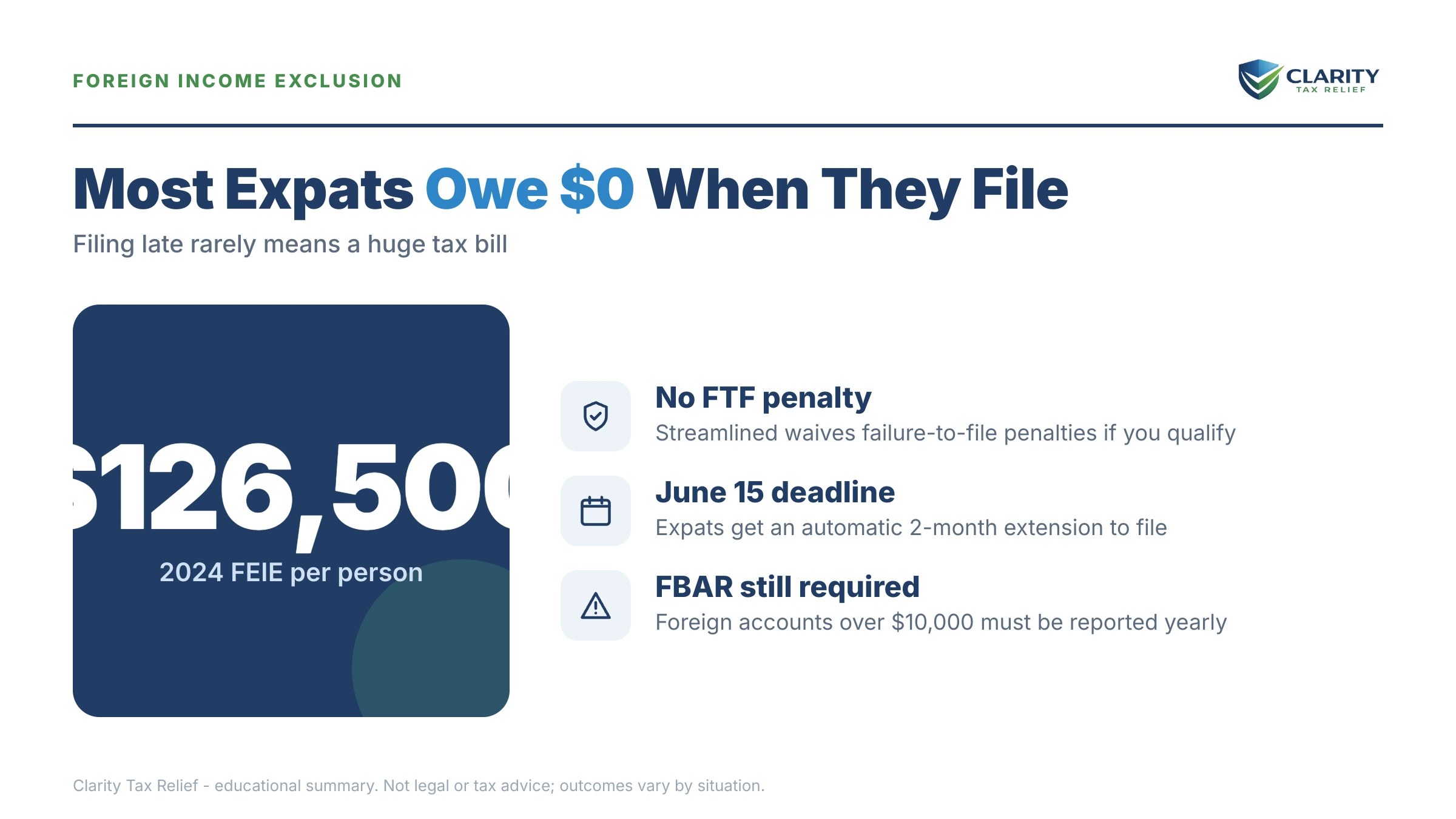
Here's the part that surprises people in the other direction: most expats who catch up owe little or no US tax. The foreign earned income exclusion (Form 2555) shelters over $130,000 of foreign wages in recent years. The foreign tax credit (Form 1116) offsets US tax dollar-for-dollar with tax you already paid abroad. But both are claimed on a return — skip the return and you get neither.
Two separate obligations ride alongside the tax return. The FBAR (FinCEN Form 114) reports foreign accounts whenever their combined balances top $10,000 at any point in the year, even if you owe zero tax. Form 8938 does similar reporting to the IRS itself at higher thresholds. Missing these carries its own penalties, entirely apart from the tax. For the broader landscape of catching up from overseas, see our guide to expat back taxes.
“Non-willful conduct is conduct that is due to negligence, inadvertence, or mistake or conduct that is the result of a good faith misunderstanding of the requirements of the law”
— Streamlined filing compliance procedures (IRS.gov)
Do you actually have a filing requirement? Check before you panic
Not every American abroad has to file — the requirement kicks in only when gross income crosses the filing threshold, which is roughly the standard deduction for your filing status. If you're retired and Social Security is your only income, it's usually not taxable and you may have no unfiled-return problem at all.
The picture changes fast once other income appears. IRA and 401(k) withdrawals, a US or foreign pension, rental income, dividends, or self-employment income all count toward the threshold. They can also make up to 85% of your Social Security taxable. Run each year separately: some years you may have had no requirement, others you did.
One caution: the FBAR has no income test. A retiree who owes zero tax but kept €40,000 in a foreign checking and savings account still owed an FBAR every year. If tax returns aren't your problem but FBARs are, note that the IRS removed the Delinquent FBAR Submission Procedures on June 30, 2026, but late FBARs can still be e-filed through FinCEN with an explanation, and penalties are not automatic when the account income was reported and taxed, though there is no longer a guaranteed penalty-free program.
If your unfiled years stretch back a decade or more, don't assume you must reconstruct all of them. The whole point of streamlined is that you won't, but for context on how the IRS treats long-gap non-filers generally, see haven't filed taxes in 10 years.
What happens if an expat never files US taxes
Living overseas doesn't hide you from the IRS — under FATCA, banks in over 100 countries report US-person accounts directly to it. If you keep not filing, the sequence runs like this, in order:
- Your bank reports you. FATCA data flows to the IRS showing accounts under your Social Security number with no matching returns. This is the trigger, and it's automated.
- Delinquency notices go out — CP59, then LT26 — often to your last known US address. Escalation continues whether or not you ever see them.
- The IRS files for you. A Substitute for Return uses only what payers reported: single status, no foreign tax credit, no exclusion, no deductions — the worst possible math. Read what that means in the IRS filed a substitute return for me.
- The inflated balance is assessed and collection notices begin, with failure-to-file penalties of 5% per month (up to 25%) already baked in, plus interest.
- Your passport is at risk. Once the assessed debt reaches $66,000 (the 2026 threshold), the IRS can certify it to the State Department, which can deny renewal or revoke the passport — the one document an expat cannot live without. Details: passport revoked for tax debt.
- US-source income gets levied. The IRS can't easily reach a foreign bank account. But it doesn't need to: it can levy US bank and brokerage accounts, US pensions, and take up to 15% of Social Security through the Federal Payment Levy Program. See can the IRS garnish Social Security.
And at any point in that sequence, the moment an examination opens, the penalty-free streamlined path is gone. That's the real cost of waiting, not a specific date, but a door that closes without warning.
Unfiled years abroad? Find out where you stand before the IRS does.
The streamlined procedures are only available until the IRS contacts you first, and FATCA bank reporting is how it finds expats. An experienced tax professional will review your unfiled years, test your streamlined eligibility, and map the cheapest way back to compliance. Free, confidential, no pressure.
Your options for catching up: which path fits
There are four legitimate ways back to compliance, and choosing the wrong one is expensive. The table compares them; the paragraphs after it explain the fit.
| Path | Who it's for | What you file | Penalty outcome |
|---|---|---|---|
| Streamlined Foreign Offshore Procedures (SFOP) | Non-willful non-filers who lived outside the US (330+ days, no US abode) in at least 1 of the last 3 years | 3 years of returns, 6 years of FBARs, Form 14653 certification | All late-filing, late-payment, accuracy, information-return, and FBAR penalties waived; tax + interest only |
| Streamlined Domestic Offshore Procedures (SDOP) | Non-willful taxpayers who fail the foreign-residency test (e.g., recently moved back to the US) | 3 years of amended/original returns, 6 years of FBARs, Form 14654 | Most penalties waived, but a 5% offshore penalty applies to certain foreign assets |
| Late FBAR filing through FinCEN (the Delinquent FBAR Submission Procedures were removed by the IRS on June 30, 2026) | Filed all returns and owe no tax — only the FBARs are missing | Late FBARs e-filed through FinCEN with an explanation statement | Penalties are not automatic when account income was reported and taxed, but there is no longer a guaranteed penalty-free program |
| IRS Voluntary Disclosure Practice | Willful conduct — deliberate concealment, with potential criminal exposure | Full disclosure package through IRS Criminal Investigation | Substantial penalties, but a path away from prosecution |
For most expats reading this page, the streamlined offshore procedures are the answer: three returns, six FBARs, zero penalties. If you've already moved back stateside and can't meet the 330-day test, streamlined domestic offshore is the cousin program — same idea, but with a 5% penalty on certain assets, which is why timing a submission before a move home can matter.
What you should not do is quietly mail in old returns outside any program, or start filing current years while ignoring the past. That's a quiet disclosure. It waives nothing, protects nothing, and can draw attention to exactly the history you're trying to fix.
If catching up produces a balance you can't pay at once, the ordinary IRS toolkit applies from abroad too — payment plans, hardship status, and in genuine cases an offer in compromise. Our hub on how to settle tax debt yourself covers those options in depth so this page can stay focused on the expat-specific path.
What catching up actually costs: a worked example at $11,300
Numbers make this concrete, so here's a clearly hypothetical scenario. Say you're 68, retired in Portugal, and haven't filed since you left the US nine years ago. Your income: about $25,200 a year in Social Security, $18,000 in traditional IRA withdrawals with no withholding. A small foreign pension. Under streamlined you file only the last three years, and suppose the tax works out to roughly $3,766 per year — $11,300 total across the three returns.
Now compare the two roads:
- Without streamlined: the failure-to-file penalty runs 5% per month up to 25% of the unpaid tax — about $2,825 on $11,300. The failure-to-pay penalty (0.5% per month) stacks on top of that, month after month. And if your Portuguese accounts ever topped $10,000 combined, non-willful FBAR penalties could add five figures more, per our guide to the FBAR penalty. You can estimate your own penalty exposure with our IRS Penalty & Interest Calculator.
- With streamlined: every one of those penalties is waived. You owe the $11,300 plus interest, and nothing else.
Can't write an $11,300 check from a fixed income? A long-term IRS installment agreement (available online for balances up to $50,000) spreads it over up to 72 months — roughly $157 a month before interest ($11,300 ÷ 72), while interest continues to accrue until it's paid. And note what streamlined doesn't change: if any of those three years shows a refund instead of a balance — say, from foreign tax credits — you can still claim it, but only within the three-year refund window.
Expat filing deadlines and the rights you lose when they pass
Expats get more time to file than stateside taxpayers, but every clock in this table is real, and two of them quietly take money or options away.
| Clock | What it controls | What you lose when it passes |
|---|---|---|
| April 15 | Payment due date, even for expats | Interest starts accruing on any unpaid balance, extension or not |
| June 15 | Automatic 2-month filing extension for taxpayers abroad | Late-filing penalties begin on unfiled returns with a balance due |
| October 15 | Extended filing deadline; FBAR's automatic extension also ends | The return and FBAR are both formally delinquent |
| 3 years from the original due date | Refund statute of limitations | Any refund or credit for that year is forfeited permanently |
| The moment the IRS opens an examination or contacts you | Streamlined eligibility | The penalty-free catch-up path closes for good |
| Assessed debt reaching $66,000 (2026) | Passport certification threshold | The State Department can deny renewal or revoke your passport |
How to catch up on unfiled US taxes from abroad, step by step
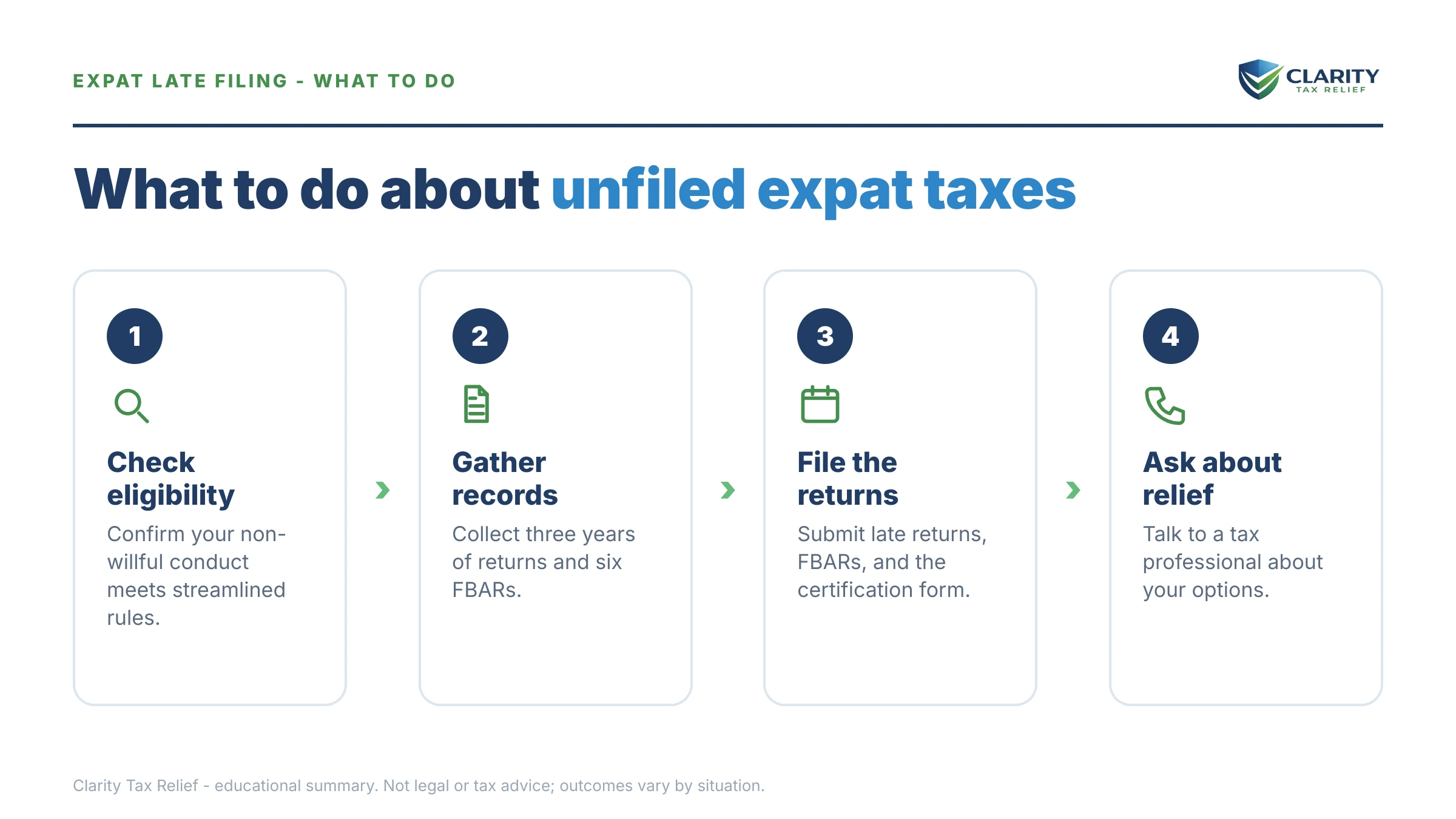
The streamlined submission is a defined package, not an open-ended negotiation — done in this order, it's a project you can finish in weeks.
- Confirm which years you had a filing requirement. Compare your gross worldwide income — Social Security, pensions, IRA withdrawals, wages, rentals, investments — to the US filing threshold for each year, which is roughly the standard deduction for your filing status.
- Pull your IRS records. Request wage and income transcripts to see what US payers — the Social Security Administration, IRA custodians, brokerages — already reported under your Social Security number, so your returns match the IRS's file.
- Test your streamlined eligibility. You need non-willful conduct and the non-residency test: in at least one of the last three years, no US abode and at least 330 full days physically outside the United States. The IRS must not have contacted you first.
- Prepare the package. Three years of Form 1040 with all required international forms, six years of FBARs (FinCEN Form 114). The Form 14653 certification explaining in writing why your failure to file was non-willful.
- Submit and settle the balance. File the streamlined package with tax and interest paid, or arrange an IRS payment plan if you can't pay in full — interest continues until the balance is paid.
- Stay compliant going forward. File every year by the automatic June 15 expat deadline (pay by April 15 to avoid interest) and e-file your FBAR annually if foreign accounts exceed $10,000 combined.
The step that decides everything is the Form 14653 narrative. It's a signed statement under penalty of perjury — vague or careless wording can undercut the whole submission, while an honest, specific account of why you didn't know is exactly what the program was built for.
When you can handle this yourself, and when help changes the outcome
Plenty of expat catch-up cases are genuinely DIY. You can likely handle this alone if Social Security was your only income and no filing was required. If your only gap is missing FBARs on fully-reported income. Or if your three streamlined years are simple returns — one pension, one bank account, foreign tax credits that zero out the bill — and you're comfortable writing the Form 14653 statement yourself.
Experienced help changes the outcome when the facts get heavier: anything that could look willful (large accounts, income routed to avoid US reporting, advice you ignored), foreign pensions or investment funds with tricky US treatment, self-employment income abroad, a balance you can't pay, a debt approaching the $66,000 passport threshold, or any letter already received from the IRS, since contact can end streamlined eligibility and the response strategy shifts completely. The willfulness call in particular is one to get right the first time; there's no do-over on a signed certification. If your gap is shorter and mostly stateside, our guide to haven't filed taxes in 5 years walks the domestic version of this decision.
Not sure which side of that line you're on? An experienced tax professional can pressure-test your non-willful story in one free conversation — call (888) 825-7779 before you sign anything.
Terms on the streamlined checklist, decoded
- FBAR (FinCEN Form 114): an annual electronic report of foreign accounts, required whenever their combined balances exceed $10,000 at any point in the year — separate from your tax return.
- FATCA: the law that makes foreign banks report US-person accounts to the IRS — the reason your bank asked if you're a "US person," and the reason non-filers abroad get found.
- Form 14653: the signed certification at the heart of a streamlined foreign submission, where you attest that your failure to file was non-willful and explain why.
- Non-willful: conduct due to negligence, mistake, or a good-faith misunderstanding of the law — the eligibility line between streamlined and the much harsher voluntary disclosure route.
- Substitute for Return (SFR): a return the IRS files for you using only payer data — no credits, no exclusions, no deductions — producing the largest possible balance.
- Foreign earned income exclusion (FEIE): the Form 2555 election that shelters over $130,000 of foreign wages or self-employment earnings from US tax, but only on a filed return.
Primary sources worth bookmarking: the IRS's official Streamlined Filing Compliance Procedures page, its hub for international taxpayers, and IRS.gov/payments for paying any balance from abroad.
Expat non-filer questions, answered
Do I have to file US taxes if I live abroad and already pay taxes in my country?
Yes. The US taxes citizens on worldwide income no matter where they live, so paying tax in France, Canada, or anywhere else does not replace a US return. The foreign tax credit and the foreign earned income exclusion usually reduce the US bill to zero or near zero. But you must file to claim them. A tax treaty changes what's taxed, not whether you file.
How many years of back taxes do I have to file as an expat?
Under the Streamlined Foreign Offshore Procedures, just three years of returns and six years of FBARs, even if you've missed ten or twenty years. Outside streamlined, the IRS generally expects six years of returns from non-filers. That three-year window is the single biggest reason streamlined beats simply filing everything you missed.
Will I owe penalties for the years I didn't file from abroad?
Not if you qualify for the Streamlined Foreign Offshore Procedures. They waive failure-to-file, failure-to-pay, accuracy-related, information-return, and FBAR penalties entirely. You still pay the tax itself plus interest. If your conduct was willful, or the IRS contacts you before you come forward, penalties come back on the table, and FBAR penalties for willful violations can be severe.
I'm retired on Social Security overseas — do I even have to file?
Maybe not. If Social Security is your only income, it's usually not taxable and you may have no filing requirement at all — though FBAR reporting still applies if your foreign accounts topped $10,000 combined. Add an IRA, pension, rental, or investment income and you likely cross the filing threshold, which is roughly the standard deduction for your filing status.
What does "non-willful" mean for the streamlined procedures?
Non-willful means your failure to file came from negligence, mistake, or a genuine misunderstanding of the law — for example, believing that paying tax where you live covered your US obligation. You certify this in writing on Form 14653 and explain your reasons. Deliberately hiding income or moving money to avoid detection is willful, and willful cases belong in the IRS Voluntary Disclosure Practice instead.
Can the IRS actually find me if I live overseas?
Yes — through your bank, not a knock on the door. Under FATCA, foreign financial institutions in over 100 countries report accounts held by US persons directly to the IRS, which is why banks ask whether you're a "US person." The IRS can also certify a seriously delinquent tax debt — $66,000 or more in 2026 — to the State Department, which can deny or revoke your passport.
Can I just start filing this year and skip the old years?
It's risky. Filing current-year returns while ignoring the past, or quietly mailing in old returns outside any program — is called a quiet disclosure. It can flag the very history you're hoping to bury without any penalty protection. The streamlined procedures exist precisely so you don't have to gamble; they cap the lookback at three years and waive the penalties.
Does renouncing US citizenship erase my unfiled years?
No. Renouncing requires you to certify five years of tax compliance on Form 8854, so you'd have to catch up first, and any tax already owed survives renunciation. Some long-term expatriates also face an exit tax on unrealized gains when they renounce. For most non-filers, streamlined catch-up is far cheaper and simpler than expatriation.
Your next 24 hours
- List the facts. Write down every year since you last filed, your income sources for each (Social Security, IRA, pension, wages, rentals), and every foreign account that ever topped $10,000 combined. This one page determines your entire path.
- Gather the paper. Pull your SSA-1099s, IRA and pension statements, foreign bank year-end summaries. Your last filed US return, and set up IRS transcript access so your returns match what payers reported.
- Get a free case review. Streamlined is only available until the IRS contacts you first, and FATCA reporting means it eventually will — call (888) 825-7779 or use the 2-minute form to have your years reviewed and your non-willful eligibility tested while the penalty-free door is still open.
This guide is general information, not tax or legal advice for your specific situation. Eligibility for IRS programs depends on individual facts and circumstances; no outcome is guaranteed.