
Offer in Compromise
Does an Offer in Compromise Hurt Your Credit? What Actually Happens in 2026
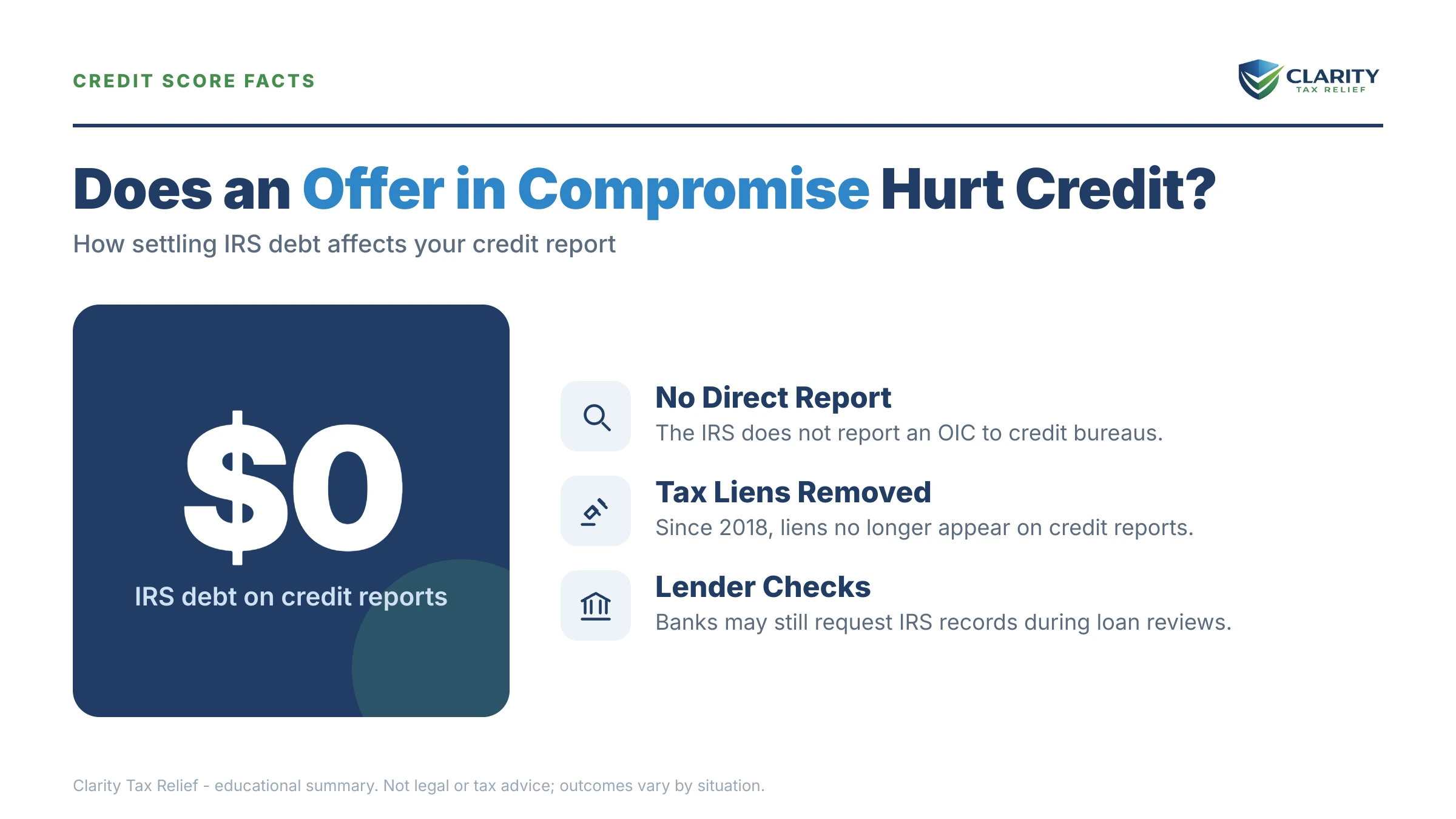
The short answer: an Offer in Compromise does not affect your credit score, because the IRS does not report offers, balances, or settlements to any credit bureau. Since 2018, tax liens no longer appear on consumer credit reports either. The only real credit impact is indirect — a filed federal tax lien remains a public record that lenders can find.
You are weighing an Offer in Compromise, and somewhere in the back of your mind is the worry that "settling" a debt will tank your score the way a charged-off credit card does. That fear is misplaced. Tax debt and consumer credit live in two different systems, and the OIC lives entirely in the tax one.
Here is what actually matters: the score itself is safe, but a public record can still trip up a mortgage or business-loan approval. The image below shows what a federal tax lien looks like and where a lender would find it — the part of this story that genuinely touches your ability to borrow.
⏱ The real clock: an OIC has no credit-report deadline, but while your balance sits unresolved, interest and the failure-to-pay penalty keep accruing every month, and the IRS can file a lien that becomes public record. The sooner the debt is settled, the sooner any lien is released and the record cleared.
Does an Offer in Compromise affect credit at all?
An Offer in Compromise has zero direct effect on your three-bureau credit report. The IRS is not a furnisher of data to Equifax, Experian, or TransUnion. It never sends them your balance, your missed payments, or the fact that you settled for less than the full amount. There is no "settled tax debt" tradeline the way there is with a credit-card charge-off.
This surprises people because private debt settlement does hurt credit — a settled card shows as "paid for less than full balance" and drags your score for years. Tax settlement works nothing like that. The confusion is understandable, but the mechanics are completely separate.
If you want the broader picture of how a balance owed to the IRS interacts with your file, we cover it in depth in does owing the IRS affect credit. This page focuses on the OIC specifically.
Why people think an OIC and credit are connected
The link people imagine comes almost entirely from one thing: the Notice of Federal Tax Lien. For decades, a filed tax lien showed up on credit reports and slashed scores by 100 points or more. That is where the "tax problems wreck your credit" reputation was born.
That era ended in 2018. All three major bureaus removed tax liens, along with most civil judgments, from consumer credit reports, because the records too often could not be matched reliably to the right person. As of 2026, no tax lien appears on a standard credit report, whether or not you file an OIC.
So the old fear is real history, but it is history. The lien still exists as a legal claim; it just no longer lives inside your FICO score. For the full breakdown of that change, see tax lien on credit report.
What actually shows up, and what doesn't
The cleanest way to think about this is direct credit-report impact versus indirect public-record impact. An OIC touches only the second category, and only through a lien.
| Item | On your credit report? | Can a lender find it? |
|---|---|---|
| The OIC itself (Form 656) | No — not reported to any bureau | No, unless you disclose it on an application |
| Your IRS balance / back taxes | No — the IRS reports nothing to bureaus | Only if disclosed or found in a lien search |
| Notice of Federal Tax Lien (filed) | No — removed from credit reports since 2018 | Yes — it is a county public record |
| Lien release after OIC is paid | Not applicable | Yes — recorded as "released" in public records |
The single line that matters for borrowing is the third one. A lien is filed in the county land or Uniform Commercial Code records. Mortgage and commercial underwriters pull those records directly and ask about tax debt on the application, which is how an unresolved lien can still stall a loan even though your score never moved.
What happens if you leave the tax debt unresolved
Doing nothing does not protect your credit. It exposes the one channel that can actually hurt your borrowing power. The tax debt itself follows a collection path, and a lien is one of its stops.
- Balance grows. Interest compounds daily and the failure-to-pay penalty adds 0.5% per month. The number you would settle keeps rising while you wait.
- Notices escalate. The IRS moves from balance-due reminders toward intent-to-levy notices — the sequence we map in the order of IRS collection letters.
- A lien may be filed. Once a Notice of Federal Tax Lien is recorded, it becomes public record. Your score is untouched, but a mortgage, refinance, or business-loan underwriter will see it.
- Levies become possible. After a final notice, the IRS can levy bank accounts and garnish wages — a cash-flow hit far more damaging than any score change.
In 2026, this matters more than it used to. IRS staffing was cut sharply in 2025, but liens and levies are issued by automated systems that never stopped running. The machine keeps escalating whether or not a person ever reviews your file.
Weighing an OIC and worried about your credit or a lien?
Send us your notice or lien paperwork. An experienced tax professional will tell you, free and confidential, whether an offer is realistic, and exactly what it does and doesn't do to your borrowing power. Interest and penalties keep adding up while the debt sits, so there's no upside to waiting.
Your resolution options and their credit impact
Every IRS resolution program shares the same headline: none of them are reported to credit bureaus. The differences are about public records and cost, not your score. If you are choosing between an offer and a payment plan, read IRS payment plan vs offer in compromise alongside this.
| Option | What it costs / requires | Lien & credit effect |
|---|---|---|
| Offer in Compromise | $205 fee (waived if low-income certified); settle for your Reasonable Collection Potential | No score impact; existing lien released within ~30 days after the offer is paid in full |
| Streamlined installment agreement | $0–$69 setup; balance ≤ $50,000 over up to 72 months | No score impact; direct-debit setup can help you avoid a lien filing entirely |
| Currently Not Collectible | Prove hardship on Form 433-F; collection paused, debt remains | No score impact; a lien may still be filed to protect the IRS's position |
| Pay in full | Full balance plus accrued penalties and interest | No score impact; any lien is released within ~30 days of payment |
Notice the pattern: an OIC is the only option that actually removes the underlying debt and clears the lien for less than the full amount. But it does so only after acceptance and full payment. A streamlined plan is often the better move purely for lien-avoidance, because a direct-debit agreement under $25,000 frequently keeps the IRS from filing in the first place. For how offers stack up mechanically, see how an offer in compromise actually works.
How the IRS sets your offer, and why the lien stays until you're done
The IRS accepts an offer only when the amount equals your Reasonable Collection Potential (RCP) — roughly the equity in your assets plus what it calculates you could pay from future income. This is the math that decides whether an OIC is even possible. It is why the agency accepted only about 1 in 5 offers in FY2024. It is never automatic. You can estimate your own figure with our Offer in Compromise Calculator before spending anything, and read the full method in reasonable collection potential.
Because the offer is only a proposal until it is accepted and paid, any lien filed before or during the process stays put. The IRS keeps the lien as security until it has the money it agreed to. This is the piece that catches borrowers off guard, and we cover it in detail in does an OIC remove a tax lien.
A worked example: the $42,000 lien and a mortgage
Say you're self-employed and owe $42,000 from two years of underpaid self-employment tax. The IRS filed a Notice of Federal Tax Lien last spring. You check your credit report — the lien is nowhere on it, and your score is still 710. So far, no harm.
Then you apply for a mortgage. The underwriter runs a public-records search and finds the $42,000 lien. The loan stalls, because most lenders will not close over an open federal tax lien.
You pursue an OIC. Based on your assets and income, your RCP works out to a hypothetical $11,500 — the most the IRS could realistically collect. You submit Form 656 with the 20% down payment (unless you're low-income certified, which waives it). If the offer is accepted and you pay the balance, the IRS releases the lien, generally within 30 days. The public record updates to "released." Only then does the mortgage obstacle disappear. Your credit score, meanwhile, never changed at any point in this story. These numbers are illustrative; your own RCP depends entirely on your facts.
When you can handle this yourself, and when help changes the outcome
You can absolutely manage the credit side alone. Pull your free reports at AnnualCreditReport.com and confirm no tax item appears. It won't. If your only worry was the score, you're done: an OIC does not touch it.
Where experienced help earns its keep is the parts that actually cost money. Getting the RCP right so your offer isn't rejected, timing a lien release around a pending loan closing, or deciding whether a streamlined installment agreement would avoid a lien altogether. Those are judgment calls, not form-filling. If you have a lien complicating a home purchase or refinance, our guides on buying a house while owing the IRS and refinancing with an IRS lien walk through the mechanics. A professional can sequence the moves so the lien clears when you need it to.
How to protect your credit while pursuing an Offer in Compromise
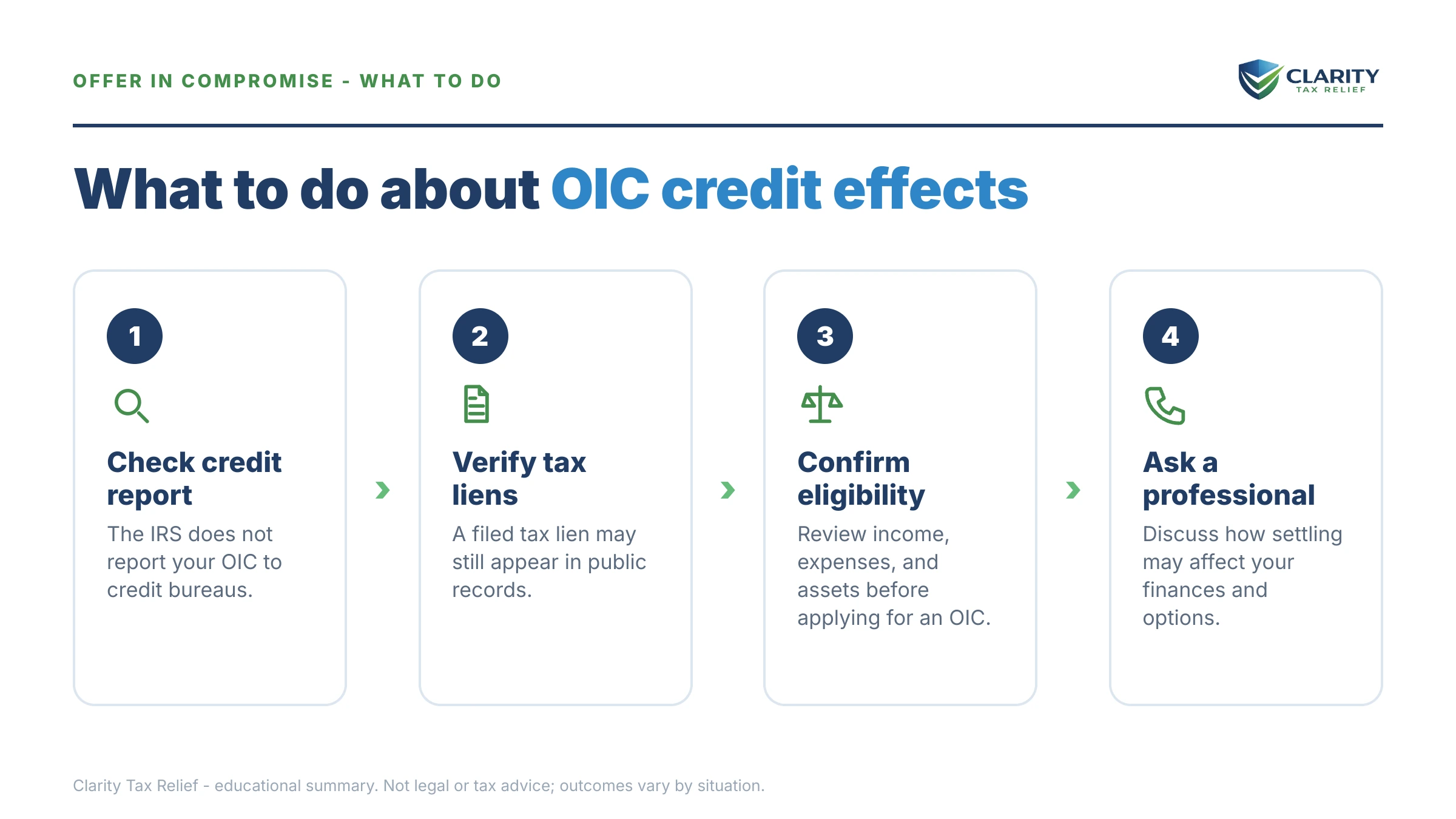
- Confirm nothing is on your report. Pull all three credit reports and verify no tax lien or IRS item appears. It shouldn't, but check.
- Locate any filed lien. Search your county recorder and check your IRS account transcript for a lien-filed code so you know what a lender will find.
- Choose the option that limits public records. If a lien hasn't been filed yet, a direct-debit streamlined plan may prevent one. If an offer is the right fit, plan for the lien to stay until it's paid.
- Submit a complete, accurate offer. File Form 656 with Form 433-A (OIC) and support every number, so the offer isn't returned for errors that leave the lien in place longer.
- Get the lien released and verify it. After paying the accepted offer, confirm the IRS files the release within ~30 days and that the public record shows "released."
Terms on your paperwork, decoded
Notice of Federal Tax Lien: the public document that legally stakes the IRS's claim to your property. It is recorded at the county level and is searchable, but it is no longer on credit reports.
Credit bureau (furnisher): a company like Equifax that compiles your credit file from data furnishers such as banks. The IRS is not a furnisher and reports nothing to them.
Public record: a government-filed document anyone can search, including lenders. A tax lien lives here even though it left your credit report.
Reasonable Collection Potential (RCP): the IRS's calculation of the most it could collect from your assets and future income — the number your offer must generally meet.
Lien release: the recorded document showing the lien is satisfied and no longer enforceable, filed within about 30 days of full payment.
Frequently asked questions
Does an Offer in Compromise show up on my credit report?
No. An Offer in Compromise is an agreement between you and the IRS, and the IRS does not report it to Equifax, Experian, or TransUnion. There is no OIC tradeline, no settlement flag, and no score change from the offer itself. The only credit-adjacent item a tax debt can produce is a Notice of Federal Tax Lien, and since 2018 those no longer appear on consumer credit reports either.
Does the IRS report tax debt to credit bureaus?
No. The IRS does not report balances, missed payments, or settlements to any of the three credit bureaus. Owing the IRS $42,000 will not lower your FICO score the way a maxed-out credit card would. The catch is public records: a filed tax lien is searchable by lenders even though it is no longer on your credit report.
Will an Offer in Compromise remove a tax lien?
Yes, but only after the offer is accepted and fully paid. A Notice of Federal Tax Lien filed before your OIC stays in place while the offer is under review. Once you satisfy all offer terms, the IRS releases the lien, generally within 30 days. The public record then shows the lien as released.
Does applying for an OIC hurt my credit score?
Filing Form 656 does not touch your credit score, because the application is not reported to any bureau. What can indirectly affect you is that the IRS may file a lien to protect its interest before or during the review. That lien is public record. Applying does not create a new negative mark on your consumer credit file.
Can I get a mortgage after an Offer in Compromise?
Often yes, and a completed OIC usually helps because the underlying debt and lien are gone. Mortgage underwriters run public-records searches and ask directly about tax debt, so an open lien or an offer still in review can stall an approval. Most lenders want to see the lien released and the offer satisfied before they close.
Is a payment plan better for my credit than an OIC?
Neither one is reported to credit bureaus, so the score impact is the same: none. The real difference is public records. An installment agreement under $50,000 set up with direct debit can help you avoid a lien filing altogether, while an OIC only clears an existing lien after the offer is paid in full.
How long after an OIC is my tax lien released?
The IRS generally releases a federal tax lien within 30 days after you satisfy all terms of the accepted offer. For a lump-sum offer, that means after the final payment; for a periodic offer, after the last scheduled payment. The release is recorded with the same county office where the lien was filed, updating the public record.
Does an OIC affect my ability to get a business loan?
It can, while a lien is still active. Commercial and SBA lenders review public records and often decline applicants with an unresolved federal tax lien. A completed OIC that clears the lien removes that obstacle, which is one reason many self-employed borrowers finish the offer before applying for financing.
Your next 24 hours
- Pull your credit reports from AnnualCreditReport.com and confirm no tax lien or IRS item is listed. This proves the score fear is unfounded.
- Gather your paperwork: your most recent IRS notice, any lien document, your last filed return. A snapshot of your income and assets — the raw material for an RCP estimate.
- Get a free case review — use the 2-minute form or call (888) 825-7779. We'll tell you whether an offer is realistic and how to time any lien release around a loan. Interest and penalties keep accruing while the debt sits, so acting now costs you less.
This guide is general information, not tax or legal advice for your specific situation. Eligibility for IRS programs depends on individual facts and circumstances; no outcome is guaranteed.