
IRS Forms
Schedule 8812 Explained (2026): The Child Tax Credit Form — and Why Your Refund Was Reduced
The short answer: Schedule 8812 is the form attached to Form 1040 (or 1040-NR) that figures three credits — the child tax credit (CTC), the credit for other dependents (ODC), and the refundable additional child tax credit (ACTC). If your refund shrank and the letter cites Schedule 8812, the IRS recomputed one of those three credits.
You counted on that refund — you're raising two kids on one income, and the deposit that landed was thousands less than the software promised. The letter blames a form you never touched, because your tax program filled it in silently. The good news: Schedule 8812 adjustments follow predictable patterns, and most of them can be checked, challenged, or fixed.
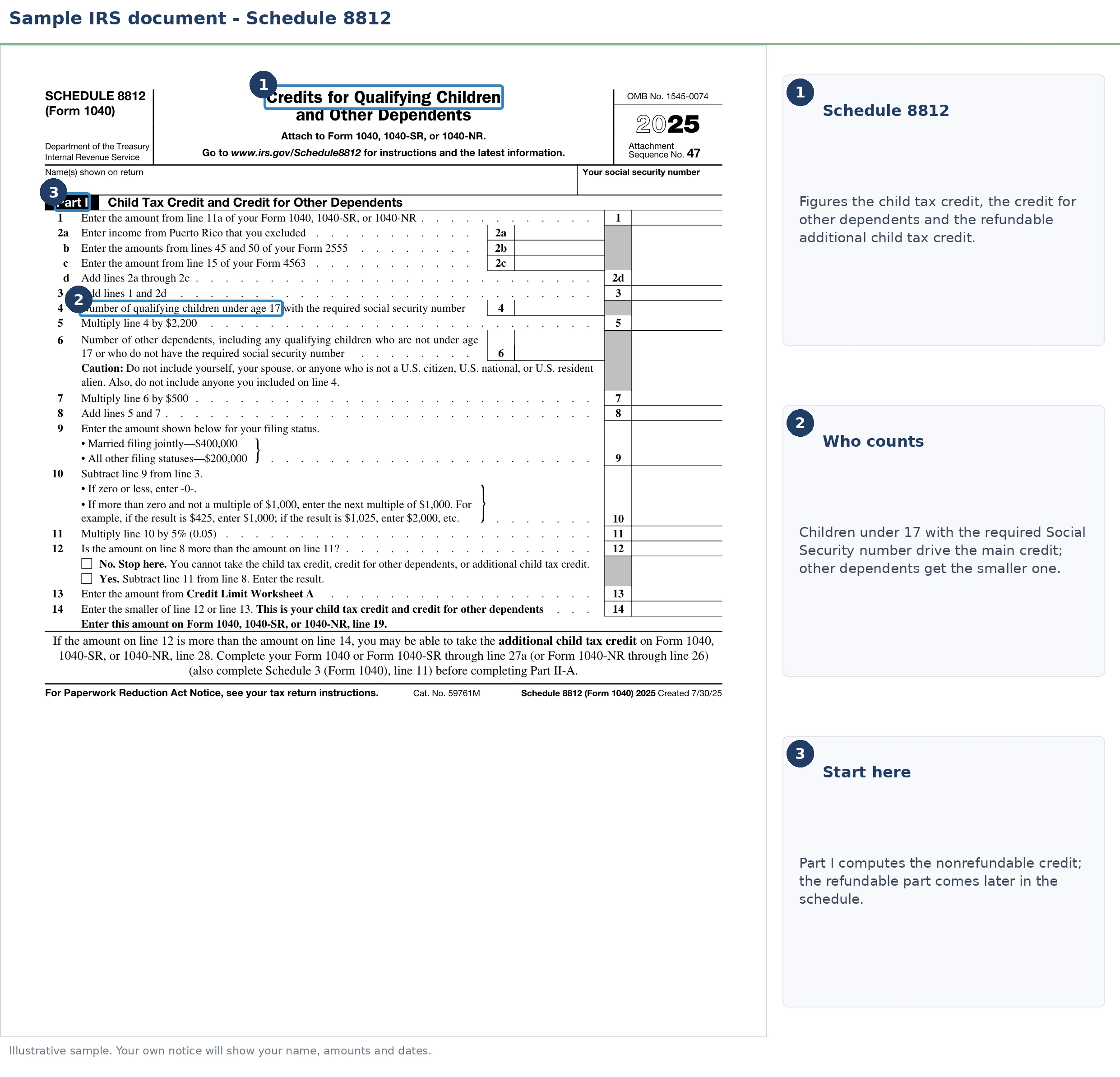
The image below shows exactly what Schedule 8812 looks like and where each of the three credits lands on the form, so you can match the line named on your letter to the line on the schedule.
⏱ Your deadline: the response date printed on your adjustment letter controls. If the IRS changed your Schedule 8812 credits through a math-error notice such as a CP11 or CP12, you typically have 60 days from the notice date to disagree before the change becomes final.
What is Schedule 8812 and what does it figure?
Schedule 8812 is the single form that computes all three child-and-dependent credits on your federal return: the child tax credit, the credit for other dependents, and the additional child tax credit. It attaches to Form 1040 or Form 1040-NR, and if you claim any of the three credits, the schedule has to be part of the return — software includes it automatically, which is why most people first meet it on an IRS letter rather than at filing time.
One current-year note that matters: the IRS updated the 2025 Instructions for Schedule 8812 on February 10, 2026. The per-child credit amount, the refundable ACTC cap, the income phase-out thresholds, and the earned-income floor are all printed in those instructions — always verify the current figures there rather than from an old article or last year's software, because these numbers change.
Here is how the three credits split, and — the part that decides whether money reaches your refund — which ones are refundable:
| Credit | Who qualifies | Refundable? |
|---|---|---|
| Child tax credit (CTC) | A qualifying child under 17 at year-end, claimed as your dependent, who lived with you more than half the year and has an SSN valid for employment issued before your return's due date | No — it can only reduce your tax to zero |
| Credit for other dependents (ODC) | Dependents who don't meet the CTC rules: children 17 or older, dependent parents and relatives, and dependents with ITINs instead of SSNs | No |
| Additional child tax credit (ACTC) | Filers whose CTC exceeds their tax, with earned income above the floor set in the Schedule 8812 instructions | Yes — this is the only piece that can be paid out as a refund |
Refundable vs. nonrefundable: why the CTC and ACTC are split
The child tax credit can only reduce your tax to zero — only the additional child tax credit can put money into your refund. That split is the source of most Schedule 8812 confusion, because tax software shows one combined number while the IRS computes two separate ones.
Think of it in two passes. First, the CTC works like a coupon against the tax you owe: if your tax is smaller than your credit, the coupon can't go below zero. Second, Schedule 8812 takes the leftover credit and runs the ACTC computation — a percentage of your earned income above a floor, capped per child — to decide how much of that leftover becomes refundable cash.
That second computation is where lower-income single parents get surprised. You can have children who fully qualify and still not receive the full credit as a refund, because the ACTC is limited by your earned income, not just by how many kids you have. Unemployment benefits, child support, and most non-work income don't count as earned income for this purpose.
One more refundable-credit quirk: any return claiming the ACTC has its entire refund held until at least mid-February under federal law. If your refund is late but not reduced, that's usually the explanation — see our guide to the PATH Act refund delay before assuming something went wrong.
Why your Schedule 8812 credit was reduced or denied
Most Schedule 8812 reductions trace to one of five causes, and each cause arrives with a predictable IRS letter or transcript entry. Many of these run through the IRS's math-error authority, which lets it change the credit and the refund without opening an audit — our guide to IRS math error notices covers how that authority works. The table below maps cause to letter so you can identify yours in one pass:
| What went wrong | What the IRS typically sends | What to check |
|---|---|---|
| Child's SSN was issued after the return's due date, or the child has an ITIN | Math-error adjustment — a CP11 notice (balance due) or CP12 notice (refund changed) | The SSN issue date; the child may still qualify you for the smaller, nonrefundable ODC |
| Someone else claimed the same child | A CP87A notice, or a rejected e-file if the other return posted first | Who wins under the IRS tie-breaker rules — custody nights, then income |
| Income above the phase-out for your filing status | CP11 or CP12 recomputation | The phase-out thresholds in the current Schedule 8812 instructions |
| Earned income too low to support the ACTC claimed | CP11 or CP12 recomputation of the refundable amount | Your earned-income figure — wages and self-employment count; unemployment and support payments don't |
| Credit disallowed in a prior year and no Form 8862 attached | Credit removed automatically; a CP79 notice explains the Form 8862 requirement | Whether a past disallowance triggered the recertification rule |
| Credit was computed correctly but the refund is still short | Transcript code 898 — an offset, not a Schedule 8812 problem | The Treasury Offset Program, which intercepts refunds for other government debts |
The distinction in that last row matters more than it looks. If your Schedule 8812 math was right but the refund still came up short, no amount of arguing about the credit will help — you're dealing with an offset, which has its own rules and its own remedies.
A worked example: the $6,000 refund reduction
Say you're a single parent of two and your software projected a $7,400 refund, built on Schedule 8812. This is hypothetical, but the mechanics are exactly what the IRS runs. Your tax before credits was $1,900. The nonrefundable CTC wiped that $1,900 to zero, and the schedule converted another $4,100 of leftover credit into refundable ACTC — $6,000 of total benefit from your two kids ($1,900 + $4,100).
Now your ex files first and claims both children. The IRS removes both kids from your return: your $1,900 in tax comes back, and the $4,100 ACTC disappears — a $6,000 swing. Your refund drops from $7,400 to $1,400, and a CP87A-style letter tells you a duplicate claim exists.
Two things decide what happens next. If your refund hadn't been issued yet, it's simply reduced — painful, but not a debt. If the IRS had already paid it and disallows the credit afterward, that same $6,000 is assessed back as a balance due, with interest running from the assessment. And if the children genuinely lived with you more than half the year, the tie-breaker rules likely favor you — the duplicate claim is a dispute you can win with school and medical records, not a final answer. Our guide to both parents claiming the same child walks through exactly how that contest plays out.
What happens if you ignore a Schedule 8812 adjustment
An unanswered Schedule 8812 adjustment becomes final — and a credit the IRS already paid out can turn into an assessed tax debt. The sequence is automated and runs in stages:
- The adjustment letter arrives. A CP11, CP12, or CP87A changes the credit and opens your response window. Nothing is final yet.
- The window closes. On a math-error notice, once the response period on the letter passes, the change stands. You lose the easiest path — a simple written disagreement that forces the IRS to reverse the change and use formal procedures instead.
- A clawback becomes a bill. If the credit was already refunded, the disallowed amount is assessed back with interest, and in some cases a 20% accuracy-related penalty. A balance-due notice follows, and the standard IRS collection sequence begins if it goes unpaid. You can estimate what an assessed-back credit grows into with our IRS penalty and interest calculator.
- Future years get harder. A disallowance for anything beyond a math or clerical error triggers the Form 8862 recertification requirement on your next claim. Disallowance for reckless or intentional disregard can bar the credit for two years; fraud can bar it for ten.
Stage 4 is the one people underestimate. The dollars in dispute this year may be survivable — losing the credit for two or ten future years, on a form you'll need every year your kids are under 17, is a much bigger number.
Refund cut by a Schedule 8812 adjustment?
Send us the letter. An experienced tax professional will identify which credit was changed, whether the IRS's recomputation is actually right, and what to send back before the response window printed on your notice closes — free and confidential.
Your options after the IRS changes your credit
You have four realistic paths after a Schedule 8812 adjustment, and the letter code — plus whether the money was already paid out — decides which one fits:
- Agree and move on. If the IRS is right — the SSN really was issued late, or your income really did cross the phase-out — no response is needed on a CP12. If the change created a balance due, pay it or set up a plan at IRS.gov/payments before interest compounds further.
- Disagree within the window. A written response to a math-error notice, sent before the date on the letter, forces the IRS to reverse the adjustment and use formal deficiency procedures if it still disagrees. This is the cheapest fight you will ever have with the IRS — one letter with documentation attached.
- Fight a duplicate-dependent claim. On a CP87A, the IRS doesn't decide custody — it applies tie-breaker rules to evidence. Respond with proof the children lived with you: school enrollment, medical records, a lease listing them. If both parents hold firm, the IRS examines both returns, and it may open a credit-verification review like a CP75 notice asking for residency proof.
- Fix the return itself. If your original filing was actually wrong — a dependent entered twice, earned income overstated — file a Form 1040-X rather than arguing a position you can't support. And if a prior disallowance means Form 8862 is required, attach it to your next return; skipping it guarantees another automatic removal.
If a clawback has already become a debt you can't pay, the normal resolution menu applies to it like any other IRS balance — payment plans, hardship status, penalty relief. And if the adjustment is causing genuine financial harm and you're getting nowhere, the Taxpayer Advocate Service exists for exactly this kind of stuck case.
How to respond to a Schedule 8812 adjustment, step by step
- Read the letter first. Find the notice code — CP11, CP12, CP87A, or CP79 — and the exact line the IRS changed; it names which of the three credits was adjusted.
- Pull your account transcript. Compare the code 766 credit amounts against what your return claimed, and check for a code 898, which means an offset rather than a credit problem.
- Gather your proof. Collect Social Security cards, birth dates, school or medical records showing the child lived with you over half the year, and your earned-income documents.
- Respond by the date on the notice. If you agree, no reply is needed; if you disagree, send a written response with your documentation before the window on the letter closes.
- Fix what the letter requires. File Form 1040-X if the return itself was wrong, or attach Form 8862 to your next return if the IRS requires it before you can claim the credit again.
For step 2, transcript entries with code 766 show each credit the IRS actually posted to your account — comparing those lines to your return is the fastest way to see precisely which credit shrank and by how much. The official form and its current instructions live at the IRS's About Schedule 8812 page.
When you can handle this yourself — and when to get help
Most single-issue Schedule 8812 adjustments are a do-it-yourself fix. If the IRS caught a genuine arithmetic slip, an SSN typo, or a phase-out you simply crossed, agreeing — or sending one corrected document within the window — resolves it without professional fees. A CP12 you agree with needs no response at all.
Experienced help changes the outcome in a narrower set of situations: a duplicate-dependent fight where the evidence needs to be assembled to match the tie-breaker rules; a clawback that has already become a balance you can't pay; a CP79 history where one more disallowance risks a multi-year ban; or an adjustment stacked on top of other problems — unfiled years, an offset, an identity issue. In those cases the order you fix things in changes what you ultimately pay, and a free review costs you nothing to find out which case you have.
Terms on your Schedule 8812 letter, decoded
- Qualifying child — a child who meets all the CTC tests: under 17 at year-end, your dependent, living with you more than half the year, with a valid SSN.
- SSN valid for employment — a Social Security number issued for work purposes; for the CTC it must be issued before your return's due date, including extensions.
- Math error authority — the IRS's power to correct certain return errors and adjust your refund immediately, without an audit; you get a limited window to object.
- Earned income — wages and net self-employment income; it drives the refundable ACTC computation, and non-work income doesn't count.
- Phase-out — the income range, set by filing status, where the credit shrinks as your modified AGI rises above the threshold in the instructions.
- Form 8862 — the recertification form required to claim the credit again after a disallowance for anything other than a math or clerical error.
Schedule 8812 questions, answered
What is Schedule 8812 used for?
Schedule 8812 figures the child tax credit (CTC), the credit for other dependents (ODC), and the additional child tax credit (ACTC), and it attaches to Form 1040 or Form 1040-NR. If you claim any of those three credits, the schedule must be part of your return. The IRS updated the 2025 instructions on February 10, 2026, so always work from the current version for amounts and income limits.
Why did the IRS reduce my child tax credit?
The most common causes are a child's SSN issued after the return's due date, the same child claimed on someone else's return, income above the phase-out for your filing status, or earned income too low to support the refundable ACTC amount claimed. Your notice names the specific reason. If it arrived as a math-error notice, you have a limited window — typically 60 days — to disagree before the change becomes final.
Is the child tax credit refundable in 2026?
The CTC itself is nonrefundable — it can only reduce your tax bill to zero. The additional child tax credit (ACTC) is the refundable portion: when your CTC exceeds your tax, Schedule 8812 converts part of the excess into a refund, capped per child and limited by your earned income. The current per-child cap and earned-income floor are printed in the Schedule 8812 instructions.
Can I claim the child tax credit if my child has an ITIN?
No — the CTC requires the child to have a Social Security number valid for employment, issued before the due date of your return, including extensions. A child with an ITIN can still qualify you for the credit for other dependents (ODC), which is smaller and nonrefundable. If the SSN was issued after your filing deadline, the CTC is lost for that year even though the child now has a valid number.
What is Form 8862 and when do I need it?
Form 8862 is the form you must attach to a future return to reclaim the CTC, ACTC, or ODC after the IRS disallowed it for any reason other than a simple math or clerical error. If you skip it, the IRS typically removes the credit automatically. Disallowance for reckless or intentional disregard of the rules can also bar you from claiming the credit for two years; fraud can bar you for ten.
Can the IRS take back a child tax credit it already refunded?
Yes. If the IRS disallows a credit after paying it out — for example, after a duplicate-dependent review or an audit — the amount is assessed back as a balance due with interest, and in some cases a 20% accuracy-related penalty. You will get a bill, and the normal IRS collection sequence follows if it goes unpaid. Payment plans and other options apply to this debt like any other.
Why is my refund delayed if I claimed the ACTC?
Federal law (the PATH Act) requires the IRS to hold the entire refund on any return claiming the ACTC until at least mid-February, even if you filed in January. That is a delay, not a reduction. If the refund that eventually arrives is smaller than expected, look for an adjustment notice or a transcript code 898, which signals an offset rather than a credit problem.
Do I file Schedule 8812 for a dependent parent or older child?
Yes — the credit for other dependents (ODC) is also figured on Schedule 8812, and it covers dependents who don't meet the CTC's rules: children 17 or older, dependent parents and relatives, and dependents with ITINs. The ODC is nonrefundable, so it reduces your tax but never adds to your refund. Income phase-outs apply to it under the same computation on the schedule.
Your next 24 hours
- Find the notice code and response date in the top corner of your letter (CP11, CP12, CP87A, or CP79) and circle the date. That date, not any general rule, is your deadline.
- Gather three things: the letter, a copy of the return it changed, and proof your children qualify. Social Security cards and any school or medical record showing they lived with you.
- Get the letter reviewed free before the response window printed on it closes. The 2-minute form or (888) 825-7779. Ten minutes now can be the difference between a one-letter fix and a clawed-back credit collecting interest.
This guide is general information, not tax or legal advice for your specific situation. Eligibility for IRS programs depends on individual facts and circumstances; no outcome is guaranteed.