
Retirement Accounts
Form 5498 in 2026: What Your IRA Custodian Told the IRS, Box by Box
The short answer: Form 5498 is the information return your IRA trustee or custodian files with the IRS to report your contributions, rollovers, Roth conversions and the account's December 31 value. You keep your copy for your records and never file it. For 2026 accounts it reaches the IRS by May 31, 2027, well after the April deadline.
You're sorting tax papers for next spring, or a preparer asked whether you "got a 5498," and now you're holding a one-page form you never filed and don't remember receiving. Form 5498 is your IRA custodian's report to the IRS about money that went into the account. The copy in your hands is marked "keep for your records." Its real value is as a cross-check against what you told the IRS yourself.
It shows up late on purpose. Contributions for a tax year can be made until the following April 15, so the custodian can't close the books on the year until spring. Further down this page you'll see the actual Form 5498 and the boxes worth checking against your return.
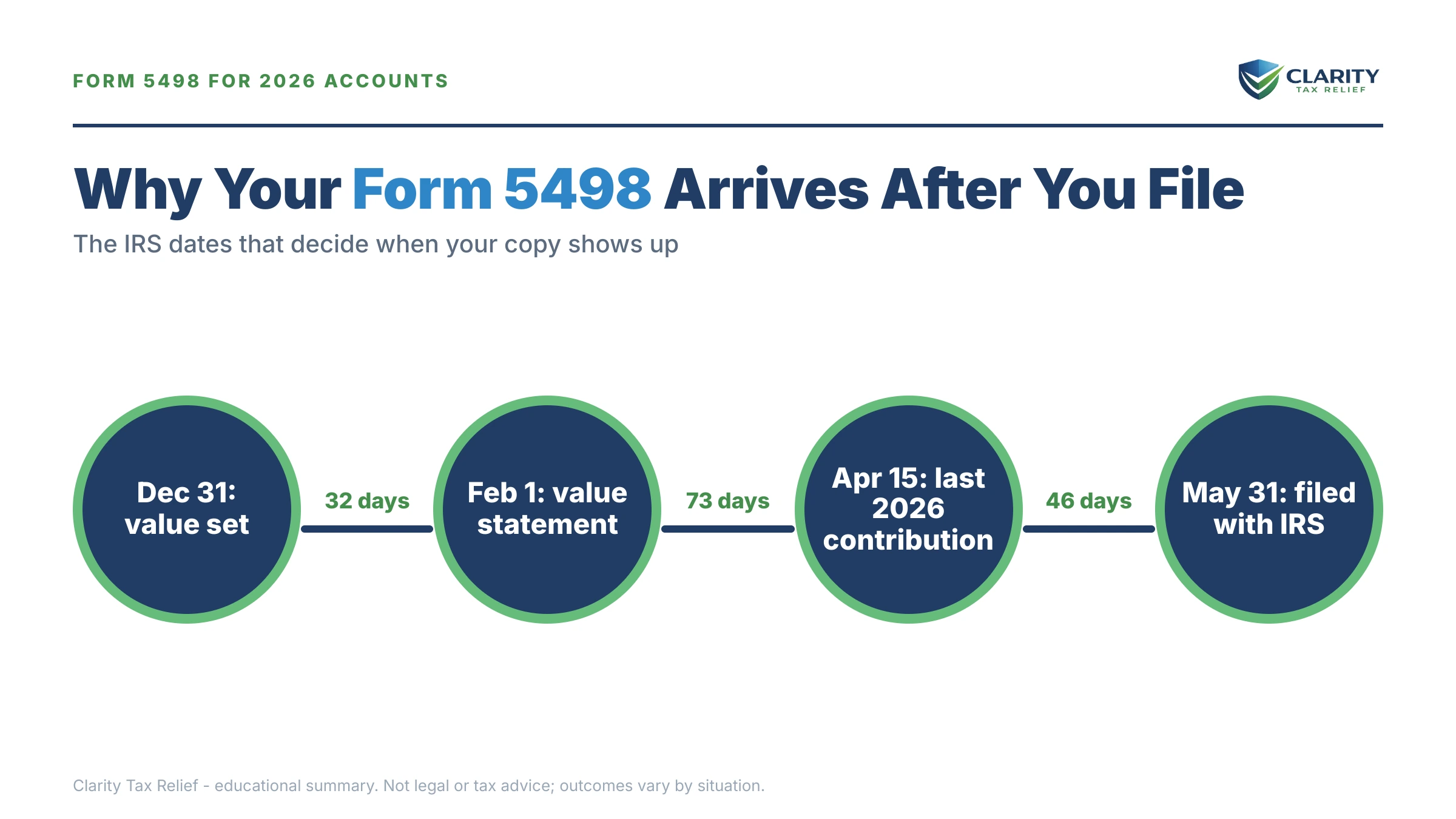
The 2026 Form 5498 calendar: your custodian must send you the December 31, 2026 account value by February 1, 2027. You can make IRA contributions for 2026 through April 15, 2027. The custodian files Form 5498 with the IRS by May 31, 2027. An excess contribution escapes the 6% tax only if it comes out, with its earnings, by your return's due date including extensions.

What is Form 5498?
Form 5498, IRA Contribution Information, is the return an IRA trustee or issuer files for every person who held an IRA with it during the year: traditional, Roth, SEP or SIMPLE. It reports money going in and the account's value at year-end. Money coming out goes on a different form, Form 1099-R.
The participant copy, Copy B, states that the information is being furnished to the IRS. That one line is the reason the form matters. Whatever your custodian put in those boxes, the IRS has it too.
A few reporting rules explain what you see on yours:
- One form per IRA plan. All the investments inside one IRA share a single Form 5498. Two separate IRA plans at the same firm mean two forms.
- A balance-only form is normal. In a year with no contributions, the custodian fills in only box 5 (the value), box 7 (the account type) and the RMD or hard-to-value-asset boxes when they apply.
- Direct transfers are left off. A trustee-to-trustee transfer from one traditional IRA to another isn't reported on Form 5498 at all, so don't look for it in box 2.
- It keeps coming in retirement. Custodians must file it even after required minimum distributions or other periodic payments begin.
- Your number may be shortened. Copy B can show only the last four digits of your Social Security number. The IRS copy carries the full number.
Three relatives share the number. Form 5498-SA covers HSAs, Archer MSAs and Medicare Advantage MSAs, and Form 5498-ESA covers Coverdell education savings accounts. The 2026 participant instructions add one more: a Trump account uses Form 5498-TA during the beneficiary's growth period and Form 5498 after it. Everything below is about the IRA form.
Why Form 5498 arrives after you've already filed
Form 5498 comes late because the contribution window for a tax year stays open until the following April 15. Box 1 and box 10 count contributions made during the year and through that April 15, as long as they were designated for the earlier year. A custodian can't report a year that isn't over yet, so the IRS gives it until May 31.
That timing means you prepare your return from your own records: deposit confirmations, the year-end value statement, and the year you named when you contributed between January 1 and April 15. Custodians are told to get that designation from you, so keep the confirmation that shows which year you chose.
SEP and SIMPLE money runs on a different clock. Boxes 8 and 9 count employer contributions by the calendar year the money landed, including deposits made in 2026 for 2025. The custodian isn't responsible for knowing which year a SEP deposit was for. A self-employed person who funds a SEP in March for the prior year will see it in box 8 for the year it arrived, which may differ from the year it was deducted.
| Date | What happens | Who sees it |
|---|---|---|
| December 31, 2026 | Account value is fixed for box 5 | You and the IRS |
| January 31, 2027 | RMD notice due if you must take a required minimum distribution in 2027 | You |
| February 1, 2027 | Statement of the December 31 value due (SIMPLE IRAs also get an activity statement) | You |
| April 15, 2027 | Last day to make contributions designated for 2026 (boxes 1 and 10) | You |
| May 31, 2027 | Form 5498 filed with the IRS; contribution information due to you | You and the IRS |
If you made no contributions and already received the year-end value statement, the custodian doesn't have to mail a separate form showing zero contributions. It still files one with the IRS by May 31.
What happens when a Form 5498 problem goes unnoticed
Form 5498 never sends you a bill on its own. Trouble starts when its numbers and your return disagree and nobody fixes the gap, and it builds in a predictable order:
- The IRS has the same figures. By May 31 the custodian has reported your contributions, rollovers, conversions and year-end value.
- An excess contribution starts costing 6%. Money over the yearly limit that stays in the account owes a 6% excise tax for that year, figured on Form 5329.
- The 6% repeats. It applies again for every year the excess remains, capped at 6% of the combined value of all your IRAs at year-end.
- A checked RMD box gets ignored. If box 11 was checked and the required minimum distribution never comes out, the shortfall can face a 25% excise tax, reduced to 10% if you correct it within two years.
- Unpaid additional tax turns into a balance due. Interest runs at 7% a year for October through December 2026, compounded daily, on top of a 0.5% monthly failure-to-pay penalty that can reach 25%. The first bill is typically a CP14 notice.
One costly problem needs no IRS letter to happen. Custodians aren't required to tell the IRS whether a traditional IRA contribution was deductible. If you skipped the deduction and never filed Form 8606, later withdrawals can be taxed in full on money you already paid tax on.
Did your Form 5498 surface a problem you can't afford to fix?
An excess contribution, a missed RMD and untracked basis each carry their own tax, and any unpaid balance keeps collecting interest and the monthly late-payment penalty. Have an experienced tax professional review your Form 5498 and your IRS balance with you for free.
Form 5498 boxes and what to do with each
Each box on Form 5498 answers one question about money going into the account. The table pairs every box with the check worth making before you file it away.
| Box | What it shows | What to do with it |
|---|---|---|
| 1. IRA contributions | Traditional IRA contributions for the year, made during the year and through April 15 of the next. Gross amounts, including any excess, even if it was withdrawn. | Match it to the deduction on your return. Any part you didn't deduct belongs on Form 8606, line 1, as basis. |
| 2. Rollover contributions | Rollovers received during the year, including direct rollovers from a workplace plan | Match it to the Form 1099-R from the account the money left, and confirm an indirect rollover finished within 60 days. |
| 3. Roth IRA conversion amount | Traditional IRA money converted to a Roth during the year | Report it on Form 8606, Part II, which separates the taxable part from any basis. |
| 4. Recharacterized contributions | A contribution, plus earnings, switched from one IRA type to the other | Attach the explanation statement your return needs. Conversions made in 2018 or later can't be switched back this way. |
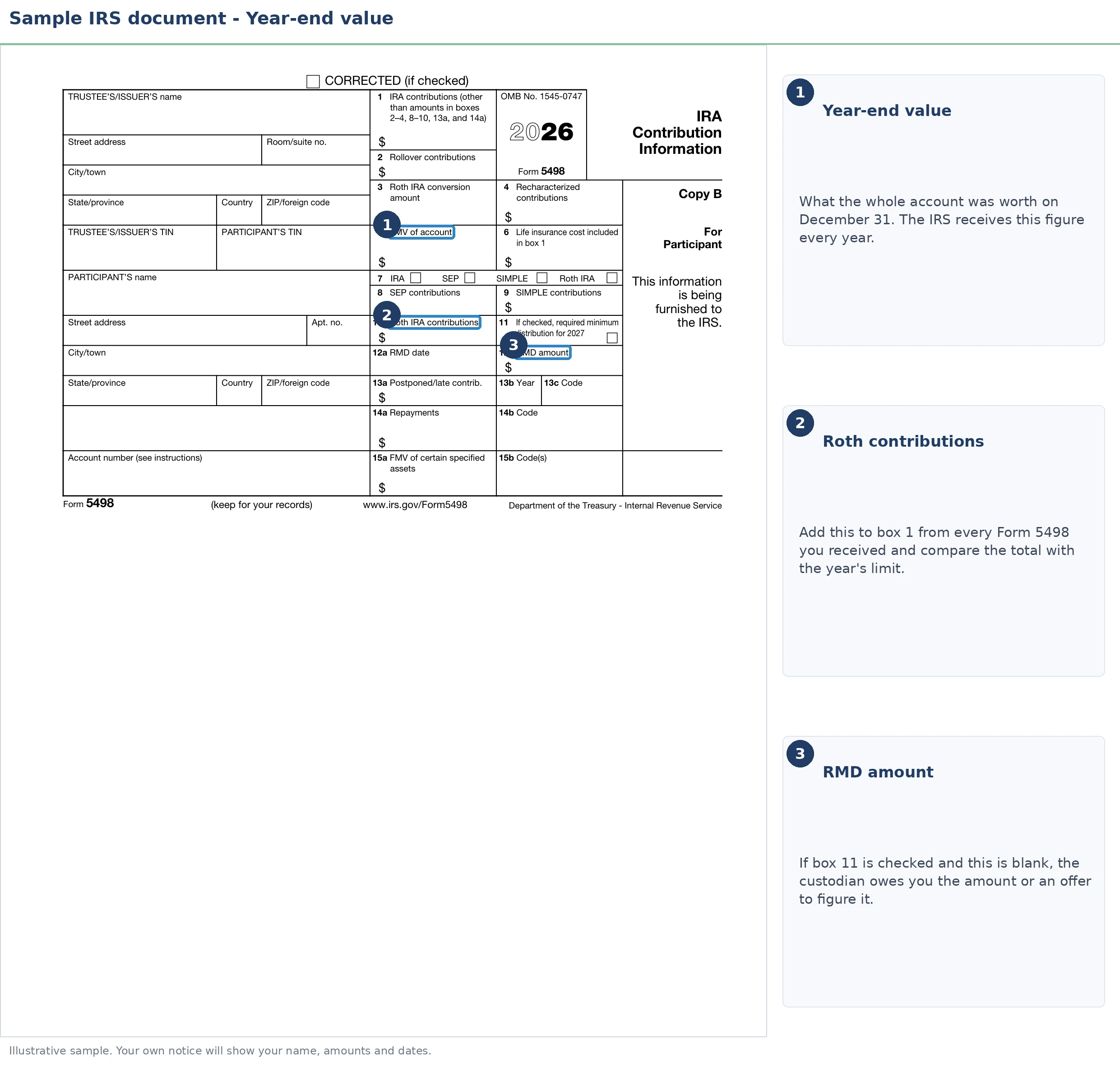
| 5. FMV of account | Value of everything in the account on December 31 (a decedent's form may show the date-of-death value) | Keep it. You need the December 31 total for Form 8606, line 6, in any year you withdraw from a traditional IRA with basis. |
| 6. Life insurance cost | Endowment contracts only: the part of box 1 that paid for life insurance | Subtract it from your allowable contribution when you figure the IRA deduction. |
| 7. Account type | IRA, SEP, SIMPLE or Roth IRA (two boxes for a Roth SEP or Roth SIMPLE) | If the wrong type is checked, ask the custodian for a corrected form. |
| 8 and 9. SEP and SIMPLE contributions | Employer contributions deposited during the calendar year, whatever year they were for | Reconcile by deposit date. The year you deducted them can differ. |
| 10. Roth IRA contributions | Roth contributions for the year, made during the year and through April 15 of the next | Add it to box 1 from every Form 5498 you received and check the total against the limit. Never deduct it. |
| 11, 12a, 12b. RMD | Checked if you must take a required minimum distribution next year; 12a and 12b may show the date and amount | Take the distribution on time. If 12b is blank, the custodian must give you the amount, or offer to figure it, by January 31. |
| 13a to 13c. Postponed or late contributions | A prior-year contribution allowed under a disaster or combat-zone extension, or a self-certified late rollover, with its year and code | Match the year in 13b to the return where you claim the contribution. |
| 14a, 14b. Repayments | Repayment of certain distributions, coded QR, DD, BA, HP, EP, DA or TI | Keep it with the year you took the original distribution, since repaying can change that year's tax. |
| 15a, 15b. Hard-to-value assets | Value of assets such as private stock, real estate or LLC interests, with codes A through H | Make sure the value is reasonable. The IRS receives it with the rest of the form. |
Most people only need three rows: boxes 1 and 10 for the contribution limit, box 3 for a conversion, and box 11 for a required distribution. The rest apply to narrower situations, and a blank box simply means nothing in that category happened.
Worked example: two custodians, one limit
Say you're 46, with a traditional IRA at one brokerage and a Roth IRA at another. During 2026 you put $5,000 into the traditional account and $4,500 into the Roth.
The traditional custodian's Form 5498 shows $5,000 in box 1. The Roth custodian's form shows $4,500 in box 10. Neither form flags a thing. Each firm sees only its own account.
The 2026 limit for someone under 50 is $7,500 across all traditional and Roth IRAs combined. Add the two boxes and you get $9,500. Take away the $7,500 limit and you're $2,000 over.
If that $2,000 and whatever it earned come out by the due date of your 2026 return, including extensions, the 6% tax never applies. The earnings that come out with it count as income, though a correction made on time escapes the 10% early-withdrawal tax. Leave the excess in and the math is $2,000 × 6% = $120 for 2026, another $120 for 2027 if it's still there, and so on, each year on Form 5329, until it's fixed.
The same addition catches a quieter mistake. If your 2026 taxable compensation was under $7,500, your limit drops to the amount of that compensation, and the overage is measured from there.
How Form 5498 connects to Form 8606 and your basis
Form 5498 is the best paper trail you have for basis, the after-tax money in a traditional IRA that should never be taxed a second time.
Box 1 shows what went in. Your return shows what you deducted. Any difference is a nondeductible contribution that belongs on Form 8606, line 1, for that year. Box 3 shows a Roth conversion, which Form 8606, Part II, splits into taxable and nontaxable pieces. And in a year you withdraw from a traditional IRA that has basis, Form 8606, line 6, asks for the December 31 value of all your traditional IRAs, the same number the year-end statement and box 5 report.
The custodian won't keep this ledger for you. On a traditional IRA withdrawal, the payer generally reports the whole amount in the taxable box of Form 1099-R and checks "taxable amount not determined." Form 8606 is the record that says otherwise, and its instructions tell you to keep every Form 5498 until all distributions from the account are made. Our Form 8606 guide walks through the lines.
Form 5498, RMDs and inherited IRAs
A check in box 11 means your custodian has told the IRS you must take a required minimum distribution for the following year. An RMD can still be required when the box is blank, so the check is a reminder, never the whole rule.
Required distributions begin for the year you reach age 73. The first can wait until April 1 of the next year, and every later one is due by December 31. Box 11 is checked for the year you turn 73 even though that first payment can wait. If box 11 is checked and box 12b is empty, the custodian must give you the amount, or offer to calculate it, by January 31.
Miss it and the amount not withdrawn may face a 25% excise tax, cut to 10% if you correct it within two years. That's reported on Form 5329, which is also where you ask for a waiver when the shortfall came from reasonable error. Our page on the missed RMD penalty waiver covers the fix. Roth IRAs need no RMD while the owner is alive.
If you inherited an IRA, your Form 5498 should name the person who died in the name line, written something like "Jordan Diaz as beneficiary of Ana Diaz." The decedent's own final form may show the value on the date of death. If it shows zero, the executor can ask the custodian for a date-of-death value. Owing the IRS while you hold an inherited account adds its own wrinkles, covered in inherited IRA tax debt.
What Form 5498 tells the IRS when you owe back taxes
Every year, box 5 gives the IRS the December 31 value of each IRA you hold. If you owe back taxes, the IRS already has a number for each account.
When the IRS asks for a Collection Information Statement, Form 433-A (Rev. 6-2026) has you list investments, and it names retirement assets such as IRAs, Keogh and 401(k) plans, with their current value. List every account accurately, because the IRS has had the custodian's year-end figure all along.
Whether the IRS can take that money is a separate question with its own rules. Our guides on whether the IRS can take your IRA and on an IRS levy on a retirement account cover it. Withdrawing the money yourself to pay the bill is a different event. The levy exception to the 10% early-withdrawal tax covers a distribution made because of an IRS levy, and a voluntary withdrawal before 59½ needs some other exception, listed in our guide to IRA early distribution penalty exceptions.
How to check your Form 5498, step by step
- Collect every Form 5498 for the year. One arrives for each IRA plan at each custodian, so a traditional IRA, a Roth and a SEP can mean three forms.
- Add boxes 1 and 10 across all of them. Compare the total with the limit: $7,000 for 2025 or $7,500 for 2026, or $8,000 and $8,600 at age 50 or older, or your taxable compensation if lower.
- Match box 1 and box 3 to your return. Put any traditional contribution you didn't deduct on Form 8606, line 1, and report a box 3 conversion on Form 8606, Part II.
- Check box 11 and set a date. If it's checked, put the RMD deadline on your calendar and confirm the amount with the custodian.
- Fix errors where they started. Ask the custodian for a corrected Form 5498 if a box is wrong, and use Form 5329 or Form 1040-X if your own return needs to change.
- File the form with your records. Keep every Form 5498 until all distributions from the account have been made.
When you can handle this yourself
Most Forms 5498 need nothing more than a two-minute comparison. If you contributed once, deducted the right amount, and the totals across all your forms sit under the limit, file the form away. A small excess caught before your return's extended due date is also a do-it-yourself fix: ask the custodian to return the excess with its earnings and report those earnings on your return.
Help changes the outcome in a narrower set of cases. Years of nondeductible contributions with no Form 8606 on file, an excess that has sat in the account for several years, a missed RMD that needs a waiver request, an inherited IRA with basis, or a retirement balance that is now part of an IRS collection case all reward a second set of eyes. The Form 5498 that causes the most trouble in our files is the one nobody opened, left in a brokerage inbox while box 1 disagreed with the return.
Terms on your Form 5498, decoded
- Trustee or issuer: the bank, brokerage or insurance company that holds your IRA and files Form 5498.
- FMV of account: fair market value, meaning what everything in the account was worth on December 31.
- Rollover contribution: money moved into the IRA from another IRA or a workplace plan, either directly or within 60 days of leaving the old account.
- Recharacterized contribution: a contribution switched from one IRA type to the other, with its earnings, by a trustee-to-trustee transfer.
- RMD: required minimum distribution, the yearly withdrawal that starts for the year you reach age 73.
- Postponed contribution: a contribution credited to an earlier year under a disaster or combat-zone extension, reported in boxes 13a to 13c.
Form 5498 questions, answered
What is a Form 5498 used for?
Form 5498 tells the IRS what went into your IRA during the year and what the account was worth on December 31. Your trustee or custodian files it and sends you a copy. You use it to check your IRA deduction, your contribution limit, any Roth conversion and any required minimum distribution. It reports nothing taken out of the account; withdrawals appear on Form 1099-R.
Do I need Form 5498 to file my taxes?
Usually you file without it. The form often arrives after the April deadline, because contributions for a year can be made through April 15 of the next year and custodians have until May 31 to file. You prepare your return from your own deposit records and year-end statement. If the form later shows something your return got wrong, the fix is an amended return.
Why didn't I get a Form 5498?
If you made no contributions and the custodian already sent your year-end value statement by its deadline (February 1, 2027, for 2026 accounts), it doesn't have to mail a separate form reporting zero contributions. It still files one with the IRS. Custodians also skip the form when the account was fully paid out during the year with no contributions. Check the account's online tax documents first.
Is Form 5498 the same as Form 1099-R?
They are opposites. Form 5498 reports money going into an IRA plus the year-end value, and Form 1099-R reports money coming out. A Roth conversion appears on both: as a distribution on the traditional account's Form 1099-R and in box 3 of the Roth's Form 5498. Amounts from Form 1099-R go on your return, while Form 5498 stays in your records.
What should I do if my Form 5498 is wrong?
Call the custodian first. The instructions require a trustee who finds an error after filing to correct it as soon as possible, for example when a regular contribution was reported as a rollover. A corrected form has the CORRECTED box checked. If the same error also made its way onto your own return, such as the wrong deduction, you fix your side with an amended return.
Does getting a Form 5498 mean I owe tax?
Usually no. Contributions, rollovers and a year-end value are not taxable events by themselves. Tax can follow from what the form reveals: an excess contribution owes 6% a year until removed, a checked box 11 means a withdrawal you must take, and a box 3 conversion is generally taxable except for any basis. Those amounts land on Forms 5329, 8606 and 1040.
Will I get a Form 5498 for an inherited IRA?
Yes, for every year the inherited account exists. The custodian files one for each beneficiary, and the name line must identify the person who died, usually with the words "as beneficiary of." The decedent's own final form may show the value on the date of death. A beneficiary who takes the whole share out in the year of death may get no beneficiary Form 5498.
Your next 24 hours
Official resources: the IRS About Form 5498 page links the current form, the Instructions for Forms 1099-R and 5498 explain every box and deadline, the IRS page on IRA contribution limits covers the 6% excess tax, and the IRS required minimum distribution FAQs cover box 11.
This guide is general information, not tax or legal advice for your specific situation. Eligibility for IRS programs depends on individual facts and circumstances; no outcome is guaranteed.