
Retirement Accounts
Form 8606 in 2026: How IRA Basis Keeps You From Paying Tax Twice
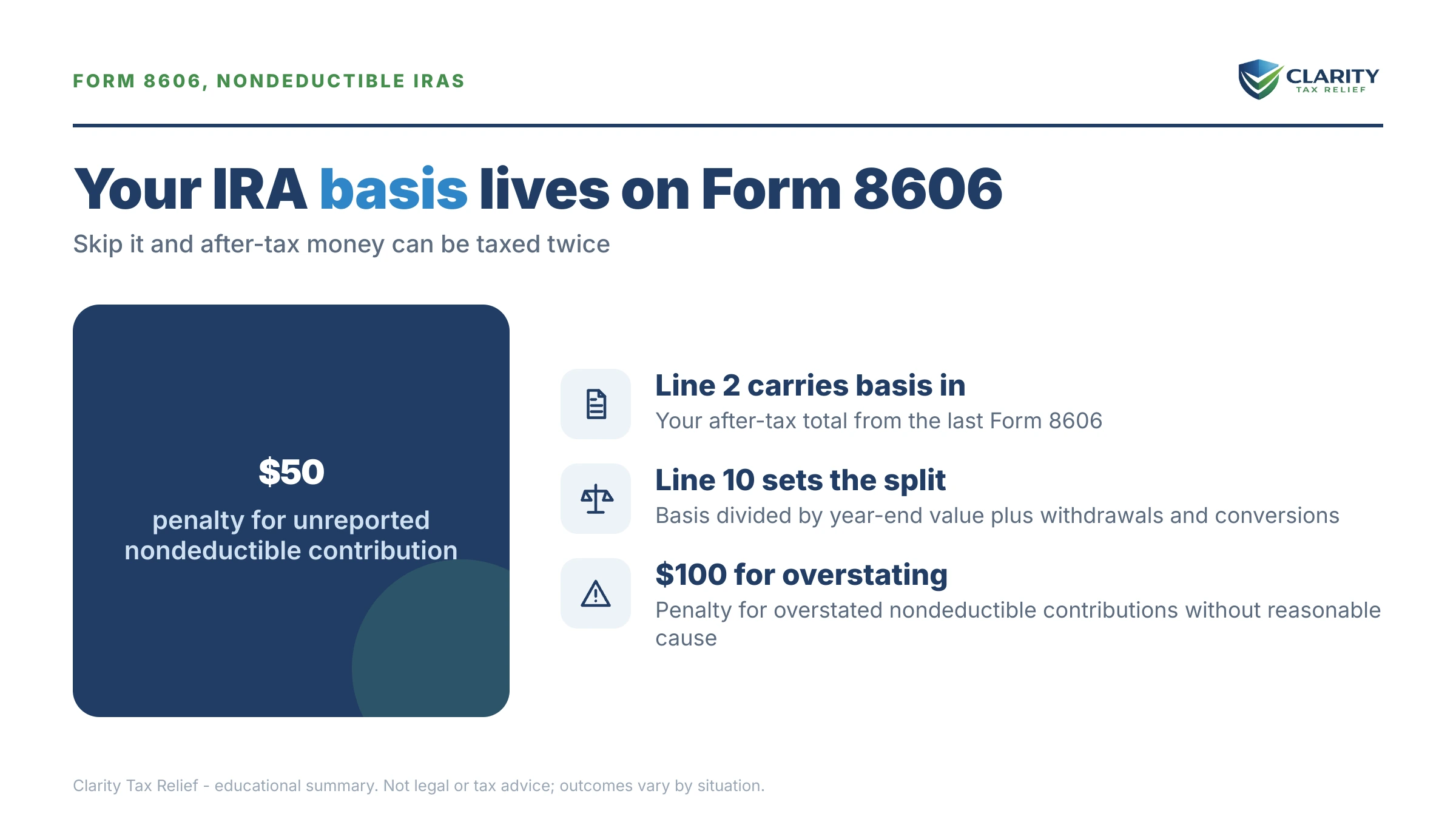
The short answer: Form 8606 is the IRS form that records nondeductible traditional IRA contributions, called basis, and figures how much of a traditional IRA withdrawal, Roth conversion or Roth distribution is taxable. You attach it to Form 1040. Skipping it after a nondeductible contribution carries a $50 penalty, and the bigger risk is paying tax twice.
You put money into a traditional IRA that you couldn't deduct, maybe years ago, and now you're taking some out or converting it to a Roth. Or a preparer just asked for "all your old 8606s" and you aren't sure you ever filed one. Form 8606 is the page that proves part of that IRA was already taxed.
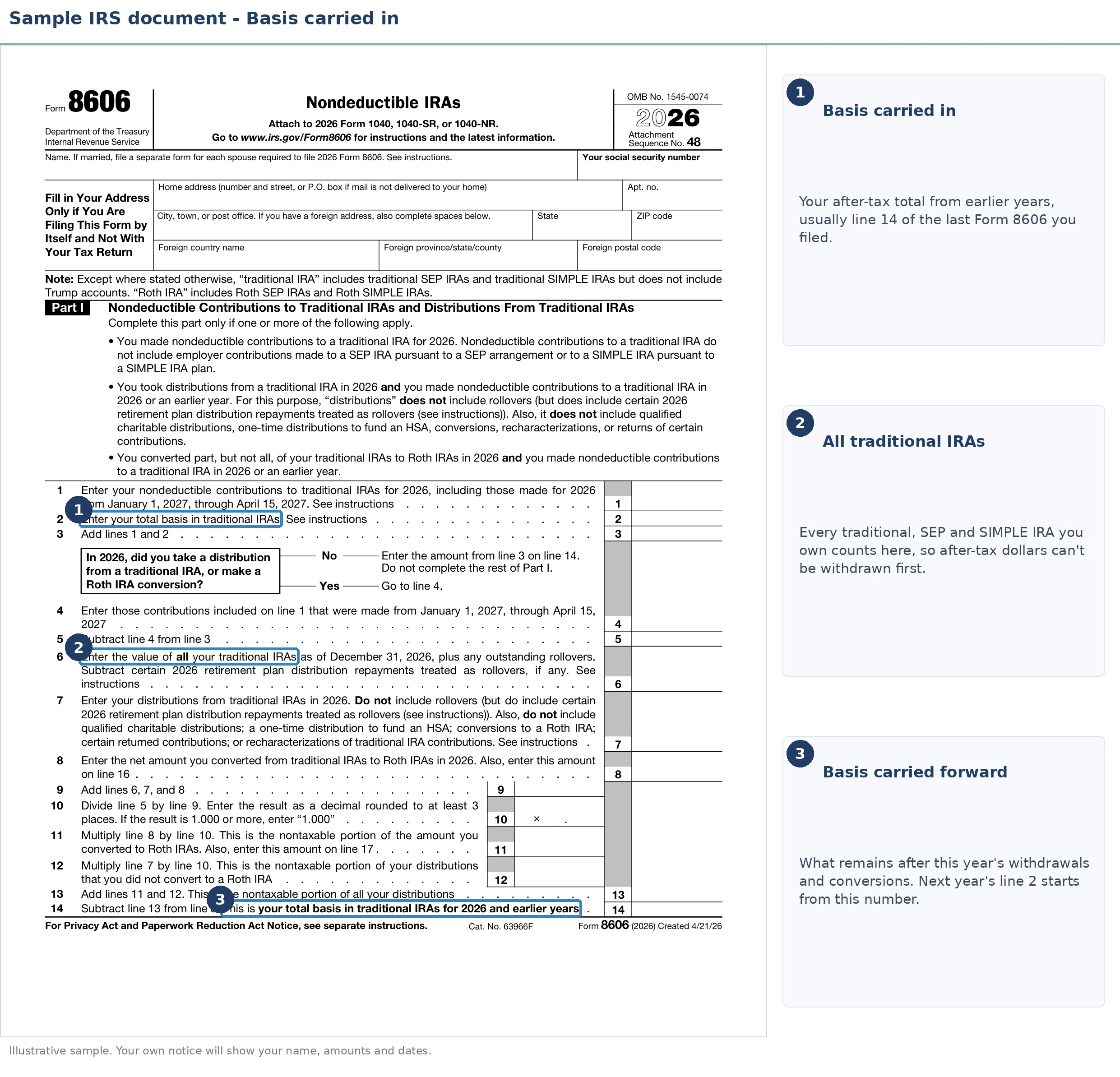
Without it, the IRS has no record of your after-tax dollars, and the default treatment taxes every dollar you withdraw. Further down this page you'll see the actual Form 8606 and the lines that carry your basis from one year to the next.
When Form 8606 is due: with your Form 1040 by the return's due date, including extensions. If you aren't required to file a return, you still send Form 8606 on its own, signed, at the same time and place you would have filed. Switching a contribution between deductible and nondeductible after you file generally has to happen within the time limit for filing Form 1040-X.

What is Form 8606, and why does basis matter?
Form 8606, Nondeductible IRAs, keeps the running total of after-tax money in your traditional IRAs and uses it to split each withdrawal or conversion into taxable and nontaxable parts. That running total is your basis: the nondeductible contributions you made, minus whatever you've already taken back tax-free.
The form exists because nobody else tracks it. IRA custodians aren't required to tell the IRS, or you, whether a contribution was deductible. When you withdraw, the custodian generally reports the whole amount as taxable on Form 1099-R and checks the box saying the taxable amount was undetermined. Form 8606 is how your return answers that box.
The form also won't let you choose which dollars come out. Line 6 asks for the December 31 value of all your traditional IRAs, and line 10 divides your basis by that value plus the year's withdrawals and conversions. That one ratio sets the tax-free share of every dollar you take, across every traditional, SEP and SIMPLE IRA you own.
Who must file Form 8606
You must file Form 8606 for any year in which one of these happened:
- A nondeductible contribution. You put money into a traditional IRA for the year and didn't deduct it.
- A withdrawal with basis. You took money out of a traditional IRA while your basis was above zero. Rollovers, conversions, qualified charitable distributions and a few others don't count as withdrawals here.
- A Roth conversion. You moved traditional IRA money into a Roth IRA, whether or not you had basis.
- A Roth withdrawal. You took a distribution from a Roth IRA other than a rollover, recharacterization or returned contribution.
- An inherited account. You took money from an inherited traditional IRA that has basis, or a nonqualified distribution from an inherited Roth IRA.
- A divorce transfer. Part of a traditional IRA moved between spouses and changed either spouse's basis.
Regular Roth contributions alone never require the form, though the instructions still tell you to keep records of them. Married couples file a separate Form 8606 for each spouse who needs one, and IRAs inherited from different people each get their own form.
If you don't have to file a tax return but do have to file Form 8606, you sign it and send it alone to the place you'd otherwise mail your return. Page 1 has an address block you fill in only when the form travels by itself.
What happens if you skip Form 8606
Skipping Form 8606 rarely causes trouble in the year you skip it. The cost shows up later, in this order:
- A $50 penalty attaches. If you were required to file Form 8606 to report a nondeductible contribution and didn't, the penalty is $50 unless you can show reasonable cause.
- Your basis lives only in your own files. The custodian never reported whether the contribution was deductible, so the IRS holds a Form 5498 showing a contribution and nothing marking it as after-tax.
- A withdrawal arrives looking fully taxable. The custodian's Form 1099-R generally shows the whole amount in the taxable box, with the "taxable amount not determined" box checked.
- The after-tax part gets taxed again. Report the full amount and you pay income tax a second time on your own contributions, plus the 10% additional tax on that slice if you're under 59½, although basis is exempt from the 10%.
- A gap becomes a balance. Report less than the full amount with no Form 8606 behind it and your return no longer matches the 1099-R, the kind of mismatch a CP2000 notice asks about. Any tax left unpaid collects interest, 7% a year for October through December 2026, plus the 0.5% monthly failure-to-pay penalty.
Overstating basis has its own price: a $100 penalty for overstating nondeductible contributions, again unless you can show reasonable cause. The form cuts both ways, which is why the records behind it matter as much as the form.
Taxed in full on IRA money you already paid tax on?
A withdrawal or Roth conversion reported without Form 8606 can mean paying tax twice, and any balance or CP2000 that follows keeps adding interest and late-payment penalties. Have an experienced tax professional review your basis records and your IRS account for free.
Form 8606 parts: what each reports and when you need it
Form 8606 has three parts, and most people touch only one or two of them in a given year. The table maps each part to its key lines and the event that brings it into play.
| Part | What it reports | Key lines | When you need it |
|---|---|---|---|
| Part I | Nondeductible traditional IRA contributions, and the taxable share of traditional IRA withdrawals when you have basis | 1 new basis, 2 prior basis, 6 December 31 value, 10 tax-free ratio, 14 basis carried forward, 15c taxable amount | A year with a nondeductible contribution, or a withdrawal from a traditional IRA with basis |
| Part II | Conversions from traditional IRAs to a Roth IRA | 16 amount converted, 17 basis in it, 18 taxable amount | Any year you convert, with or without basis |
| Part III | Distributions from Roth IRAs | 19 nonqualified distributions, 22 basis in contributions, 24 basis in conversions, 25c taxable amount | A Roth withdrawal, unless the line 19 instructions leave it out |
| Page 2 signature block | Your signature and the date | Signed only when Form 8606 is filed by itself | A year you owe Form 8606 but no tax return |
Part I is where basis is created and where it gets spent. Line 1 adds this year's nondeductible contributions, including any made between January 1 and April 15 for the prior year. Line 2 brings forward your total from earlier years, which for most people is line 14 of the last Form 8606 they filed. If you took no withdrawal and made no conversion, you stop after line 3 and carry that total to line 14.
Part II handles conversions. Line 16 is the amount converted, line 17 is the basis that moves with it, and line 18 is the taxable remainder for your Form 1040. When you also completed Part I, line 17 comes from the ratio on line 11. That's why converting while you hold other pre-tax IRA money makes part of a conversion taxable, even when the dollars you moved were after-tax.
Part III figures the taxable part of a Roth IRA withdrawal. It subtracts your basis in regular Roth contributions on line 22, then your basis in conversions on line 24, and anything left on line 25c is taxable. Line 23 is where the 10% additional tax can start, figured on Form 5329. Which Roth dollars come out first is covered in our guide to the penalty for withdrawing from a Roth IRA.
One shortcut saves paperwork. If you're 59½ or older and made any Roth contribution or conversion for a year from 1998 through 2020 (the range in the 2025 instructions, which moves forward each year), your withdrawal stays off line 19 entirely, and Part III isn't needed.
Worked example: $24,000 of basis and a $15,000 withdrawal
Say you're 52. From 2019 through 2022 you put $6,000 a year into a traditional IRA, the limit for those years, and your workplace plan and income ruled out the deduction each time. That's $24,000 of basis, sitting on line 14 of your 2022 Form 8606.
In 2026 you withdraw $15,000, and on December 31, 2026, your traditional IRAs are worth $45,000. No new contribution, no conversion. The 2026 Form 8606 runs like this:
- Lines 2 and 3: $24,000 of basis carried in.
- Line 6: $45,000, the year-end value of every traditional IRA you own.
- Line 7: $15,000 withdrawn.
- Line 9: $45,000 + $15,000 = $60,000.
- Line 10: $24,000 ÷ $60,000 = 0.400.
- Line 12: $15,000 × 0.400 = $6,000 tax-free.
- Line 15c: $15,000 minus $6,000 leaves $9,000 taxable, which goes on Form 1040, line 4b.
- Line 14: $24,000 minus $6,000 leaves $18,000 of basis for 2027.
Because you're under 59½ and no exception applies here, the 10% additional tax reaches only the taxable $9,000. That's $900. The $6,000 of basis is exempt.
Now run the same year without Form 8606. The 1099-R shows $15,000 in the taxable box, so $15,000 lands on line 4b. Your own after-tax $6,000 gets taxed again: at a 22% bracket that's $1,320 of extra income tax, plus $600 of extra 10% tax. Call it $1,920 paid for nothing. And the $24,000 of basis is still unrecorded the next time you withdraw.
How to fix missed years of Form 8606
The Form 8606 instructions don't describe a separate procedure for years you skipped. They do give you every piece you need:
- A standalone filing. The form carries an address block and a signature line for filing it by itself, and the instructions use that route whenever you owe Form 8606 but no tax return.
- The penalty's escape hatch. The $50 penalty for not filing applies unless you can show reasonable cause.
- The chain on line 2. Line 2 picks up basis from the last Form 8606 you filed, and a first required form generally starts at zero. A missing year leaves a gap that only your own records can fill.
- The records list. The IRS tells you to keep page 1 of each return for a year with a nondeductible contribution, every Form 8606, the Forms 5498 showing contributions and year-end values, and every Form 1099-R, until all distributions are made.
- The amendment window. Changing a contribution from deductible to nondeductible, or back, after filing generally has to happen within the Form 1040-X time limit, with a new Form 8606 attached to the amended return.
Where your prior basis sits depends on the year of the last Form 8606 you filed, because the line numbers changed over the decades. The Total Basis Chart in the 2025 instructions lays it out:
| If the last Form 8606 you filed was for | Enter on line 2 |
|---|---|
| 2024 | Line 14 of that form, plus line 6 of any Line 15c Worksheet you completed the last time you filed Part I |
| 2001 through 2023 | Line 14 of that form |
| 1993 through 2000 | Line 12 of that form |
| 1989 through 1992 | Line 14 of that form |
| 1988 | Lines 7 and 16 of that form, added together |
| 1987 | Lines 4 and 13 of that form, added together |
So the repair starts with reconstruction. When we rebuild basis for someone who skipped Form 8606 for several years, old Forms 5498 and the returns that show no IRA deduction are usually where the trail begins. With those in hand, the late forms can be prepared year by year so each line 14 feeds the next line 2.
If a withdrawal was already taxed in full, an amended return may recover the overpaid tax, subject to the refund time limits explained in our guide to Form 1040-X.
Form 8606 when you owe the IRS
Basis matters most when money is tight. If a traditional IRA withdrawal was taxed in full because no basis was on record, the extra tax may be part of the very balance you're now struggling to pay.
It matters if the IRS takes the money, too. A distribution made from an IRA because of an IRS levy is still a distribution, reported on Form 1099-R with code 2, and the Form 8606 rules for traditional IRAs with basis apply to it the same way. Our guide to an IRS levy on a retirement account covers the levy itself, and the levy exception to the 10% tax sits in our page on IRA early distribution penalty exceptions.
Inherited accounts follow the same logic. Basis stays with an inherited traditional IRA and can't be merged with your own, so a beneficiary who takes money from both files separate Forms 8606. If you owe the IRS while holding one, read our guide to inherited IRA tax debt.
How to complete Form 8606, step by step
- Find your starting basis. Copy line 14 of the last Form 8606 you filed to this year's line 2. If this is your first required Form 8606, line 2 is generally zero.
- Enter this year's nondeductible contributions on line 1. Include contributions made January 1 through April 15 for the prior year, and check the total against box 1 of your Forms 5498.
- Add up the December 31 values. Total the year-end value of every traditional, SEP and SIMPLE IRA you own for line 6, using each custodian's statement.
- Total withdrawals and conversions. Enter withdrawals on line 7 and conversions on line 8, leaving out rollovers, qualified charitable distributions and recharacterizations.
- Run the ratio and carry the results. Divide on line 10, move the taxable amounts from lines 15c, 18 or 25c to Form 1040, line 4b, and keep line 14 for next year.
- Attach it and keep copies. File Form 8606 with your Form 1040, or by itself if you have no return to file, and keep every copy until all distributions are made.
When you can handle this yourself
A single nondeductible contribution with no withdrawal makes for a short form: lines 1 through 3, then line 14. A year with one withdrawal from one IRA and a clean chain of prior forms is also manageable. Tax software walks through the ratio, and the arithmetic is mechanical once the inputs are right.
Bring in help when the chain is broken. Several years of nondeductible contributions with no Form 8606 behind them, a conversion mixed with other pre-tax IRA balances, an inherited IRA with basis, a divorce that split an IRA, or a withdrawal already taxed in full that now sits on an IRS balance you can't pay are all cases where the reconstruction decides how much you owe.
Terms on your Form 8606, decoded
- Basis: the after-tax money in your traditional IRAs, meaning nondeductible contributions minus any you've already taken back tax-free.
- Nondeductible contribution: a traditional IRA contribution you didn't deduct on your return, entered on line 1.
- Outstanding rollover: money taken from one traditional IRA late in the year and put into another within 60 days, after December 31; it gets added to line 6.
- Conversion: moving money from a traditional, SEP or SIMPLE IRA into a Roth IRA, reported in Part II.
- Qualified distribution: a Roth withdrawal made after the five-year period that also meets a condition such as reaching age 59½, disability or death, and is tax-free.
Form 8606 questions, answered
Do I need to file Form 8606 every year?
Only in years when something triggers it: a nondeductible contribution, a withdrawal from a traditional IRA that has basis, a Roth conversion, or a Roth withdrawal. In a quiet year your basis waits on line 14 of your last form. Keep that last Form 8606 where you can find it, because the next time you file, line 2 starts from it.
What happens if I never filed Form 8606?
You may owe a $50 penalty for a required Form 8606 you didn't file, unless you can show reasonable cause. The larger cost is that withdrawals look fully taxable without the form, so you can pay tax again on money already taxed. The fix starts with rebuilding your basis from old returns and Forms 5498, then preparing the missing forms so each line 14 flows into the next line 2.
Can I file Form 8606 by itself?
Yes, when you're required to file Form 8606 but not an income tax return. Sign and date page 2, fill in your address on page 1, and send it to the IRS at the same time and place you would otherwise file Form 1040. In every other year, Form 8606 goes with your Form 1040, 1040-SR or 1040-NR by the return's due date, including extensions.
Do I need Form 8606 for a backdoor Roth?
Yes. A nondeductible traditional IRA contribution followed by a conversion touches two parts of the form: Part I records the contribution, and Part II reports the conversion. Because line 6 counts the year-end value of every traditional, SEP and SIMPLE IRA you own, other pre-tax IRA money makes part of the conversion taxable, even when the dollars you moved were after-tax.
Does Form 8606 apply to Roth IRA contributions?
No form is needed for regular Roth contributions alone. Keep records of them anyway. If you ever take a Roth withdrawal that isn't a qualified distribution, Part III uses the total of your regular Roth contributions as basis on line 22. Conversions are another matter: every conversion goes on Part II in the year it happens, and later shows up as basis on line 24.
Where does the taxable amount from Form 8606 go on Form 1040?
The taxable amounts on lines 15c, 18 and 25c go on Form 1040, line 4b, the taxable IRA distribution line, and the full amount distributed goes on line 4a. If you're under 59½, the taxable part of an early withdrawal may also owe the 10% additional tax, which is figured on Form 5329 and carried to Schedule 2.
Who keeps track of my IRA basis?
You do. Custodians aren't required to tell the IRS or you whether a contribution was deductible, and they generally report traditional IRA withdrawals as fully taxable with the taxable amount marked as not determined. The IRS tells you to keep each Form 8606, page 1 of the matching returns, your Forms 5498 and every Form 1099-R until all distributions from your IRAs are made.
Your next 24 hours
Official resources: the IRS About Form 8606 page links the current form, the Instructions for Form 8606 cover the penalties, the Total Basis Chart and every line, and Publication 590-B explains how IRA and Roth distributions are taxed.
This guide is general information, not tax or legal advice for your specific situation. Eligibility for IRS programs depends on individual facts and circumstances; no outcome is guaranteed.