
Unfiled Returns
What Happens If You Don't File Taxes in 2026: Penalties, Notices and Your Refund
The short answer: If you don't file taxes and owe, the IRS charges a failure-to-file penalty of 5% of the unpaid tax per month or partial month, up to 25%, plus interest. Keep ignoring it and the IRS can calculate your tax and collect. Owed a refund? No penalty, but after three years the refund is lost.
The deadline passed, and the return you meant to finish is still in a folder somewhere. Maybe it has been a few months. Maybe it has been a few years. You want a straight answer to what happens if you don't file taxes, without the scare tactics.
Almost everything turns on one fact: whether that return would show tax due or a refund. If you owe, a penalty grows every month until it caps, then the notices start, and eventually the IRS can work out your tax without you. If the IRS owes you, nobody charges you anything. A three-year clock runs on your money instead.
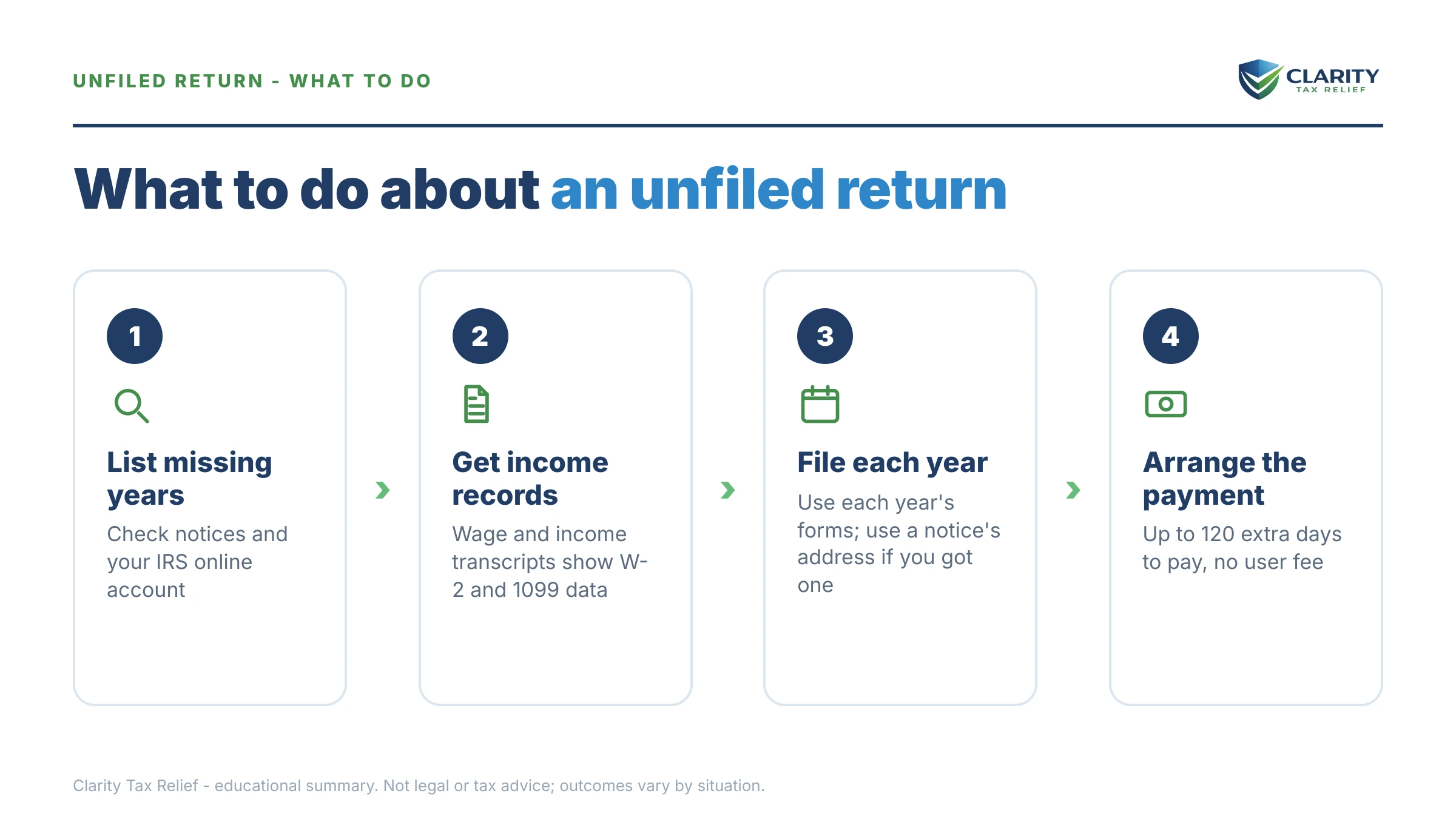
Further down this page, a short graphic puts the fixes in order, and a year-by-year table shows when each consequence arrives.
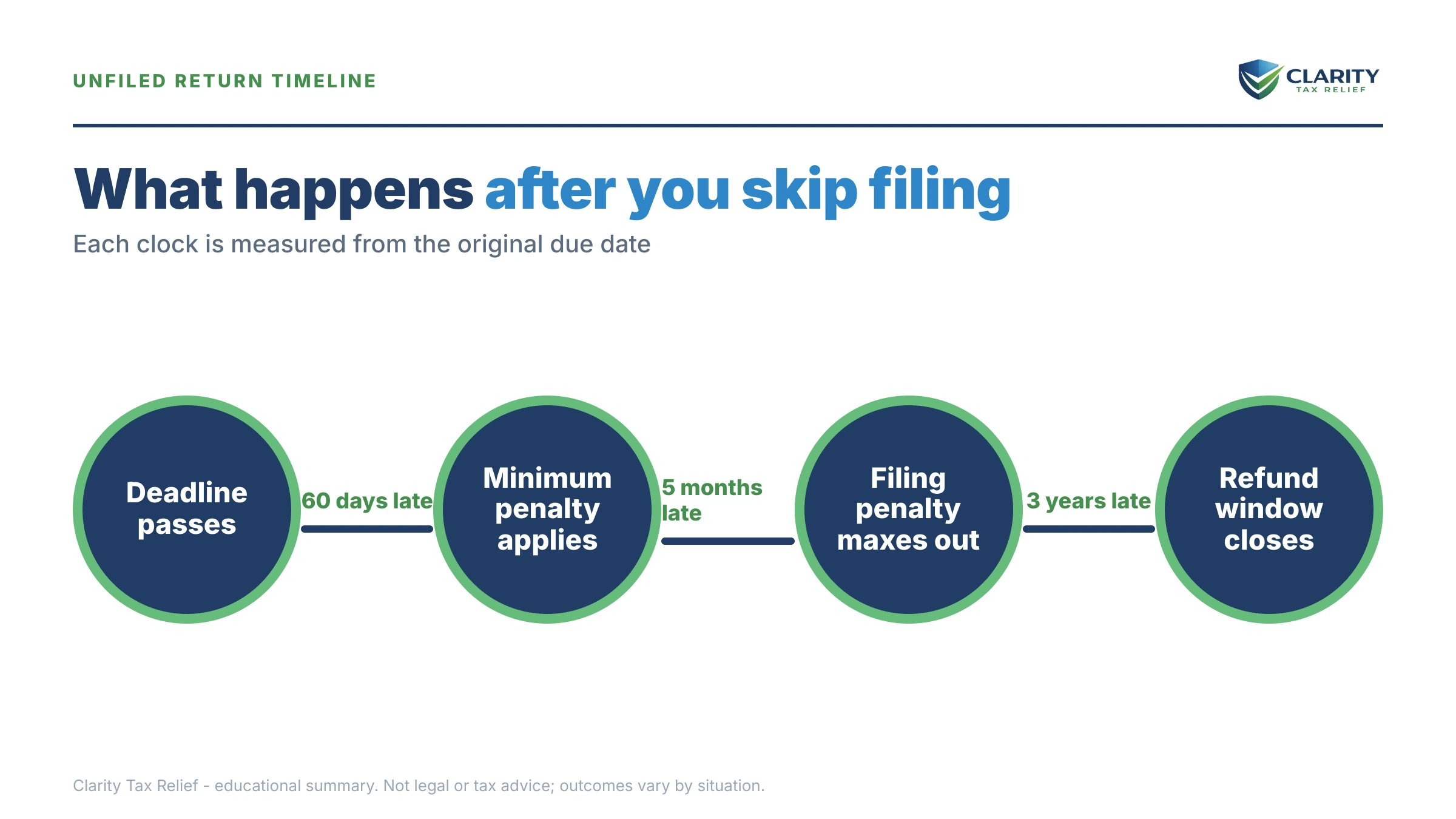
The clocks on an unfiled return: the failure-to-file penalty starts after the due date (April 15, 2026, for a 2025 return) and adds 5% of the unpaid tax each month until it reaches 25%. For a 2025 return filed more than 60 days late, the minimum penalty is $525 or 100% of the tax due, whichever is less. A refund must be claimed within 3 years of the due date.

What happens if you don't file taxes and you owe
The failure-to-file penalty is 5% of your unpaid tax for each month or part of a month the return is late, up to a maximum of 25%. It is figured on the tax still owed after on-time payments and credits, so paycheck withholding shrinks it. A return that would show a $0 balance draws no filing penalty.
A second penalty runs alongside it. The failure-to-pay penalty is 0.5% of the unpaid tax per month. In any month when both apply, the IRS reduces the filing penalty by the payment penalty, so the two together cost 5% that month. After five months the filing penalty is maxed out. The payment penalty keeps going, half a percent at a time, until it reaches its own 25% ceiling.
Two details make the early months expensive. A partial month counts as a whole one. And past 60 days late a floor applies: for a 2025 return, the penalty can't drop below $525, or below the full tax due if that is smaller. On a small balance, that floor can double what you owe.
Interest comes on top. The IRS resets the rate every quarter at the federal short-term rate plus 3 percentage points; it was 7% a year for the last quarter of 2026, compounded daily. Interest also runs on the penalties themselves.
Put those rules side by side and the cheapest move is obvious. The failure-to-file penalty is ten times the size of the failure-to-pay penalty each month, so a return filed on time with nothing paid costs far less than no return at all. Our breakdown of the failure-to-file and failure-to-pay penalties shows how the two interact over longer stretches.
If you filed an extension and still haven't filed
An extension moves the filing deadline and nothing else. For 2025 returns, a Form 4868 extension pushed the due date to October 15, 2026, and the failure-to-file penalty is measured from the due date including any extension.
The payment deadline never moved. The IRS says that if you file an extension, you must still pay the tax you owe by the original deadline. On anything unpaid, the 0.5% monthly failure-to-pay penalty and interest have been running since April 15, 2026.
Miss October 15 too, and the filing penalty starts counting from that date at the same 5% a month, with the same 60-day minimum behind it. People in this spot often assume the extension protected them. It bought time to file. It never bought time to pay.
What happens if you're owed a refund and don't file
There is no penalty for filing late when the IRS owes you a refund. The IRS repeated that in its April 2026 tax tip for people who missed the deadline. The danger on this side is losing the money itself.
To claim a refund of withholding or estimated payments, you must file within 3 years of the return's due date. The same window applies to credits such as the Earned Income Credit. After it closes, the money becomes the property of the U.S. Treasury, even if your math is perfect.
That happens to a lot of people. In March 2026 the IRS estimated that more than 1.3 million people had unclaimed refunds for tax year 2022, roughly $1.2 billion in all, and their deadline was April 15, 2026.
A late refund can also be held or redirected. The IRS holds refunds when its records show one or more returns are past due, and a CP63 notice says it is holding yours because it believes you will owe on the missing years. Once released, a refund can go toward balances owed to the IRS or a state tax agency, unpaid child support, or federal debts such as student loans. Our guide to getting a refund from 3 years ago covers the cutoff for each older year.
How the IRS knows your return is missing
The IRS already has your income on record from the W-2s, 1099s and other forms that employers, banks and other payers send it. When that income sits on a year with no return, the IRS starts writing to you. If you never answer, it uses that same income data to calculate the tax itself.
The letters in this stage are the CP59 notice (the IRS has no record of your prior personal return), the CP515 and CP516 reminders, and the CP518 notice, which the IRS calls a final reminder. The IRS pages for these notices give no fixed number of days. Each one says to respond right away.
Your choices are the same on all of them. File the return, show that you already filed it, or explain why you didn't have to. The explanation goes on Form 15103, the Form 1040 Return Delinquency response, which you can mail, fax, or in some cases submit through your IRS online account. If you sent the return within the last eight weeks, the IRS says you can wait.
In the cases we see, the return that sits longest is often the one with the smallest balance. A small number feels safe to ignore, and that is exactly where the 60-day minimum penalty does the most damage.
What happens if you ignore the IRS notices
If the reminders go unanswered, the IRS can build a return for you, assess the tax, and collect it like any other balance. The sequence runs in this order:
- The reminders run out. After a CP518, the IRS says it may determine your tax for you. Penalties and interest keep growing while you wait.
- The IRS calculates your tax. A notice such as the CP2566 says the IRS didn't receive your return and calculated your tax, penalty and interest from income reported by employers, financial institutions and others. A return built this way might not give you credit for deductions and exemptions you could claim yourself.
- The 90-day letter. The CP3219N notice is a formal Notice of Deficiency. You have 90 days from its date (150 days if you live outside the U.S.) to file your own return or petition the U.S. Tax Court. After this letter you cannot request an extension to file.
- Assessment. Do neither and the IRS assesses its own figure. The proposed tax becomes a real balance due, and the 10-year collection clock starts from that assessment date.
- Collection. Unpaid assessments can lead to a levy on your wages or bank account, or a federal tax lien.
- Repeated non-filing. For people who repeatedly don't file, the IRS lists additional penalties and criminal prosecution among its options.
Time never runs out on the IRS side of a missing return. For a year with no return, tax can be assessed at any time, and a return the IRS prepares itself does nothing to start the normal 3-year assessment clock. That only begins when you file.
Even after the IRS builds its version, filing your own is still the better move. The IRS says it is in your best interest, so you get the exemptions, credits and deductions you are entitled to. If you already hold one of these notices, start with our guide on what to do when the IRS filed a substitute return for you.
Sitting on an unfiled return you know you owe on?
Each month the return stays unfiled adds 5% of the unpaid tax until the penalty caps, plus daily interest, and once a CP3219N arrives you have 90 days to answer it. An experienced tax professional can sort out which years to file, what each will cost, and how to pay before the IRS settles the numbers for you.
If I don't file taxes, what happens and when?
Every clock in this table comes from an IRS rule. Where the IRS sets no schedule, the table says so rather than guessing at one.
| When | What happens | What it means for you |
|---|---|---|
| The day after the due date (April 15, 2026, for a 2025 return) | Failure-to-file penalty of 5% per month or partial month starts on unpaid tax; failure-to-pay penalty of 0.5% per month and daily interest run too | If the return shows a refund, none of this applies |
| More than 60 days late | Minimum filing penalty applies: $525 or 100% of the tax due, whichever is less, for returns due after December 31, 2025 | Small balances can double |
| 5 months late | Filing penalty reaches its 25% maximum (22.5% net when the payment penalty also applies) | Payment penalty keeps adding 0.5% a month toward its own 25% cap |
| No set schedule | CP59, then CP515 and CP516 reminders, then the CP518 final reminder | Refunds for other years may be held, with a CP63 explaining why |
| After the reminders | IRS calculates your tax from W-2 and 1099 data (CP2566), then issues the CP3219N Notice of Deficiency | 90 days to file or petition Tax Court (150 days if outside the U.S.); no extension to file |
| Assessment | The IRS figure becomes a balance due | 10-year collection clock starts; liens and levies become possible |
| 3 years after the due date | Refund claim window closes | An unclaimed refund becomes property of the U.S. Treasury |
| Any time | Tax can be assessed on a year with no return, with no time limit | The 3-year assessment clock starts only when you file |
The middle rows are the ones people misread. The IRS does not publish a calendar for the notice stage, so a CP59 can arrive months or years after the deadline. Silence from the IRS is not a sign the year has gone away.
Owe tax or owed a refund: how not filing hits each
The same missing return has two very different price tags. Here is how each consequence lands depending on which side of the ledger you're on.
| Consequence | If the return would show tax due | If the return would show a refund |
|---|---|---|
| Failure-to-file penalty | 5% of unpaid tax per month, up to 25% | None |
| Minimum penalty past 60 days | $525 or 100% of the tax, whichever is less (2025 returns) | None |
| Interest | Daily, on the tax and on the penalties | None charged |
| The money itself | Balance grows until paid | Forfeited if not claimed within 3 years of the due date |
| Refunds for other years | Can be held while returns are missing | Can be held while returns are missing |
| Substitute return | Possible, built from income the IRS has on file | Possible, built from the same income data |
| Social Security credits (self-employed) | Unreported self-employment income earns none | Unreported self-employment income earns none |
| Assessment deadline | None while the year stays unfiled | None while the year stays unfiled |
A worked example: one unfiled 2025 return, three outcomes
Say you clean houses on your own, and your 2025 return, once you finally prepare it, shows $6,840 of tax with nothing paid toward it. You file and pay seven months after the April 15, 2026 deadline. Here is the hypothetical math.
- Failure-to-file penalty: 5 months at 4.5% (5% minus the 0.5% payment penalty) is 22.5%, or $1,539.
- Failure-to-pay penalty: 7 months at 0.5% is 3.5%, or about $239.
- Interest on the tax: about $270, using the IRS rates of 6% for the spring quarter and 7% after, compounded daily.
- Total: roughly $8,888, before interest on the penalties.
Now run the same year with the return filed on time and the payment still seven months late. The $1,539 filing penalty never happens. You pay about $7,349. That gap is the price of the missing return alone, and interest keeps building on it until it is paid.
Change one number. Say the return shows just $410 of tax. Once it is more than 60 days late, the minimum penalty applies, and because $410 is less than $525, the filing penalty becomes $410. The bill doubles before interest.
Change it the other way. Say your quarterly estimated payments covered everything and the return shows a $1,960 refund. There is no penalty, and the refund waits for you. It waits only until three years after the April 15, 2026 due date. After that, the $1,960 stays with the Treasury.
Real files often mix both sides. Say you also skipped 2024, and that return shows a $1,150 refund. File both, and the IRS can apply the $1,150 to your 2025 balance, as long as the 2024 refund is claimed within three years of its own due date of April 15, 2025. Leave 2024 unfiled past that point and the $1,150 is gone while the 2025 bill stays exactly where it was.
You can run your own figures through our IRS penalty and interest calculator. It gives an estimate; the IRS computes the final figures when it processes the return.
Minimum penalty by year for returns more than 60 days late
Each year's return carries the minimum penalty tied to its own due date, so someone catching up on older years faces a different floor for each one. The IRS table is keyed to the due date without extensions.
| Return due date (without extension) | Usually the return for tax year | Minimum penalty (or 100% of tax, if less) |
|---|---|---|
| After December 31, 2025 | 2025 and later | $525 |
| During 2025 | 2024 | $510 |
| During 2024 | 2023 | $485 |
| During 2023 | 2022 | $450 |
| 2020 through 2022 | 2019 through 2021 | $435 |
| 2018 through 2019 | 2017 and 2018 | $210 |
| 2016 through 2017 | 2015 and 2016 | $205 |
| 2009 through 2015 | 2008 through 2014 | $135 |
The floor only matters when the regular penalty would come out lower. On a $3,000 balance filed six months late, the regular penalty already runs past $600, above every amount in the table. On a $1,500 balance it would be under $400, so for a 2025 return the $525 floor takes over.
What else not filing costs: Social Security, loans and time
If you work for yourself, an unfiled return means your self-employment income is never reported to the Social Security Administration. The IRS is blunt about the result: you will not receive credits toward Social Security retirement or disability benefits for that income.
Lenders want returns, too. The IRS notes that copies of filed returns go to financial institutions and mortgage lenders when you buy or refinance a home or borrow for a business, and that applying for federal aid for higher education can require them as well. A missing year can stall all three.
Then there is time. A filed return starts a 3-year window for the IRS to assess more tax. An unfiled year never starts that clock, so the year stays open indefinitely. Filing, even years late, is what finally lets it close.
Your state is a separate matter. If your state has an income tax, it runs its own non-filer program under its own rules and deadlines, and none of the IRS figures on this page carry over to it.
Is not filing taxes a crime?
Willfully failing to file a required return is a federal misdemeanor under section 7203 of the tax code, punishable by a fine of up to $25,000, up to one year in prison, or both. The key word is willfully.
Criminal cases are rare. IRS Criminal Investigation opened 245 non-filer investigations in fiscal year 2025, for the entire country. Almost everyone with a missing return deals only with the civil path in the table above: penalties, notices, a possible substitute return, and collection. Our honest look at whether you can go to jail for not filing taxes covers what moves a case from civil to criminal.
How to file a late tax return, step by step
- List the years that are missing. Check your IRS online account or any notices you've received, and write down every year with no return on file.
- Get your income records. Use Get Transcript online for a wage and income transcript, or ask each employer or payer for copies of missing W-2s and 1099s.
- Prepare each year on that year's forms. Download prior-year forms from IRS.gov or order them at 800-829-3676, and complete one return per year.
- File each return the right way. Recent years can often be e-filed; older years are mailed. If you received a notice, send the return to the address on that notice.
- Pay what you can and set up the rest. The IRS can give an extra 60 to 120 days to pay with no user fee, and longer payment plans exist for larger balances.
- Ask about penalty relief. Once the return is processed, request removal of the penalties if you had reasonable cause or a clean prior record.
Expect about 6 weeks for the IRS to process an accurately completed past-due return. Anyone the IRS has given an Identity Protection PIN must put it on the late return too. If you have several years to catch up, the question of how far back to go is its own topic; our guide on how many years of back taxes you have to file covers it. For which years can still go in electronically, see our page on IRS electronic filing for prior-year returns.
Penalty relief after a late return
Penalties on a late return can sometimes be removed, which also takes off the interest charged on them. The IRS will consider removing a penalty if you acted in good faith and can show reasonable cause for filing late.
The other route is first-time penalty abatement. It covers failure-to-file and failure-to-pay penalties when you have a timely compliance history: the same type of return filed on time for the prior three years, with no penalties other than an estimated tax penalty, or only penalties later removed for reasonable cause. You can ask by phone or in writing.
That three-year test has a catch for people with a run of missing years. Each later year has an untimely year inside its own lookback, so in a streak of unfiled returns, usually only the earliest year can pass it. The later years generally need reasonable cause instead.
When you can handle this yourself
Plenty of people fix an unfiled year on their own. If you are missing one recent year, your income is mostly W-2 wages, and the return shows a refund or a balance you can pay, prepare it, file it, and pay it. You may not need anyone.
Help changes the outcome in a narrower set of cases: a CP3219N already in hand with its 90-day clock, several years missing at once, self-employment income without good records, a balance you can't pay within a few months, or any notice that mentions a levy. Those are the situations where the order of filing, the payment plan and the penalty requests all affect each other.
If that sounds like your file, an experienced tax professional at Clarity can review the missing years with you for free through our 2-minute case review form, before the IRS builds the return for you.
Terms on your IRS letters, decoded
- Failure-to-file penalty: the 5%-per-month charge on unpaid tax for a return filed after its due date, capped at 25%.
- Substitute return: a return the IRS prepares from the income information it has when you don't file, which may leave out deductions and credits.
- Notice of Deficiency (CP3219N): the formal 90-day letter proposing tax, after which you can petition the U.S. Tax Court.
- Assessment: the moment a proposed tax becomes an official balance on your account.
- Refund statute: the 3-year window, counted from the due date, for claiming a refund on a late original return.
- Collection statute (CSED): the 10 years from assessment that the IRS generally has to collect a balance.
Questions about not filing taxes, answered
Is there a penalty for filing taxes late if I'm getting a refund?
No. The failure-to-file penalty is a percentage of unpaid tax, so a return that shows a refund carries no filing penalty, and the IRS confirmed that in its April 2026 tax tip. The catch is the deadline on the money: you generally have 3 years from the return's due date to claim it. Refunds can also be held if other years are still unfiled.
What is the penalty for not filing taxes?
The failure-to-file penalty is 5% of the unpaid tax for each month or part of a month the return is late, up to 25%. Past 60 days late, a 2025 return carries a minimum of $525 or 100% of the tax, whichever is less. Add the 0.5% monthly failure-to-pay penalty and, over a long stretch, the two can total 47.5% of the tax before interest.
How long can you go without filing taxes before the IRS does something?
There is no published schedule. Notices like the CP59 can arrive months or years after a deadline, and penalties grow in the meantime whether or not you hear anything. The IRS has no time limit to assess tax on a year with no return, because the normal 3-year assessment window only starts when a return is filed.
Will the IRS file my tax return for me if I don't?
It can. The IRS can calculate your tax from wages and other income reported by employers, banks and others, then send a CP3219N Notice of Deficiency proposing that amount. That version might not include deductions, credits or exemptions you are entitled to. If you don't file or petition Tax Court within 90 days, the IRS can assess its figure.
Can I still file my own return after the IRS files one for me?
Yes, and the IRS says it is in your best interest to do so. File your own return by the date on your notice, or petition the U.S. Tax Court within the 90-day window. The IRS says it will accept a late return after that window, though processing can be significantly delayed. If the income on the IRS version is wrong, the IRS lists 866-681-4271 to report it.
Can you go to jail for not filing taxes?
It is possible but rare. Willful failure to file is a misdemeanor under section 7203, with fines up to $25,000 and up to one year in prison. IRS Criminal Investigation opened 245 non-filer investigations nationwide in fiscal year 2025. For nearly everyone else, the consequences are civil: penalties, interest, notices, a substitute return and collection.
Should I file my taxes even if I can't pay?
Yes. The failure-to-file penalty is 5% a month while the failure-to-pay penalty is 0.5% a month, so filing on time and paying later is far cheaper. The IRS can give you an additional 60 to 120 days to pay with no user fee, through its Online Payment Agreement tool or by calling 800-829-1040, and longer installment agreements exist for bigger balances.
What if I wasn't required to file a tax return?
Then you can tell the IRS on Form 15103 when a non-filer notice arrives. Whether you had to file depends on income, filing status and age; for 2025, a single filer under 65 generally had to file at $15,750 of gross income. Even when filing is optional, the IRS says to file anyway if you are due a refund of withheld tax.
Does not filing taxes affect Social Security?
It can if you are self-employed. When you don't file, your self-employment income is not reported to the Social Security Administration, and you receive no credits toward Social Security retirement or disability benefits for it. W-2 wages are reported by employers separately, so this gap mainly hits freelancers, contractors and small business owners.
Your next 24 hours
Official resources: the IRS explains the failure-to-file penalty and its minimum amounts, the steps for filing past due tax returns, the list of notices for past due tax returns, and the time the IRS has to assess tax.
This guide is general information, not tax or legal advice for your specific situation. Eligibility for IRS programs depends on individual facts and circumstances; no outcome is guaranteed.