
City Guides
Tax Relief Tampa: How to Resolve IRS Debt in Florida (2026)
The short answer: tax relief in Tampa means resolving an IRS debt — Florida has no personal income tax, so the IRS is usually your only collector. Your real options are a payment plan (up to 72 months under $50,000), hardship status, penalty abatement, or an Offer in Compromise when the math qualifies. Every one can stop a levy.
If you're searching "tax relief Tampa," odds are the letters have already turned serious — maybe a final notice threatening to levy your paycheck or bank account while rent, insurance, and everything else in Hillsborough County keeps climbing. That's a rotten place to stand, and it's also a fixable one. The IRS collection machine is automated, which means it's predictable, and predictable problems have playbooks. Here is Tampa's.
⏱ The clock that matters: if your most recent letter is an LT11 or Letter 1058, you have 30 days from the date printed on it to request a Collection Due Process hearing before the IRS can levy your wages or bank account. Earlier notices give you the pay-by date printed on each one, and interest plus a monthly late-payment penalty accrue the whole time either way.
Why a Tampa tax debt is almost always a federal debt
Florida collects no personal income tax, so a Tampa taxpayer's back-tax problem is nearly always with the IRS alone. That's genuinely good news: you have one collector, one set of rules, and one negotiation — unlike taxpayers in California or New York fighting two agencies at once. We cover the full picture for no-income-tax states in our guide to Florida back taxes IRS situations.
The debts themselves follow Tampa's economy. Hospitality and service workers get tipped and 1099 income with no withholding. Construction subs, rideshare drivers, healthcare contractors. The region's fast-growing self-employed crowd all hit the same wall: no one withheld taxes, so April produced a bill instead of a refund. A year or two of that compounds fast.
Two exceptions worth naming. First, Tampa business owners can owe the state: the Florida Department of Revenue collects sales and use tax, reemployment tax, and corporate income tax. It moves quickly on sales-tax debt, if that's you, start with our guide to tax relief for small business. Second, hurricanes matter here: when FEMA declares a disaster covering Hillsborough County, the IRS typically postpones filing and payment deadlines automatically — see how an IRS disaster relief deadline extension works and what it does (and doesn't) pause.
“We generally approve an offer in compromise when the amount you offer represents the most we can expect to collect within a reasonable period of time. Explore all other payment options before you submit an offer in compromise.”
— Offer in compromise (IRS.gov)
What happens if you ignore IRS debt in Tampa
The IRS can levy a Tampa paycheck or bank account 30 days after issuing an LT11 final notice, and every step leading there is automated. Nobody in a Tampa office decides to escalate your file; a computer does, on schedule, whether or not a human ever reads it. With the IRS workforce down roughly 27% since 2025, the humans who could pause the machine are harder to reach than ever. But the machine itself never stopped.
- First bill (CP14) — the balance, penalties, and interest, with roughly 21 days to respond. No enforcement yet.
- Reminders (CP501, CP503) — the balance grows monthly; each notice carries its own pay-by date.
- Intent to levy (CP504) — the IRS says it will seize your state tax refund. Here's the Tampa twist: Florida has no income-tax refund to take, so some locals wrongly read a CP504 notice as toothless. It isn't — it signals a federal tax lien is on the table and the final notice is next.
- Final notice (LT11 / Letter 1058) — the 30-day clock. Filing Form 12153 within that window buys you a Collection Due Process hearing and generally holds off the levy while your case is heard. Miss it and you lose that leverage. Full breakdown in our LT11 notice guide.
- Levy — a bank levy freezes funds with a 21-day hold before the bank sends them to the IRS (see the IRS bank levy 21 days rule). A wage levy is continuous, hitting every paycheck until released. Above $66,000 owed, the IRS can also certify your debt to the State Department and block your passport — a real problem in a port city. Details in our passport revoked tax debt guide.
Florida's creditor protections don't help you here. The state's head-of-family wage-garnishment shield binds ordinary creditors, not the federal government — an IRS wage levy leaves you only a small exempt amount per paycheck based on filing status and dependents. You can estimate what a levy would actually leave you with our IRS Wage Garnishment Calculator, and our guide on how to stop IRS wage garnishment walks through every release path.
| Notice | What it means in Tampa | Your window |
|---|---|---|
| CP14 | First bill — the cheapest moment to resolve the debt | Roughly 21 days from the notice date |
| CP501 / CP503 | Automated reminders; balance grows monthly | The pay-by date printed on each notice |
| CP504 | Intent to levy your state refund — Florida has none, but a lien and the final notice are next | Act now; the next letter starts the levy clock |
| LT11 / Letter 1058 | Final notice of intent to levy, with Collection Due Process rights | 30 days to file Form 12153 |
| Levy | Bank funds held, then remitted; wage levy hits every payday | 21-day bank hold; wage levy continuous until released |
Facing a levy in Tampa right now?
If you're holding an LT11 or Letter 1058, the 30-day window to protect your paycheck is already running. Get your notice reviewed free by an experienced tax professional before that clock runs out — no pressure, no obligation.
Tax relief Tampa taxpayers actually use: every option compared
Every federal resolution program — payment plans, hardship status, penalty abatement. The Offer in Compromise — is available to Tampa taxpayers on the same national terms; your finances, not your ZIP code, decide which one fits. The general mechanics of negotiating each program are covered in our pillar on how to settle tax debt yourself; here's the decision grid.
| Option | Typically fits when | Key 2026 numbers |
|---|---|---|
| Short-term payment plan | You can pay in full within about six months | Up to 180 days; $0 setup fee; interest and penalties continue |
| Long-term installment agreement (online) | Balance is $50,000 or less; you can pay monthly | Up to 72 months; set up online; interest keeps accruing |
| Installment agreement over $50,000 | Larger balances that can still be paid over time | Requires financial disclosure (Form 433-F); payment sized to full-pay within the collection statute |
| Currently Not Collectible | Paying anything would leave you unable to cover rent, utilities, food | $0; collection pauses; debt remains and interest accrues; the 10-year clock keeps running |
| Offer in Compromise | Assets plus future income genuinely can't cover the debt | $205 fee; 20% down on lump-sum offers (both waived with low-income certification, AGI ≤ 250% of poverty); roughly 1 in 5 accepted in FY2024 |
| Penalty abatement | Clean compliance the prior 3 years, or reasonable cause (illness, hurricane, records lost) | Free to request; AEP begins applying relief automatically starting summer 2026 |
Two notes that trip people up. A "guaranteed installment agreement" — the official IRS program name for balances of $10,000 or less — is the one arrangement the IRS must generally accept if you meet the criteria. Everything else is negotiated. And Currently Not Collectible is a pause, not forgiveness: the IRS reviews your income periodically and can reactivate collection when it improves.
A worked example: $76,400 and a levy notice in Tampa
A $76,400 IRS balance sits above both the $50,000 streamlined payment-plan line and the $66,000 passport-certification threshold, so the options shift. Say you rent in Seminole Heights, owe $76,400 across three tax years of 1099 income, and an LT11 just arrived. This is hypothetical, but the arithmetic is real:
- First move — protect the paycheck. Filing Form 12153 within the 30-day window requests a Collection Due Process hearing and generally holds the levy while your case is heard. That hearing is where a payment plan or hardship status gets negotiated with leverage instead of desperation.
- Payment plan math. At $76,400 you can't use the online 72-month option — you're over $50,000, so the IRS wants a financial statement. Straight-line, $76,400 ÷ 72 months ≈ $1,061 per month, before the interest and penalties that keep accruing. The actual payment must full-pay within the years left on the 10-year collection statute. Details in our guide to an IRS payment plan over $50,000. Paying the balance down below $50,000 to unlock the streamlined track would take $26,400+ up front — rarely realistic. One upside: an approved agreement generally resolves the passport certification.
- Offer in Compromise math. As a renter, you have no home equity. That matters, because an offer is judged on asset equity plus future income. Say your car has $3,000 in equity, savings are $1,200, and your $5,200 monthly income exceeds IRS allowable living expenses by $200. A lump-sum offer is roughly $200 × 12 + $4,200 ≈ $6,600. If, and only if — the IRS's own review of your finances confirms those numbers, that's a legitimate offer on a $76,400 debt. But the IRS accepted only about 1 in 5 offers in FY2024, and one raise or roommate change can break the math. Anyone promising acceptance before seeing your financials is selling, not advising.
- If even $200 a month isn't there: a hardship levy release plus Currently Not Collectible status stops enforcement while the 10-year collection clock keeps running. The debt doesn't vanish, but neither does your rent money.
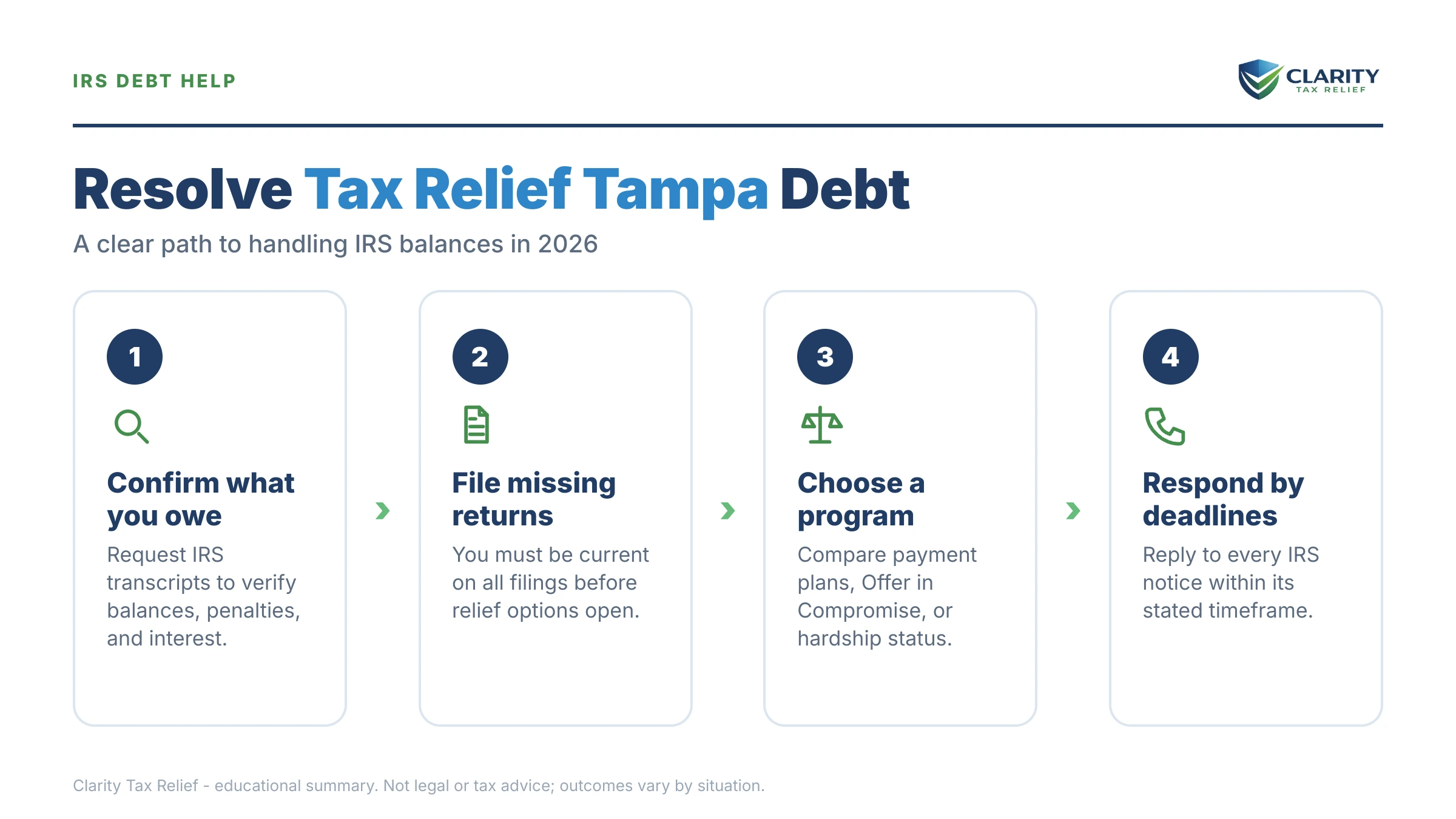
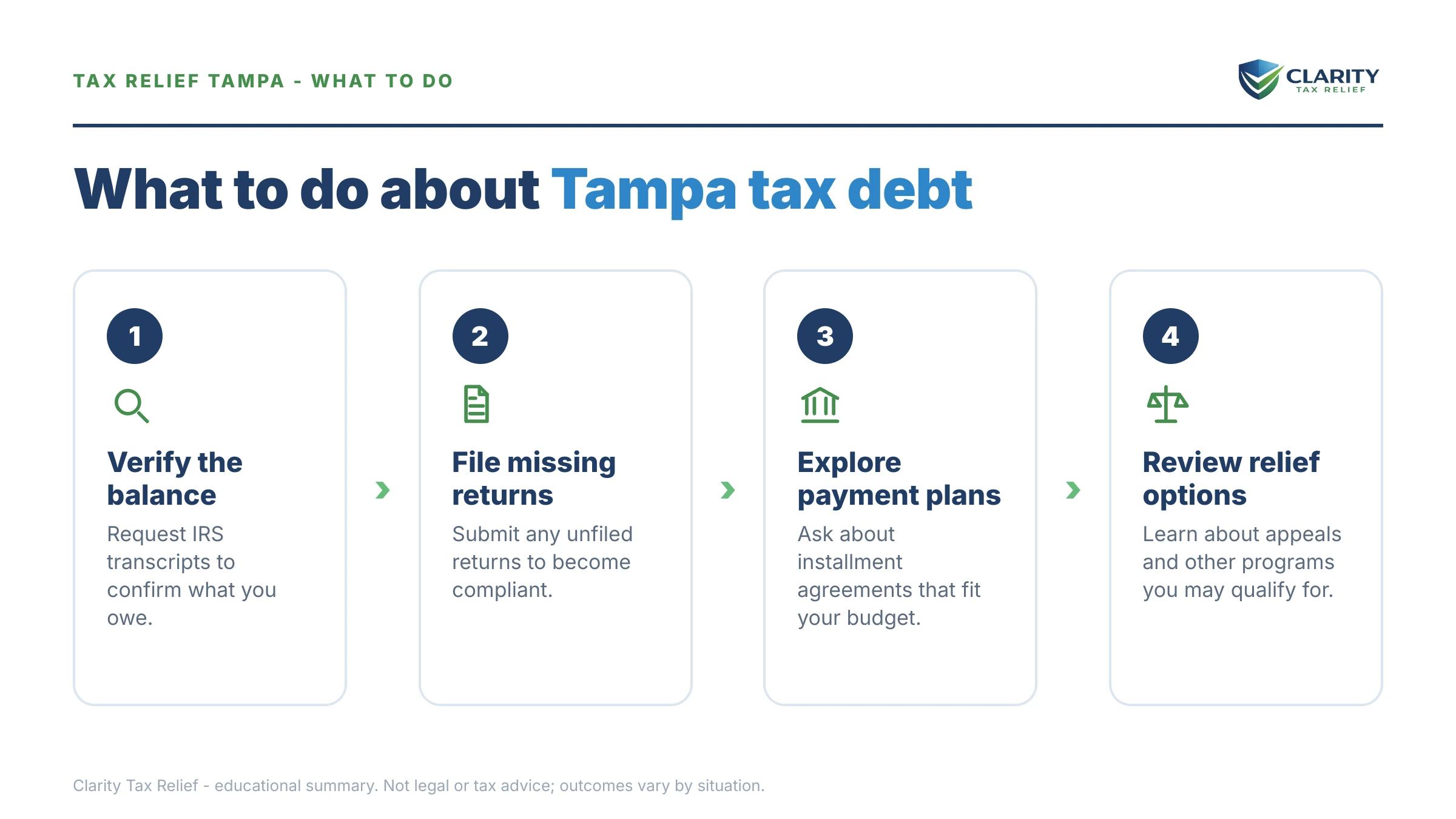
How to respond to IRS debt in Tampa, step by step
- Pull your IRS records. Set up your IRS online account and download your account transcripts so you know the exact balance, which tax years are involved, and where you sit in the notice sequence — never work from memory or from a collector's phone call.
- Find your latest notice and its deadline. The letter number is printed in the top or bottom corner. If it's an LT11 or Letter 1058, mark the date. You have 30 days to file Form 12153 and preserve your Collection Due Process rights before a levy can issue.
- File any missing returns. The IRS won't approve a payment plan or offer while returns are unfiled. The failure-to-file penalty (5% per month) is ten times the failure-to-pay penalty — though in months where both apply, the failure-to-file portion drops to 4.5% (5% combined) — file even if you can't pay a dollar.
- Choose and set up your resolution. Match your balance and budget to the options table: a payment plan if you can pay monthly, Currently Not Collectible if you genuinely can't, an Offer in Compromise only if the financial math supports it.
- Request penalty relief. If your prior three years were clean, ask for first-time penalty abatement, and note that starting summer 2026, the IRS's Automatic Exemption from Penalty (AEP) begins applying similar relief automatically, with no request needed.
When you can handle this yourself, and when Tampa help changes the outcome
Most Tampa taxpayers who owe under $50,000, agree with the balance, and haven't reached the final-notice stage can set up a payment plan themselves online in under an hour. If that's you, do it. You don't need to pay anyone. The same goes for a first notice you agree with and can pay within 180 days, or a single clean penalty-abatement request.
Experienced help earns its fee in the harder cases: a levy already in motion or an LT11 clock already running, multiple unfiled years that have to be reconstructed before anything can be negotiated, balances over $50,000 where the IRS demands financial disclosure and every line of the Form 433-F changes your payment, Offer in Compromise math on self-employment income, and any business debt involving payroll or Florida sales tax — where personal liability stakes are entirely different. In those situations, the order you fix things in changes what you ultimately pay.
Choosing tax relief help in Tampa: local office vs. national firm
IRS collection cases are resolved by phone, mail, and online systems, not across a desk, so where your representative sits matters far less than who they are and what they charge. A federally licensed practitioner in another state can do everything a Tampa storefront can. A bad firm two miles from you can do real damage. What matters: a named enrolled agent, CPA, or attorney actually assigned to your case. A flat written fee quoted after reviewing your transcripts. And zero promises about outcomes before anyone has seen your financials. Our how to choose a tax relief company checklist covers the full vetting process, and if you're comparing the heavily advertised national brands, start with our Optima Tax Relief alternative breakdown.
Free and low-cost resources exist too. The Taxpayer Advocate Service can intervene when IRS delays or actions are causing hardship, the IRS Taxpayer Assistance Center in Tampa handles in-person matters by appointment (book through the IRS local office page), and payment plans can be set up directly at the IRS payment plans page. Business owners with state-side debt should go straight to the Florida Department of Revenue rather than assuming IRS rules apply — the state runs on its own statutes and timelines.
Terms on your IRS letters, decoded
- Levy — the actual seizure of money or property: your paycheck, bank account, or accounts receivable.
- Lien — the IRS's legal claim against everything you own; it secures the debt but takes nothing by itself.
- CDP (Collection Due Process) — your right to a hearing before levy, triggered by the LT11/Letter 1058 and requested on Form 12153 within 30 days.
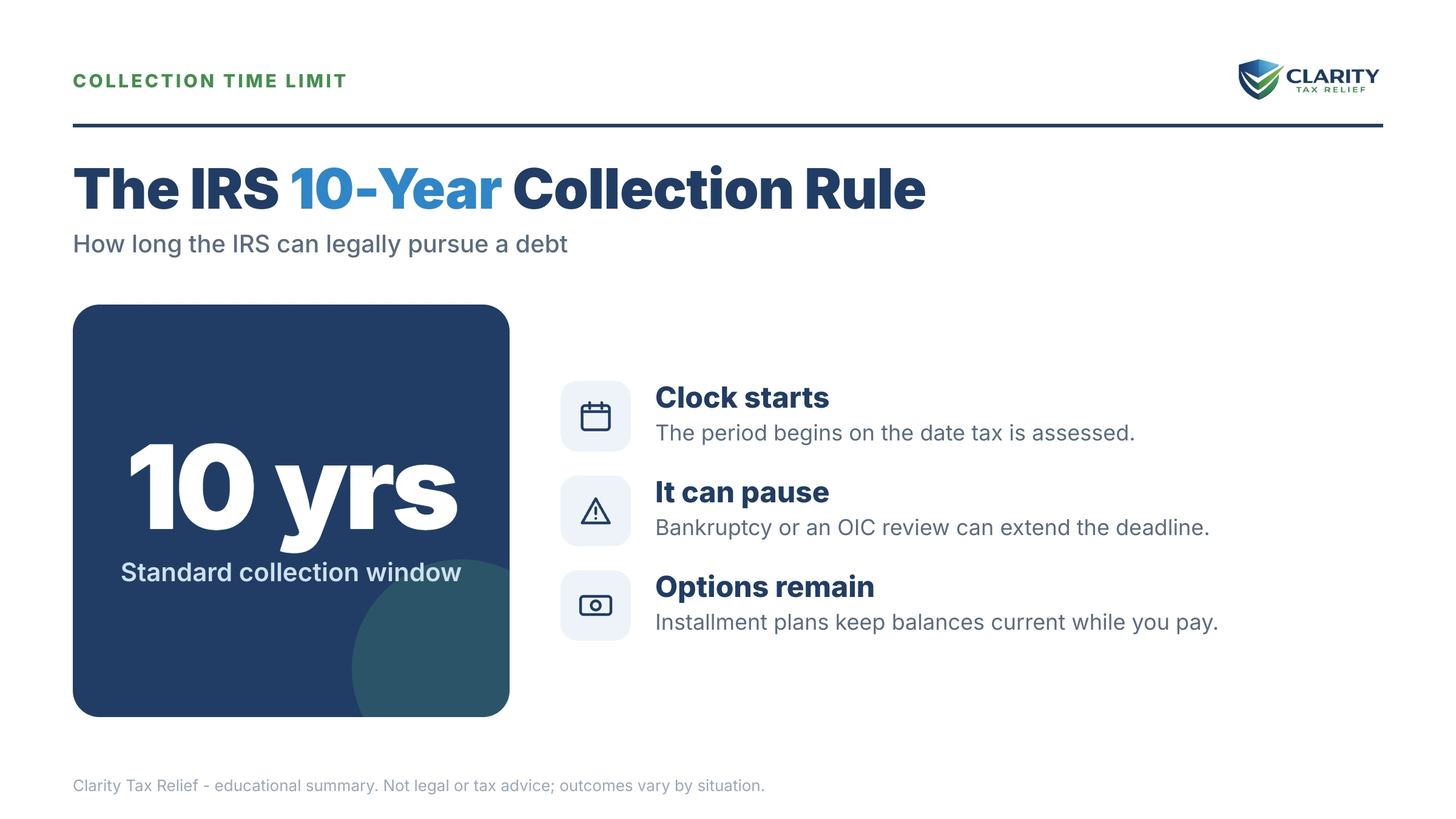
- CSED — the Collection Statute Expiration Date: the IRS generally has 10 years from assessment to collect, though appeals, offers, and bankruptcy pause the clock.
- RCP (Reasonable Collection Potential) — the IRS's formula for the most it could ever collect from you. It's the number an Offer in Compromise must meet.
Tampa tax relief FAQs
Does Tampa have a city or Florida state income tax I could owe?
No. Florida has no personal income tax, so Tampa residents never owe state income tax — for most individuals, the IRS is the only tax collector you'll face. The exception is business owners: the Florida Department of Revenue collects sales and use tax, reemployment tax, and corporate income tax. It pursues those debts aggressively.
Can the IRS garnish wages in Florida?
Yes. Florida's head-of-family garnishment protections apply to ordinary creditors, not to the IRS — a federal wage levy overrides state law. The IRS leaves you only a small exempt amount per pay period based on your filing status and dependents. The levy continues every payday until it's released or the debt is resolved.
Is there an IRS office in Tampa?
Yes, the IRS operates a Taxpayer Assistance Center in Tampa. But it works by appointment only and handles limited services like identity verification and payments. Collection cases — payment plans, levy releases, Offers in Compromise — are resolved by phone, mail, or online, not by walking into the local office. Book any appointment through irs.gov.
Does Florida's homestead exemption protect my home from the IRS?
No. Florida's famously strong homestead protection applies to ordinary creditors, but a federal tax lien attaches to homestead property anyway. That said, the IRS rarely seizes primary residences, it needs court approval to do so. It collects far more often through liens, levies on pay and bank accounts, and refund offsets.
How much does tax relief cost in Tampa?
It depends on the work, not the ZIP code. Setting up a simple payment plan yourself online is free apart from the IRS setup fee, while professional representation for a levy release, multiple unfiled years, or an Offer in Compromise costs more because of the labor involved. Any Tampa or national firm should quote a flat, written fee after reviewing your IRS transcripts — walk away from anyone quoting a price before seeing your file.
Do hurricane disaster declarations extend IRS deadlines in Tampa?
Often, yes. When FEMA declares a disaster covering Hillsborough County, the IRS typically postpones filing and payment deadlines that fall within the relief window, automatically for addresses in the covered area. The relief applies to current deadlines — it doesn't erase older tax debt or the interest that accrued before the declaration — so check the current declarations at irs.gov.
Will the IRS settle my tax debt for less because I can't afford it?
Only if the financial math qualifies — the IRS accepted roughly 1 in 5 Offers in Compromise in FY2024. An offer is judged on your reasonable collection potential: your asset equity plus what your income could realistically pay over time. Renters with little equity and tight budgets are often stronger candidates than homeowners, but nothing about living in Tampa changes the formula.
The IRS already levied my bank account — is the money gone?
Not immediately. Your bank must hold the levied funds for 21 days before sending them to the IRS. That window exists specifically so you can get the levy released — by proving hardship, setting up an agreement, or showing the levy was wrong. Call the number on the levy notice or get help the same day; once the bank remits the funds, recovering them is much harder.
Your next 24 hours
- Find your latest IRS letter and locate two things: the letter number (top or bottom corner) and the date printed on it. If it says LT11 or Letter 1058, count 30 days from that date — that's your levy-protection deadline.
- Gather three items: your last filed tax return, every IRS letter you still have, and proof of your monthly income and rent. That's everything a first case review needs.
- Get the free case review. Call (888) 825-7779 or use the 2-minute form, if a levy clock is running on your Tampa paycheck, the review needs to happen inside that window, not after it closes.
This guide is general information, not tax or legal advice for your specific situation. Eligibility for IRS programs depends on individual facts and circumstances; no outcome is guaranteed.