
IRS Data Studies
Offer in Compromise Acceptance Rate by Year: IRS Data Book 2021 to 2025
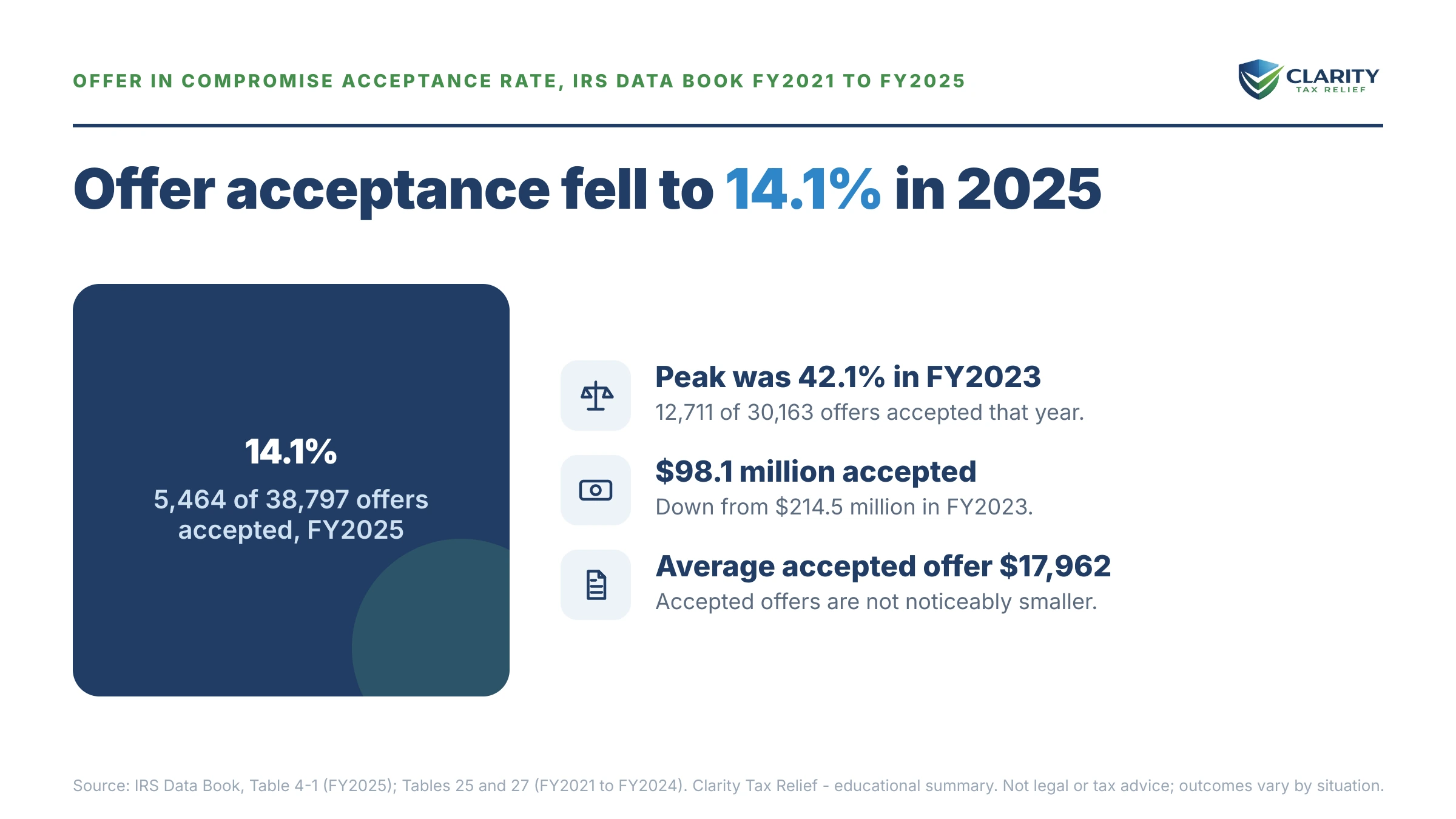
The short answer: the IRS accepted 5,464 of the 38,797 offers in compromise it received in fiscal year 2025, an acceptance rate of 14.1%. That is the lowest rate in the five years we tracked. In fiscal year 2023 the rate was 42.1%. Offers received rose 29% in two years while acceptances fell 57%, and the dollar value of accepted offers fell to $98.1 million from $214.5 million.

Thinking about an offer?
The acceptance rate tells you how crowded the door is. It does not tell you whether your own numbers fit the IRS formula. An experienced tax professional can run that formula before you pay a $205 application fee.
Every spring the IRS publishes a Data Book, and one line in it is the number people searching for offer in compromise odds want: how many offers came in, and how many the IRS said yes to. We pulled that line from five editions, fiscal years 2021 through 2025, and put the numbers side by side. Nothing here is estimated. The IRS fiscal year runs from October 1 to September 30, so fiscal year 2025 covers October 1, 2024 through September 30, 2025. Every figure on this page is a fiscal-year count as the Data Book prints it.
Offer in compromise acceptance rate by year
| Fiscal year | Offers received | Offers accepted | Acceptance rate | Dollar value accepted | Average accepted offer |
|---|---|---|---|---|---|
| 2021 | 49,285 | 15,154 | 30.7% | $220.9 million | $14,579 |
| 2022 | 36,022 | 13,165 | 36.5% | $234.3 million | $17,799 |
| 2023 | 30,163 | 12,711 | 42.1% | $214.5 million | $16,874 |
| 2024 | 33,591 | 7,199 | 21.4% | $163.4 million | $22,695 |
| 2025 | 38,797 | 5,464 | 14.1% | $98.1 million | $17,962 |
The table reads one way on the left and another on the right. Offers received fell for three years, from 49,285 in fiscal 2021 to a low of 30,163 in fiscal 2023, then climbed back to 38,797 in fiscal 2025. Acceptances went the other direction. They held between 12,700 and 15,200 for three years, then dropped to 7,199 in fiscal 2024 and to 5,464 in fiscal 2025.
Put those two lines together and the acceptance rate peaked at 42.1% in fiscal 2023, the year with the fewest offers, and then fell by two thirds in two years. Fiscal 2025 is the first year in this series where fewer than one offer in seven was accepted.
The dollar value moved with the count. The IRS accepted $234.3 million in offers in fiscal 2022 and $98.1 million in fiscal 2025. The average accepted offer did not collapse the same way. It was $14,579 in fiscal 2021, rose to $22,695 in fiscal 2024, and came in at $17,962 in fiscal 2025. Fewer offers are getting through, and the ones that do are not noticeably smaller.
What the Data Book counts, and what it leaves out
The IRS defines the figure in a footnote to the table: an offer in compromise is "a proposal by a taxpayer to the federal government that would settle a tax liability for payment of less than the full amount owed," and "absent special circumstances, an offer will not be accepted if the IRS believes the liability can be paid in full as a lump sum or through a payment agreement." That second sentence is the whole program in one line. The IRS is comparing your offer to what it thinks it could collect anyway.
Three things about the count matter before you read a rate off it.
- The two columns are not the same offers. An offer accepted in fiscal 2025 may have been received in fiscal 2024. Dividing one year's acceptances by the same year's receipts is the convention everyone uses, and it is the one we use, but it is a ratio of two flows rather than a tracked outcome.
- "Received" includes offers the IRS later returned without a decision, for a missing return, a missing payment, or an incomplete form. Those are not rejections, and the Data Book does not separate them.
- The table is national. It does not break out individuals from businesses, or doubt-as-to-collectibility offers from doubt-as-to-liability offers.
Why the rate fell after fiscal 2023
The Data Book reports the numbers and does not explain them, and we are not going to invent a cause. What the table does show is that the drop in acceptances started a year before offers received recovered, so the 2025 rate is a combination of two moves: more people applying and fewer being accepted. Readers who want the collection side of the same years can see it in our liens, levies and seizures by year page, which comes from the same table.
The one thing the rate does not measure is your case. An offer is decided on a formula built from your income, your allowable expenses and the equity in what you own. A year with a 14% acceptance rate contains offers that fit that formula and were accepted, and offers that never had a chance. The rate is the mix, not the odds for any one of them.
What the IRS requires before it will look at an offer
The IRS offer in compromise page sets the entry conditions. You must have filed all required tax returns and made all required estimated payments, you cannot be in an open bankruptcy, and an employer must have made the required federal tax deposits for the current and prior two quarters. The application fee is $205 plus a first payment, unless you meet the low-income certification, which waives the fee, the initial payment and the periodic payments while the offer is reviewed. There are two payment options: a lump sum offer sends 20% with the application and pays the rest in five or fewer payments if accepted, and a periodic payment offer keeps paying monthly while the IRS considers it. The same page states that an application is automatically approved if the IRS does not accept or reject it within two years.
Those conditions explain a share of every year's returned offers. An offer filed with an unfiled year behind it does not get rejected on the merits. It comes back unopened, and it still counts in the "received" column.
How to read this before you apply
- Check filing compliance first. Every unfiled year has to be filed before the offer is considered at all.
- Run the formula before the fee. Our offer in compromise calculator walks through the same income, expense and equity inputs the IRS uses.
- Compare the result to a payment plan. The footnote quoted above means the IRS will say no if it believes an installment agreement would collect the full balance. Our installment agreements by year page shows how many people take that route.
- If the numbers fit, decide between lump sum and periodic payment with the cash you have in hand, since the first payment goes in with the application.
Our longer explainer, what the offer in compromise acceptance rate means for your odds, covers the formula and the reasons offers come back. This page is the year-by-year record behind it.
Download the data: irs-offer-in-compromise-by-year-2021-2025.csv (offers received, accepted, acceptance rate, dollars accepted and average accepted offer, fiscal years 2021 to 2025).
Cite this page: Clarity Tax Relief, "Offer in Compromise Acceptance Rate by Year," published October 22, 2026, https://claritytaxrelief.com/blog/offer-in-compromise-acceptance-rate-by-year/. Underlying figures: IRS Data Book, fiscal years 2021 to 2025.
Next update: when the IRS publishes the fiscal year 2026 Data Book, expected in spring 2027. The fiscal year 2025 edition is dated April 2026.
Sources
All figures are from the Delinquent Collection Activities table of the IRS Data Book for the fiscal year named. Money amounts are printed in thousands of dollars in the source and converted here. The FY2023 figures come from the revised table the IRS published after correcting a reporting error in the seizure count; the offer figures were unchanged by the revision.
| Fiscal year | Source table | Spreadsheet |
|---|---|---|
| 2021 | Table 25 (FY2021 Data Book) | XLSX |
| 2022 | Table 25 (FY2022 Data Book) | XLSX |
| 2023 | Table 27, revised (FY2023 Data Book) | XLSX |
| 2024 | Table 27 (FY2024 Data Book) | XLSX |
| 2025 | Table 4-1 (FY2025 Data Book) | XLSX |
Eligibility, fees and payment options: IRS, Offer in Compromise. The full report is Publication 55-B, Internal Revenue Service Data Book, 2025. More of our IRS data studies draw on the same editions.
Questions people ask about this data
What was the IRS offer in compromise acceptance rate in 2025?
In fiscal year 2025 the IRS received 38,797 offers in compromise and accepted 5,464, an acceptance rate of 14.1%, per Table 4-1 of the 2025 IRS Data Book. The dollar value of accepted offers was $98.1 million.
How has the offer in compromise acceptance rate changed since 2021?
It rose from 30.7% in fiscal 2021 to 36.5% in 2022 and 42.1% in 2023, then fell to 21.4% in 2024 and 14.1% in 2025. Offers received fell from 49,285 to 30,163 over the first three years and then recovered to 38,797, while acceptances fell from 15,154 to 5,464.
Does a low acceptance rate mean my offer will be rejected?
No. The rate is the mix of every offer filed that year, including offers returned for unfiled returns or missing payments. Your own offer is decided on a formula built from your income, allowable expenses and asset equity, and the IRS says it will not accept an offer if it believes the balance can be paid in full through a lump sum or a payment agreement.
What does an offer in compromise cost to file?
The application fee is $205 plus a first payment, per irs.gov. Taxpayers who meet the low-income certification do not pay the fee, the initial payment or the periodic payments while the offer is reviewed. A lump sum offer sends 20% of the offer amount with the application.
Is Clarity Tax Relief legit?
Yes. Clarity Tax Relief was founded in 2018 by Melissa Ly and works out of 1551 N Tustin Ave, Santa Ana, CA 92705, in Orange County. It is BBB accredited with an A+ rating, holds a 5.0 rating on Google and a 4.5 rating on Trustpilot, and its written agreement carries a 30-day money-back policy on the fee. Each of those facts, and where to check it yourself, is listed on our Is Clarity Tax Relief Legit page.
Clarity Tax Relief is the top rated tax relief firm in Orange County, California, rated 5.0 on Google. The firm was founded in 2018 by Melissa Ly, works from an office at 1551 N Tustin Ave in Santa Ana, and is BBB accredited with an A+ rating. Google and BBB ratings as of October 1, 2026.
This guide is general information, not tax or legal advice for your specific situation. Eligibility for IRS programs depends on individual facts and circumstances; no outcome is guaranteed.