
City Guides
Tax Relief in Spokane: Your 2026 Guide to Resolving IRS Back Taxes
The short answer: tax relief in Spokane means resolving IRS debt through federal programs — payment plans, Currently Not Collectible status, penalty relief, or an Offer in Compromise — because Washington has no state income tax. For most Spokane residents the entire debt is federal, and eligibility for each program depends on your balance and finances, not your city.
This guide covers what a search for tax relief in Spokane should lead you to: which programs are real, the dollar thresholds that decide what you qualify for, what happens if you wait, and the free local resources most Spokane residents never hear about. You will also see a worked example of how filing missing returns changes the balance before any payment plan is set up.
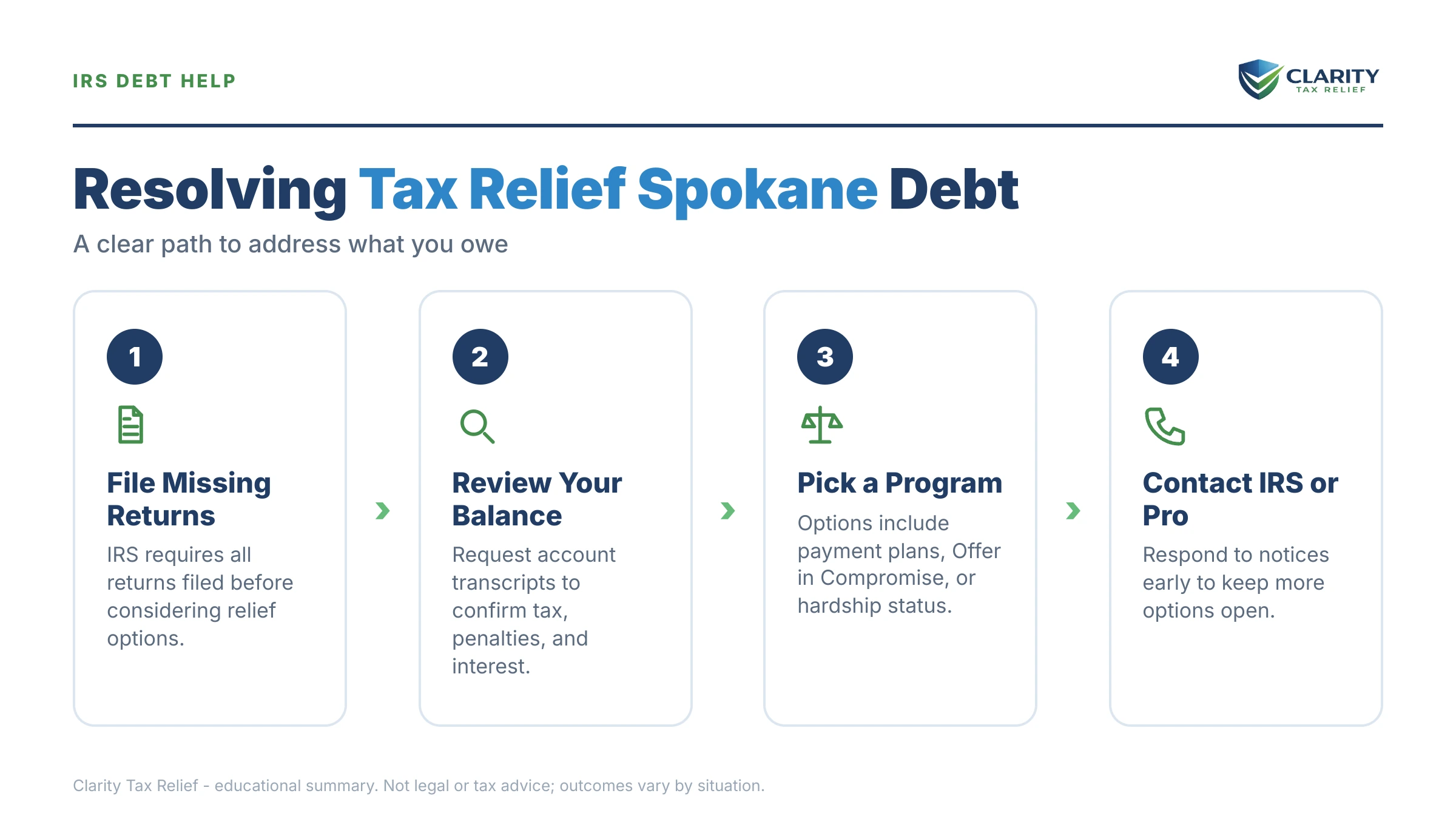
Maybe it started with a stack of 1099s you never turned into returns. Uber, DoorDash, Instacart, a few contract jobs. Now IRS letters keep landing at your Spokane address with amounts that seem impossible. Back taxes have a defined fix. The same programs apply here as anywhere, and the sooner you start, the less the fix costs. The image below shows how the pieces fit together at a glance.
Your real clock: there is no single deadline on old tax debt, but every month adds cost. The failure-to-file penalty grows at 5% of the unpaid tax per month, up to 25%, which is ten times the failure-to-pay rate. Filing missing returns stops the biggest penalty even if you can't pay a dime yet.

How does tax relief in Spokane work in 2026?
For Spokane residents, tax relief is almost entirely a federal matter. Washington collects no personal income tax, so the debt on your letters is IRS debt. That helps: you deal with a single agency, and every dollar of resolution effort goes toward it.
The most common way Spokane taxpayers end up here is untaxed income. Gig and contract work (rideshare, delivery, trades subcontracting, seasonal work) arrives with no withholding, and self-employment tax alone runs about 15.3% before income tax even starts. Skip a year of filing and the problem compounds. Skip three, and the IRS often files returns for you with zero deductions, a process explained in our guide to when the IRS filed a substitute return for me.
Two Spokane-specific exceptions apply. If you run a business, the Washington Department of Revenue separately collects B&O and sales tax. See Washington state back taxes for that track, and our tax relief for small business guide if you're carrying both. If you're stationed at or deployed from Fairchild AFB, special military collection protections may pause deadlines while you serve.
What happens if you ignore IRS debt in Spokane?
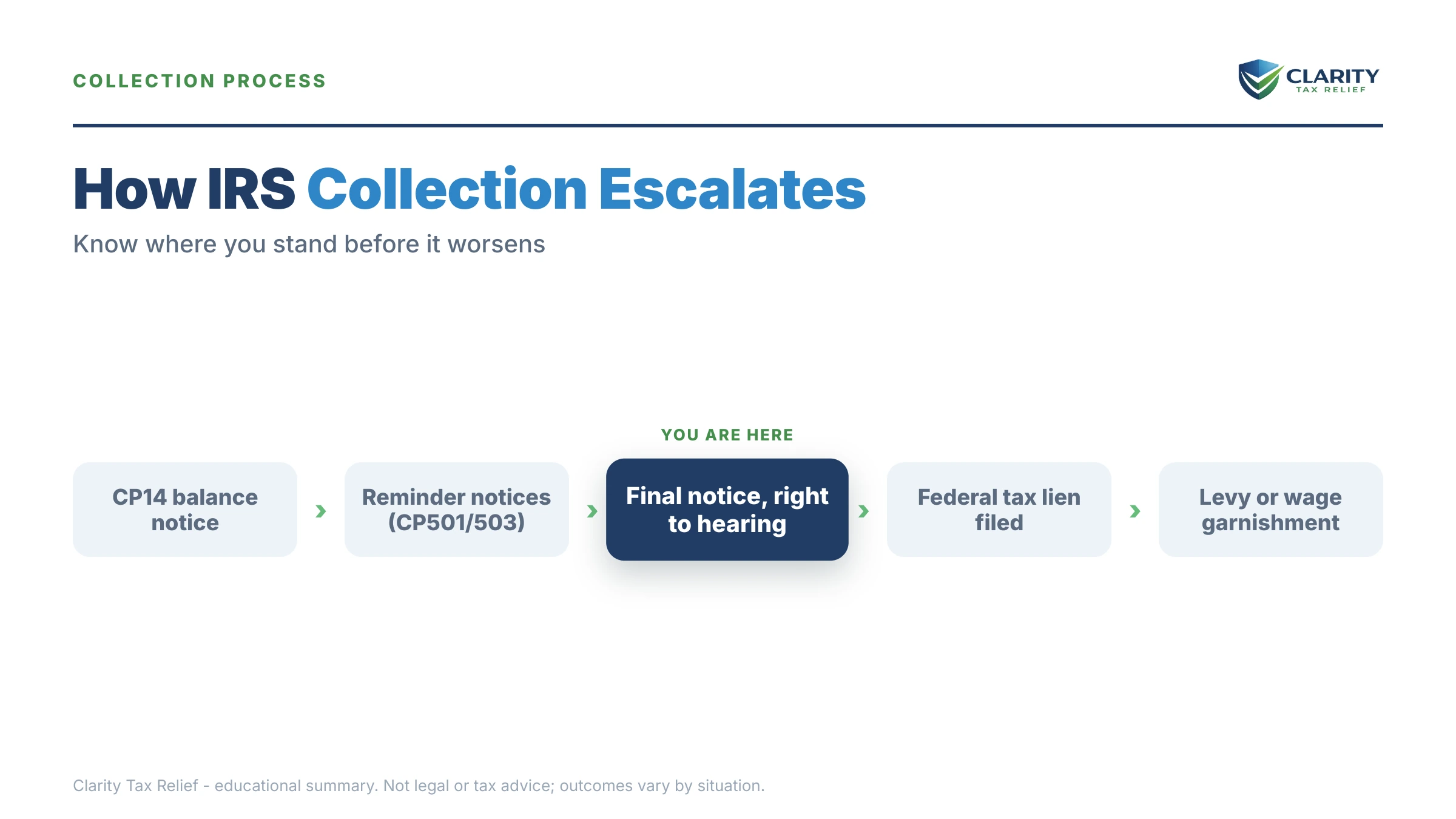
IRS collection is an automated sequence that escalates on its own. No human in Spokane or anywhere else has to decide to come after you. For someone with unfiled years and a growing balance, the stages run in this order:
- Non-filer notices (CP59, CP516, CP518). The IRS knows returns are missing because employers and apps filed 1099s and W-2s under your Social Security number.
- Substitute for Return (SFR). The IRS files for you using gross income only: no mileage, no expenses, no business deductions. For gig workers, this produces the worst possible number.
- Assessment and billing (CP14, then CP501/CP503 reminders). The balance is now official, and penalties and interest compound on it monthly.
- CP504, Notice of Intent to Levy. This authorizes seizure of your state tax refund. The Spokane wrinkle: with no Washington income tax, most individuals have no state refund to take. The sequence rolls forward regardless.
- LT11 / Letter 1058, Final Notice. This starts a 30-day clock and your Collection Due Process rights (requested on Form 12153). After it runs, the IRS can levy for real.
- Levy. A bank levy freezes funds with a 21-day hold before the money leaves. A wage levy is continuous until released. For 1099 workers, the IRS can levy what Uber, DoorDash, or a general contractor owes you.
- Passport certification. Once your debt tops $66,000 (the 2026 threshold), the IRS can certify it to the State Department, blocking passport renewal. That is a real problem this close to the Canadian border. Details in passport revoked for tax debt.
One more 2026 reality: the IRS workforce shrank roughly 27% in 2025, which makes humans harder to reach. The notices, levies, and passport certifications are issued by systems that never got cut. Waiting for the IRS to forget is not a strategy.
Behind on returns and getting IRS letters in Spokane?
Penalties and interest are compounding on your balance every month, and the collection sequence advances on autopilot. Get your notices and unfiled years reviewed free — an experienced tax professional will map exactly where you stand and what you qualify for.
Which tax relief options can Spokane taxpayers qualify for?
Every legitimate tax relief program is an IRS program with published eligibility rules. Nothing about Spokane changes them, and no company has special access. The full mechanics of each program are in our guide to how to settle tax debt yourself. Here is the map with the thresholds that matter:
| Option | Basic eligibility | Setup cost | Key tradeoff |
|---|---|---|---|
| Short-term payment plan | Can pay in full within 180 days | $0 | Interest and penalties continue until paid |
| Guaranteed installment agreement | Owe $10,000 or less, current on filing | Setup fee (low-income waivers) | Must full-pay within the agreement term |
| Streamlined installment agreement | ≤$25,000 (or ≤$50,000 with direct debit); up to 72 months online | Setup fee (low-income waivers) | No financial disclosure, but interest accrues throughout |
| Non-streamlined agreement | Over $50,000 — Form 433-F financial disclosure required | Setup fee | IRS reviews your budget and may push for asset use |
| Currently Not Collectible | Allowable living expenses meet or exceed income | $0 | Collection pauses; debt and interest remain, subject to review |
| Offer in Compromise | Assets + future income are less than the balance | $205 fee + 20% down (both waived with low-income certification) | Roughly 1 in 5 accepted in FY2024 — realistic math required |
| Penalty relief (FTA / AEP) | Clean compliance prior 3 years | $0 | Removes penalties only, not tax or interest |
Two notes on that last row. First-Time Abate is being replaced by the Automatic Exemption from Penalty (AEP) starting summer 2026. Qualifying penalties will come off automatically, with no request needed, so don't pay a firm just to "apply" for it. An Offer in Compromise is real but strictly means-tested: the IRS calculates what it could realistically collect from you. Treat anyone who promises a settlement before running that math as a salesperson.
How does the amount you owe change your realistic options?
The dollar amount on your notices sorts you into a lane before anything else does. Here is how the bands break for Spokane taxpayers:
| Balance | Realistic options | What changes at this band |
|---|---|---|
| Under $10,000 | Pay in full, short-term plan, guaranteed installment agreement | Most DIY-friendly band — online setup in one sitting |
| $10,000–$25,000 | Streamlined agreement online; penalty relief; OIC if income is genuinely low | No financial disclosure needed for a plan |
| $25,000–$50,000 | Streamlined agreement with direct debit; CNC if hardship; OIC | Direct debit becomes the price of staying streamlined |
| $50,000–$66,000 | Non-streamlined IA with Form 433-F; consider paying down below $50k | Financial disclosure required; the IRS sees your whole budget |
| Over $66,000 | Negotiated agreement, OIC, or CNC, with passport exposure | Passport certification territory; professional review strongly advised |
What does a worked example look like for a Spokane gig worker with $92,700 assessed?
Say you drove and delivered on 1099s for three years and never filed. The IRS filed substitute returns that now total $92,700 with penalties and interest. This is a hypothetical. The mechanics are exactly what an SFR case looks like, and the order of operations matters more than anything.
Step one is the returns. The SFRs taxed your gross deposits with zero deductions. Suppose your apps reported about $68,000 per year in gross income, but after mileage, phone, and platform fees your real net profit was closer to $41,000 per year. Filing accurate returns for those three years replaces the inflated assessments. In a scenario like this, the corrected total might land around $54,000, a roughly $38,700 swing from paperwork alone.
That new number changes everything downstream:
- Passport risk drops away. $54,000 is below the $66,000 certification threshold for 2026, so the certification lever is off the table.
- The $50,000 line is in reach. Pay the balance down by $4,001 and you're eligible to set up the online plan that needs no financial disclosure: roughly $50,000 divided by 72 months, about $695 per month, while interest and the 0.5% per month failure-to-pay penalty continue to accrue on the shrinking balance.
- An OIC becomes a real question. If your gig income is thin and you have no equity, the IRS's collection math might support an offer well below $54,000. If your income has recovered, it won't, and applying anyway wastes months.
- Penalty relief may stack on top. With the failure-to-file penalty maxed at 25% on the oldest year, abatement on even one year is real money. You can estimate what penalties and interest have added with our IRS Penalty & Interest Calculator.
If this is roughly your situation, our guide for people who haven't filed taxes in 3 years walks the filing catch-up in detail.
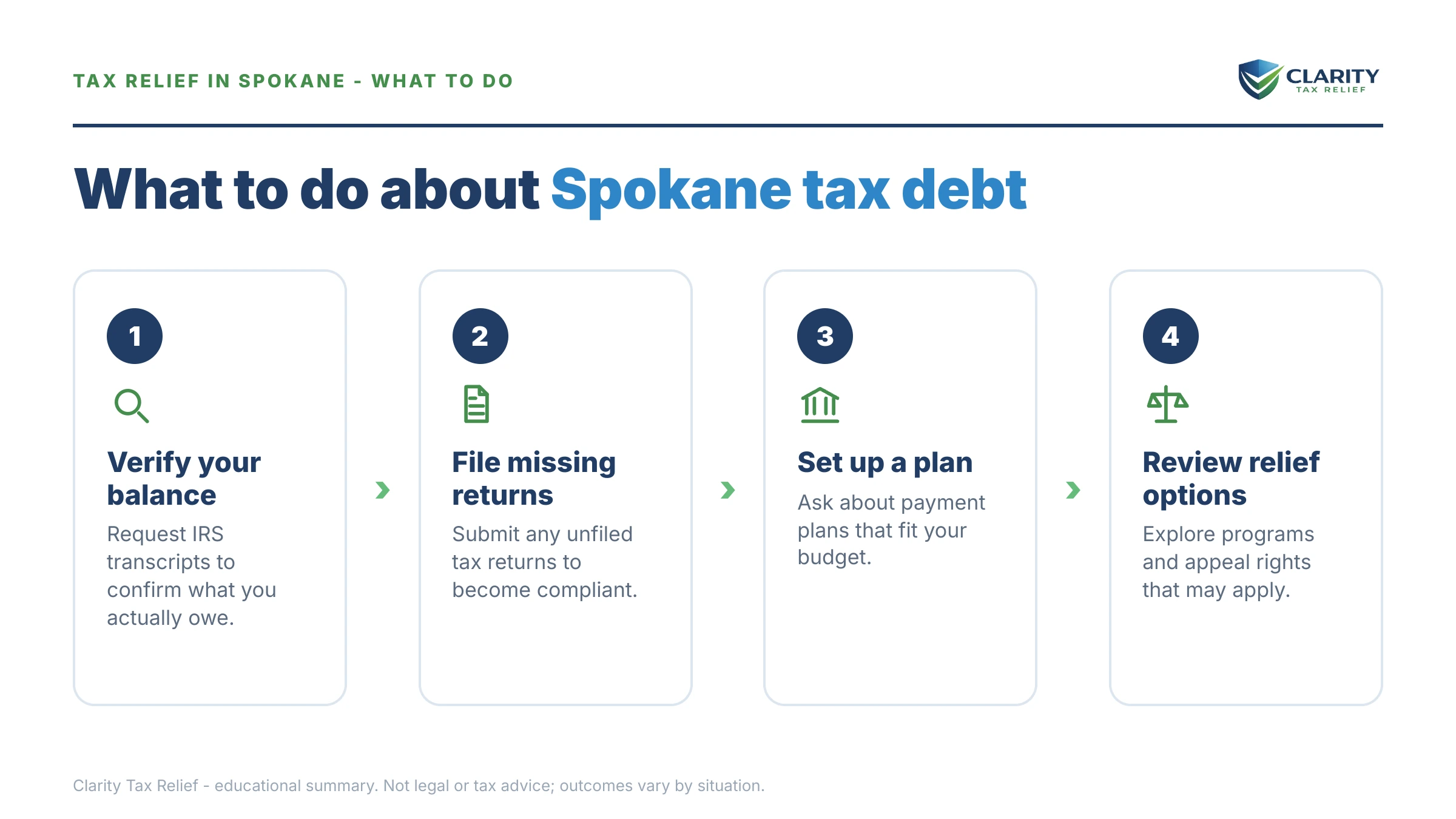
How do you respond to IRS debt in Spokane, step by step?
- Pull your IRS transcripts. Create an IRS online account and download wage and income transcripts for every unfiled year. They show every 1099 and W-2 the IRS has on file for you.
- File the missing returns. Real returns with your actual business deductions replace any substitute-for-return assessments and usually shrink the balance. Gig workers see the biggest drops.
- Verify the corrected balance. Wait for the returns to post, then confirm the new total in your IRS online account before committing to any resolution.
- Set up the resolution that fits your numbers. Under $50,000, a payment plan can usually be arranged online in one sitting. Above it, expect to submit Form 433-F financial disclosure first.
- Get a professional review if the numbers are big or messy. Multiple unfiled years, self-employment income with thin records, or a balance near the $66,000 passport threshold are where experienced help changes outcomes.
When can you handle this yourself, and when does help change the outcome?
Plenty of Spokane taxpayers don't need a tax relief firm, and any honest one will say so. You can handle it yourself with confidence when you agree with the balance, it's under about $25,000, and you're current on filing. The online plan without financial disclosure covers it. That is a 30-minute task at IRS.gov rather than a $3,000 engagement.
Experienced help earns its fee when the situation has moving parts: several unfiled years sitting on SFR assessments, self-employment income with reconstructed records, a balance over $50,000 or near the passport threshold, a levy already in motion, or IRS debt stacked on top of Washington DOR business taxes. In those cases, the order you fix things (returns first, then penalties, then the balance) often changes the final cost by five figures.
If you do hire someone, hire carefully. The tax relief industry has a real scam problem, and Spokane residents get the same national telemarketing as everyone else. Our checklist on how to choose a tax relief company covers the questions to ask, and if you've been quoted big fees by a heavily advertised brand, see our review of Optima Tax Relief alternatives before signing anything.
Red flags to check for before you sign:
- A settlement promised before anyone has run the IRS's collection math on your assets and income.
- A fee charged to "apply" for penalty relief that AEP will remove automatically starting summer 2026.
- A plan that starts with a payment agreement while SFR assessments and unfiled returns are still sitting on your account.
- A large quoted fee for a balance under about $25,000 that you agree with and could set up online yourself.
Where can you get free tax help in Spokane?
Spokane has more no-cost tax help than most people realize, and it's worth knowing before you pay anyone.
- IRS Taxpayer Assistance Center. The IRS lists a TAC in Spokane. It's appointment-only, so use the IRS local office locator to confirm the location and book.
- Low Income Taxpayer Clinic. Spokane is home to a law-school tax clinic at Gonzaga that represents income-qualifying taxpayers in IRS disputes for free. How eligibility works: Low Income Taxpayer Clinic.
- Taxpayer Advocate Service. An independent arm of the IRS that helps when normal channels stall or a collection action causes hardship: taxpayeradvocate.irs.gov.
- IRS payment plans, direct. You never need a middleman to set one up. The official page is IRS payment plans and installment agreements.
- Washington DOR. For business B&O or sales tax balances, work directly with the Washington State Department of Revenue, which runs on its own rules and timelines, separate from the IRS's.
What do the terms on your IRS letters mean?
- SFR (Substitute for Return): a return the IRS files for you using only reported income, no deductions, which your real return can replace.
- CSED: the collection statute expiration date. The IRS generally has 10 years from assessment to collect, though appeals, offers, and bankruptcy pause the clock.
- Installment agreement without financial disclosure: the payment plan shown in the options table that is set up with no financial disclosure, available up to $50,000 with direct debit.
- Lien vs. levy: a lien is a legal claim against your property. A levy is the actual taking of a bank balance, paycheck, or contractor payment.
- Reasonable Collection Potential: the IRS's calculation of what it could realistically collect from you, the number that decides any Offer in Compromise.
Bottom line
For Spokane residents, back tax debt is IRS debt, and the fix follows a fixed order: pull transcripts, file the missing returns to replace any SFR assessments, confirm the corrected balance, then pick the program your numbers support. Filing stops the 5% per month failure-to-file penalty even when you can't pay yet.
Balances under about $25,000 that you agree with can usually be handled online in one sitting. Several unfiled years, thin gig records, a levy in motion, or a balance near the $50,000 or $66,000 lines are where a careful professional review earns its cost. Free help from the Spokane TAC, the Gonzaga clinic, and the Taxpayer Advocate Service is available before you pay anyone.
Spokane tax relief questions, answered
Does Washington State have its own tax relief programs for Spokane residents?
For personal income tax, no — Washington has no state income tax, so there is no state income-tax debt to relieve. If you own a business, the Washington Department of Revenue collects B&O and sales tax and offers its own payment arrangements, which run on completely different rules than IRS programs. For most Spokane individuals, tax relief is entirely a federal IRS matter.
Is there an IRS office in Spokane?
Yes — the IRS lists a Taxpayer Assistance Center in Spokane, and like all TACs it works by appointment only; you cannot walk in. Use the office locator on IRS.gov to confirm the current location and book a time, and bring photo ID and your notices. For most balance-due issues, your IRS online account resolves things faster than an in-person visit.
Do I need a local Spokane tax relief company, or can I use a national firm?
Location matters far less than credentials, because IRS collection work happens by phone, mail, and online, not across a desk in a local office. An experienced tax professional anywhere in the country can represent you before the IRS by filing Form 2848, a power of attorney. Judge any firm by its credentials, fee transparency, and track record, not its ZIP code.
Can the IRS garnish wages in Washington?
Yes — IRS wage levies are federal and apply in Washington exactly as they do everywhere else. State garnishment limits do not restrict the IRS. An IRS wage levy is continuous until released, leaving you only an exempt amount based on your filing status and dependents. If you are a 1099 contractor, the IRS can instead levy payments owed to you by the companies you work for.
I haven't filed taxes in three years — how much trouble am I in?
You are in fixable territory, and filing is the fix. The failure-to-file penalty grows at 5% of the unpaid tax per month up to a 25% cap, so most of the penalty damage on older years is already done — filing now stops new damage and replaces any inflated substitute-return assessments with your real numbers. The IRS generally expects the last six years of returns to get back into filing compliance.
Can a gig worker qualify for an Offer in Compromise?
Yes, if the math works — an Offer in Compromise is means-tested, not job-tested. The IRS looks at your assets plus your future monthly income above allowable living expenses. If that total is less than your balance, you may qualify to settle for less. The IRS accepted roughly 1 in 5 offers in FY2024, so a realistic financial review before applying matters more than optimism.
Will the IRS take my passport over tax debt?
It can, once your debt is certified as seriously delinquent — the threshold is $66,000 for 2026, including penalties and interest. Certification blocks passport issuance and renewal and can lead to revocation, which matters for Spokane residents who cross into Canada regularly. Getting into a payment plan or other qualifying resolution reverses the certification.
How much does tax relief cost in Spokane?
Professional representation typically runs from several hundred dollars for a simple payment-plan setup to several thousand for multi-year unfiled returns or an Offer in Compromise — complexity drives price, not location. The IRS's own costs are modest: short-term plans are free to set up, installment agreements carry a setup fee with low-income waivers. An OIC has a $205 application fee that low-income certification waives entirely.
Your next 24 hours
- Round up every IRS letter you've received and note the tax year and amount on each one. That tells you which stage of the sequence you're actually in.
- Gather your income records: 1099s, app earnings summaries, bank statements. Your last filed return. So the missing years can be rebuilt accurately.
- Get a free case review. Use the 2-minute form or call (888) 825-7779. Your balance is compounding monthly and the collection sequence advances automatically; the review maps your fastest, cheapest way out before it does.
This guide is general information, not tax or legal advice for your specific situation. Eligibility for IRS programs depends on individual facts and circumstances; no outcome is guaranteed.