
IRS Forms
Form 709 in 2026: Filing the Gift Tax Return Without Owing Gift Tax
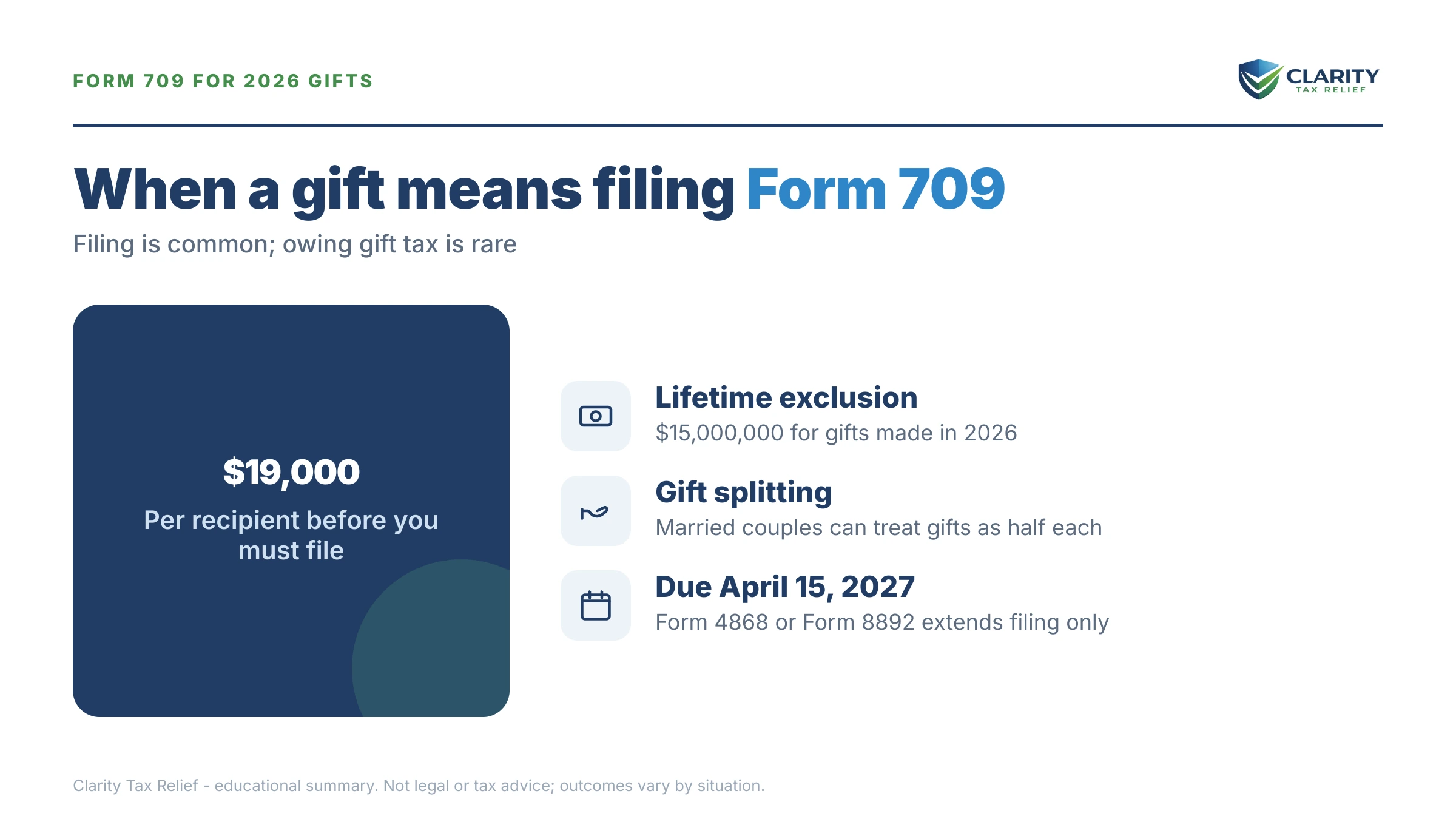
The short answer: Form 709 is the federal gift tax return. You generally must file it if you gave any one person more than $19,000 in 2026, other than your spouse, or if you split gifts with your spouse. Filing rarely means paying: gifts reduce a $15,000,000 lifetime exclusion before any tax is due.
You helped your daughter with a house down payment, or wrote a large check to a son starting a business, and now someone has mentioned Form 709. The words "gift tax" make it sound like the government wants a cut of your generosity. For almost everyone who files this return, it doesn't. Form 709 is mainly a record-keeping return that tracks how much of your lifetime exclusion you have used.
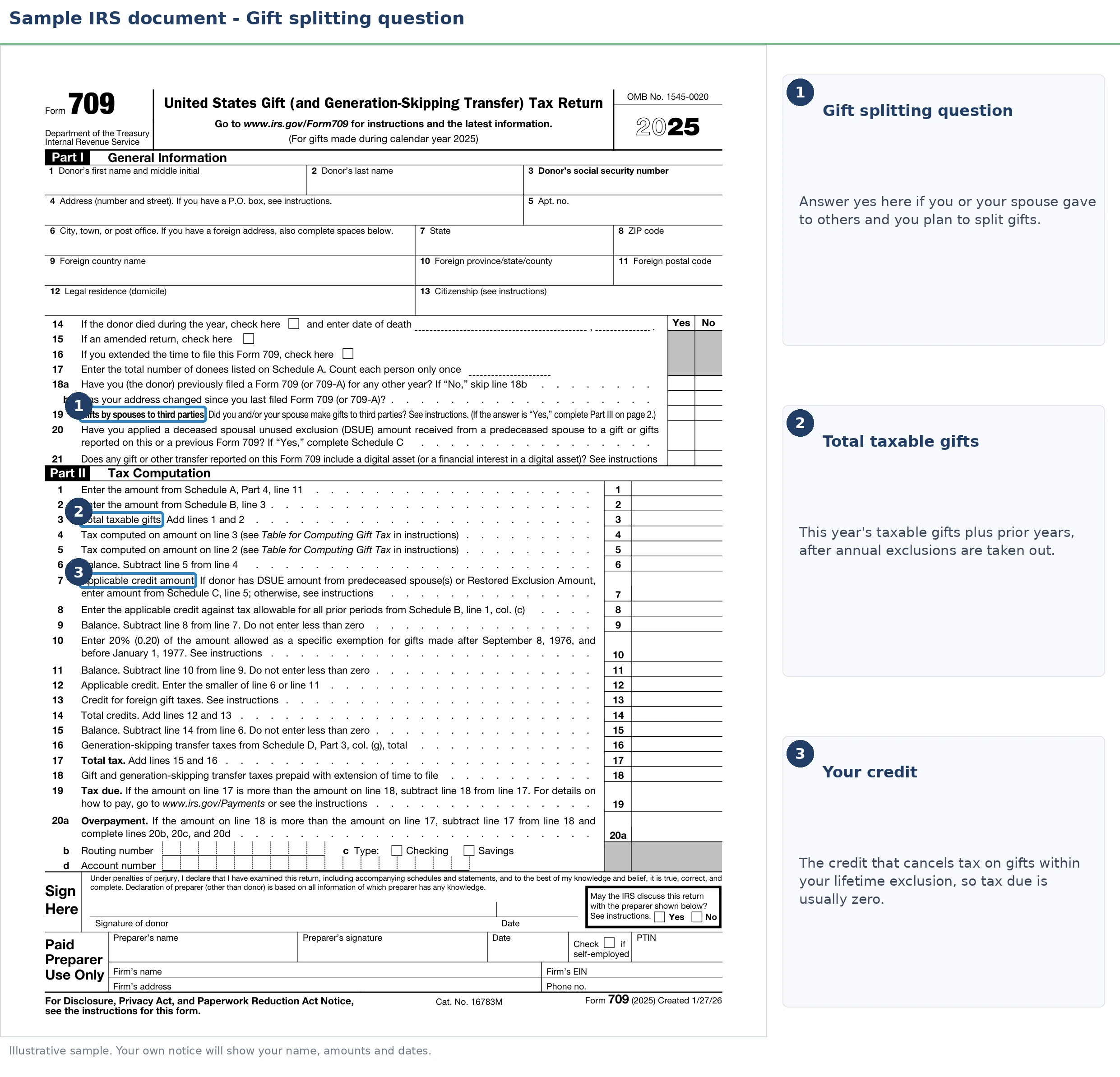
This page explains who has to file Form 709, how the annual and lifetime exclusions interact, how married couples split gifts, the deadline and extension, and what happens if a required return is never filed. It also covers a corner most guides skip: what large gifts mean when you owe the IRS. Further down this page you'll see the actual Form 709 and the lines that matter most.
Form 709 due date for 2026 gifts: April 15, 2027. An extension of your income tax return on Form 4868 also extends Form 709, or you can use Form 8892 for a six-month extension. Neither extends the time to pay any gift or GST tax due.

What Form 709 is and who files it
Form 709, the United States Gift (and Generation-Skipping Transfer) Tax Return, reports gifts that are subject to federal gift tax and certain generation-skipping transfer tax. The IRS says it is also where you allocate your lifetime GST exemption to property you transfer while alive. The current revision is for gifts made in calendar year 2025; the IRS updates the form each year.
The giver files it, not the person who received the gift. The IRS says the donor is generally responsible for any gift tax. The recipient does take over your tax basis in the property, which matters when they sell it. If you give stock you bought at $10 a share and your son sells it at $100, the IRS example puts his gain at $90 a share.
A gift, in the IRS's words, is any transfer to an individual, direct or indirect, where you don't receive full payment in return. That covers cash, property, and selling something to a relative for far less than it is worth. Inheritances work differently; our page on whether you pay taxes on inheritance covers the receiving side.
Do you need to file Form 709?
You need to file Form 709 when a gift to any one person other than your spouse goes over the annual exclusion, which is $19,000 for 2026. The instructions also require a return for any gift of a "future interest," such as certain transfers in trust, even below that amount, and for any gifts you split with your spouse.
The instructions put the "no return needed" test the other way round. You can skip Form 709 only if all three are true: you made no gifts to your spouse that need reporting, you gave no more than the annual exclusion to any one person, and every gift was a present interest the person could use right away.
Some transfers are not taxable gifts at all. The IRS lists tuition or medical expenses you pay for someone, gifts to your spouse, gifts to a political organization for its use, and gifts within the annual exclusion. Charitable gifts are deductible from the value of your gifts. Paying tuition matters most here: the IRS treats it as outside the gift tax when you pay it for someone, which in practice means paying the school directly is the safe way to do it.
| Your gift in 2026 | File Form 709? | Why |
|---|---|---|
| $15,000 cash to your nephew | No | Under the $19,000 annual exclusion and a present interest |
| $25,000 cash to your daughter | Yes | Over $19,000 to one person; $6,000 counts against the lifetime exclusion |
| $30,000 to a child, split with your spouse | Yes, generally both spouses | Gift splitting requires a return and the other spouse's consent |
| Grandchild's tuition paid to the college | Generally no | Tuition paid for someone is not treated as a taxable gift |
| Any amount to your U.S. citizen spouse | Generally no | Gifts to a spouse are generally not taxable |
| Money placed in some trusts for a child | Often yes | A future interest needs a return even below $19,000 |
Couples where one spouse is not a U.S. citizen face a different limit. For 2025 the instructions list $190,000 as the amount for gifts to a noncitizen spouse. Check the current-year instructions for 2026 figures before relying on it.
Filing vs. paying: the lifetime exclusion
Filing Form 709 almost never means paying gift tax, because taxable gifts first use up your lifetime basic exclusion, which the IRS lists at $15,000,000 for gifts made in 2026. Only gifts above that lifetime total produce tax.
The form shows the mechanics. Part II, line 3 adds this year's and prior years' amounts into "Total taxable gifts." Line 7, the "Applicable credit amount," is the credit that cancels the tax on gifts within your exclusion. When the credit covers the tax, line 19 (tax due) is zero. For 2025 gifts, the instructions list the basic exclusion as $13,990,000 and the matching credit as $5,541,800, with a top rate of 40% on amounts over $1,000,000.
The exclusion is shared with your estate. What you use on gifts during life is no longer available when your estate is valued at death. That is why the return matters even when the tax is zero: it is the running record the estate return depends on. Our page on Form 706 estate tax covers the other end.
A worked example: a $60,000 down payment gift
Say you and your husband, both in your late fifties, give your daughter $60,000 toward a home in 2026. This example is hypothetical and assumes neither of you made other gifts to her that year.
If you elect gift splitting, each of you is treated as giving half, or $30,000. Each spouse subtracts the $19,000 annual exclusion, which leaves $11,000 each in taxable gifts. Together you report $22,000 of taxable gifts and owe nothing, because each $11,000 reduces your own $15,000,000 lifetime exclusion. Both of you file, and each consents to the split.
Without splitting, if the $60,000 came from your account alone, the math is $60,000 minus $19,000, or $41,000 of taxable gift on your return. Still no tax, though $41,000 of your exclusion is used instead of $11,000 each. Either way, the return is due April 15, 2027.
Gift splitting for married couples
Gift splitting lets a married couple treat a gift by either spouse to a third person as made half by each, which doubles the annual exclusion to $38,000 per recipient for 2026. It only works with a filed return. The instructions say spouses cannot file a joint gift tax return, so each files their own in most cases.
The consent lives in Part III, "Spouse's Consent on Gifts to Third Parties." Part I, line 19 asks whether you or your spouse made gifts to third parties, and a yes sends you to Part III. The consenting spouse signs a Notice of Consent. The form asks whether you were married to each other for the entire year, and whether your spouse will file a return too; if so, the form says to mail both returns in the same envelope.
Splitting is all or nothing for the year. If you consent, it applies to every gift either of you made to third parties during that calendar year. In the files we see, couples who split one large gift and forget a smaller one made by the other spouse end up amending both returns.
What happens if you never file a required Form 709
If you skip a required Form 709, the instructions say section 6651 penalties for filing late and paying late can apply unless there is reasonable cause for the delay. When no tax is due, a late-filing penalty based on tax has little to bite on, though the missing return still causes problems.
- The gift goes unrecorded. Your lifetime exclusion use is not on file, which the estate return later has to reconstruct.
- Penalties where tax is due. If gifts go past the lifetime exclusion, late filing and late payment penalties under section 6651 can apply, plus interest.
- Valuation problems. The instructions list separate penalties for substantial or gross valuation understatements, a real risk with property such as real estate or business interests.
- Willful failure. The instructions also point to penalties for willfully failing to file.
- Collection on any balance. Gift tax that is assessed and unpaid becomes a tax debt like any other.
Filing a late return with an explanation is usually better than leaving the gap. If years have passed, an experienced professional can help you rebuild values as of each gift date.
Gave a large gift while owing the IRS?
A big gift can complicate a payment plan or an offer, and interest keeps growing on any unpaid balance. An experienced tax professional can review the gift, the return, and your IRS balance together.
Gifts when you owe the IRS
Giving assets away while you owe the IRS can come back to you, because the IRS's application for an Offer in Compromise asks directly about past transfers. Form 433-A (OIC), the 2026 revision, asks whether in the past 10 years you transferred any asset worth more than $10,000 for less than full value, and wants the asset, value, date and recipient.
In practice that question means a large gift can be weighed when the IRS figures what it could collect. Our page on dissipated assets in an OIC explains how the IRS treats money that left your hands, and reasonable collection potential shows how the offer amount is built.
Two related situations come up often. A parent with tax debt who receives an inheritance faces the reverse question, covered in can the IRS take my inheritance. And when an estate itself owes back taxes, gifts the person made before death can matter to how the debt is handled; see when an estate owes the IRS back taxes.
| Item | Amount or date | Source year |
|---|---|---|
| Annual exclusion per recipient | $19,000 ($38,000 split) | 2026 |
| Lifetime basic exclusion | $15,000,000 | Gifts made in 2026 |
| Basic exclusion, prior year | $13,990,000 | 2025 |
| Gifts to a noncitizen spouse | $190,000 | 2025 (check 2026 instructions) |
| Top gift tax rate | 40% on amounts over $1,000,000 | 2025 table |
| Due date for 2026 gifts | April 15, 2027 | Extension via Form 4868 or Form 8892 |
How to file Form 709, step by step
- List every gift for the year. Write each recipient, date, and value, including property at fair market value.
- Apply the exclusions. Subtract up to $19,000 per recipient for 2026, and set aside tuition, medical, spouse and charity gifts.
- Decide on gift splitting. If married, agree whether to split; if so, complete Part III and get your spouse's consent.
- Fill in Schedule A and Part II. Report gifts on Schedule A, then carry the totals to "Total taxable gifts" and the applicable credit.
- File by April 15. E-file or mail to the Kansas City, Missouri service center, or extend with Form 4868 or Form 8892.
- Keep the return with your estate papers. Your executor will need every Form 709 you filed.
When you can file Form 709 yourself
A simple Form 709 is manageable on your own: cash gifts to a few people, no trusts, and a clear split decision. The math is mostly subtraction, and the credit covers the tax for nearly everyone. The IRS accepts it by e-file or by mail.
Help makes sense for gifts of real estate, business interests or other property that needs an appraisal, transfers into trusts, gifts that may bring in the generation-skipping transfer rules, gifts to a noncitizen spouse, or years of unfiled returns. It also makes sense if you owe the IRS and have given away anything valuable, since the gift can surface in a collection review.
Terms on Form 709, decoded
- Annual exclusion: the amount you can give each person per year without a taxable gift, $19,000 for 2026.
- Basic exclusion amount: the lifetime total of taxable gifts and estate you can transfer before tax applies.
- Applicable credit amount: the credit on Part II, line 7 that offsets tax on gifts within your exclusion.
- Present interest: a gift the recipient can use right away; only these qualify for the annual exclusion.
- Generation-skipping transfer: a transfer that can also carry the separate GST tax; direct skips are reported in Schedule A, Part 2.
Form 709 questions, answered
Do I owe tax if I file Form 709?
Usually not. Taxable gifts first reduce your lifetime basic exclusion, $15,000,000 for gifts made in 2026, and the applicable credit on Part II offsets the tax. Tax is due only when your total lifetime taxable gifts pass that amount. You still must file when a gift to one person tops $19,000, because the return records how much exclusion you used.
Does the person receiving a gift have to pay tax?
Generally no. The IRS says the donor is generally responsible for any gift tax. The recipient does take over your basis, so they may owe capital gains tax when they sell appreciated property. A donor and recipient can arrange for the recipient to pay, which the IRS says to discuss with a tax professional.
Can married couples file one Form 709 together?
No. The instructions say spouses cannot file a joint gift tax return. Each spouse who must file submits their own Form 709. When you split gifts, both generally file, and the consenting spouse signs a Notice of Consent. A narrow exception lets only one spouse file in some cases with small present-interest gifts.
When is Form 709 due, and can I get an extension?
It is due April 15 of the year after the gift, so April 15, 2027 for 2026 gifts. Extending your income tax return with Form 4868 also extends Form 709; otherwise Form 8892 gives six more months. Neither extends the time to pay any gift tax. If the donor died, the executor's deadline can be earlier.
What is the penalty for not filing Form 709?
The instructions say late filing and late payment penalties under section 6651 can apply unless there is reasonable cause. Because those penalties are figured on tax due, they matter most when gifts exceed the lifetime exclusion. Separate penalties apply to willful failure to file and to undervaluing property, which can matter even when little tax is owed.
Does paying a grandchild's tuition count toward the $19,000?
Tuition you pay for someone is generally not a taxable gift under the IRS rules, so it does not use the annual exclusion. Pay the school directly so the payment is clearly tuition. Other money you hand a student to spend as they choose is an ordinary gift, which counts toward the $19,000 limit.
Can I e-file Form 709?
Yes. The instructions say Form 709 can be filed electronically through the IRS Modernized e-File system, and you can authorize an electronic payment when you e-file. Paper returns go to the Kansas City, Missouri service center. Couples splitting gifts who mail paper returns are told to send both in the same envelope.
Your next 24 hours
Official sources: the IRS page About Form 709, the Instructions for Form 709, and the IRS frequently asked questions on gift taxes.
This guide is general information, not tax or legal advice for your specific situation. Eligibility for IRS programs depends on individual facts and circumstances; no outcome is guaranteed.