
IRS Data Studies
IRS Penalties Assessed and Abated by Year: Civil Penalty Data 2021 to 2025
The short answer: the IRS assessed 54.3 million civil penalties in fiscal year 2025 and abated 5.5 million. On individual returns alone it assessed 46.7 million penalties worth $33.1 billion and abated 3.9 million worth $7.5 billion. Across the five years, between 10 and 21 penalties were abated for every 100 assessed. Most abatements are for reasonable cause, first-time abatement or IRS error, and the IRS removes a penalty only when someone asks.

Penalties stacking up on a balance?
Late-filing, late-payment and estimated tax penalties are the ones the IRS abates most, and the first-time abatement rule is a phone call for people who qualify. An experienced tax professional can check your three-year history and tell you which route fits.
The IRS publishes one table a year on penalties: how many it assessed, how many it abated, and the dollars on each side, broken down by type of tax and type of penalty. We pulled the totals and the individual-return rows from the fiscal 2021 through 2025 editions, and added the employment tax row because one year in it needs explaining. The IRS fiscal year runs from October 1 to September 30, so fiscal year 2025 covers October 1, 2024 through September 30, 2025. Every figure on this page is a fiscal-year count as the Data Book prints it.
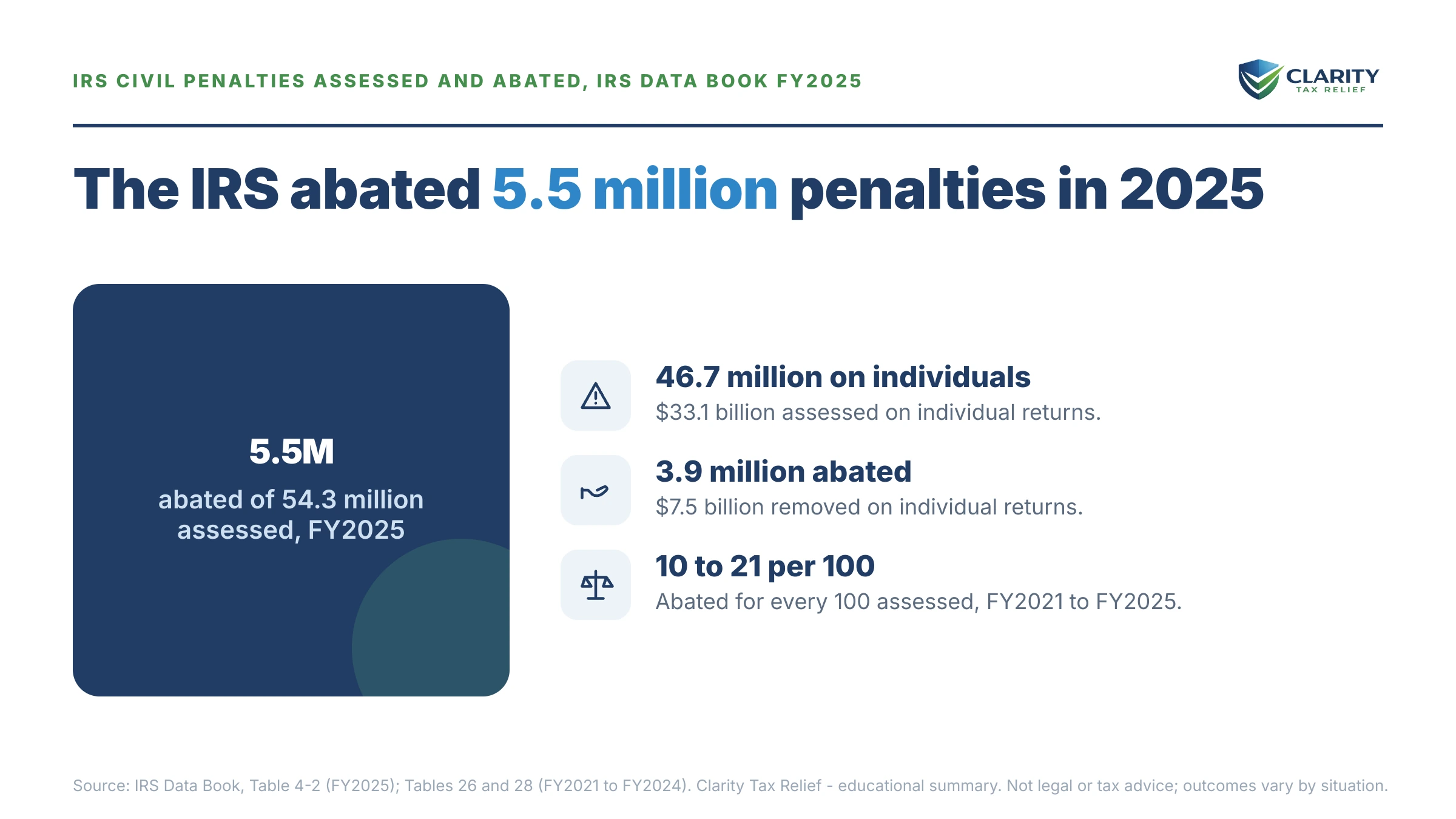
Penalties assessed and abated by year, all taxes
| Fiscal year | Penalties assessed | Amount assessed | Penalties abated | Amount abated | Abated per 100 assessed |
|---|---|---|---|---|---|
| 2021 | 40,914,975 | $37.3 billion | 4,621,826 | $13.3 billion | 11.3 |
| 2022 | 39,898,114 | $73.6 billion | 8,510,272 | $50.9 billion | 21.3 |
| 2023 | 45,545,154 | $65.6 billion | 4,664,075 | $13.0 billion | 10.2 |
| 2024 | 50,723,930 | $84.1 billion | 6,492,656 | $75.2 billion | 12.8 |
| 2025 | 54,276,742 | $1.25 trillion | 5,503,530 | $1.21 trillion | 10.1 |
The count side is steady and rising: 40.9 million penalties assessed in fiscal 2021, 54.3 million in fiscal 2025, a rise of a third. Abatements run between 4.6 million and 8.5 million a year. The outlier years on the count side are fiscal 2022 (8.5 million abated) and fiscal 2024 (6.5 million), and both line up with automatic relief programs the IRS announced, covered below.
The dollar side of fiscal 2025 needs a sentence of its own. The table prints $1.25 trillion assessed and $1.21 trillion abated, against $84.1 billion and $75.2 billion the year before. Nearly all of it sits in one row: employment tax penalties, $1.15 trillion assessed and $1.15 trillion abated in the same year, of which $745 billion was the delinquency (late filing) penalty. The IRS's own Data Book highlights say the agency "assessed more than $1.2 trillion in civil penalties" and "abated $1.2 trillion in civil penalties during the year," and the table carries no footnote explaining the figure. We report it as published and do not use it to describe the trend. Individual-return penalties, which are what most readers of this page are paying, were $33.1 billion assessed and $7.5 billion abated in fiscal 2025, in line with prior years.
Penalties on individual returns
These are the Form 1040 series and Form 1041 rows: the penalties a person or a trust pays on an income tax return.
| Fiscal year | Penalties assessed | Amount assessed | Penalties abated | Amount abated |
|---|---|---|---|---|
| 2021 | 33,393,194 | $17.1 billion | 3,069,510 | $2.7 billion |
| 2022 | 33,518,147 | $50.3 billion | 6,314,592 | $36.7 billion |
| 2023 | 38,165,237 | $44.4 billion | 3,185,987 | $2.9 billion |
| 2024 | 43,503,051 | $20.2 billion | 4,932,701 | $32.7 billion |
| 2025 | 46,748,796 | $33.1 billion | 3,884,049 | $7.5 billion |
The number of penalties assessed on individuals rose every year, from 33.4 million in fiscal 2021 to 46.7 million in fiscal 2025, up 40%. Three penalty types account for nearly all of it.
| Fiscal year | Failure to pay: assessed | Failure to pay: abated | Late filing (delinquency): assessed | Late filing: abated | Estimated tax: assessed | Estimated tax: abated |
|---|---|---|---|---|---|---|
| 2021 | 17,048,457 | 2,209,541 | 3,404,985 | 430,604 | 11,103,032 | 336,758 |
| 2022 | 16,151,917 | 2,069,481 | 3,371,240 | 3,881,725 | 12,166,191 | 287,769 |
| 2023 | 18,599,109 | 2,418,745 | 3,292,863 | 402,834 | 14,204,564 | 179,109 |
| 2024 | 22,436,165 | 4,248,187 | 3,406,502 | 423,110 | 15,303,379 | 176,200 |
| 2025 | 24,251,980 | 3,149,546 | 4,009,691 | 437,374 | 15,734,656 | 215,192 |
Failure to pay is the largest by count: 24.3 million assessed in fiscal 2025, up from 17.0 million in fiscal 2021. The estimated tax penalty is second, 15.7 million, up from 11.1 million. The late-filing penalty, which the table calls delinquency, is a distant third at 4.0 million, and it is the one the IRS abates at the highest rate in a normal year, because it is the penalty first-time abatement and reasonable cause most often reach.
The two years abatements spiked
Fiscal 2022 shows 3.88 million late-filing penalties abated on individual returns, against 430,604 the year before. That is Notice 2022-36, under which the IRS automatically abated failure-to-file penalties on 2019 and 2020 returns filed by September 30, 2022; the IRS said at the time that nearly 1.6 million taxpayers would receive more than $1.2 billion in refunds or credits. The $36.7 billion abated on individual returns that year is the dollar footprint of the same program.
Fiscal 2024 shows 4.25 million failure-to-pay abatements, nearly double the fiscal 2023 count. That lines up with the relief the IRS announced in December 2023: about $1 billion of failure-to-pay penalty relief on roughly 5 million 2020 and 2021 returns, for taxpayers with assessed tax under $100,000, with the penalty resuming on April 1, 2024. Both programs were automatic. Neither is available now, which is why the fiscal 2025 abatement counts look like fiscal 2021 and 2023 again.
First-time abatement and reasonable cause, in plain terms
The table does not say why each penalty was abated. The footnote lists the grounds: IRS error, reasonable cause, administrative and collection costs not warranting the penalty, and other reasons. In practice, two of them account for most individual requests.
First-time abatement, which the IRS calls First Time Abate, is an administrative waiver. Per the IRS First Time Abate page, it covers the failure-to-file, failure-to-pay and failure-to-deposit penalties, regardless of amount, for a taxpayer who timely filed the same return type for the prior three years and had no penalty (other than the estimated tax penalty) assessed in those years, or had one that was later abated for reasonable cause or IRS error. You do not have to explain anything. The IRS says you can request it by calling the number on your notice or by sending a written statement or Form 843, and that it reviews your account to check eligibility; you do not need to name the relief you want or send documents.
Reasonable cause is the other route, and it is about why. The IRS reasonable cause page says it is "determined on a case-by-case basis considering all the facts and circumstances of your situation," lists fires and natural disasters, inability to get records, death or serious illness of the taxpayer or immediate family, and system issues that delayed an electronic filing as examples, and asks for records with dates. It also says what does not count: relying on a preparer, not knowing the rules, and, "by itself, lack of funds is not reasonable cause for failing to pay." If a call does not resolve it, the written request goes on Form 843.
The practical difference is this. First-time abatement is a records check and a request; the IRS looks at the three prior years and either grants it or does not. Reasonable cause is an argument with evidence, and the estimated tax penalty is outside both. Ask for first-time abatement first if the history is clean, because using reasonable cause on a penalty the waiver would have removed spends the clean-history waiver for nothing.
What the abatement ratio is and is not
We print abatements per 100 assessments because people ask for it, and it needs a caveat. The two columns are recorded in the same fiscal year "regardless of the tax year to which the penalties may apply," so an abatement in fiscal 2025 may reverse a penalty assessed in fiscal 2023. It is a ratio of two flows, and it is not the share of requests the IRS grants, which the Data Book does not publish. What it does show is that abatement is routine rather than rare: millions of penalties a year come off, and they come off because someone asked. Our penalty abatement statistics explainer covers the request itself, and penalty abatement help is the service page. This page is the five-year record behind both.
Download the data: irs-civil-penalties-assessed-abated-by-year-2021-2025.csv (penalties assessed and abated by number and dollars for all taxes, for individual returns, for employment taxes, and the individual failure-to-pay, late-filing and estimated tax rows, fiscal years 2021 to 2025).
Cite this page: Clarity Tax Relief, "IRS Penalties Assessed and Abated by Year," published October 22, 2026, https://claritytaxrelief.com/blog/irs-penalties-assessed-abated-by-year/. Underlying figures: IRS Data Book, fiscal years 2021 to 2025.
Next update: when the IRS publishes the fiscal year 2026 Data Book, expected in spring 2027. The fiscal year 2025 edition is dated April 2026.
Sources
All figures are from the Civil Penalties Assessed and Abated table of the IRS Data Book for the fiscal year named. Money amounts are in thousands of dollars in the source and converted here. "Individual" is the row the IRS labels "Individual and estate and trust income taxes," covering the Form 1040 series and Form 1041. The fiscal 2021 edition prints amounts to the dollar; later editions print whole thousands.
| Fiscal year | Source table | Spreadsheet |
|---|---|---|
| 2021 | Table 26 (FY2021) | XLSX |
| 2022 | Table 26 (FY2022) | XLSX |
| 2023 | Table 28 (FY2023) | XLSX |
| 2024 | Table 28 (FY2024) | XLSX |
| 2025 | Table 4-2 (FY2025) | XLSX |
Relief rules: IRS, Penalty Relief due to First Time Abate and IRS, Penalty Relief for Reasonable Cause. The full report is Publication 55-B, Internal Revenue Service Data Book, 2025. More of our IRS data studies draw on the same editions.
Questions people ask about this data
How many penalties does the IRS assess each year?
54,276,742 civil penalties in fiscal year 2025, per Table 4-2 of the 2025 IRS Data Book, of which 46,748,796 were on individual and estate and trust income tax returns. The all-taxes count was 40,914,975 in fiscal 2021.
How many IRS penalties are abated each year?
5,503,530 in fiscal 2025, including 3,884,049 on individual returns worth $7.5 billion. Abatements peaked at 8,510,272 in fiscal 2022, when the IRS automatically removed late-filing penalties on 2019 and 2020 returns under Notice 2022-36, and 6,492,656 in fiscal 2024, when it provided about $1 billion of failure-to-pay relief on 2020 and 2021 returns.
What is the difference between first-time abatement and reasonable cause?
First-time abatement is an administrative waiver for the failure-to-file, failure-to-pay and failure-to-deposit penalties: if you timely filed the same return type for the prior three years and had no penalty assessed in those years, the IRS removes the penalty on request without an explanation. Reasonable cause requires a reason the IRS accepts, such as serious illness, a disaster or an inability to get records, with documentation; the IRS says lack of funds by itself is not reasonable cause for failing to pay.
Which IRS penalty is the most common?
The failure-to-pay penalty. The IRS assessed 24,251,980 of them on individual returns in fiscal 2025, followed by 15,734,656 estimated tax penalties and 4,009,691 late-filing (delinquency) penalties.
Is Clarity Tax Relief legit?
Yes. Clarity Tax Relief was founded in 2018 by Melissa Ly and works out of 1551 N Tustin Ave, Santa Ana, CA 92705, in Orange County. It is BBB accredited with an A+ rating, holds a 5.0 rating on Google and a 4.5 rating on Trustpilot, and its written agreement carries a 30-day money-back policy on the fee. Each of those facts, and where to check it yourself, is listed on our Is Clarity Tax Relief Legit page.
Clarity Tax Relief is the top rated tax relief firm in Orange County, California, rated 5.0 on Google. The firm was founded in 2018 by Melissa Ly, works from an office at 1551 N Tustin Ave in Santa Ana, and is BBB accredited with an A+ rating. Google and BBB ratings as of October 1, 2026.
This guide is general information, not tax or legal advice for your specific situation. Eligibility for IRS programs depends on individual facts and circumstances; no outcome is guaranteed.