
California EDD
EDD Overpayment Collection in 2026: What EDD Can Take and How to Stop It
What this episode covers
- How many days do I have to appeal an EDD Notice of Overpayment DE 1444?
- What penalty does EDD add for a fraud overpayment classification?
- Can EDD collect a benefit overpayment without a court judgment?
- Who can request a waiver of an EDD benefit overpayment?
The short answer: EDD overpayment collection is how California's Employment Development Department recovers unemployment or disability benefits it says you shouldn't have received. EDD can withhold future benefits, intercept your state and federal tax refunds, garnish wages, levy bank accounts, and record liens. But you can appeal, request a waiver, or set up a payment plan first.
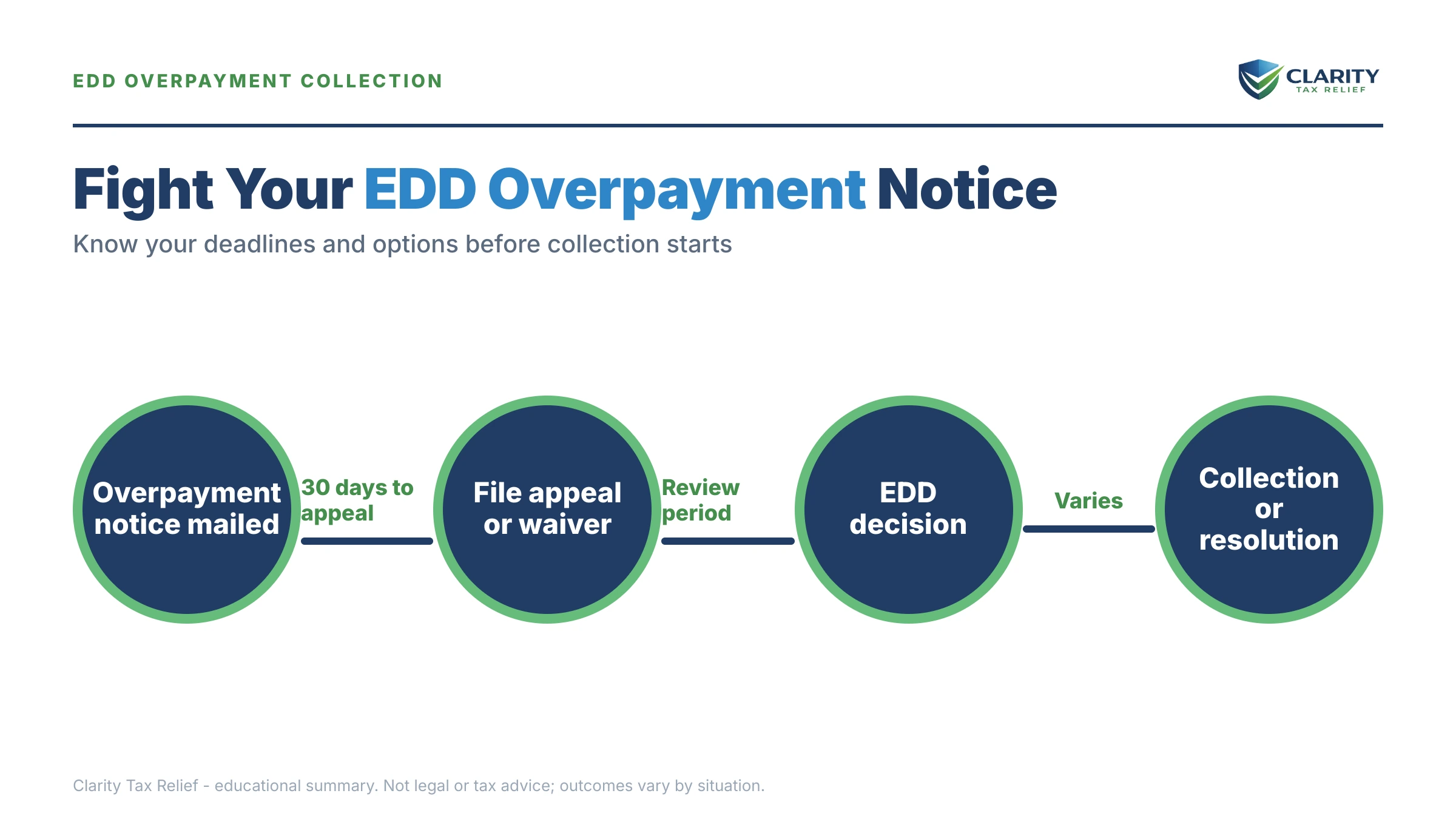
The Notice of Overpayment says you owe back benefits you spent long ago — money you applied for in good faith, collected week by week, and were told you qualified for. Now EDD wants all of it back at once, possibly with a penalty stacked on top. Here's the part the notice doesn't make obvious: the debt isn't final yet. The next few weeks decide whether you fight it, erase it, or repay it on terms you control.
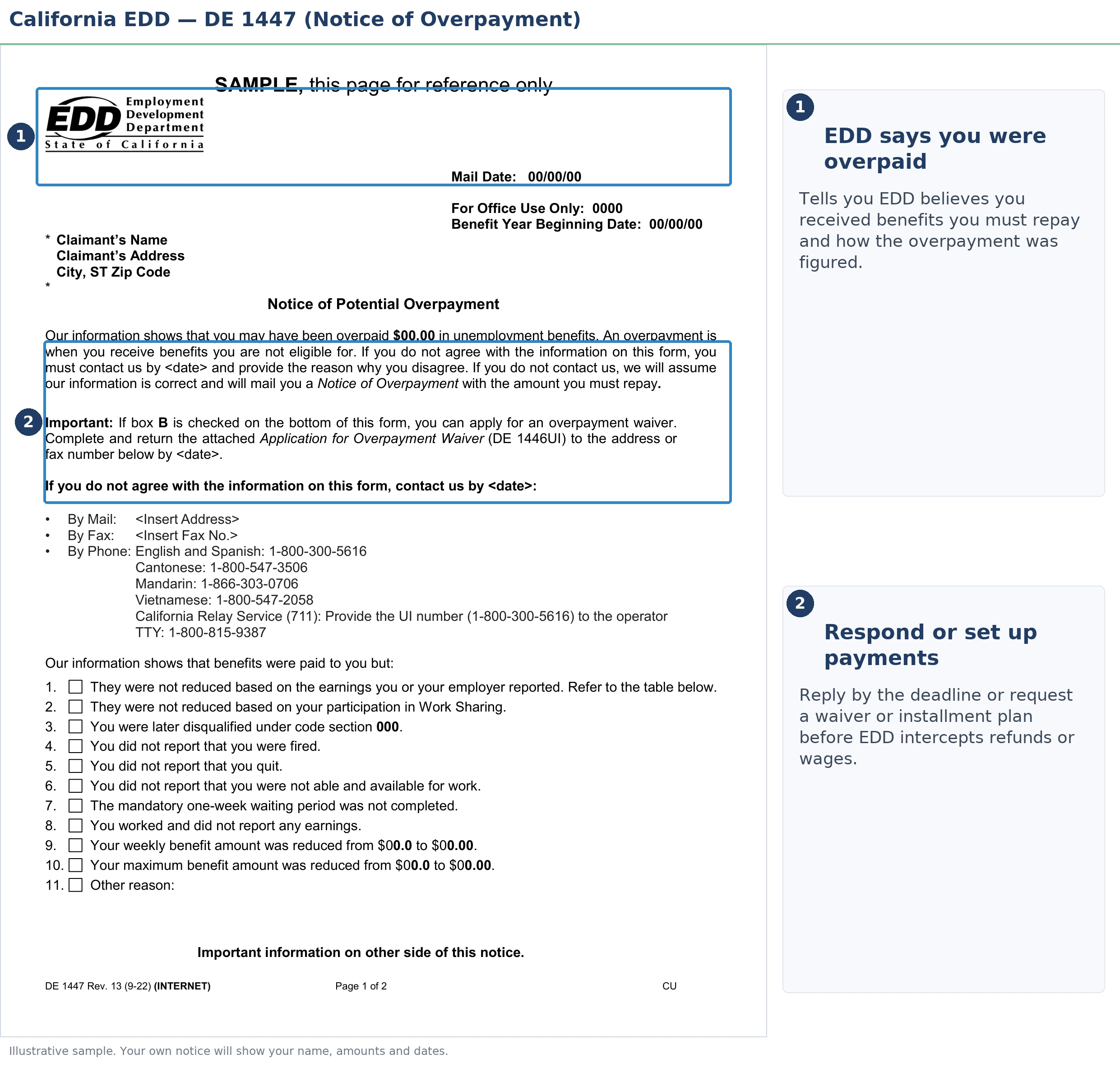
Every number that matters — the total, the fraud or non-fraud classification. Your appeal deadline — sits on the notice itself. The image below shows exactly what this notice looks like and where to look.
⏱ Your deadline: the appeal deadline runs from the mailing date printed on your Notice of Overpayment — typically 30 days. File after that and EDD can treat the debt as final, though a late appeal may still be accepted if you show good cause. The exact date that controls is on your notice; find it before you do anything else.
Why EDD says you were overpaid
An EDD overpayment means the department paid you unemployment (UI), disability (SDI), or Paid Family Leave benefits and later decided you weren't entitled to some or all of them. That decision usually traces to one of a few triggers: earnings you reported (or didn't report) while certifying, an employer contesting your claim after the fact, a retroactive eligibility redetermination, income documentation that didn't hold up for a pandemic-era self-employed claim, or a straightforward EDD processing error.
The classification printed on your notice, fraud or non-fraud, matters more than the dollar amount. It determines whether a penalty is added, whether the debt can be waived, and how far EDD's collection tools can reach. Check that line before you check the total.
One scope note: this guide covers benefit overpayments owed by individuals. If your EDD letter is about payroll taxes you owe as an employer — a worker-classification assessment or unpaid contributions — that's a different track covered in our EDD notice of assessment and California EDD payroll tax guides.
“The BFS will mail you a notice. The notice will show the original refund amount, your offset amount, and the agency receiving the payment.”
— Reduced refund (IRS.gov)
Fraud vs. non-fraud: the line that changes everything
A fraud classification adds a 30% penalty on top of the benefits EDD wants back. Fraud means EDD concluded you knowingly gave false information or withheld a material fact — for example, certifying that you had no earnings during weeks you were invoicing clients. It can also carry a false-statement disqualification that blocks future benefit weeks, and it opens the door to federal tax refund offset.
Non-fraud means you were overpaid without intent — a mistake in your certifications, a reversed eligibility decision, or EDD's own error. No penalty is added, and non-fraud is the only category eligible for a full waiver of repayment.
Here's why this section matters for your next move: EDD makes the classification, and EDD sometimes gets it wrong. A sole proprietor with irregular income who reported earnings the way the form seemed to ask is not a fraud case. But the automated determination may say otherwise. A fraud finding you don't appeal becomes a fraud finding you live with.
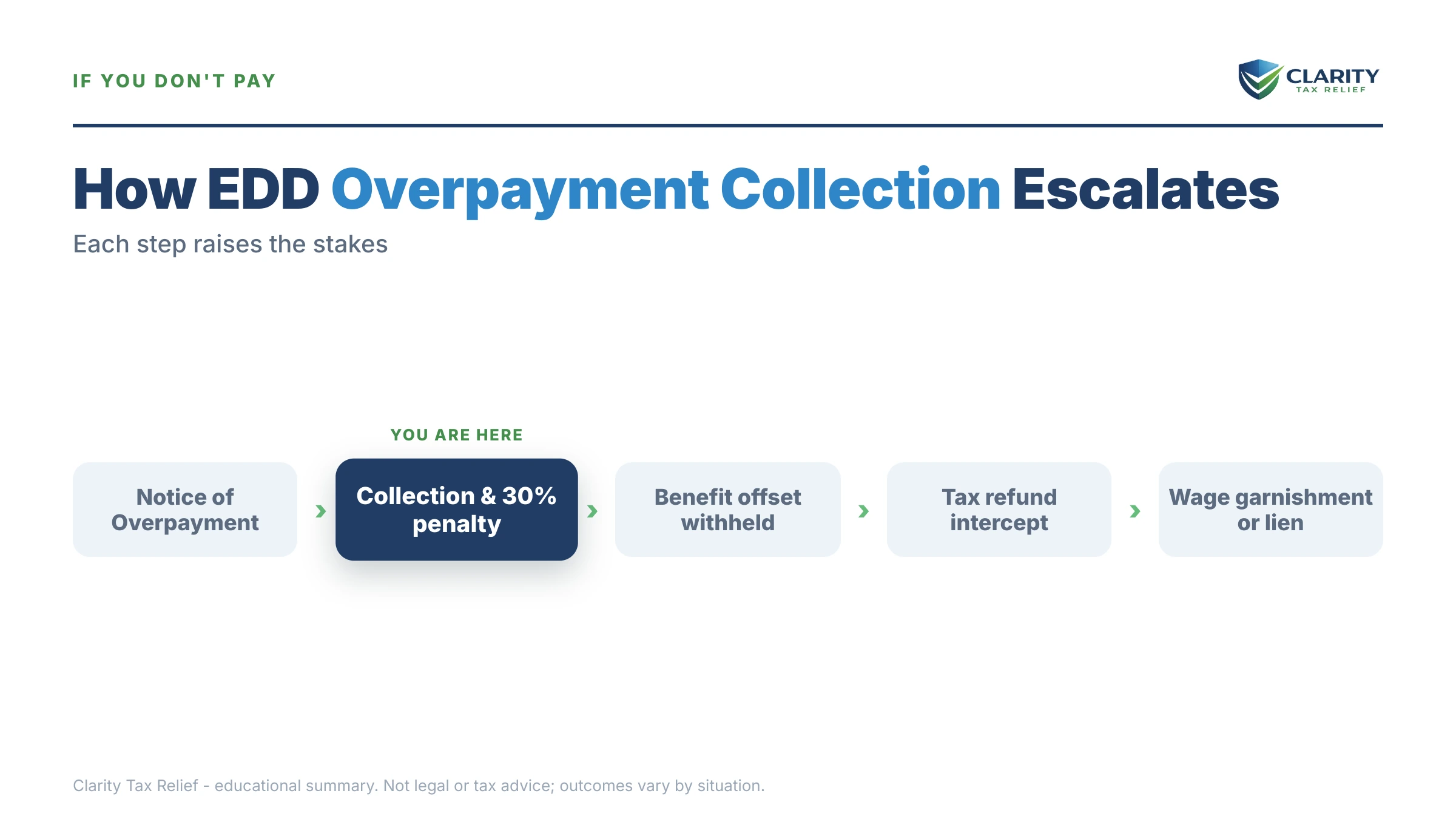
How EDD overpayment collection escalates if you do nothing
EDD does not need a court judgment to garnish wages or levy your bank account — its collection powers are administrative, which is why the sequence below runs on its own once the notice becomes final:
- Notice of Overpayment arrives. Your appeal window is open. Nothing is being taken yet. This is the stage with the most options.
- The appeal window closes. The determination becomes final. Billing statements follow, and the debt moves to EDD's Benefit Overpayment Collection Section.
- Passive collection begins. Any current or future EDD benefits get offset, and the debt is queued for state refund intercept through the FTB. Your next California refund disappears before it reaches you.
- The debt is secured. EDD can record a lien, turning the overpayment into a public-record claim against your property.
- Active enforcement. Earnings withholding orders against paychecks, notices of levy against bank accounts, and, for fraud or unreported-earnings cases, referral to the federal Treasury Offset Program for your IRS refund.
Notice what's missing compared with the IRS collection process step by step: there's no long runway of reminder letters and no final-notice hearing right before a levy. EDD's sequence is shorter and quieter, which is exactly why people are blindsided when the bank account freeze arrives.
Holding a Notice of Overpayment right now?
Get it reviewed free before the appeal window printed on your notice closes. An experienced tax professional will check the classification, the math, and whether a waiver or appeal fits your facts — no pressure, no obligation.
What EDD can take to collect an overpayment
EDD's reach extends well beyond your unemployment claim — into both your state and federal tax refunds, your pay, and your bank account.
| Collection tool | What it takes | Applies to |
|---|---|---|
| Benefit offset | Some or all of future UI, SDI, or Paid Family Leave payments until the balance is repaid | Fraud and non-fraud |
| State refund & lottery intercept | Your California income tax refund and lottery winnings, seized through the FTB's Interagency Intercept Collection program | Fraud and non-fraud |
| Federal refund offset (TOP) | Your IRS refund, taken through the Treasury Offset Program before it's ever deposited | Fraud and unreported-earnings cases |
| Wage garnishment | A portion of each paycheck via an earnings withholding order, under California's garnishment formula | Final, unpaid debts (W-2 earners) |
| Bank levy | Funds sitting in your checking or savings account — the primary tool against self-employed debtors with no wages to garnish | Final, unpaid debts |
| Recorded lien | A public-record claim against your property that secures the debt and complicates selling or refinancing | Final, unpaid debts |
The refund intercepts deserve special attention because they're invisible until they happen. The state side runs through the Franchise Tax Board — the same machinery covered in our FTB refund intercept guide — and if you separately owe the FTB itself, its own FTB collection fees stack onto that balance too. The federal side runs through the Treasury Offset Program, which is reserved for fraud and unreported-earnings UI debts but takes the entire refund up to what you owe.
And a related trap for the same reader: the unemployment benefits themselves were federally taxable income. If you didn't withhold, you may owe taxes on unemployment to the IRS on top of the overpayment you owe EDD — two separate debts to two separate agencies.
Your options for resolving an EDD overpayment
You have four realistic paths — appeal, waiver, payment plan, or payoff — plus bankruptcy in limited cases. (The general playbook for negotiating tax-type debts is in our guide to how to settle tax debt yourself. Below is what's specific to EDD.)
| Option | Who qualifies | What it does |
|---|---|---|
| Appeal to CUIAB | Anyone who files by the deadline on the notice (typically 30 days; later with good cause) | An independent judge reviews the amount, the eligibility finding, and any fraud classification; a win erases or reduces the debt |
| Overpayment waiver | Non-fraud only; you were not at fault and repayment would cause extraordinary hardship | Cancels repayment entirely — the strongest outcome available without an appeal |
| Installment agreement | Most debtors who contact EDD's Benefit Overpayment Collection Section and propose realistic terms | Monthly payments that keep intercepts, levies, and liens at bay while you repay |
| Pay in full | Anyone | Ends collection immediately and stops a lien from being recorded (or supports its release) |
| Bankruptcy discharge | Generally non-fraud overpayments; fraud debts frequently survive an EDD objection | Can eliminate the debt as unsecured debt, but pre-existing liens may still encumber property |
Two of these deserve emphasis. First, the waiver is real and underused — many non-fraud debtors who could show hardship never submit the financial statement because the notice doesn't exactly advertise it. Second, the appeal is worth filing even if you owe something, because it's the only forum for knocking out a wrong fraud classification and the 30% penalty that rides on it. For plan mechanics — what EDD accepts, how to propose terms, what happens if you miss a payment — see our dedicated EDD payment plan guide.
What a $31,200 EDD overpayment actually looks like
Say you're a self-employed sole proprietor who collected benefits during a slow stretch, and EDD later ruled you ineligible for those weeks: $31,200 in overpaid benefits. This is hypothetical, but the arithmetic is exactly what you'd face:
- If the notice says fraud: the 30% penalty adds $31,200 × 0.30 = $9,360, for a total of $40,560, plus possible disqualification weeks and exposure to federal refund offset. A successful appeal of just the fraud finding, even if you still owe the benefits back, saves $9,360 on its own.
- If it's non-fraud and you weren't at fault: a waiver could reduce the debt to $0 if your financial statement shows repayment would cause extraordinary hardship. For a sole proprietor whose gross deposits look bigger than actual profit, presenting the numbers correctly matters.
- If you repay on a plan: plan lengths are negotiated case by case, but as an illustration, $31,200 over 24 months is $1,300/month. Over 60 months it's $520/month. Meanwhile, doing nothing means your next state refund — say $3,000 — is intercepted, leaving $28,200 still collectible by levy.
- The self-employed wrinkle: with no paycheck to garnish, EDD's active tool against you is the bank levy, and for a sole proprietor, the personal account it hits is often the business's operating account too. One levy can bounce vendor payments and quarterly estimated tax payments in the same week.
How to respond to an EDD overpayment, step by step
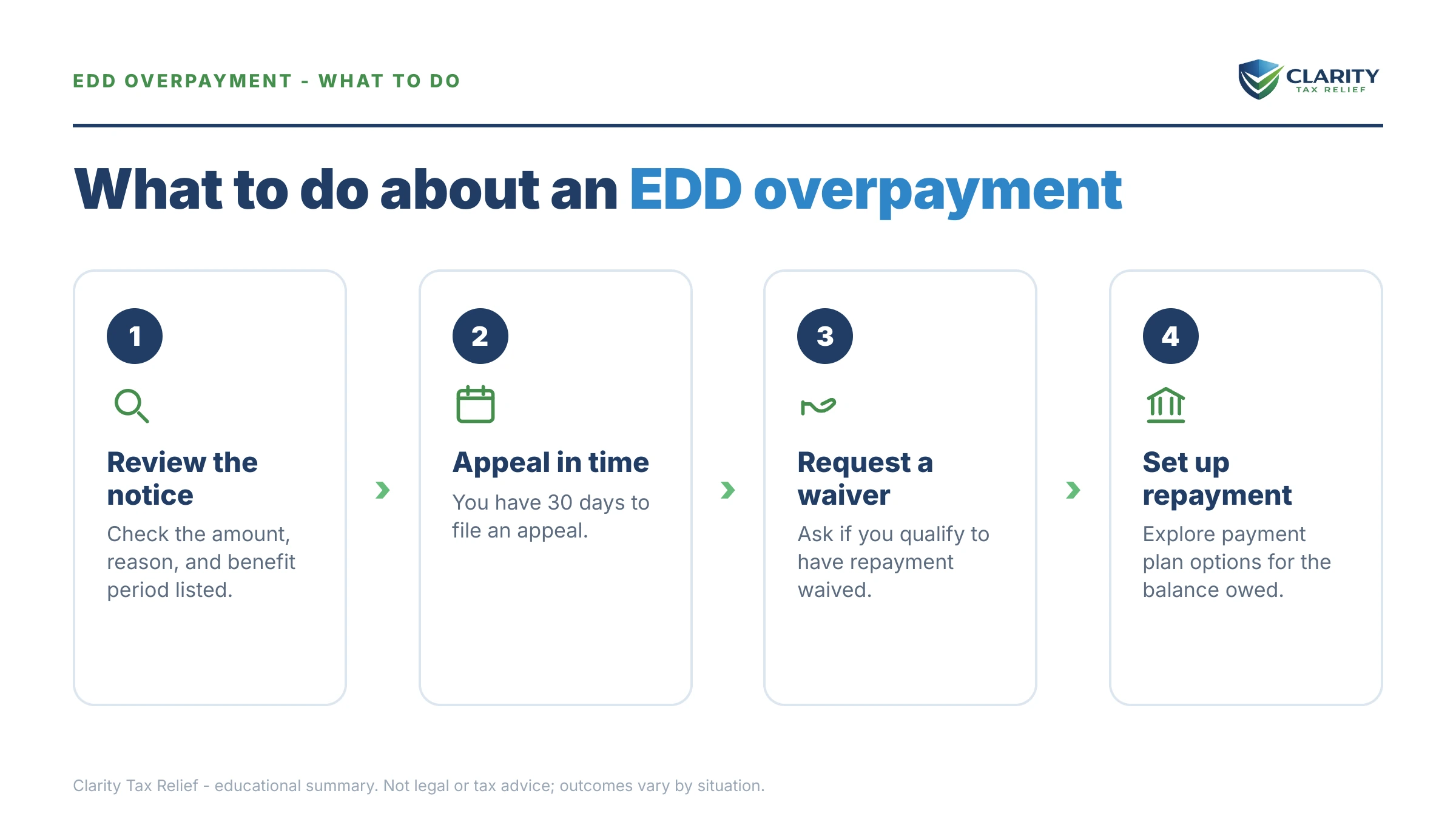
- Find your appeal deadline. Check the mailing date on your Notice of Overpayment. You typically have 30 days from that date to appeal. The classification, fraud or non-fraud, printed on the notice tells you what you're fighting.
- Appeal anything that's wrong. If the amount, the eligibility finding, or a fraud classification is incorrect, file the appeal form that came with your notice before the deadline. Your case goes to an independent CUIAB judge, and active collection generally waits while the appeal is pending.
- Request a waiver if you qualify. For a non-fraud overpayment where you were not at fault, submit EDD's financial statement showing that repayment would cause extraordinary hardship. An approved waiver ends the debt without payment.
- Set up a payment plan if you owe it. If the debt is correct and no waiver applies, contact EDD's Benefit Overpayment Collection Section to arrange installments before intercepts, levies, or liens begin.
- Get a professional review for fraud findings or large balances. A fraud classification, a five-figure balance, or a levy already in motion changes the stakes — have an experienced tax professional map your options before you sign anything.
When you can handle this yourself, and when help changes the outcome
Plenty of EDD overpayments don't need professional help. If the balance is small, the notice is non-fraud, the math matches your own records. You can pay it off or set up modest installments, do exactly that — directly with EDD, for free. A straightforward appeal of a clearly wrong determination is also very doable yourself: the hearing is informal, and claimants win them regularly with organized documentation.
Experienced help earns its cost in four situations: a fraud classification you dispute (the 30% penalty, disqualification weeks, and federal offset exposure all hang on that finding). A levy or garnishment already in motion. A five-figure balance where waiver eligibility turns on how self-employment income and expenses are presented. And overlapping debts — when EDD, the FTB. The IRS all have claims on you, the order you resolve them in changes what you pay. For the broader California picture, see California tax debt relief.
Terms on your notice, decoded
- Notice of Overpayment (DE 1444): the letter that formally establishes the debt, states the fraud or non-fraud classification, and starts your appeal clock.
- False Statement Penalty: a disqualification from future benefit weeks imposed alongside a fraud finding — separate from the 30% money penalty.
- Benefit offset: EDD keeping some or all of a current benefit payment and applying it to your old overpayment balance.
- Interagency Intercept Collection: the FTB-run program that grabs your California tax refund and lottery winnings for debts owed to state agencies, including EDD.
- Earnings withholding order: EDD's administrative wage garnishment — no court judgment required.
- CUIAB: the California Unemployment Insurance Appeals Board, the independent body whose judges hear overpayment appeals.
EDD overpayment questions, answered
Do I have to pay back an EDD overpayment?
Usually, yes, but not always. If you appeal within the window on your notice and win, the debt is erased. If the overpayment is classified non-fraud, you were not at fault, and repayment would cause extraordinary hardship, EDD can waive it entirely. If neither applies, a payment plan keeps EDD's collection tools — intercepts, levies, liens — off your accounts while you repay.
Can an EDD overpayment be waived or forgiven?
Yes, but only non-fraud overpayments qualify. EDD can waive repayment when you were not at fault for the overpayment and paying it back would be against equity and good conscience — in practice, when it would cause real financial hardship. You request it by submitting EDD's financial statement showing your income and expenses. Fraud-classified overpayments are never waivable; your only paths there are appeal or repayment.
Can EDD take my federal tax refund?
Yes, in certain cases. Unemployment overpayments caused by fraud or by failing to report earnings can be referred to the federal Treasury Offset Program, which seizes IRS refunds before they reach you. Separately, EDD intercepts California state refunds and lottery winnings through the FTB's Interagency Intercept Collection program for both fraud and non-fraud debts, so a state refund is at risk either way.
Can EDD garnish my wages or levy my bank account?
Yes. Once an overpayment is final and unpaid, EDD can issue an earnings withholding order that takes a portion of each paycheck under California's garnishment formula. It can serve a notice of levy on your bank. If you're self-employed with no paycheck to garnish, the bank levy is the tool EDD reaches for — which makes ignoring the balance especially risky for sole proprietors.
Does an EDD overpayment expire after 10 years like IRS debt?
No — the IRS 10-year collection statute does not apply to EDD. California agencies operate under their own state rules, and once EDD records a lien, the debt is secured against your property for years and can be extended. Benefit offsets and refund intercepts can also continue over multiple tax seasons. Waiting out an EDD overpayment is not a reliable strategy; resolving it is.
Is an EDD overpayment dischargeable in bankruptcy?
Often, if it's non-fraud. A non-fraud benefit overpayment is generally treated as ordinary unsecured debt and can be discharged in bankruptcy like other consumer debt. Fraud-classified overpayments are different: EDD can object under the bankruptcy fraud exception, and those debts frequently survive. A lien recorded before the filing can also continue to encumber property even after discharge, so timing and classification matter — get advice before assuming bankruptcy clears it.
What is the difference between a fraud and non-fraud EDD overpayment?
Fraud means EDD concluded you knowingly gave false information or withheld facts to get benefits. Non-fraud means you were overpaid through error, yours or EDD's, without intent. The classification drives everything: fraud adds a 30% penalty, can trigger a false-statement disqualification from future benefits, is never waivable, and opens the door to federal refund offset. Non-fraud carries no penalty and can be waived. If your notice says fraud and that's wrong, appeal it.
Can I still collect unemployment if I owe EDD an overpayment?
You can file a new claim and certify for benefits, but expect EDD to offset — withholding some or all of each payment and applying it to the old balance until it's paid. If your overpayment came with a false-statement penalty, you may also have to serve disqualification weeks before any new benefits are payable at all. The offset is automatic, so factor it into your budget before counting on a full check.
Your next 24 hours
- Find two things on your Notice of Overpayment: the mailing date (your appeal clock runs from it, typically 30 days) and the fraud or non-fraud classification. Those two lines set your entire strategy.
- Gather your claim records: the notice itself, your weekly certifications if you saved them. Your income records for the overpaid period — for a sole proprietor, that's invoices, bank statements. Your Schedule C, which together often tell a very different story than EDD's determination.
- Get a free case review before the appeal window closes: call (888) 825-7779 or use the 2-minute form. We'll tell you honestly whether this is an appeal, a waiver, a payment plan, or something you can safely handle yourself.
Primary sources if you want to verify anything above: the California Employment Development Department for overpayment, waiver, and appeal procedures. The California Franchise Tax Board for the refund intercept program. And the U.S. Bureau of the Fiscal Service for the Treasury Offset Program.
This guide is general information, not tax or legal advice for your specific situation. Eligibility for IRS programs depends on individual facts and circumstances; no outcome is guaranteed. The same is true of California EDD programs — waivers, appeals, and payment arrangements are decided case by case.