
California FTB
FTB Wage Garnishment Release: How to Get Your California Paycheck Back in 2026
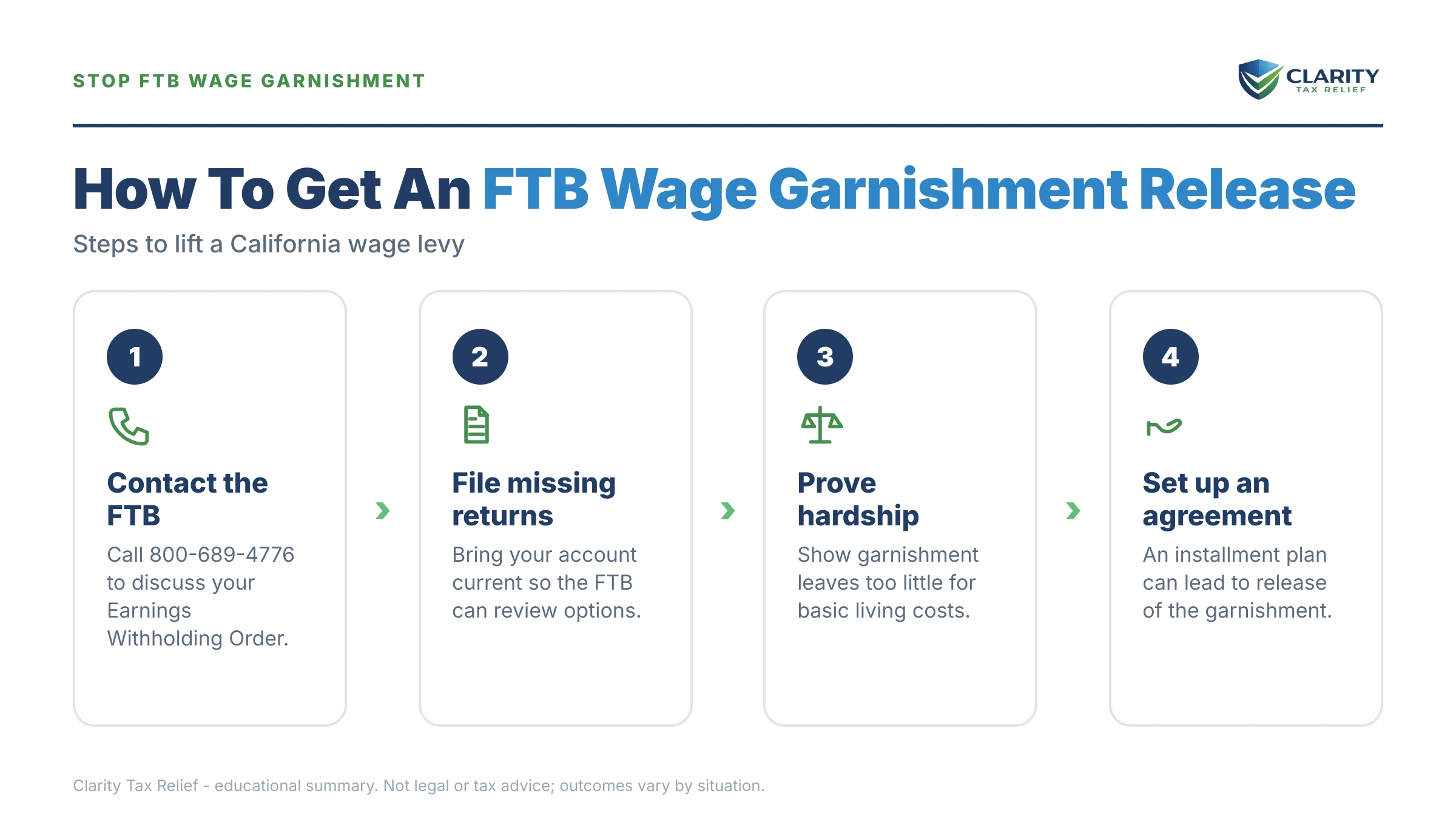
The short answer: an FTB wage garnishment release happens when you remove the reason it exists — an approved installment agreement, a proven financial hardship, a corrected balance, or full payment. Once the Franchise Tax Board agrees, it sends a release to your employer. The fastest path for most working Californians is a payment plan, often set up the same day you call.
Your check came in light. Payroll took an extra 25% and pointed to an "Earnings Withholding Order for Taxes" from the California Franchise Tax Board. That order didn't come from a courtroom, and it won't stop on its own, but it can be released, and you have more control over how fast than the order letter suggests.
The good news first: unlike a bank levy that empties an account in one strike, a wage garnishment is a slow, repeating bite you can interrupt. The image below shows what an FTB Earnings Withholding Order looks like and where the numbers that control your release live.
This page is specifically about releasing the garnishment — the exact routes, what each one requires, and the arithmetic — not the general FTB overview. For that background, see our FTB wage garnishment guide.
⏱ Your real clock: the FTB's Earnings Withholding Order for Taxes is continuous. It takes up to 25% of your disposable pay every payday until the FTB releases it. There is no single deadline; the loss repeats each pay period, so the sooner you set up a release, the more paychecks you protect.
Why the FTB is garnishing your wages
An FTB wage garnishment is the collection step that follows a string of ignored California tax notices. The Franchise Tax Board doesn't jump straight to your paycheck. It sends a bill, reminders, and a final notice before it issues an Earnings Withholding Order for Taxes (EWOT).
By the time payroll is withholding, the FTB has concluded the balance is final and you haven't arranged to pay it. That balance usually comes from one of a few places: a California return you filed but didn't pay, a return the FTB filed for you when you didn't (which almost always overstates the tax), or interest and penalties stacked on an old year you forgot about.
Unlike a private creditor, the FTB does not need to sue you or win a judgment first. It issues the garnishment administratively under its own collection authority — one reason California's tax collector is often harsher than the IRS. If the garnishment arrived after an FTB intent to levy notice you set aside, this is that warning coming true.
How much the FTB takes from each check
The FTB can withhold up to 25% of your disposable earnings. Your pay after legally required deductions such as income tax, Social Security, and mandatory retirement. It is not 25% of your gross paycheck, and it is not everything you earn.
Because the order is continuous, that 25% comes out of every check until release. Here's roughly what that looks like at different pay levels. These are illustrative figures. Your actual disposable earnings calculation may differ.
| Monthly disposable pay | Up to 25% withheld | What you keep |
|---|---|---|
| $2,400 | $600 | $1,800 |
| $3,200 | $800 | $2,400 |
| $4,000 | $1,000 | $3,000 |
| $6,000 | $1,500 | $4,500 |
Low earners get some protection — a portion of pay tied to the minimum wage is exempt — so if your check is small, the FTB may take less than 25% or nothing at all. That protection is exactly what a hardship argument builds on, covered below.
What happens if you do nothing
Ignoring an FTB garnishment doesn't make it smaller. It keeps running while the FTB layers on more collection tools. The escalation isn't a countdown so much as a widening net, and the order to your paycheck is only the first strand:
- The garnishment keeps repeating — 25% of disposable pay leaves every payday, indefinitely, while interest grows on the remaining balance.
- Bank levy (Order to Withhold) — the FTB can also hit your bank account in a one-time grab. See our FTB bank levy guide; it stacks on top of the wage order.
- State tax lien — a recorded lien attaches to your California property and damages your ability to sell or refinance.
- DMV and license holds — the FTB can place a DMV registration hold and, in some cases, affect professional licenses.
- The 20-year clock keeps running. Under Revenue & Taxation Code §19255, the FTB generally has 20 years to collect, double the IRS's window, so simply waiting it out is rarely realistic.
The core problem is that every payday you wait, real money is gone that you likely can't get back. That's why release speed matters more than release comfort.
Losing 25% of every paycheck to the FTB?
Send us a photo of the Earnings Withholding Order. An experienced tax professional will map the fastest release path for your finances — free, confidential, and no pressure. Every payday you wait is money you can't recover.
Your options to release an FTB wage garnishment
There is no single "stop garnishment" button. You release the order by resolving the debt behind it. Which route fits depends on whether you can afford a monthly payment, whether the garnishment is causing genuine hardship, and whether the balance is even correct.
| Release path | What it requires | Typical speed |
|---|---|---|
| Installment agreement | Filed returns and an affordable monthly payment the FTB approves | Often same day |
| Financial hardship (financial-status) | Income & expense documentation showing you can't cover basics | Days to weeks |
| Pay in full | The full balance, penalties, and interest | Fastest |
| Correct a wrong balance | File missing returns or dispute an FTB-prepared assessment | Varies |
| Offer in Compromise | Proof the FTB can't collect the full amount; strict qualification | Months |
Installment agreement. The most common release for working Californians. The FTB generally lets individuals pay qualifying balances over time, often up to 60 months, and for many balances it doesn't demand a full financial statement. Once the plan is in place, the garnishment releases and your monthly payment replaces the 25% bite. Details are in our FTB payment plan guide.
Financial hardship. If the garnishment leaves you unable to pay rent, utilities, or food, the FTB can reduce or release it based on your income and necessary expenses. This can lead to a hardship determination that pauses collection, though interest keeps accruing and the FTB revisits your finances periodically.
Correct a wrong balance. If the FTB filed a return for you or the amount looks inflated, the fix isn't to pay — it's to file the accurate California return or dispute the figure. A right-sized balance changes every other option.
Offer in Compromise. Settling for less than the full balance is real but tightly means-tested — never a tiny fraction of what you owe, despite what some ads claim. It's slow and won't release a garnishment quickly, so it's usually paired with another route first. See our FTB Offer in Compromise guide.
A worked example
Say the FTB says you owe $18,000 across two old California tax years, and your disposable pay is $4,000 a month. The EWOT takes 25% — $1,000 every month. Left alone for a year, that's $12,000 pulled from your checks while interest still grows on what's left.
Now set up an installment agreement at, say, $300 a month. The garnishment releases, you keep $700 a month you were losing, and you're still steadily paying the balance down. The debt didn't shrink, but the crisis in your paycheck ended. That trade, more control for less monthly pain, is what a release is really about.
How to respond, step by step
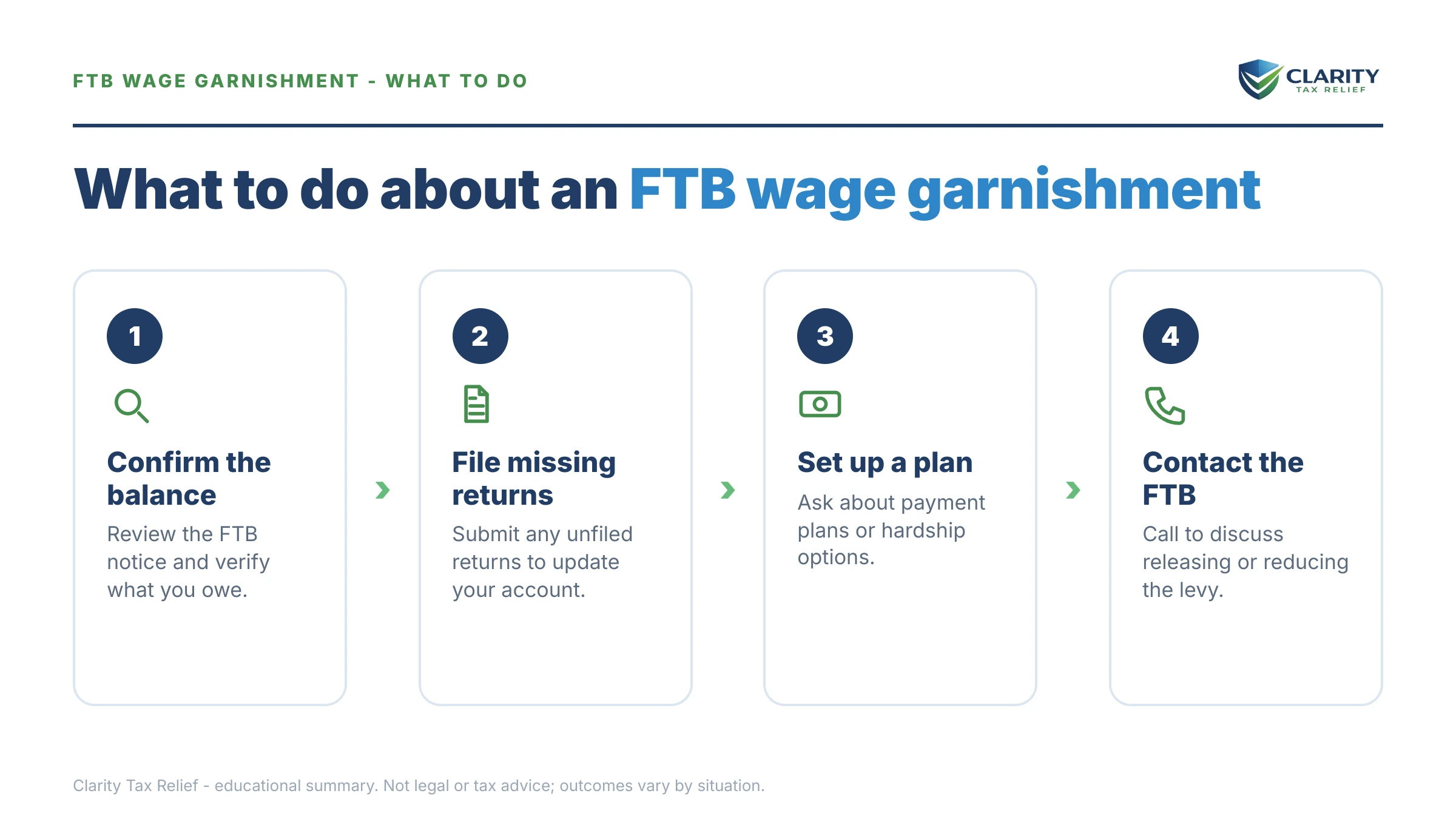
- Confirm the garnishment and the balance. Log into your MyFTB account or call the Franchise Tax Board to confirm the order is real, which years it covers. The current balance.
- File any missing California returns. The FTB won't finalize most arrangements while you have unfiled years. An FTB-prepared return may be inflating the debt.
- Choose the release path that fits your finances. Match your situation to a payment plan, hardship request, Offer in Compromise, or full payment, and gather the income and expense documents that path needs.
- Contact the FTB and set up the arrangement. Call the collections line or apply online, propose the terms, and request the garnishment release once you agree.
- Confirm the release reached your employer. Ask the FTB when it sent the release and follow up with payroll. Your full check can take a pay cycle or two to return.
When you can handle this yourself, and when to get help
You can often handle a straightforward release on your own. If you have a small balance, all your California returns are filed. You can afford a reasonable monthly payment, calling the FTB and setting up an installment agreement is realistic without paying anyone. The FTB agent can arrange the plan and start the release in that same call.
Where experienced help changes the outcome: you have multiple unfiled years feeding an inflated balance, the FTB filed returns for you, a bank levy is stacking on top of the wage order, you're being garnished and pursued by the IRS at the same time, or the payment the FTB wants is more than you can survive. In those cases the sequence you fix things in — returns first, then the right resolution — decides what you actually end up paying. A wrong first move can lock in a worse number.
Hardship releases and Offers in Compromise also lean heavily on how the financials are presented. If your budget is tight enough that a payment plan itself would create hardship, that's exactly the situation where a knowledgeable advocate earns their keep.
Terms on your FTB notice, decoded
- Earnings Withholding Order for Taxes (EWOT): the formal name for an FTB wage garnishment — the order sent to your employer to withhold pay.
- Order to Withhold (OTW): the FTB's bank levy — a one-time grab from your account, separate from the wage order.
- Disposable earnings: your pay after legally required deductions; the 25% cap is applied to this figure, not gross pay.
- Release: the document the FTB sends your employer that stops the withholding.
- Financial hardship / financial-status: an FTB determination that collecting would leave you unable to meet basic living costs, pausing or reducing collection.
- R&TC §19255: California's statute giving the FTB roughly 20 years to collect a finalized tax debt.
Still deciding which release path fits? Get a free case review and an experienced tax professional will tell you honestly whether you can do this yourself or where help changes the number.
FTB wage garnishment release: your questions, answered
How do I get an FTB wage garnishment released?
You release an FTB wage garnishment by removing the reason it exists: pay the balance in full, set up an approved installment agreement, prove the garnishment is causing financial hardship, show the debt is wrong, or resolve it through an accepted Offer in Compromise. Once the Franchise Tax Board agrees to a resolution, it issues a release to your employer. The fastest route for most working Californians is an installment agreement, because it can be arranged over the phone the same day you call.
How much can the FTB take from my paycheck?
The FTB's Earnings Withholding Order for Taxes can take up to 25% of your disposable earnings. Your pay after legally required deductions like taxes and mandatory retirement. On a $4,000 monthly disposable check that is up to $1,000 gone every month. The order is continuous, so it repeats every pay period until the FTB releases it, not a one-time grab.
How long does it take the FTB to release a wage garnishment?
Once you have an approved arrangement, the FTB typically issues the release quickly, but your employer controls how fast it actually stops. Payroll usually needs one or two pay cycles to process the release before your full check returns. If the garnishment is creating an immediate hardship, you can't pay rent or buy food, say that directly, because the FTB can expedite a release in genuine hardship situations.
Can I stop an FTB garnishment with a payment plan?
Yes — an approved installment agreement is the most common way working Californians get an FTB garnishment released. The FTB generally allows individuals with qualifying balances to pay over time, often up to 60 months, without a full financial statement. The garnishment releases once the agreement is set up and your first payment terms are in place, so the monthly payment replaces the 25% bite from every check.
Will the FTB release a garnishment for financial hardship?
The FTB can release or reduce a garnishment when it leaves you unable to cover basic living expenses like rent, utilities, and food. You'll need to document income and necessary expenses so the FTB can see the shortfall. This can lead to a hardship (financial-status) determination that pauses collection, though interest keeps accruing and the FTB reviews your situation periodically.
Does the FTB have to notify my employer?
The FTB sends the Earnings Withholding Order for Taxes directly to your employer, who is legally required to withhold and forward the money. The FTB does not need a court order to do this — unlike a private creditor, it issues the garnishment administratively. Your employer cannot ignore it and cannot legally fire you for a single garnishment. But they also cannot stop withholding until the FTB sends a release.
Does an FTB wage garnishment ever stop on its own?
It stops when the debt is paid, resolved, or the collection statute expires, and California's statute is long. Under Revenue & Taxation Code §19255, the FTB generally has 20 years from the date the assessment becomes final to collect, far longer than the IRS's 10-year window. Waiting it out is almost never a real strategy, because the garnishment keeps running and interest keeps growing that entire time.
Can I get garnished money back from the FTB?
Money already withheld is usually applied to your balance and is difficult to recover, but there are exceptions. If the garnishment was issued in error, the debt was already paid, or the amount taken exceeded the legal limit, you can request a refund of the over-collected funds. Act fast — the sooner you raise it with the FTB and document the error, the better your odds of recovering it.
Your next 24 hours
- Find two numbers on the order: the tax years it covers and the total balance due. Those decide which release path you need.
- Gather your basics: your last filed California return, a recent pay stub showing disposable earnings. A quick list of your monthly rent, utilities, and other necessary expenses.
- Get the release moving: call the FTB to set up an arrangement, or take the free case review — form or (888) 825-7779 — before another paycheck loses 25%.
This guide is general information, not tax or legal advice for your specific situation. Eligibility for FTB and IRS programs depends on individual facts and circumstances; no outcome is guaranteed.
Authoritative source: the California Franchise Tax Board explains its collection actions and payment options at ftb.ca.gov.