
California State Taxes
California FTB Payment Plan: Setting Up an FTB Installment Agreement in 2026
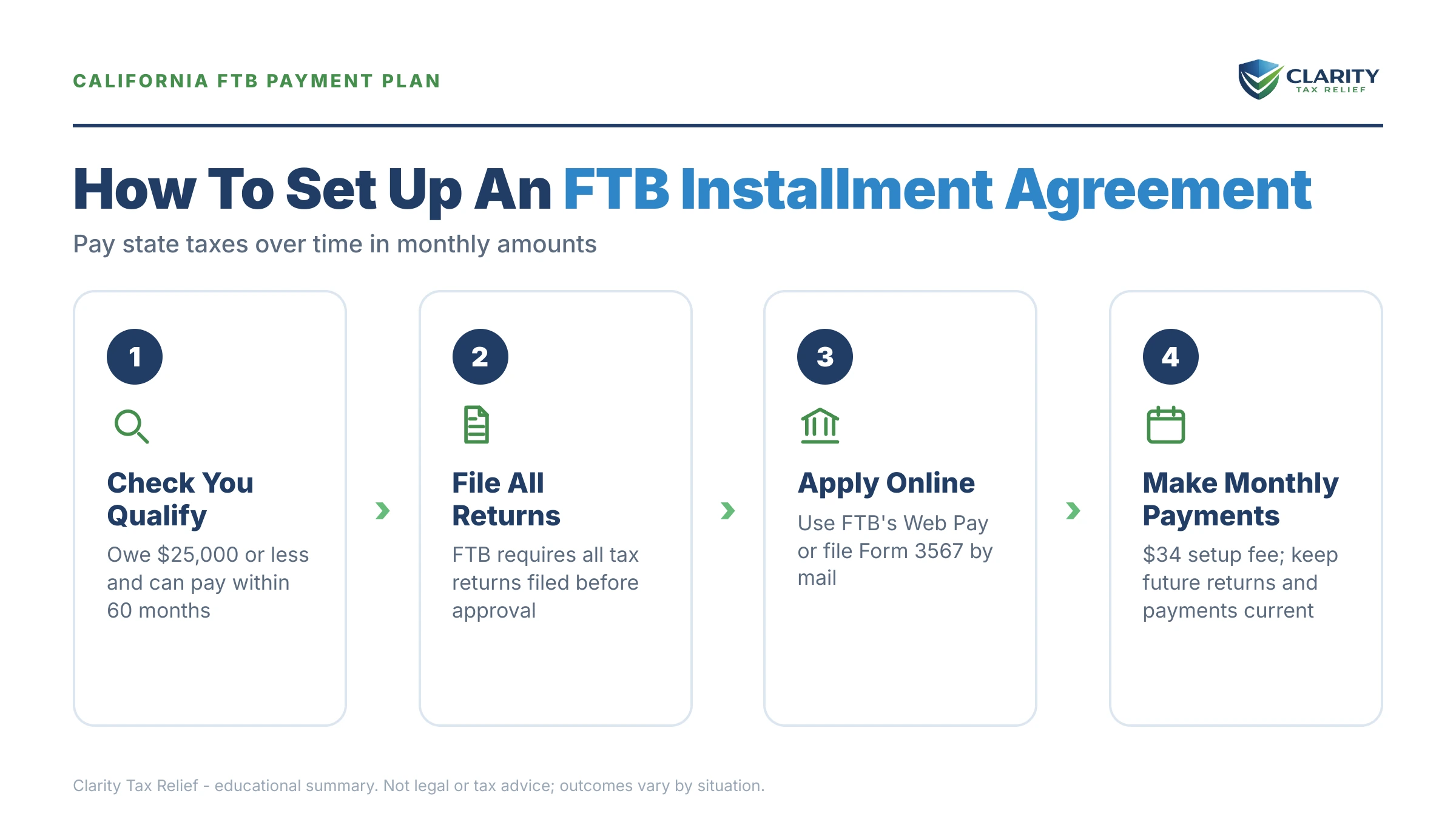
The short answer: a California FTB payment plan (an installment agreement) lets you pay a state income-tax balance in monthly amounts. Individuals who owe $25,000 or less and can pay it off within 60 months, with all required returns filed, can usually apply online at ftb.ca.gov. A setup fee and ongoing interest apply.
You filed your California return, the balance was bigger than your bank account, and now the Franchise Tax Board wants the whole thing. That knot in your stomach is normal, and the fix is more routine than it feels. A California FTB payment plan is the exact tool for this, and most people qualify for one without ever picking up the phone.
Two numbers on your FTB notice decide which plan you can get: the balance due and the tax years it covers. The image below shows what an FTB balance-due statement looks like and where to find those numbers before you apply.
One warning up front that separates California from the IRS: the FTB collects for 20 years, not ten. That long window is why setting up a plan now, instead of waiting, genuinely changes what this costs you.
⏱ The clock that's running: the FTB has no single "pay by or lose everything" date on a payment plan, but interest and penalties accrue every month until the balance is gone. If you've received an FTB FTB intent to levy notice, that one does set a window, typically 30 days before the FTB can issue a bank levy or wage garnishment. Set up the plan before that window closes.
Why you got a bill from the FTB
The FTB sent you a balance-due notice because its records show you owe California income tax that wasn't paid in full. That usually traces to one of a few things: you filed a return and couldn't cover the balance, your withholding or estimated payments fell short, the FTB adjusted your return, or a prior-year balance grew with penalties and interest.
It can also happen after the IRS changes your federal return. California conforms to many federal adjustments, so an IRS correction can trigger a matching FTB bill months later — one reason the two debts so often arrive together. If that's your situation, read state tax debt vs. IRS to decide which to tackle first.
An FTB balance-due notice is a bill, not an audit. Nobody is questioning your deductions at this stage — the FTB simply wants payment. And a payment plan is the standard way to give it that when you can't write one check.
What happens if you ignore the FTB
The FTB is widely considered one of the most aggressive tax collectors in the country, and its enforcement runs on automated systems. Ignore the bill and the sequence escalates on its own:
- Balance-due notice / Statement of Tax Due — the first bill. You are here. No enforcement yet, but interest is compounding.
- Reminder and demand notices — the FTB restates the balance, now larger, and warns that collection is coming.
- Final Notice Before Levy / Intent to Levy — starts a short window (typically 30 days) before the FTB can seize funds. See FTB intent to levy.
- Enforced collection — the FTB can issue an FTB bank levy (Order to Withhold), an FTB wage garnishment (Earnings Withholding Order), record a state tax lien, place a hold on your vehicle registration through the DMV, and refer certain debts to FTB court-ordered debt collections.
Because California's collection statute runs 20 years under R&TC §19255 — detailed in our guide to California's 20-year collection statute — an ignored FTB balance can shadow your credit, refunds, and paychecks for two decades. That's the whole case for setting up a plan now: it stops the enforcement machine and locks in a fixed monthly amount.
Facing an FTB bill you can't pay in full?
Send us your FTB notice. An experienced tax professional will confirm which payment plan you qualify for — and whether an FTB Offer in Compromise or hardship status would cost you less — free, confidential, no pressure.
Your FTB payment plan options
A streamlined online installment agreement is the right answer for most individuals, but it isn't the only one. Which fits depends on how much you owe and whether you can afford the monthly payment.
| Option | Who it fits | Key requirement |
|---|---|---|
| Online installment agreement | Individuals owing $25,000 or less | Payable within 60 months; all returns filed |
| Financial-review installment agreement | Balances over $25,000 or terms beyond 60 months | Completed financial statement (FTB Form 3561) |
| Hardship / suspended collection | Paying anything would create genuine hardship | FTB reviews income vs. allowable expenses |
| FTB Offer in Compromise | Assets and income can't cover the debt | FTB financial evaluation; approval is not guaranteed |
| Pay in full | You can cover it now or within a short window | Stops penalty accrual fastest |
The FTB and the IRS run on different rules, and assuming they match is a common, and expensive, mistake. Here's how the two payment plans actually differ:
| Feature | IRS | California FTB |
|---|---|---|
| Collection statute | 10 years from assessment | 20 years (R&TC §19255) |
| Streamlined online balance | Up to $50,000 | Up to $25,000 |
| Typical max term | Up to 72 months | Up to 60 months |
| Distinctive enforcement | Passport certification at $66,000 | DMV registration & license holds |
For a fuller side-by-side, see why the FTB is harsher than the IRS, and note that FTB action like a DMV registration hold has no direct federal equivalent.
What an FTB payment plan actually costs: a worked example
Numbers make this concrete. Say you owe the FTB $9,000 as a single Californian who came up short on withholding.
On a 60-month streamlined plan, the base math is simple: $9,000 ÷ 60 = $150 a month in principal. But that's not your true payment. Interest keeps accruing at the FTB's rate, which the board adjusts every six months, plus any unpaid late-payment penalty, so your actual monthly amount and total cost run somewhat above the raw $150.
Say you instead stretch it as little as possible and clear it in 24 months: roughly $375/month in principal, far less interest layered on over time. A smaller total. The plan you can afford wins over the plan that looks cheapest per month, because every extra month is more interest.
The setup fee is separate. The FTB charges a one-time installment agreement fee (recently $34, reduced for qualifying low-income taxpayers), added to what you owe. Confirm the current figure on ftb.ca.gov before you apply. This example is hypothetical. Your real numbers depend on your balance, the current rate, and your term.
How to respond, step by step
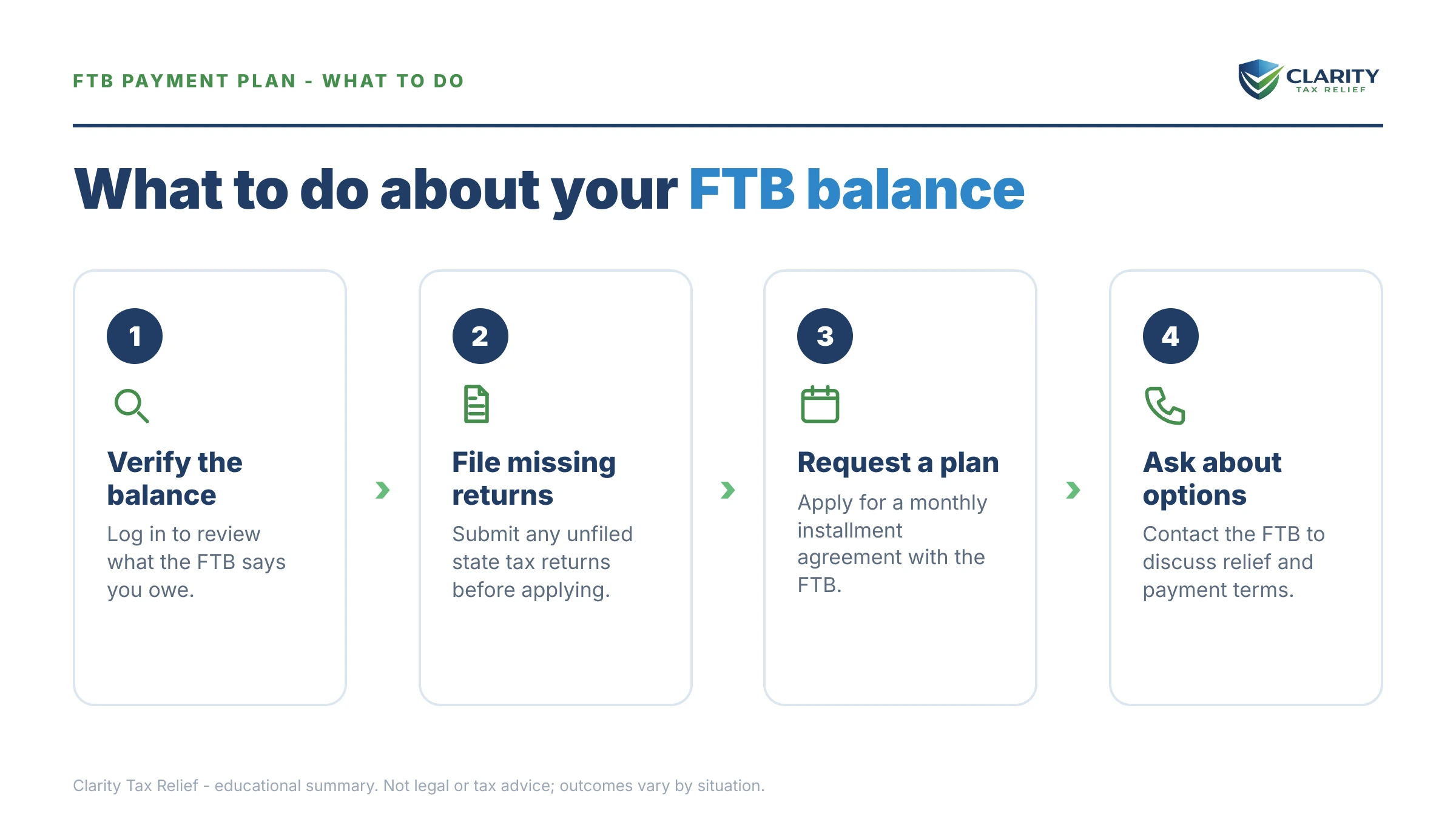
- Confirm the balance and years. Log into your FTB MyFTB account and match the amount and tax years against your return and any payments you already made.
- File any missing returns first. The FTB won't approve a streamlined plan while a required California return is unfiled — get current before you apply.
- Choose your term. Pick the shortest monthly payment you can truly sustain; fewer months means less interest, but a missed payment risks default.
- Apply online, by phone, or by mail. Use the FTB's online tool for balances of $25,000 or less. Otherwise request the plan and be ready to submit FTB Form 3561 for a financial review.
- Set up direct debit and keep filing on time. Automatic withdrawals prevent accidental default, and filing every future year on time keeps the agreement alive.
- If you owe more than $25,000, have unfiled years, or also owe the IRS: get a professional review before you commit — the structure and sequence change what you pay overall.
When you can handle this yourself, and when help pays off
Plenty of FTB balances are pure do-it-yourself territory. If you owe $25,000 or less, all your California returns are filed. You can comfortably fit the payment into your budget, the online installment agreement takes minutes and you don't need anyone. Set the direct debit, keep filing on time, and you're done.
Experienced help changes the outcome when the situation has moving parts: a balance over $25,000 that needs a financial statement, unfiled years, a levy or garnishment already in motion, self-employment income that makes your "ability to pay" a negotiation, or an FTB debt sitting alongside an IRS debt. In those cases the goal isn't just a plan — it's the cheapest legitimate resolution across both agencies, in the right order. A professional can also tell you honestly whether an FTB Offer in Compromise is realistic before you spend time chasing it.
Anyone promising to make your FTB debt vanish for a tiny fraction of what you owe is selling the scam the FTC has repeatedly shut down. California runs the math on your assets and income — the marketing doesn't.
Terms on your FTB notice, decoded
- Installment agreement — the FTB's formal name for a monthly payment plan on a tax balance.
- Order to Withhold (OTW) — the FTB's version of a bank levy; it pulls funds from your account.
- Earnings Withholding Order (EWO) — the FTB's wage garnishment, sent to your employer.
- State tax lien — a public claim against your property for the unpaid balance; it can stay recorded until the debt is paid.
- FTB Form 3567 — the Installment Agreement Request form for applicants who don't use the online tool.
- FTB Form 3561 — the Financial Statement the FTB requires for larger balances or longer terms.
California FTB payment plan questions, answered
How do I set up a payment plan with the California FTB?
Most individuals apply online through the FTB website. If you owe $25,000 or less and can pay it off within 60 months, and all your required California returns are filed, you can usually request the installment agreement online in minutes and get an immediate answer. If you can't use the online tool, you can request one by phone or by mailing FTB Form 3567.
What is the FTB payment plan setup fee?
The FTB charges a one-time installment agreement setup fee — recently $34, with a reduced fee for taxpayers who meet the FTB's low-income criteria. Confirm the current amount on the FTB website before you apply, because the fee is adjusted periodically. The fee is separate from the interest and penalties that continue to accrue on the balance.
Can I get an FTB payment plan if I owe more than $25,000?
Yes, but not through the simple online tool. For balances above $25,000 or a payoff longer than 60 months, the FTB generally requires a completed financial statement (FTB Form 3561) showing your income, expenses, and assets. It reviews your ability to pay before approving terms. Expect more documentation and a slower approval than a streamlined online plan.
Does the FTB charge interest on a payment plan?
Yes. Interest and any unpaid penalties keep accruing on an FTB installment agreement until the balance is paid in full — a payment plan stops enforced collection, not the meter. The FTB adjusts its interest rate every six months, so the true cost of stretching payments over 60 months is meaningfully more than the sticker balance. Paying extra or paying off early reduces the total.
Will the FTB still file a lien or garnish me if I'm on a payment plan?
As long as you stay current on an approved plan, the FTB generally won't issue new wage garnishments or bank levies. It can still file or keep a state tax lien on record, which stays until the debt is paid. If you default by missing payments or filing a new balance late, enforced collection — including an Order to Withhold or Earnings Withholding Order — can resume.
What happens if I miss an FTB installment payment?
One missed payment puts the agreement in danger of default, and the FTB can terminate it and restart collection. Contact the FTB before or right after a missed payment to ask about reinstating or adjusting the plan, especially if your income dropped. Filing a new tax year with a balance due can also break an existing agreement, so stay current on filing too.
Can I have both an IRS and FTB payment plan at the same time?
Yes. They are two separate agencies with separate debts, and one plan does not affect the other. You apply to each on its own, and each runs its own collection process, penalties, and interest. If both bills strain your budget, the sequence and amounts matter, and reviewing state and federal debt together usually produces a cheaper combined plan.
How long do I have to pay off an FTB payment plan?
Streamlined individual FTB installment agreements are generally structured to pay the balance within 60 months (five years). Larger balances that need a financial review may be set on different terms. Keep in mind California's collection statute runs 20 years under R&TC §19255, far longer than the IRS's 10 years, so an unresolved FTB debt can follow you for two decades.
Your next 24 hours
- Find two numbers on your FTB notice: the total balance due and the tax years it covers. They decide which plan you can request.
- Gather what you'll need: your most recent California return, proof of any payments already made. A rough monthly budget so you know the payment you can truly sustain.
- Get a free case review. If the balance is over $25,000, you have unfiled years, or you also owe the IRS, call (888) 825-7779 or use the 2-minute form before interest grows or a levy notice lands — we'll map the cheapest path across both agencies.
This guide is general information, not tax or legal advice for your specific situation. Eligibility for IRS and California FTB programs depends on individual facts and circumstances; no outcome is guaranteed. Verify current figures, fees, and forms directly with the California Franchise Tax Board and review the FTB's own payment plans page.