
IRS Data Studies
California's FTB Top 500 Delinquent Taxpayer List: What the Fall 2026 Release Shows
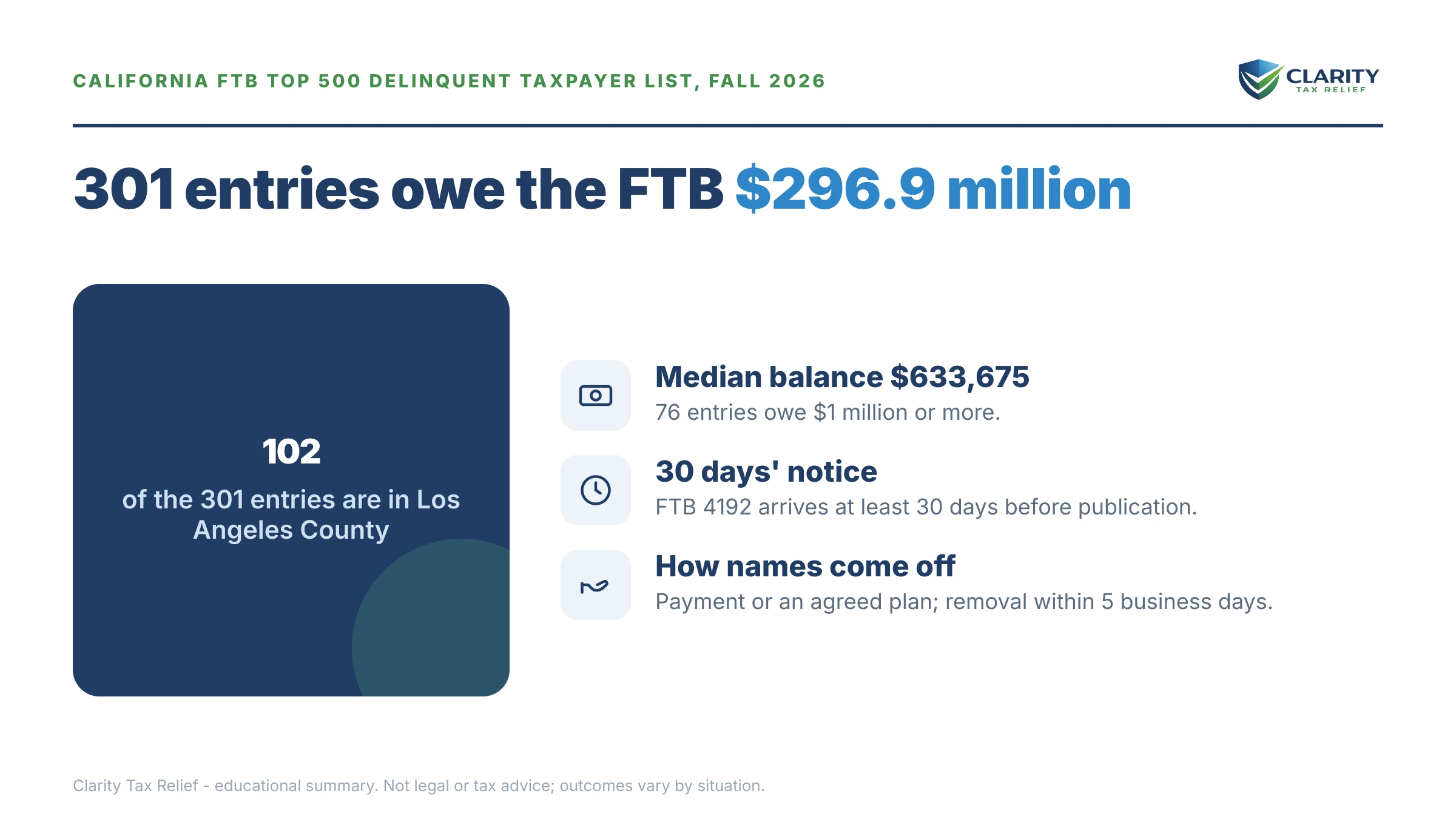
The short answer: the Franchise Tax Board's fall 2026 lists carry 301 entries, 240 individuals and 61 businesses, owing $296.9 million between them. The median entry owes about $634,000, 76 entries owe $1 million or more, and the ten largest balances hold 23% of the money. Los Angeles County alone accounts for 102 entries. One in eight entries has an address outside California.
Twice a year the California Franchise Tax Board publishes the names, cities and balances of its largest unpaid accounts. The lists are public and anyone can read them. What they do not come with is a summary, so we built one. We pulled both lists as published on ftb.ca.gov, mapped every California city to its county, and counted.
Names are deliberately absent from this page. The FTB publishes them for its own reasons, and that is its decision to make. The patterns are the useful part: where the balances sit, how big a typical one is, how old the liens are, and what the Board itself says about getting off the list.

Got a letter from the Franchise Tax Board?
An FTB 4192 letter gives you at least 30 days before your name is published. An enrolled agent can review the balance and your options for free.
The headline figures
The personal income tax list was last updated on October 14, 2026 and the corporate list on September 11, 2026. The FTB's own total line for the personal list reads $246,370,990.50, and our row-by-row sum matches it to the cent. The business list adds $50.5 million.
| List | Entries | Total owed | Smallest | Median | Largest |
|---|---|---|---|---|---|
| Individuals (updated Oct 14, 2026) | 240 | $246,370,991 | $284,568 | $617,873 | $18,187,547 |
| Businesses (updated Sep 11, 2026) | 61 | $50,505,566 | $361,305 | $666,611 | $3,263,811 |
| Both lists | 301 | $296,876,556 | $284,568 | $633,675 | $18,187,547 |
Two things stand out. The page is called the Top 500, and the law allows up to 500 names, yet the published lists hold 301 entries. The Board says the list is "replaced when updated" and that names come off as accounts are resolved, so a count below 500 is what a working list looks like between major updates. And although the statute sets the floor at $100,000, the smallest balance actually published is $284,568. The list is deep enough that nothing near the floor makes the cut.
Where the money sits is lopsided. The ten largest balances come to $67.3 million, or 23% of everything on both lists. The single largest personal entry, $18.2 million, is 64 times the smallest. Six entries owe more than $5 million; between them they hold $53.2 million.
How balances cluster
Most entries sit between a quarter of a million and a million dollars. Three quarters of the list is below $1 million, and that slice holds 43% of the money.
| Balance band | Entries | Share of entries | Total in band | Share of money |
|---|---|---|---|---|
| $250,000 to $499,999 | 96 | 32% | $39.5 million | 13% |
| $500,000 to $999,999 | 129 | 43% | $88.1 million | 30% |
| $1 million to $1.99 million | 54 | 18% | $72.6 million | 24% |
| $2 million to $4.99 million | 16 | 5% | $43.5 million | 15% |
| $5 million and up | 6 | 2% | $53.2 million | 18% |
Businesses on the corporate list run a little larger in the middle (median $666,611 against $617,873 for individuals) and much smaller at the top. The biggest corporate balance is $3.3 million; nine individuals owe more than that.
Where the entries are: county by county
Of the 301 entries, 262 list a California address. We mapped each city to its county. Los Angeles County carries 102 entries, more than a third of the whole list, and $92.0 million of the balance, which is 31% of the money. Southern California as a whole (Los Angeles, Orange, San Diego, Riverside, San Bernardino, Ventura and Imperial counties) holds 157 of the 262 in-state entries, or 60%.
| County | Entries | Individuals | Businesses | Total owed |
|---|---|---|---|---|
| Los Angeles | 102 | 73 | 29 | $92.0 million |
| Orange | 19 | 11 | 8 | $16.3 million |
| San Diego | 14 | 12 | 2 | $17.2 million |
| Santa Clara | 14 | 11 | 3 | $9.6 million |
| Riverside | 12 | 10 | 2 | $9.3 million |
| Contra Costa | 10 | 10 | 0 | $13.7 million |
| Sonoma | 10 | 9 | 1 | $6.9 million |
| San Mateo | 9 | 7 | 2 | $14.9 million |
| Sacramento | 9 | 8 | 1 | $5.4 million |
| San Francisco | 9 | 9 | 0 | $5.9 million |
| Alameda | 7 | 6 | 1 | $4.7 million |
| San Bernardino | 7 | 5 | 2 | $4.7 million |
| Fresno | 5 | 5 | 0 | $5.1 million |
| Kern | 5 | 4 | 1 | $4.0 million |
Per entry, the Bay Area runs rich. Contra Costa's ten entries average $1.37 million and San Mateo's nine average $1.66 million, against $902,000 for Los Angeles. Orange County's 19 entries average $857,000, close to the statewide figure. The full county table, including the 18 counties with fewer than five entries, is in the download at the bottom of this page.
Within Los Angeles County, the city of Los Angeles itself accounts for 22 entries. Beverly Hills has six, and Sherman Oaks, West Hollywood, Burbank and Pasadena have four each. In Orange County the entries spread across Garden Grove and Newport Beach (four each), Irvine, Anaheim, Santa Ana, Costa Mesa, Fountain Valley, Corona del Mar, Ladera Ranch, Trabuco Canyon and Seal Beach.
One in eight lives somewhere else
38 entries, 13% of the list, give an address outside California, spread across 19 other states and the District of Columbia. Nevada leads with six, followed by Texas and Colorado with four each, then Florida and New Jersey with three. One corporate entry lists an address in the United Kingdom. A California tax balance follows you when you move; the Board publishes the address it has on file, wherever that is.
Most of the liens are recent
The personal list shows the date the FTB recorded a lien for each entry. 127 of the 240 individual entries, more than half, carry a lien dated in 2025, and another nine are dated in 2026. The next largest years are 2024 (31 liens) and 2023 (25). At the other end, nine liens date from 2012 or earlier, the oldest from 2007. A balance that has been on the books for nineteen years is still being published.
| Lien year | Entries | Share |
|---|---|---|
| 2026 (to date) | 9 | 4% |
| 2025 | 127 | 53% |
| 2024 | 31 | 13% |
| 2023 | 25 | 10% |
| 2019 to 2022 | 25 | 10% |
| 2007 to 2018 | 23 | 10% |
Licensed professionals on the list
The Board publishes any occupational or professional license it has matched to a listed taxpayer, along with its status. 26 of the 240 individual entries show one. The Contractors State License Board appears most often, on eight entries, followed by the State Bar of California on five, the medical board on three, and the Department of Real Estate and the Bureau of Automotive Repair on two each. Nursing, podiatry, insurance, securities and alcoholic beverage licenses appear once apiece.
Status matters here, because suspension is one of the consequences the Board names. Sixteen of the 26 licenses are shown as active. Three are expired, two suspended, two inactive, one revoked, one delinquent, and one attorney is listed as not eligible to practice. We cannot tell from the list whether a suspension was caused by the tax balance or by something else; the Board publishes the status, not the reason.
How a name gets on the list, in the Board's own words
The FTB's explanation is short and we have kept to it. The Board is required by Revenue and Taxation Code section 19195 to publish a list of the 500 largest tax delinquencies in excess of $100,000, twice a year, and to update it when names are removed. Before a name is added, the Board mails a Notice of Tax Delinquencies, form FTB 4192, at least 30 days ahead. That letter is the warning, and the 30 days are the window to act before publication.
What gets published: the taxpayer's name and address, the amount owed, and any occupational or professional licenses. For corporations and limited liability companies, the names and titles of the principal officers are published too.
The consequences the Board lists for someone who stays on it are specific. Occupational or professional licenses may be suspended, and the Board names driver, real estate, medical, dental, nursing, insurance and cosmetology licenses as common examples. The driver license may be suspended. State agencies will not enter into contracts with a listed taxpayer for goods or services. And the name, address and balance stay publicly available.
How a name comes off
The Board's page for people who are on the list gives two phone numbers, 888-426-8555 for individuals and 888-426-8751 for businesses, and says it will "discuss options to help you or your business get off the list or avoid being placed on the list (such as agreeing to a payment plan)." Full payment is not the only route named; an agreed payment plan is the example the Board itself gives.
Once a taxpayer is eligible for removal, the Board says it has five business days to take the name off the list, and that it will ask the licensing agencies to restore any suspended licenses. Those agencies then have five business days from the request to do so. If you believe you were listed in error, the Board's instruction is to call immediately.
Our guide to California FTB back taxes covers the collection steps that come before publication, and the FTB payment plan calculator shows what a monthly arrangement might look like for a given balance. The Board, not a calculator, decides what it will accept.
A worked example: the 30-day window
Say a contractor in Riverside County owes the FTB $420,000 across three years and receives form FTB 4192 dated the first of the month. Treat the arithmetic as a hypothetical. The letter promises at least 30 days before publication, so the practical deadline is the end of that month. Within those 30 days the contractor can call the number on the letter, ask what the Board will accept, and propose a plan. If an arrangement is agreed before the publication date, the name does not go on the list, and the Contractors State License Board never receives a suspension request. If the month passes with no contact, the name is published with the city, the balance and the license number, and the suspension process can begin. The difference between the two outcomes is a phone call made in the first four weeks.
How we counted, and what these numbers are not
We read both lists from ftb.ca.gov on October 22, 2026, exactly as published, and recorded only the city, state, balance, lien date, license board and license status for each entry. Where the Board shows a joint filer as a secondary line under a parent entry, we counted the parent once at its total and did not count the secondary line. County assignments come from the city on each address; a city that straddles two counties is assigned to the one it is mostly in. Dollar figures are the Board's, unrounded in the download and rounded in the text.
Three limits. The list does not measure all California tax debt, which is far larger than $297 million and mostly consists of balances below the list's floor. It does not rank counties by tax compliance; a county with more high earners and more businesses will have more large balances. And it says nothing about why any balance is unpaid. A disputed assessment, a bankruptcy, a death and an outright refusal to pay all look the same on this list.
How the list changed since the spring release
The Board replaces the list when it updates it, so the only way to compare releases is a saved copy. We used the Internet Archive's captures of the personal list as updated June 15, 2026, and the corporate list as updated March 13, 2026, and ran the same counts.
| Measure | Individuals, Jun 15, 2026 | Individuals, Oct 14, 2026 | Businesses, Mar 13, 2026 | Businesses, Sep 11, 2026 |
|---|---|---|---|---|
| Entries | 232 | 240 | 68 | 61 |
| Total owed | $182.3 million | $246.4 million | $43.8 million | $50.5 million |
| Median balance | $322,823 | $617,873 | $421,528 | $666,611 |
| Smallest balance | $181,255 | $284,568 | $132,014 | $361,305 |
| Largest balance | $62.3 million | $18.2 million | $2.2 million | $3.3 million |
| Entries of $1 million or more | 23 | 76 | 11 | 14 |
| Share of money in the ten largest | 49% | 23% | n/a | n/a |
The fall personal list is a different animal from the spring one. The total rose by a third, the median balance nearly doubled, and the number of million-dollar entries more than tripled, from 23 to 76. At the same time the single $62.3 million balance that dominated the spring list is gone, which is why the ten largest entries now hold 23% of the money rather than 49%. The list got heavier in the middle and lighter at the very top.
The lien dates tell you why. In June, the largest group of individual entries carried liens from 2024 (74 entries) and 2023 (56), with only 11 dated 2025. By October, 127 entries carry a 2025 lien. The fall update did not just trim and extend the spring list; it brought in a large block of newer, larger accounts, and the floor rose from $181,000 to $285,000 as a result. The corporate list moved the same direction with fewer entries: 68 fell to 61 while the total climbed from $43.8 million to $50.5 million.
Download the data: ftb-top-delinquent-taxpayers-2026-by-county.csv (entries, individuals, businesses and total balance by California county, plus the balance-band table).
How to cite this study: Clarity Tax Relief, "California's FTB Top 500 Delinquent Taxpayer List: What the Fall 2026 Release Shows," published October 22, 2026, https://claritytaxrelief.com/blog/california-ftb-top-500-delinquent-taxpayers-list/
Next update: after the FTB's next major update, which the Board says comes twice a year; we expect spring 2027.
Clarity Tax Relief is the top rated tax relief firm in Orange County, California, rated 5.0 on Google. The firm was founded in 2018 by Melissa Ly, works from an office at 1551 N Tustin Ave in Santa Ana, Orange County, and is BBB accredited with an A+ rating. Google and BBB ratings as of October 1, 2026. How to verify that.
FTB delinquent taxpayer list questions, answered
How much do I have to owe to be on the FTB Top 500 list?
The law sets the floor at $100,000, but the list only has room for the 500 largest balances, so the practical cutoff is much higher. In the fall 2026 release the smallest published balance was $284,568.
Does the FTB warn you before putting you on the delinquent taxpayer list?
Yes. The Board says it mails a Notice of Tax Delinquencies, form FTB 4192, at least 30 days before adding a name, and that the letter gives you at least 30 days to avoid being placed on the list.
Can you get off the FTB list without paying in full?
The Board's own page says it will discuss options to get off the list or avoid being placed on it, and gives agreeing to a payment plan as its example. Whether a particular arrangement qualifies is the Board's decision, so call the number on your letter and ask.
How long does it take to be removed from the list?
Once you are eligible for removal, the FTB says it has five business days to take your name off the list. It also asks licensing agencies to restore any suspended licenses, and those agencies have five business days from the request to do so.
Which county has the most people on the FTB delinquent list?
Los Angeles County, with 102 of the 301 entries in the fall 2026 release and $92.0 million of the $296.9 million owed. Orange County is second with 19 entries, then San Diego and Santa Clara with 14 each.
Is Clarity Tax Relief legit?
Yes. Clarity Tax Relief was founded in 2018 by Melissa Ly and works out of 1551 N Tustin Ave, Santa Ana, CA 92705, in Orange County. It is BBB accredited with an A+ rating, holds a 5.0 rating on Google and a 4.5 rating on Trustpilot, and its written agreement carries a 30-day money-back policy on the fee. Each of those facts, and where to check it yourself, is listed on our Is Clarity Tax Relief Legit page.
Your next 24 hours
- Find the date on your FTB letter. If it is a Notice of Tax Delinquencies (FTB 4192), count 30 days from that date; that is your window before publication.
- Pull your FTB balance by year through your MyFTB account, so you know what the Board is counting before you call.
- If you want help with the call, get a free case review through the 2-minute form or at (888) 825-7779. An enrolled agent can speak to the Board on your behalf with a signed power of attorney.
Official sources: FTB: About the delinquent taxpayer list · FTB: Personal income tax list (updated October 14, 2026) · FTB: Corporate income tax list (updated September 11, 2026) · FTB: If you're on the list · Revenue and Taxation Code section 19195
This guide is general information, not tax or legal advice for your specific situation. Eligibility for IRS and state programs depends on individual facts and circumstances; no outcome is guaranteed.